
July 8, 2026
Publications
🌐Follow Marie-Anne Frison-Roche on LinkedIn
🌐subscribe to the Newsletter MAFR Regulation, Compliance, Law
🌐Subscribe to the Video Newsletter MAFR Surplomb
🌐Subscribe to the MaFR Law & Art Newsletter
____
► Full reference: M.A. Frison-Roche, “Si l'heureux stratagème probatoire du Roi Salomon n'avait pas fonctionné (If King Solomon's probationary strategy hadn't worked)”, in Collective Book dedicated to Professor Pierre Crocq, Liber Amicorum, LGDJ-Lextenso, 2026, pp. 713–723.

____
📝Read the article (in French)
____
🚧Read the bilingual working document on which this article is based
____
► Introduction to the article:
As renowned and significant in biblical scholarship as it is in legal culture and imagination, Solomon’s Judgement is a procedural measure, an evidential stratagem (I). But even a King cannot be certain of the success of an investigative measure that his authority allows him to impose; nothing guarantees the success of the evidential stratagem he has devised, that is to say, the discovery of the truth. The investigative measure he devised presupposes a maternal love that leads the woman—who might prefer to continue disputing—to choose instead not to keep the child and to leave him in a state of death, a mere inert prey to the claim of appropriation made by the plaintiff. It is the woman’s virtue that enables the Judge’s wisdom. The evidence stratagem might not have worked (II). This is scarcely considered, as King Solomon is always portrayed as wise and the mother as preferring the child to herself. But if we step outside the Book of Kings, where virtue reigns—that of the mother as well as that of the judge—to confront the passion of the woman who smothered her newborn in the night and now seeks the force of justice to seize the second, one might reflect, whilst wandering through the lobby of a courthouse, that it is all too often the case that adults put themselves before children. What if the second mother had put herself before the child? What would have happened if the judge’s order, already being carried out, had not been halted by the virtue of the defendant? (III). What would the King then have done to exercise his office as Judge justly, since the truth would not have been accessible to him? (IV). If one changes an element of the narrative, because justice is human, because passions drive the parties, because children are often the silent victims on both sides, is justice still possible?
________

May 29, 2026
Publications
🌐Follow Marie-Anne Frison-Roche on LinkedIn
🌐Subscribe to the Newsletter MAFR Regulation, Compliance, Law
🌐Subscribe to the video newsletter MAFR Overhang
🌐Subscribe to the Newsletter MaFR Law & Art
____
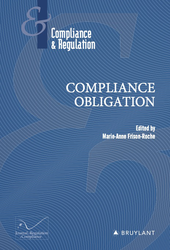
► Full Reference: M.-A. Frison-Roche, "In Compliance Law, the legal consequences for Entreprises of their commitments and undertakingsn", in M.-A. Frison-Roche (ed.), Compliance Obligation, Journal of Regulation & Compliance (JoRC) and Bruylant, "Compliance & Regulation" Serie, 2026, forthcoming.
____
📝read the article
____
____
📘read a general presentation of the book, Compliance Obligation, in which this article is published
____
► Summary of this article: The innocents might believe, taking the Law and its words literally, that "commitments" are binding on those who make them. Shouldn't they be afraid of falling into the trap of the 'false friend', which is what the Law wants to protect them from (as stated in the prolegomena)?
Indeed, the innocent persons think that those who make commitments ask what they must do and say what they will do. Yet, strangely enough, the 'commitments' that are so frequent and common in compliance behaviours are often considered by those who adopt them to have no binding value! Doubtless because they come under disciplines other than Law, such as the art of Management or Ethics. It is both very important and sometimes difficult to distinguish between these different Orders - Management, Moral Norms and Law - because they are intertwined, but because their respective standards do not have the same scope, it is important to untangle this tangle. This potentially creates a great deal of insecurity for companies (I).
The legal certainty comes back when commitments take the form of contracts (II), which is becoming more common as companies contractualise their legal Compliance Obligations, thereby changing the nature of the resulting liability, with the contract retaining the imprint of the legal order or not having the same scope if this prerequisite is not present.
But the contours and distinctions are not so uncontested. In fact, the qualification of unilateral undertaking of will is proposed to apprehend the various documents issued by the companies, with the consequences which are attached to that, in particular the transformation of the company into a 'debtor', which would change the position of the stakeholders with regard to it (III).
It remains that the undertakings expressed by companies on so many important subjects cannot be ignored: they are facts (IV). It is as such that they must be legally considered. In this case, Civil Liability will have to deal with them if the company, in implementing what it says, what it writes and in the way it behaves, commits a fault or negligence that causes damage, not only the sole existence of an undertaking.
________
________

Oct. 2, 2025
Publications
🌐follow Marie-Anne Frison-Roche on LinkedIn
🌐subscribe to the Newsletter MAFR Regulation, Compliance, Law
🌐subscribe to the VideoNews MAFR Surplomb
🌐subscribe to the Newsletter MaFR Law & Art
____
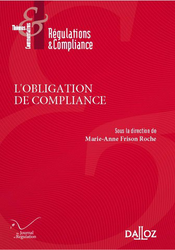
► Full Reference: M.-A. Frison-Roche (dir.), L'Obligation de Compliance, coll."Régulations & Compliance", Journal of Regulation & Compliance (JoRC) and Dalloz, 2025, 816 p.
____
📘 At the same time, a book in English, Compliance Obligation, is published in the collection copublished by the Journal of Regulation & Compliance (JoRC) and the Éditions Bruylant.
____
📚This volume is one of a series of books devoted to Compliance in the series edited by Marie-Anne Frison-Roche.
___
► General presentation of this book: Compliance is sometimes presented as something that cannot be avoided, which is tantamount to seeing it as the legal obligation par excellence, Criminal Law being its most appropriate mode of expression. It is sometimes presented as something that the company does out of ethical concern, self-regulation which is the opposite of legal obligation. For the moment, therefore, there is no single vision of the Compliance Obligation. This is all the less the case because of the multitude of texts, themselves constantly evolving and changing, which inject such a wide range of compliance obligations that we give up trying to establish any unity, thinking that, on a case-by-case basis, we will define a regime and a legal constraint of greater or lesser strength, aimed at one subject or debtor or another, for the benefit of one or other.
This lack of unity, due to the absence of a definition of the Compliance Obligation, makes the application of the texts difficult to foresee and therefore makes the Judge fearful, even though he/she is going to take on more and more importance.
This book asks the practical questions: What is Compliance obliging? Who is obliged to comply? and How far are we obliged to comply? and provides answers, Compliance practices, constraints and innovations will be better mastered and anticipated by all those they affect: companies, stakeholders, technicians, lawyers, consultants, institutions and courts.
____
🏗️general construction of this Book: The book opens with a double Introduction. The first, which is freely accessible, consists of a summary of the book, while the second, which is substantial, deals with the unified conception that we can, and indeed should, have, of the "Compliance Obligation", without losing the concrete and active character that characterises this branch of law.
The first Part of the book aims to define the Compliance Obligation. To this end, Chapter I deals with the Nature of this obligation. Chapter II deals with the Spaces of the Compliance Obligation.
The Part II aims to articulate the Compliance Obligation with other branches of Law.
The Part III of the book looks at the way in which the possibility of obliging and the means of obliging are provided. To this end, Chapter I deals with the Convergence of the Sources of the Compliance Obligation. Chapter II considers International Arbitration as a reinforcement of the Compliance Obligation. To this end, Chapter I deals with the Convergence of the Sources of the Compliance Obligation. Chapter II considers International Arbitration as a reinforcement of the Compliance Obligation.
The last Part of the book is devoted to Vigilance, the leading edge of the Compliance Obligation. Chapter I is devoted to a study of the various sectors, and analyses the Intensities of the Vigilance Obligation. Chapter II deals with the Variations in Tension generated by the Vigilance Obligation. Finally, Chapter III deals with the New Modalities of the Compliance Obligation, highlighted by the Vigilance Imperative.
____
TABLE OF CONTENTS
ANCRER LES OBLIGATIONS DE COMPLIANCE SI DIVERSES
DANS LEUR NATURE, LEURS REGIMES ET LEUR FORCE
POUR DEGAGER L'UNITE DE L'OBLIGATION DE COMPLIANCE
LA RENDANT COMPREHENSIBLE ET PRATIQUABLE
(ANCHOR COMPLIANCE OBLIGATIONS, SO DIVERSE
IN THEIR NATURE, THEIR REGIMES AND THEIR FORCE,
TO BRING OUT THE UNITY OF THE COMPLIANCE OBLIGATION
MAKING IT COMPREHENSIBLE AND PRACTICABLE)
TITRE I.
CERNER L’OBLIGATION DE COMPLIANCE
(IDENTIFYING THE COMPLIANCE OBLIGATION)
CHAPITRE I : LA NATURE DE L’OBLIGATION DE COMPLIANCE (THE NATURE OF THE COMPLIANCE OBLIGATION)
Section 1 ♦️ La volonté, le cœur et le calcul, les trois traits cernant l'Obligation de Compliance (Will, Heart and Calculation, the three traits encercling the Compliance Obligation), by 🕴️Marie-Anne Frison-Roche
Section 2 ♦️ De la dette à l’obligation de compliance (From the Debt to the Compliance Obligation), by 🕴️Bruno Deffains
Section 3 ♦️ Obligation de Compliance et droits humains (Compliance Obligation and Human Rights), by 🕴️Jean-Baptiste Racine
Section 4 ♦️ L'Obligation de Compliance et les mutations de la souveraineté et de la citoyenneté (Compliance Obligation and changes in Sovereignty and Citizenship), by 🕴️René Sève
Section 5 ♦️ La définition de l''obligation de compliance confrontée au droit de la cybersécurité (The definition of the Compliance Obligation in Cybersecurity Law) by🕴️Michel Séjean
CHAPITRE II : LES ESPACES DE L’OBLIGATION DE COMPLIANCE (SPACES OF THE COMPLIANCE OBLIGATION)
Section 1 ♦️ Entités industrielles et Obligation de compliance (Industrial entities and Compliance Obligation), by 🕴️Etienne Maclouf
Section 2 ♦️ L'Obligation de Compliance dans les chaînes de valeur (The Compliance Obligation in Value Chains), by 🕴️Lucien Rapp
Section 3 ♦️ Compliance et conflits de lois. Le droit international de la vigilance-conformité à partir de quelques applications récentes sur le continent européen (Compliance and conflict of laws. International Law of Vigilance-Conformity, based on recent applications in Europe), by 🕴️Louis d'Avout
TITRE II.
ARTICULER L’OBLIGATION DE COMPLIANCE AVEC DES BRANCHES DU DROIT
(ARTICULATING THE COMPLIANCE OBLIGATION WITH BRANCHES OF LAW)
Section 2 ♦️ Droit fiscal et obligation de compliance (Tax Law and Compliance Obligation), by 🕴️Daniel Gutmann
Section 3 ♦️ Le droit processuel, prototype de l'Obligation de Compliance (General Procedural Law, prototype of the Compliance Obligation), by 🕴️Marie-Anne Frison-Roche
Section 4 ♦️ Le droit des sociétés et des marchés financiers face à l'Obligation de Compliance (Corporate and Financial Markets Law facing the Compliance Obligation), by 🕴️Anne-Valérie Le Fur
Section 5 ♦️ Le rapport entre le Droit de la responsabilité civile et l'Obligation de Compliance (The link between Tort Law and Compliance Obligation), by 🕴️Jean-Sébastien Borghetti
Section 6 ♦️ Dimensions environnementales et climatiques de l'Obligation de Compliance (Environmental and Climatic Dimensions of the Compliance Obligation), by 🕴️Marta Torre-Schaub
Section 7 ♦️ Droit de la concurrence et Droit de la Compliance (Competition Law and Compliance Law), by 🕴️Jean-Christophe Roda
Section 8 ♦️ L'Obligation de Compliance en Droit global (The Compliance Obligation in Global Law), by 🕴️Benoît Frydman & 🕴️Alice Briegleb
Section 9 ♦️ Les juges du droit des entreprises en difficulté et les obligations de compliance (Judges of Insolvency Law and Compliance Obligations), by 🕴️Jean-Baptiste Barbièri
TITRE III.
COMPLIANCE : DONNER ET SE DONNER LES MOYENS D’OBLIGER
(COMPLIANCE : GIVE AND TAKE THE MEANS TO OBLIGE)
CHAPITRE I : LA CONVERGENCE DES SOURCES (CONVERGENCE OF SOURCES)
Section 1 ♦️ Obligation sur obligation vaut (Compliance Obligation on Obligation works), by 🕴️Marie-Anne Frison-Roche
Section 2 ♦️ Les technologies disponibles, prescrites ou proscrites pour satisfaire Compliance et Vigilance (Technologies available, prescribed or prohibited to meet Compliance and Vigilance requirements), by 🕴️Emmanuel Netter
Section 3 ♦️ Contrainte légale et stratégie des entreprises en matière de Compliance (Legal Constraint and Company Strategies in Compliance matters), by 🕴️Jean-Philippe Denis & Nathalie Fabbe-Costes
Section 4 ♦️ La loi, source de l’Obligation de Compliance (The Law, source of the Compliance Obligation), by 🕴️Jean-Baptiste Blanc
Section 5 ♦️ Opposition et convergence des systèmes juridiques américains et européens dans les règles et cultures de compliance (Opposition and Convergence of American and European Legal Systems in Compliance Rules and Cultures), by 🕴️Raphaël Gauvain & 🕴️Blanche Balian
Section 6 ♦️ Ce à quoi les engagements engagent qu'est un engagement (What a ), by 🕴️Marie-Anne Frison-Roche
CHAPITRE II : L’ARBITRAGE INTERNATIONAL EN RENFORT DE L’OBLIGATION DE COMPLIANCE (INTERNATIONAL ARBITRATION IN SUPPORT OF THE COMPLIANCE OBLIGATION)
Section 1 ♦️ Comment l'arbitrage international peut être un renfort de l'Obligation de Compliance (How International Arbitration can reinforce the Compliance Obligation), by 🕴️Laurent Aynès
Section 2 ♦️ La considération par l'Arbitrage de l'Obligation de Compliance pour une place d'arbitrage durable (Arbitration' consideration of Compliance Obligation for a Sustainable Arbitration Place), by 🕴️Marie-Anne Frison-Roche
Section 3 ♦️ L’usage de l’arbitrage international pour renforcer l’obligation de Compliance : l’exemple du secteur de la construction (The use of International Arbitration to reinforce the Compliance Obligation: the example of the construction sector), by 🕴️Christophe Lapp
Section 4 ♦️ L’arbitre, juge, superviseur, accompagnateur ? (The Arbitrator, Judge, Supervisor, Support) , by 🕴️Jean-Baptiste Racine
TITRE IV.
LA VIGILANCE, POINTE AVANCÉE DE L’OBLIGATION DE COMPLIANCE
(VIGILANCE, SPEARHEAD OF THE COMPLIANCE OBLIGATION)
Section 1 ♦️ La Vigilance, pointe avancée et part totale de l'Obligation de Compliance (....), by 🕴️Marie-Anne Frison-Roche
CHAPITRE I : LES INTENSITÉS DE L’OBLIGATION DE VIGILANCE, POINTE AVANCÉE DU SYSTÈME DE COMPLIANCE (INTENSITIES OF THE VIGILANCE OBLIGATION, SPEARHEAD OF THE COMPLIANCE SYSTEM)
Section 2 ♦️ L’intensité de l’Obligation de Vigilance selon les secteurs : le cas des opérateurs financiers (Intensity of the Vigilance Obligation by Sectors: the case of Financial Operators), by 🕴️Anne-Claire Rouaud
Section 3 ♦️ L’intensité de l’Obligation de Vigilance selon les secteurs : le cas des opérateurs bancaires et d’assurance (Intensity of the Vigilance Obligation by Sectors: the case of Banking and Insurance Operators), by 🕴️Mathieu Françon
Section 4 ♦️ L’intensité de l’obligation de vigilance selon les secteurs : le cas des opérateurs numériques (Intensity of the Vigilance Obligation by Sectors: the case of Digital Operators), by 🕴️Grégoire Loiseau
Section 5 ♦️ L’Obligation de vigilance des opérateurs énergétiques (The Vigilance obligation of Energy Operators), by 🕴️Marie Lamoureux
Section 2 ♦️ Transformation de la gouvernance et obligation de Vigilance (Transformation of Governance and Vigilance Obligation), by 🕴️Véronique Magniermag
CHAPITRE II : LES DISPUTES AUTOUR DE L'OBLIGATION DE VIGILANCE, POINTE AVANCÉE DU SYSTÈME DE COMPLIANCE, DANS SON RAPPORT AVEC LA RESPONSABILITÉ
Section 1 ♦️ Le rapport entre le droit de la responsabilité civile et l'obligation de compliance, by 🕴️Jean-Sébastien Borghetti
Section 2 ♦️ Repenser le concept de responsabilité civile à l’aune du devoir de vigilance, pointe avancée de la compliance (Rethinking the Concept of Civil Liability in the light of the Duty of Vigilance, Spearhead of Compliance), by 🕴️Mustapha Mekki
Section 3 ♦️ Tensions et contradictions entre les instruments relatifs à la vigilance raisonnable des entreprises, by 🕴️Laurence Dubin
Section 4 ♦️ Compliance, Vigilance et Responsabilité civile : mettre en ordre et raison garde (Compliance, Vigilance and Civil Liability: put in order and keep the Reason), by 🕴️Marie-Anne Frison-Roche
CHAPITRE III : LES MODALITÉS NOUVELLES DE L'OBLIGATION DE COMPLIANCE, MISES EN LUMIÈRE PAR L'IMPÉRATIF DE VIGILANCE (NEW MODALITIES OF THE COMPLIANCE OBLIGATION, HIGHLIGHTED BY THE VIGILANCE IMPERATIVE)
Section 1 ♦️ Clauses et contrats, modalités de l’obligation de vigilance (Clauses and Contracts, terms and conditions of implementation of the Vigilance Obligation), by 🕴️Gilles J. Martin
Section 2 ♦️ La preuve de la bonne exécution de la Vigilance au regard du système probatoire de Compliance (Proof that Vigilance has been properly carried out with regard to the Compliance Evidence System), by 🕴️Jean-Christophe Roda
TITRE V.
LE JUGE ET L'OBLIGATION DE COMPLIANCE
(THE JUDGE AND THE COMPLIANCE OBLIGATION)
Section 1 Section 1 ♦️ Devoir de vigilance et litiges commerciaux : une compétence à partager ?, par 🕴️François Ancel
Section 2 ♦️ Les enjeux présents à venir de l’articulation des principes de procédure civile et commerciale avec la logique de compliance (Present and Future Challenges of Articulating Principles of Civil and Commercial Procedure with the Logic of Compliance), by 🕴️Thibault Goujon-Bethan
Section 3 ♦️ Le juge de l’amiable et la compliance (The amicable settlement judge and compliance), by 🕴️Malik Chapuis
Section 4 ♦️ Le Juge requis pour une Obligation de Compliance effective (The Judge required for an Effective Compliance Obligation), by 🕴️Marie-Anne Frison-Roche
L’OBLIGATION DE COMPLIANCE : VISION D’ENSEMBLE
(COMPLIANCE OBLIGATION : OVERVIEW)
♦️ L'obligation de compliance, charge portée par les entreprises systémiques donnant vie au Droit de la Compliance. - lignes de force de l'ouvrage (The Compliance Obligation, a burden borne by Systemic Companies giving life to Compliance Law - key points of the book (free access) by 🕴️Marie-Anne Frison-Roche
________
Oct. 2, 2025
Publications
🌐follow Marie-Anne Frison-Roche on LinkedIn
🌐subscribe to the Newsletter MAFR Regulation, Compliance, Law
🌐subscribe to the Video Newsletter MAFR Surplomb
🌐subscribe to the Newsletter MaFR Droit & Art
____
► Full Reference: M.-A. Frison-Roche, "La volonté, le cœur et le calcul, les trois traits cernant l'Obligation de Compliance" ("Will, Heart and Calculation, the three marks surrounding the Compliance Obligation"), in M.-A. Frison-Roche (ed.), L'Obligation de Compliance, Journal of Regulation & Compliance (JoRC) and Dalloz, coll. "Régulations & Compliance" 2025, pp.49-65.
____
📝read the article (in French)
____
____
📕read the general presentation of the book, L'Obligation de Compliance, in which this article is published
📚see the general presentation of the series "Régulations & Compliance" in which this book is published
____
► English summary of this contribution : There is often a dispute over the pertinent definition of Compliance Law, but the scale and force of the resulting obligation for the companies subject to it is clear. It remains difficult to define. First, we must not to be overwhelmed by the many obligations through which the Compliance Obligation takes shape, such as the obligation to map, to investigate, to be vigilant, to sanction, to educate, to collaborate, and so on. Not only this obligations list is very long, it is also open-ended, with companies themselves and judges adding to it as and when companies, sectors and cases require.
Nor should we be led astray by the distance that can be drawn between the contours of this Compliance Obligation, which can be as much a matter of will, a generous feeling for a close or distant other in space or time, or the result of a calculation. This plurality does not pose a problem if we do not concentrate all our efforts on distinguishing these secondary obligations from one another but on measuring what they are the implementation of, this Compliance Obligation which ensures that entities, companies, stakeholders and public authorities, contribute to achieving the Goals targeted by Compliance Law, Monumental Goals which give unity to the Compliance Obligation. Thus unified by the same spirit, the implementation of all these secondary obligations, which seem at once disparate, innumerable and often mechanical, find unity in their regime and the way in which Regulators and Judges must control, sanction and extend them, since the Compliance Obligation breathes a common spirit into them.
In the same way that the multiplicity of compliance techniques must not mask the uniqueness of the Compliance Obligation, the multiplicity of sources must not produce a similar screen. Indeed, the Legislator has often issued a prescription, an order with which companies must comply, Compliance then often being perceived as required obedience. But the company itself expresses a will that is autonomous from that of the Legislator, the vocabulary of self-regulation and/or ethics being used in this perspective, because it affirms that it devotes forces to taking into consideration the situation of others when it would not be compelled to do so, but that it does so nonetheless because it cares about them. However, the management of reputational risks and the value of bonds of trust, or a suspicious reading of managerial choices, lead us to say that all this is merely a calculation.
Thus, the contribution sets out to identify the Compliance Obligation by recognising the role of all these different sources. It emphasises that, in monitoring the proper performance of technical compliance obligations by Managers, Regulators and Judges, insofar as they implement the Compliance Obligation, it is pointless to limit oneself to a single source or to rank them abruptly in order of importance. The Compliance Obligation is part of the very definition of Compliance Law, built on the political ambition to achieve these Monumental Goals of preserving systems - banking, financial, energy, digital, etc. - in the future, so that human beings who cannot but depend on them are not crushed by them, or even benefit from them. This is the teleological yardstick by which the Compliance Obligation is measured, and with it all the secondary obligations that give it concrete form, whatever their source and whatever the reason why the initial standard was adopted.
In order to define Compliance's Obligation, the study endeavours to recognise the contribution of all these three sources: Will, Heart and Calculation.
________
Dec. 11, 2024
Publications

🌐suivre Marie-Anne Frison-Roche sur LinkedIn
🌐s'abonner à la Newsletter MAFR Regulation, Compliance, Law
🌐s'abonner à la Newsletter en vidéos Surplomb, par MAFR
____
► Référence complète : M.-A. Frison-Roche, "Les conditions requises pour favoriser la "contractualisation" du droit", in G. Cerqueira & A. Schreiber (dir.), La contractualisation du droit. Approches françaises et brésiliennes, Société de législation comparée (SLC), coll. "Colloques", vol. 61, 2024, pp. 435-448
____
____
🚧lire le document de travail bilingue sur la base duquel cet article a été élaboré, doté de développements supplémentaires, de références techniques et de liens hypertextes
____
► Résumé de l'article :
_______

Updated: Dec. 4, 2024 (Initial publication: Feb. 6, 2024)
Publications

🌐follow Marie-Anne Frison-Roche on LinkedIn
🌐subscribe to the Newsletter MAFR Regulation, Compliance, Law
🌐subscribe to the Video Newsletter MAFR Surplomb
____
► Full Reference: M.-A. Frison-Roche, In Compliance Law, the legal consequences for Entreprises of their commitments and undertakings, June 2024.
____
📝 This Working Paper is the basis for the contribution "In Compliance Law, the legal consequences for Entreprises of their commitments and undertakings", in📘Compliance Obligation.
____
► Summary of this Working Paper: The innocents might believe, taking the Law and its words literally, that "commitments" are binding on those who make them. Shouldn't they be afraid of falling into the trap of the 'false friend', which is what the Law wants to protect them from (as stated in the prolegomena)?
Indeed, the innocent persons think that those who make commitments ask what they must do and say what they will do. Yet, strangely enough, the 'commitments' that are so frequent and common in compliance behaviours are often considered by those who adopt them to have no binding value! Doubtless because they come under disciplines other than Law, such as the art of Management or Ethics. It is both very important and sometimes difficult to distinguish between these different Orders - Management, Moral Norms and Law - because they are intertwined, but because their respective standards do not have the same scope, it is important to untangle this tangle. This potentially creates a great deal of insecurity for companies (I).
The legal certainty comes back when commitments take the form of contracts (II), which is becoming more common as companies contractualise their legal Compliance Obligations, thereby changing the nature of the resulting liability, with the contract retaining the imprint of the legal order or not having the same scope if this prerequisite is not present.
But the contours and distinctions are not so uncontested. In fact, the qualification of unilateral undertaking of will is proposed to apprehend the various documents issued by the companies, with the consequences which are attached to that, in particular the transformation of the company into a 'debtor', which would change the position of the stakeholders with regard to it (III).
It remains that the undertakings expressed by companies on so many important subjects cannot be ignored: they are facts (IV). It is as such that they must be legally considered. In this case, Civil Liability will have to deal with them if the company, in implementing what it says, what it writes and in the way it behaves, commits a fault or negligence that causes damage, not only the sole existence of an undertaking.
_____
🔓read the developments below ⤵️
Nov. 5, 2024
Publications

🌐follow Marie-Anne Frison-Roche on LinkedIn
🌐subscribe to the Newsletter MAFR Regulation, Compliance, Law
____
► Full Reference: M.-A. Frison-Roche, "Naissance d'une branche du Droit : le Droit de la Compliance" ("Birth of a branch of Law: Compliance Law"), in Mélanges offerts à Louis Vogel. La vie du droit, LexisNexis - Dalloz - LawLex - LGDJ, 2024, pp.177-188.
____
📝read the article (in French)
____
____
► English Summary of the article: The study focuses on the various movements that have given rise to Compliance Law, with particular emphasis on Competition Law.
After a preliminary reflection on the construction of the legal system into branches of Law, their classification in relation to each other, the difficulty encountered in this respect by Economic Law, and the various movements that give rise to one of them, the diversity of which the branch subsequently keeps track of, the study is constructed in 4 parts.
To find out what gave rise to Compliance Law, the first part invites everyone to reject the narrow perspective of a definition that is content to define it by the fact of "complying" with the applicable regulations in the sens to obey them automatically. This has the effect of increasing the effectiveness of the regulations, but it does not produce a branch of Law, being only an efficiency tool like any other.
The second part of the study aims to shed light on what appears to be an "enigma", because it is often claimed that this is the result of a flexible method through the "soft law", or of an American regulation (for instance FCPA), or of as many regulations as there are occasions to make. Instead, it appears that in the United States, in the aftermath of the 1929 crisis, it was a question of establishing an authority and rules to prevent another atrocious collapse of the system, while in Europe, in 1978, in memory of the use of files about Jews, it was a question of establishing an authority and rules to prevent an atrocious attack on human rights. A common element that aims for the future ("never again"), but not the same object of preventive rejection. This difference between the two births explains the uniqueness and diversity of the two Compliance Law, the tensions that can exist between the two, and the impossibility of obtaining a global Compliance Law.
The third part analyses the way in which Competition Law has given rise to conformity mechanisms: they had only constituted a secondary branch which is a guarantee of conformity with competition regulations. Developed in particular through the soft law issued by the competition authorities, the result is a kind of "soft obedience", a well-understood collaboration of a procedural type through which the company educates, monitors and even sanctions, without going outside Competition Law, of which compliance (in the sens of conformity) is the appendix. The distance between a conformity culture and Compliance Law can be measured here.
The fourth part aims to show that Competition Law and Compliance Law are two autonomous and articulated branches of Law. Since Compliance Law is a autonomous and strong branch of Law built around Monumental Goals, in particular the sustainability of systems and the preservation of the human beings involved so that they are not crushed by these systems but benefit from them : the current challenge of European integration is to build the pillar of Compliance Law alongside the competitive pillar. Jurisdictions are in the process of doing this and articulating them.
________
Updated: March 15, 2024 (Initial publication: Nov. 30, 2023)
Publications

🌐follow Marie-Anne Frison-Roche on LinkedIn
🌐subscribe to the Newsletter MAFR Regulation, Compliance, Law
🌐subscribe to the Video Newsletter MAFR Surplomb
____
► Full Reference: M.-A. Frison-Roche, Births of a branch of Law: Compliance Law, Working Paper, November 2023.
____
📕This Working Paper was drawn up as a basis for a contribution to the collective book given to Professor Louis Vogel, published in 2024
____
► Summary of this Working Paper: The study looks at the various movements that have given birth to Compliance Law, with particular emphasis on Competition Law.
After a preliminary reflection on the construction of the legal system into branches of Law, their classification in relation to each other, the difficulty encountered in this respect by Economic Law, and the various movements that give birth to one of them, the diversity of which the branch subsequently keeps track of, the study is constructed in 4 parts.
To find out what gave rise to Compliance Law, the first part invites us to reject the narrow perspective of a definition that is content to define it by the fact of "being conform" with all the applicable regulations. This has the effect of increasing the efficacy of the regulations, but it does not produce a branch of Law, being just a set of tools like others.
The second part of the study aims to shed some light on what appears to be an "enigma", as it is often claimed that this is the result of a soft method, or of an American political decision, or of as many regulations as there are occasions to make. Instead, it appears that in the United States, in the aftermath of the 1929 crisis, it was a decision of establishing an authority and rules to prevent another atrocious collapse of the system, while in Europe in 1978, in memory of the use of files of personal and racial information, it was a question of establishing an authority and rules to prevent an atrocious attack on human rights. A common element that aims for the future ("never again") but not the same object of preventive rejection. This difference between the two births explains the uniqueness and diversity of the two Compliance Laws, the tensions that can exist between the two, and the impossibility of obtaining a global Law.
The third part analyses the way in which Competition Law has given rise to conformity: a secondary branch which is a guarantee of conformity with competition rules. Developed in particular through the soft law issued by the competition authorities, the result is a kind of soft obedience, a well-understood collaboration of the procedural type through which the firm educates, monitors and even sanctions, without leaving the cercle of Competition Law, of which conformity is an appendix. The distance between a culture of conformity and the substantial Compliance Law can be measured here.
The fourth part aims to show that Competition Law and Compliance Law are two autonomous and articulated branches of Law. Since Compliance Law is a branch of Law built on Monumental Goals, in particular the sustainability of systems and the preservation of the human beings involved so that they are not crushed by them but benefit from them, the current challenge of European integration is to build the pillar of Compliance Law alongside the competitive pillar. Jurisdictions are in the process of doing this and of linking the two.
____
🔓read the Working Paper below⤵️
Feb. 19, 2024
Publications

🌐 follow Marie-Anne Frison-Roche on LinkedIn
🌐subscribe to the Newsletter MAFR Regulation, Compliance, Law
____
► Full Reference: M.-A. Frison-Roche, Compliance and conformity: distinguishing them to articulate them, Working Paper, February 2024.
____
📝 this working paper was drawn up to serve as a basis for the article published in French in the Chronique MAFR - Compliance Law, published in the Recueil Dalloz.
____
► Summary of this Working Paper: The words "conformité" and "compliance" are sometimes used interchangeably, presenting "conformité" as the translation into good legal French vocabulary of "compliance", which would come from the American system. This is not true, however, because each of these terms refers to two distinct and even opposing concepts.
"conformity"' would require companies to show that they are actively obeying all the 'regulations' applicable to them, regardless of their content. "Compliance Law" is a new substantial branch of Law that derives its normativity from the "Monumental Goals" targeted by the political and public authorities: these monumental goals are intended to ensure that systems do not collapse in the future (Negative Monumental Goals), or even improve (Positive Monumental Goals). The systems concerned are banking, finance, energy, health, transport, digital and climate systems. The scope of Compliance Law is therefore both much more limited and more ambitious.
Distinguishing between the two allows us to put conformity back where it belongs, as a tool of Compliance Law. As such, conformity justifies the collation and correlation of information, with the algorithmic system playing a major role in this. On the other hand, the human concern that underpins Compliance Law justifies making training and the actions of in-house lawyers, attorneys and judges, central to it. The evidentiary system of Compliance that is currently being developed is based on evidentiary techniques rooted on the one hand in the tool of conformity and on the other in the culture of Compliance, which can be articulated as soon as they are no longer confused.
____
🔓read the working paper below⤵️
June 21, 2023
Publications

♾️follow Marie-Anne Frison-Roche on LinkedIn
♾️subscribe to the Newsletter MAFR Regulation, Compliance, Law
____
► Full Reference: M.-A. Frison-Roche, Conditions required to promote the "contractualisation" of the Law, Working Paper, June 2023.
____
🎤This Working Paper has been done as a basis for the closing conference of the colloquia La contractualisation du droit. Acte II, organised by the Société de législation comparée (SLC) and the Procuradoria Geral do Estado do Rio de Janeiro (PGE-RJ), on 19, 20 and 21 June 2023.
____
📝It is also the basis of the article "Les conditions requises pour favoriser la "contractualisation" du droit" ("Conditions required to promote the "contractualisation" of Law"), published in the book 📗La contractualisation du droit. Approches françaises et brésiliennes (Contractualisation of Law. French and Brazilian approaches).
____
► English Summary of the Working Paper :
____
🔓read the Working Paper⤵️
Feb. 8, 2023
Publications

🌐follow Marie-Anne Frison-Roche on LinkedIn
🌐subscribe to the Newsletter MAFR Regulation, Compliance, Law
____
► Full Reference: M.-A. Frison-Roche, "Instaurer l'insécurité juridique comme principe, outil de prévention des crises systémiques catastrophiques totales" ("Establishing legal uncertainty as a principle and a tool for preventing total catastrophic systemic crises"), in G. Gerqueira, H. Fulchiron et N. Nord (eds.), Insécurité juridique : l'émergence d'une notion ?, Société de législation comparée, coll. "Colloques", vol. 53, 2023, pp. 153-167.
___
📝read the article (in French)
____
🚧read the bilingual Working Papier which is the basis of the conference and this article
____
🎤watch the conference of March 22, 2021 that took place in the Cour de cassation (French Court de cassation) and for which this reflection was globally led
____
► English Summary of the article: "whatever it takes". In 2015, Mario Draghi used this formula to aim for the defence of the European currency, when the Euro was in danger of collapsing under the dance of the speculators who would be enriched by its collapse. Rarely has a formula been more violently political and more strongly prescriptive. It contributed to his being dubbed "Super Mario", as in the video game. The formula was used again in 2020 by the Président de la République Française (President of the French Republic) in the face of the financial turmoil caused by the health crisis that led to similar calculations. It goes beyond the mere "financial cost". With this formula, the President of the European Central Bank stated that the economic crisis in Europe was such that the institution would do everything in its power to put an end to it, without any limits; that all those who, by their behaviour, even supported by their legal prerogatives, in this case the speculators, because they were destroying the economic and financial system, would come up against this and would themselves be swept away by the Central Bank because the latter's mission, in that it is absolutely to safeguard the Euro itself, would prevail "quoi qu'il en coûte" ("whatever the cost"). At one point, the master stood up. If the royal position is the seated position, when he listens and judges, it is by rising that he shows his acceptance of also being the master, because he is in charge of more and will use everything to win.
More broadly, we might consider drawing up a positive concept of legal uncertainty (which is bound to please the Hegelians), increasing legal certainty: this would make it possible to associate a clearer legal regime with the hypotheses of legal uncertainty. Indeed, rather than sweeping Law under the carpet, which explains many of the tensions between the Conseil constitutionnel (French Constitutional Council) and the Conseil d'État (Council of State) on the one hand, and the legislator and the government on the other, concerning the "État d'urgence" ("State of emergency"), we could set out the conditions in which legal uncertainty makes it possible to set aside or limit rules.
The idea proposed is therefore that in "extraordinary situations", legal uncertainty would be a dimension, or even a principle which would be admissible. And developing this first point, it is proposed that the hypothesis of an "economic crisis" justifies a dimension, or even a principle of "legal uncertainty". But this first assertion needs to be tested. Is an economic crisis, a concept that needs to be defined, if it is to have such a major reversal effect, such an extraordinary 'situation'? Furthermore, to deal with this extraordinary situation constituted by an 'economic crisis', how much legal uncertainty would be legally acceptable, or even legally claimed? Could we even conceive of a reversal of principle that would bring applicable Law to an economic crisis under the aegis of legal uncertainty? In such a case, the question that then arises is to determine the conditions and criteria for emerging from the economic crisis, or even to determine the elements of perspective of an economic crisis, which could justify in advance the admission of an injection of legal uncertainty. Above all, Law has control over the future.
The economic crisis should therefore be legally defined as an exceptional situation, before stressing that Regulation and Compliance Law, because on the one hand we move from crisis to crisis and on the other hand the whole system aims to avoid and manage the future crisis in advance or to exclude it; this is particularly true of health and climate issues (the way the health crisis was managed was to 'decree' that the State should initiate an economic crisis), which means that legal insecurity is no longer seen as a distant exception, a failure to be combated, but as a lever that can be used to influence the future.
________
Sept. 25, 2022
Publications
🌐 suivre Marie-Anne Frison-Roche sur LinkedIn
🌐 s'abonner à la Newsletter MAFR Regulation, Compliance, Law
____
► Référence complète : M.-A. Frison-Roche, "Fonder la compliance", in Revue de l'ACE, La compliance, n° spéc. n°157, septembre 2022, p.17-31.
____
► Résumé de l'article : L'article traite le sujet en 20 étapes
- Pourquoi fonder les pratiques de compliance ? Pour des impératif pratiques
- Fonder les pratiques de compliance pour rendre supportables, car compréhensibles, les pouvoirs et les charges concentrés dans les outils de Compliance
- Fonder les pratiques de compliance pour maîtriser un savoir technique exponentiel
- Fonder les pratiques pour y trouver la part du Droit
- Fonder la Compliance sur les process d’efficacité
- Rendre supportable la Compliance fondée sur les process d’efficacité par un mix de procédure et d’éthique
- Les professionnels de la Compliance fondée sur des process
- La place particulière de l’avocat et du juge dans la Compliance fondée sur des process
- Fonder la Compliance sur l’obligation de donner à voir par avance que l’on se conforme à la réglementation applicable
- L’aporie de la Compliance fondée sur l’obligation de donner à voir par avance que l’on se conforme à la réglementation applicable
- Les charges engendrées de la Compliance fondée sur l’obligation de donner à voir par avance que l’on se conforme à la réglementation applicable
- L’impraticabilité de la Compliance fondée sur l’obligation de donner à voir par avance que l’on se conforme à la réglementation applicable
- Fonder la Compliance sur des buts substantiels ponctuels
- Les professionnels de la Compliance impliquées par la Compliance fondée sur des buts substantiels ponctuels
- Fonder la Compliance par des buts substantiels globaux et à venir
- Fonder la Compliance par les Buts Monumentaux, négatifs et positifs
- Les professionnels de la Compliance fondée sur les Buts Monumentaux
- La place particulière de la population concernée et de l'Etat dans la Compliance fondée sur les Buts Monumentaux
- La place particulière de l’avocat et du juge dans la Compliance fondée sur les Buts Monumentaux
- L'avenir du Droit de l'Avenir
____
____
____
lire la revue dans son intégralité
_________
Sept. 1, 2022
Publications
♾️follow Marie-Anne Frison-Roche on LinkedIn
♾️subscribe to the Newsletter MAFR Regulation, Compliance, Law
____
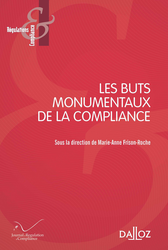
► Full Reference: M.-A. Frison-Roche, "Les Buts Monumentaux, cœur battant du Droit de la Compliance" ("Monumental Goals, beating heart of Compliance Law"), in M.-A. Frison-Roche (ed.), Les Buts Monumentaux de la Compliance, coll. "Régulations & Compliance", Journal of Regulation & Compliance (JoRC) and Dalloz, 2022, p. 21-44.
____
📝read the article (in French)
____
🚧read the bilingual Working Paper which is the basis of this article, with additional developments, technical references and hyperlinks
____
📕read a general presentation of the book, Les Buts Monumentaux de la Compliance, in which this article is published
____
► Summary of the article: Compliance Law can be defined as the set of processes requiring companies to show that they comply with all the regulations that apply to them. It is also possible to define this branch of Law by a normative heart: the "Monumental Goals". These explain the technical new legal solutions, thus made them clearer, accessible and anticipable. This definition is also based on a bet, that of caring for others that human beings can have in common, a universality.
Through the Monumental Goals, appears a definition of Compliance Law that is new, original, and specific. This new term "Compliance", even in non-English vocabulary, in fact designates a new ambition: that a systemic catastrophe shall not be repeated in the future. This Monumental Goal was designed by History, which gives it a different dimension in the United States and in Europe. But the heart is common in the West, because it is always about detecting and preventing what could produce a future systemic catastrophe, which falls under "negative monumental goals", even to act so that the future is positively different ("positive monumental goals"), the whole being articulated in the notion of "concern for others", the Monumental Goals thus unifying Compliance Law.
In this, they reveal and reinforce the always systemic nature of Compliance Law, as management of systemic risks and extension of Regulation Law, outside of any sector, which makes solutions available for non-sector spaces, in particular digital space. Because wanting to prevent the future (preventing evil from happening; making good happen) is by nature political, Compliance Law by nature concretizes ambitions of a political nature, in particular in its positive monumental goals, notably effective equality between human beings, including geographically distant or future human beings.
The practical consequences of this definition of Compliance Law by Monumental Goals are immense. A contrario, this makes it possible to avoid the excesses of a "conformity law" aimed at the effectiveness of all applicable regulations, a very dangerous perspective. This makes it possible to select effective Compliance Tools with regard to these goals, to grasp the spirit of the material without being locked into its flow of letters. This leads to not dissociating the power required of companies and the permanent supervision that the public authorities must exercise over them.
We can therefore expect a lot from such a definition of Compliance Law by its Monumental Goals. It engenders an alliance between the Political Power, legitimate to enact the Monumental Goals, and the crucial operators, in a position to concretize them and appointed because they are able to do so. It makes it possible to find global legal solutions for global systemic difficulties that are a priori insurmountable, particularly in climate matters and for the effective protection of people in the now digital world in which we live. It expresses values that can unite human beings.
In this, Compliance Law built on Monumental Goals is also a bet. Even if the requirement of "conformity" is articulated with this present conception of what Compliance Law is, this conception based on Monumental Law is based on the human ability to be free, while conformity law supposes more the human ability to obey.
Therefore Compliance Law, defined by the Monumental Goals, is essential for our future, while conformity law is not.
________
Sept. 1, 2022
Publications
♾️follow Marie-Anne Frison-Roche on LinkedIn
♾️subscribe to the Newsletter MAFR Regulation, Compliance, Law
____
► Full Reference: M.-A. Frison-Roche (ed.), Les Buts Monumentaux de la Compliance (Compliance Monumental Goals), coll. "Régulations & Compliance", Journal of Regulation & Compliance (JoRC) and Dalloz, 2022, 520 p.
____
📘In parallel, the English version of this book, Compliance Monumental Goals, is published in the collection co-published by the Journal of Regulation & Compliance (JoRC) and Bruylant.
____
📅This book comes after a cycle of colloquia 2021 organised by the Journal of Regulation & Compliance (JoRC)and its Universities partners.
____
📚This volume is one of the books dedicated to Compliance in the collection Régulations & Compliance: read the presentations of the other titles of this collection.
____
► General presentation of the book: Seize Compliance by its mind: its Monumental Goals. The notion of "monumental goals" of Compliance was proposed in 2016 by Marie-Anne Frison-Roche📎
Compliance Monumental Goals are targeted ex ante by regulations, contracts, CSR, and international treaties. Creating an alliance between business and political authorities, aiming for a new form of sovereignty. The presence in litigation of these Monumental Goals of global dimension renews the responsibilities and the Judge office. Describing and conceiving these Monumental Goals makes it possible to anticipate Compliance Law, which is more powerful every day.
____
🏗️General construction of the book: The book opens with a double Introduction, the first summarizing the book (in free access) and the second, more substantial, proposing the Monumental Goals as definition of Compliance Law putting them at its "beating heart", giving this new branch of law its originality and specificity, explaining what, in the History of the United States and Europe, gave birth to this singular corpus and justifies a substantial definition of Compliance Law. The concept of Monumental Goals is explained, justifying both systemic and political nature of Compliance Law, the practical consequences of which legal specific rules are thus better identified and limited, since Compliance Law does not lead to all-obedience. We can then determine what we can expect from this Law of the Future that is Compliance Law.
From there, the book unfolds in 5 titles.
A first Title is devoted to the "radioscopy" of this notion, in itself and branch of Law by branch of Law.
A second Title aims to measure how the Monumental Goals are questioned by a crisis, for example in a health situation, but not in that example, if they aggravate it and must be discarded, or if, on the contrary, they are exactly conceived for this hypothesis. of crisis, risks, catastrophes and that it is advisable to exploit them, in order, in this "test", to benefit from the alliance between the political authorities, public powers and crucial operators.
Once made explicit and tested, the Monumental Goals must find a sure way to be considered. Therefore, a third Title aims to measure in principle and in practice how the Proportionality method can help the integration of Compliance, thus giving a new dimension to the Law without dragging it into insecurity and illegitimate grabbing of powers.
But because Compliance Monumental Goals express a very great ambition, the question of a bearable, even beneficial relationship with the international competitiveness of companies, standards and systems must be opened. This is the object of the fourth Title.
Finally, because the Monumental Goals express by nature a new ambition of the Law in a world which must not give up in what could be the prospect of its abyss, the fifth Title has for object the relationship between the Monumental Goals of Compliance and Sovereignty.
____
► Understand the book through the Table of Contents and the summaries of each article:
DOUBLE INTRODUCTION
🕴️M.-A. Frison-Roche, 📝Résumé de l'ouvrage Les buts monumentaux du droit de la compliance (free access : click here to read this article (in French))
🕴️M.-A. Frison-Roche, 📝Les Buts Monumentaux, cœur battant du Droit de la Compliance
I. LA NOTION DE BUTS MONUMENTAUX DE LA COMPLIANCE ("THE IDEA OF COMPLIANCE MONUMENTAL GOALS")
🕴️R.-O. Maistre, 📝Quels buts fondamentaux pour le régulateur dans un paysage audiovisuel et numérique en pleine mutation ?
🕴️A.V. Le Fur, 📝Intérêt et raison d’être de l’entreprise : quelle articulation avec les Buts Monumentaux de la Compliance ?
🕴️A. Le Goff, 📝La part des banques dans la concrétisation des Buts Monumentaux de la Compliance
🕴️J.-F. Vaquieri,📝Les "Buts Monumentaux" perçus par l'entreprise. L'exemple d'Enedis
🕴️M. Malaurie-Vignal, 📝Les Buts Monumentaux du droit du marché. Réflexion sur la méthode
🕴️D. de La Garanderie, 📝Sur les Buts Monumentaux de la Compliance sociale
🕴️C. Peicuti & 🕴️J. Beyssade, 📝La féminisation des postes à responsabilité dans les entreprises comme But de la Compliance. Exemple du secteur bancaire
🕴️I. Gavanon, 📝Le droit des données personnelles dans l’économie numérique à l’épreuve des Buts Monumentaux
🕴️B. Petit, 📝Les Buts Monumentaux du droit (européen) des relations de travail : un système mouvant aux équilibres à consolider
🕴️G. Beaussonie, 📝Droit pénal et Compliance font-ils système ?
🕴️Ch. Huglo, 📝À quelles conditions le Droit climatique pourrait-il constituer un But Monumental prioritaire ?
II. MISE EN OEUVRE DES BUTS MONUMENTAUX DE LA COMPLIANCE EN ARTICULATION DU PRINCIPE MAJEUR DE LA PROPORTIONNALITÉ ("IMPLEMENTATION OF COMPLIANCE MONUMENTAL GOALS IN ARTICULATION OF THE MAJOR PRINCIPLE OF PROPORTIONALITY")
🕴️L. Rapp, 📝Conformité, proportionnalité et normativité
🕴️B. Bär-Bouyssière, 📝Les obstacles pratiques à la place effective de la proportionnalité dans la Compliance
🕴️A. Mendoza-Caminade, 📝Compliance, proportionnalité et évaluation
🕴️L. Meziani, 📝Proportionnalité en Compliance, garant de l’ordre public en entreprise
🕴️M. Segonds, 📝Compliance, proportionnalité et sanction
🕴️M.-A. Frison-Roche, 📝Définition du principe de proportionnalité et définition du Droit de la Compliance
III. LES BUTS MONUMENTAUX DE LA COMPLIANCE ÉPROUVÉS PAR LES SITUATIONS DE CRISES ("THE COMPLIANCE MONUMENTAL GOALS TESTED BY CRISIS SITUATIONS")
🕴️A. Oumedjkane, A. Tehrani et P. Idoux, 📝Normes publiques et Compliance en temps de crise : les Buts Monumentaux à l'épreuve. Éléments pour une problématique
🕴️J. Bonnet, 📝La crise, occasion de saisir la Compliance comme mode de communication des autorités publiques
🕴️M.-A. Frison-Roche, 📝Place et rôle des entreprises dans la création et l'effectivité du Droit de la Compliance en cas de crise
IV. EFFECTIVITÉ DES BUTS MONUMENTAUX DE LA COMPLIANCE ET COMPÉTITIVITÉ INTERNATIONALE ("EFFECTIVENESS OF COMPLIANCE MONUMENTAL GOALS AND INTERNATIONAL COMPETITIVENESS")
🕴️B. Deffains, 📝L’enjeu économique de compétitivité internationale de la Compliance
🕴️F. Marty, 📝L'apport des programmes de conformité à la compétitivité internationale : une perspective concurrentielle
🕴️S. Lochmann, 📝Les agences de notation ESG et l'effectivité de la Compliance face à la compétitivité internationale
🕴️M.-A. Frison-Roche, 📝Appréciation du lancement d'alerte et de l'obligation de vigilance au regard de la compétitivité internationale
V. LA COMPLIANCE PORTÉE PAR LES BUTS MONUMENTAUX, NOUVELLE VOIE DE SOUVERAINETÉ ("COMPLIANCE SUPPORTED BY MONUMENTAL GOALS AND NEW WAY OF SOVEREIGNTY")
🕴️R. Bismuth, 📝Compliance et souveraineté : relations ambigües
🕴️L. Benzoni, 📝Commerce international, compétitivité des entreprises et souveraineté : vers une économie politique de la Compliance
🕴️M.-A. Boursier, 📝Les Buts Monumentaux de la Compliance : mode d'expression des États
🕴️S. Pottier, 📝Pour une Compliance européenne, vecteur d'affirmation économique et politique
🕴️Ch. André, 📝Souveraineté étatique, souveraineté populaire : quel contrat social pour la Compliance ?
🕴️M.-A. Frison-Roche, 📝Le principe de proximité systémique active, corollaire du renouvellement du principe de souveraineté par le Droit de la Compliance
________
🕴️M.-A. Frison-Roche, 📝Le Droit de la compliance, 2016.

May 9, 2022
Publications

► Référence complète : Frison-Roche, M.-A., Notes prises pour la synthèse sur le vif de la conférence L'office du juge et les causes systémiques, in Cycle de conférences, Penser l'office du juge, Grand Chambre de la Cour de cassation, 9 mai 2022, 17h-19h.
____
► Résumé des notes prises au fur et à mesure de la conférence : les trois juges, Christophe Soulard, Président de la Chambre criminelle de la Cour de cassation, Fabien Raynaud, Conseiller d'Etat, et François Ancel, Président de la Chambre internationale de la Cour d'appel de Paris, invités à réfléchir et réagir à une hypothèse, à savoir l'existence parmi les cas qui leur sont apportés par les parties, sont intervenus à la fois d'une façon très diverse, très originale et exprimant pourtant l'unicité de l'art de juger.
Les notes prises ci-dessous montrent que les juges ont conscience que les temps ont changé et que, de plus en plus, les "systèmes" sont présents dans les causes qui, construites par les parties, leur sont présentées (1). Leurs analyses, réactions et propositions ont montré à ceux qui les écoutaient que pour appréhender des causes systémiques, les juges doivent être expérimentés (2). Ils ont eu souci de fixer des critères pour identifier la nature systémique des causes parmi la multitude de celles qu'ils traitent, justifiant alors un traitement procédural et décisionnaire particulier (3). L'auditoire a ainsi pu mesurer la part qui revient aux parties (4), puisque le système est dans la construction des faits de la cause et la part qui revient à l'office du juge (5).
Il apparaît alors que par un effet de miroir, l'office du juge se déplace de l'Ex Post vers l'Ex Ante (6), les trois juges décrivant et proposant des mécanismes concrets pour appréhender en Ex Ante cette dimension systémique et y répondre (7). Ils soulignent que cela s'opère en collaboration avec les avocats, dans une instruction élargie et le débat contradictoire (8), dans une collaboration qui s'opère en amont (9). Les trois magistrats ont recherché les techniques procédurales pour accroître la plus grande considération des systèmes (10) et les nouvelles organisations à mettre en place pour répondre à cette dimension systémique de certaines causes (11). Pour ce faire, une dialectique est à opérer vers, à la fois, de l'informel mais aussi plus de formel (12), l'ensemble produisant une meilleure réception méthodologique des systèmes par les juges (13) par une plus grande compréhension entre les juges, quel que soit leur niveau et les droits substantiels en cause, les autorités et les parties systémiques (14).
____
🎥Voir la vidéo de l'ensemble de la conférence
🎥 Voir la vidéo de la synthèse réalisée sur le vif par Marie-Anne Frison-Roche au terme de la conférence
____
📝Lire l'article de Marie-Anne Frison-Roche rendant compte au Dalloz de la conférence.
____
🚧 lire le document de travail L'hypothèse de la "cause systémique, réalisé préalablement à la conférence, pour préparer celle-ci.
_____
✏️ lire les notes exhaustives prises pendant la conférence⤵️
Updated: April 4, 2022 (Initial publication: Oct. 4, 2021)
Publications

🌐follow Marie-Anne Frison-Roche on LinkedIn
🌐subscribe to the Newsletter MAFR. Regulation, Compliance, Law
____
► Full Reference: M.-A. Frison-Roche, The Hypothesis of the category of Systemic Cases brought before the Judge, Working Paper, October 2021 and April 2022.
____
► This working paper has served as the basis for an introductory speech 🎤L'hypothèse de la catégorie des causes systémiques (The Hypothesis of the cateory of Systemic Cases), in a more general conference which I coordinated and moderated, 🧱L'office du juge et les causes systémiques, which is part of a general cycle covering Penser l'office du juge, specific conference attending the 9th May 2002 into the Grand Chamber of the Cour de cassation.
This Working Paper was drawn up in October 2021 to build the conference on the assumption that among the diversity of "cases" brought to the courts by litigants, some constitute a specific category: "systemic cases", justifying treatment that is both specific (in that they are systemic, calling in particular for procedural solutions common to all and distinguishable from the treatment of non-systemic cases) and common treatment beyond the diversity of judges who deal with them (judicial and administrative judges, criminal and non-criminal judges, French and non-French judges, judges of the member-States legal orders and European Union judges, etc.).
This working paper does not aim to deal with the whole subject, i.e. both to determine this category of "systemic causes" and the consequences that must be drawn from it for the judge's office, since that is the very purpose of the conference, which is built around several presentations: it aims to deal with the first part of the subject, i.e. the very existence of this new processual category, which is "systemic causes", leaving for other work the practical consequences to be drawn from it in the processual treatment that it calls for.
____
📝This Working Paper is also the basis of a forthcoming article
____
► Summary of the Working Paper: xx
________
Read below the developments⤵️
Dec. 24, 2021
Publications

🌐 follow Marie-Anne Frison-Roche on LinkedIn
🌐subscribe to the Newsletter MAFR Regulation, Compliance, Law
____
► Full reference: M.-A. Frison-Roche, Conceiving Power, Working Paper, December 2021
____
📝 This Working Paper serves as the basis for an article to be published in the collective book drawn up in tribute to Professor Emmanuel Gaillard.
____
► Working Paper summary: In 1985, Emmanuel Gaillard's central work came out under the title Le pouvoir en droit privé (The Power in Private Law)📎
Let's give full force to the original title of the thesis.
The deletion of the term notion perhaps implies that by defining something the essential is done, that there would be something of a pleonasm in aiming at The notion of Power and The Power, as Law likes to economise on words.
But it was indeed a renewed, simpler and more powerful conception of the notion of Power, containing the entire regime necessarily imputed, that this work imposed, henceforth illuminating positive Law. Emmanuel Gaillard's definition, on the other hand, goes beyond Private Law. We would gladly have argued in favour of retaining the heading for the term Notion, proposing instead to dispense with the reference to Private Law alone ....
Perhaps it was because the concept is so vast that in this seminal thesis its scope was restricted to Private Law, since the author already had to account for the sheer multiplicity of manifestations in this part of the legal system; Or perhaps it was because the concept of 'Power' is so familiar in Public Law that it would have needed less definition in Public Law (which, moreover, is so diversely proposed in this more political area, which is already careful on principle to distinguish between powers, which must always be plural in order to be separated), and that it was therefore reasonable to want to arrive at a single concept of Power in Private Law, where the notion of subjective rights is more familiar.
However, Emmanuel Gaillard's definition of Power as a prerogative placed, by legal rule or contract, in the hands of the person invested with them for the benefit, at least in part, of others, covers both Public and Private Law. This even contributes to the solidity of this thesis and explains why it flourishes today in legal systems where the distinction between Private Law and Public Law is weakening.
The power of this definition lies in its simplicity. Simple and brave minds are often the most fruitful. As Dean Gérard Cornu points out in his preface, the author, in particular because he bases himself more on positive law, for example that relating to the powers of corporate officers, does not get bogged down in discussions between authors only to end up preferring one over the other. He arrives at a definition that is close to our everyday experience: the one we experience when we collect an envelope on behalf of someone else and the agent asks us in what capacity we claim to be doing this on his behalf. We then show him our 'power', the legal power to do so for the benefit of the person to whom the letter is addressed, and can thus exercise the power to withdraw the letter, even though it is personal. When legal and common sense come together, it is a good omen, not only in terms of form, because everyone can understand it and the Law must remain comprehensible, but also in terms of substance, because everyone must be able to control the exercise of a power that is exercised for and over others. For this letter addressed to someone else, the person who has been able to take it by virtue of the power conferred on him/her, could just as easily open it and read it, then destroy it or give it to the worst enemy of the person to whom it was addressed. In Power, there is always might to do, and the danger to others that Power contains therefore.
This highly legal definition of Power not only distances the holder from his/her own interests, but also channels the Power thus granted to the person who benefits from it. In this respect, Emmanuel Gaillard not only distinguished between Power and subjective right, but also identified the right amount of power required for this power to effectively fulfill this 'Mission', through the notion of abuse of power, when the holder uses for other beneficiaries this power that was conferred on him/her for this sole purpose.
What is more, this concept makes it possible to distinguish Power from discretionary force, because the holder of Power thereby exercises factual , by acting for others, deciding for others, deciding on others. Because Power is inseparable from might, but might must remain the means of power and no more, the Law shall produce the antibodies that are not only the theory of abuse of power but also an Ex Ante responsibility that accounts must always be rendered, either to the other for whom everything is done or to a third party. For this third party is often there from the outset, the guardianship judge for example: because the Power was put in place because of the beneficiary's weakness, both in himself/herself and because of the situation, an impartial and disinterested third party is needed to ensure proper execution from the outset, without there even being a dispute. In this respect, how useful this thesis is for thinking about what Supervision is today!
This thesis, so clear, so simple and so strong, goes beyond Private or Civil Law. It is both much more restrictive than the more factual and political definition of Oower, which would be the ability to do something, and much broader than the usual definitions, since it embraces and legitimises de jure all situations where a person acts legally for the benefit of another. Dean Cornu shows, moreover, in two sentences that such a notion of power also captures the office of the judge, who has power over others only to serve them 📎
Moreover, Power thus contains its own limit in its very definition, since others are present in it: the holder has power only to serve others. From then on, it is only a power because it is a kind of Charge. Emmanuel Gaillard immediately uses the term: "Un individu se voit confier une charge qu'il exerce dans un intérêt au moins partiellement distinct du sien propre" ("An individual is entrusted with an office which he exercises in an interest at least partially distinct from his own") 📎
This definition offered by Emmanuel Gaillard in 1981, anchored in Private Law only insofar as it is the entire legal system, is premonitory of the Regulatory and Compliance Law as it unfolds today. It would be enough to continue the Gaillard's sentences, as if they had been half-written, to finish them 40 years later and find in them the mechanisms of Supervision of companies by public authorities which are now in place not to reduce their power but to ensure that they exercise it for the benefit of others 📎
The definition of Power thus conceived contains within itself its regime and enables us to anticipate it better today: because the holder exercises Power only for others, at least partially, he is consubstantially accountable for it, responsibility being only one form of this accountability; because this service must be effective and others must benefit fully from it, because unlike the subjective right which allows the holder freely not to use his might, Power has never been the 'most absolute' availability to use his/her might: it is even the opposite. It is the expression of a Power assigned to a purpose, compelling the holder to use his/her Power to that end. But it is equally necessary for the holder to have all the might to do so, otherwise the very notion of 'Power' is meaningless. This is the definition that should be given to the principle of Proportionality: the person on whom the Power rests must have not more power than is necessary, but all the power necessary to achieve the Monumental Goals for which the Power has been entrusted to him/her, so that others may derive full benefit from it (II).
In today's positive Law, the definition of Power as a Duty is found not only in Private Law but also in Public Law, not least because pure might, i.e. those that do not account for the use of their might, are in decline while concern for others is on the increase. The days of discretionary powers are over, and the increased independence of those who exercise Power over others requires them to be accountable. Beyond this Accountability, the personal Responsibility of those who have the Power to serve others is being established. But, no doubt because the Law is slow to evolve, the correlative idea that the holder of Power must have all the powers required to carry out his/her mission is less entrenched: As Emmanuel Gaillard has shown, the Law has only gone part of the way in sanctioning excesses of power, when the holder uses his/her power for other goals, but it has not yet clearly established that the holder - sometimes forced - of a Power is legitimate in using all the means required to achieve the result for which this Power, i.e. a charge and a duty, has been conferred on him/her.
No doubt we need to read Emmanuel Gaillard's thesis again in all its potential, to imagine the reading we could do today of what he could have written as if on blank pages that would write themselves, a magical thesis where everything is already there, a thesis so short (250 pages) and so beautiful, so dense that it already contains the Law of the Future. The Law of the Future 📎
____
Lire les développement ci-dessous⤵
Gaillard, E., Le pouvoir en droit privé, préf. Cornu. G., coll. ..., Economica, 1985.
Gaillard, E., La notion de pouvoir en droit privé, thèse .... ;
"En droit processuel, l'office du juge aurait donné à l'auteur un renfort. Pour le juge, il n'est point de pouvoir sans devoir. Au-delà de la distinction de ce qu'il a obligation de faire ou faculté d'apprécier, il y a toujours, au creux de ce qu'il peut, le sceau de ce qu'il doit, un devoir gardien - comme un âme - de l'exercice du pouvoir." (p.5).
n°3, p.9.
🕴️J. Carbonnier, 📗Essai sur les lois, 1992 (on the guardianship).
S. in a general way, 🕴️M.-A. Frison-Roche (ed.), 📕Régulation, Supervision, Compliance, 2017.
Cornu, préface précitée : "Tous les pouvoirs sont, à double face, des pouvoirs-devoirs" (p.5).
On Compliance Law as a Law of the Future, s. 🕴️M.-A. Frison-Roche, 📝Compliance Monumental Goals, beating heart of Compliance Law, in 🕴️M.-A. Frison-Roche (ed.), 📘Compliance Monumental Goals, 2023.
On the consequences for Liability Law, which is now looking to the Future, s. 🕴️M.-A. Frison-Roche, 🚧Ex Ante Responsibility, 2021.
Sur la notion de "Responsabilité Ex Ante", v. Frison-Roche, M.-A., La responsabilité Ex Ante", in Archives de Philosophie du Droit, La responsabilité, 2022.
Updated: Sept. 18, 2021 (Initial publication: Sept. 10, 1999)
Publications

► Référence complète : Frison-Roche, M.-A., Droit, finance, autorité. Sociologie comparée des autorités de marchés financiers, recherches menées puis rapport rédigé pour le Laboratoire de sociologie juridique, Université Panthéon-Assas (Paris II), remis au GIP Mission de recherche Droit et justice, septembre 1999, dactyl., 117 p.
____
📝 Lire la table des matières de l'ouvrage.
____
📝 Lire le résumé et la synthèse de l'ouvrage en 4 pages.
____
📝 Lire le rapport
____
►Lire les deux monographies accompagnant le rapport :
📝 Bouthinon-Dumas, H., Le rôle des autorités de marchés financiers dans la crise asiatique vue à travers la presse
📝 V. Magnier, Les autorités de marchés financiers aux Etats-Unis. Droit, juge et autorité de marché
____
📝 Lire les synthèses concernant les différents pays étudiés
📝 Lire la grille d'entretien semi-ouvert
________
Sept. 15, 2021
Publications

► Full Reference: M.-A. Frison-Roche, Ex Ante Responsibility, Working Paper, December 2021.
____
📝This Working Paper has been the basis for an article written in French, "La responsabilité Ex Ante", published in the Archives de Philosophie du droit (APD), in the book 📗La Responsabilité (2022).
____
► Working Paper Summary: Quel est le temps auquel s'articule la responsabilité ? La question est si classique que toutes les réponses ont été dessinées : si l'on est responsable plus aisément par rapport au temps, car l'on peut alors plus aisément faire un lien entre la situation appréhendée, sa réalisation dans le passé la rendant plus facilement connaissable, et le poids de "responsabilité" que l'on impute sur une personne, l'on peut articuler la responsabilité avec le futur. Si l'on brise le poids de cette responsabilité avec un évènement ou une situation, par exemple. Le Principe Responsabilité de Jonas ou l'Ethique de la Responsabilité font ainsi voyager la Responsabilité dans le temps, par un rapport entre le Droit et l'Ethique.
D'ailleurs l'on pourrait soutenir que le Droit peut faire ce qu'il veut et imputer une responsabilité à quiconque pour le temps qu'il désigne, par exemple désigne comme porteur d'une responsabilité, c'est-à-dire d'un poids, celui qu'il veut. Le "responsable" serait alors le titulaire d'une sorte de "poids pur", qui le charge parce que le Droit l'a voulu pour le temps qu'il veut, par exemple un devoir d'agir pour que le futur soit dessiné comme le veut le Droit, alors même que le Responsable n'a rien à se reprocher dans le passé.
Mais les Cours constitutionnelle défendent un rapport minimal entre la Responsabilité et le poids que celle-ci fait porter une personne, fut-t-elle morale, gardant ainsi le lien consubstantiel entre le Droit et la Morale, la technique juridique de la Responsabilité ne pouvant équivaloir à celle d'un prélèvement obligatoire.
Ainsi l'idée d'une Responsabilité Ex Ante est simple dans son principe (I). Elle est celle d'un poids juridiquement posé sur une personne soit par elle-même (engagement), soit par la Loi ou par le Juge sur une personne de faire quelque chose pour que n'advienne pas quelque chose qui adviendrait ou pour qu'advienne quelque chose qui n'adviendrait pas si elle ne le faisait pas.
Mais les conditions juridiques pour admettre un tel poids alors même que le lien avec une situation passée serait brisé est plus difficile (II). On continue certes continuer à voir dans le futur le passé, ce qui facilite le voyage dans le temps, et fonda par exemple le contrôle Ex Ante du contrôle des concentrations. Mais l'on peut se briser même de cette facilité et regarder non plus le rapport entre le passé et le futur, mais le présent et le futur : ce que l'on sait déjà aujourd'hui du futur, ce qui met en jeu le rapport entre le Droit et la Science ; ce que l'on observe de l'emprise de la personne présente sur le moment présent, c'est-à-dire le Pouvoir, ce qui fait en jeu le rapport entre le Droit et l'Economie politique.
Dans cette dimension-là, la contrainte de la Responsabilité Ex Ante est alors maniée par le Juge, dont l'office lui-même devient un office Ex Ante. Les pouvoirs obligés Ex Ante par une telle responsabilité maniée par le Juge étaient les personnes en situation de pouvoir, sont non seulement les entreprises, mais encore les Etats, qui perdent le privilège - partagé avec les contractants - de disposer juridiquement du futur, et notamment en leur sein le Législateur.
Une telle révolution, qui se déroule sous nos yeux, s'explique parce qu'il faut agir maintenant pour que le futur ne soit pas catastrophique. La science nous informe qu'il le sera entéléchiquement. Il est donc juridiquement requis de désigner des responsables, non pas parce qu'ils auraient fait quelque chose, la dimension Ex Post n'étant pas le sujet, mais pour qu'ils fassent quelque chose, la Responsabilité Ex Ante étant un élément central de cette nouvelle branche du Droit qu'est le Droit de la Compliance.
Aug. 25, 2021
Publications

🌐follow Marie-Anne Frison-Roche on LinkedIn
🌐subscribe to the Newsletter MAFR Regulation, Compliance, Law
____
► Full Reference: M.-A. Frison-Roche, M.-A., Monumental Goals, beating heart of Compliance Law, Working Paper, August 2021
____
📝This Working Paper is the basis for the article, "Les buts monumentaux, cœur battant du droit de la compliance", constituting the introduction ⤵
📕in its French version, of the book Les buts monumentaux de la Compliance, in the Series 📚Régulations & Compliance
📘in its English version, of the book, Compliance Monumental Goals, in the Series 📚Compliance & Regulation
____
► Summary of the Working Paper:
Compliance Law can be defined as the set of processes requiring companies to show that they comply with all the regulations that apply to them. It is also possible to define this branch of Law by a normative heart: the "Monumental Goals". These explain the technical new legal solutions, thus made them clearer, accessible and anticipable. This definition is also based on a bet, that of caring for others that human beings can have in common, a universality.
Through the Monumental Goals, appears a definition of Compliance Law that is new, original, and specific. This new term "Compliance", even in non-English vocabulary, in fact designates a new ambition: that a systemic catastrophe shall not be repeated in the future. This Monumental Goal was designed by History, which gives it a different dimension in the United States and in Europe. But the heart is common in the West, because it is always about detecting and preventing what could produce a future systemic catastrophe, which falls under "negative monumental goals", even to act so that the future is positively different ("positive monumental goals"), the whole being articulated in the notion of "concern for others", the Monumental Goals thus unifying Compliance Law.
In this, they reveal and reinforce the always systemic nature of Compliance Law, as management of systemic risks and extension of Regulation Law, outside of any sector, which makes solutions available for non-sector spaces, in particular digital space. Because wanting to prevent the future (preventing evil from happening; making good happen) is by nature political, Compliance Law by nature concretizes ambitions of a political nature, in particular in its positive monumental goals, notably effective equality between human beings, including geographically distant or future human beings.
The practical consequences of this definition of Compliance Law by Monumental Goals are immense. A contrario, this makes it possible to avoid the excesses of a "conformity law" aimed at the effectiveness of all applicable regulations, a very dangerous perspective. This makes it possible to select effective Compliance Tools with regard to these goals, to grasp the spirit of the material without being locked into its flow of letters. This leads to not dissociating the power required of companies and the permanent supervision that the public authorities must exercise over them.
We can therefore expect a lot from such a definition of Compliance Law by its Monumental Goals. It engenders an alliance between the Political Power, legitimate to enact the Monumental Goals, and the crucial operators, in a position to concretize them and appointed because they are able to do so. It makes it possible to find global legal solutions for global systemic difficulties that are a priori insurmountable, particularly in climate matters and for the effective protection of people in the now digital world in which we live. It expresses values that can unite human beings.
In this, Compliance Law built on Monumental Goals is also a bet. Even if the requirement of "conformity" is articulated with this present conception of what Compliance Law is, this conception based on Monumental Law is based on the human ability to be free, while conformity law supposes more the human ability to obey.
Therefore Compliance Law, defined by the Monumental Goals, is essential for our future, while conformity law is not.
________
Read the developments below⤵️
April 21, 2021
Publications

Full reference : Frison-Roche, M.-A., Questionnaire de Proust (Proust's Quiz), in Droit & Littérature, n°5, p.37-38, Lextenso, 2021.
The chosen topic for this volume is Proust.
Read (in French)
See its presentation on LinkedIn (in French)
Dec. 8, 2020
Publications

🌐follow Marie-Anne Frison-Roche on LinkedIn
🌐subscribe to the Newsletter MAFR Regulation, Compliance, Law
____
► Full Reference: M.-A. Frison-Roche, "La compliance" ("Compliance"), in J.-B. Racine (ed.), Le droit économique au XXIe siècle. Notions et enjeux, LGDJ, "Droit & Économie" Serie, 2020, pp. 97-108
____
📝read the article (in French)
____
🚧read the bilingual Working Paper which is the basis of this article, with additional developments, technical references and hyperlinks
____
📕read a general presentation of the book, Le droit économique au XXIe siècle. Notions et enjeux, in which this article is published
____
📚see the presentation of the other books published in this Serie, founded and directed by Marie-Anne Frison-Roche
► English Summary of the article:
________
Updated: Dec. 3, 2020 (Initial publication: July 15, 2020)
Publications

Full Reference : Frison-Roche, M.-A., Rights, primary and natural Compliance Tools, Working Paper, July 2020.
This Working paper is the basis for an article published in the collective book Compliance Tools .
____
There was a time when Regulatory techniques were above all only calculations of the best tarifications, taken up by monopolistic companies, while Compliance techniques were only obedience to all rules governing us. All this could therefore only be business of abacus and badine, used by engineers and consisted only of mechanical reflexes of "conformity" to all kinds of rules with the corset ensuring that everyone is bent in front of them
Systems have since evolved to integrate these prerogatives of each person: rights. Is this evolution really acquired? Maybe more effectively in Regulation Law than in its extension which is Compliance Law. This may be surprising since Compliance Law, in that it extends Regulatory Law in enterprises should, on the contrary, promote rights by meeting the enterprise, which is a group of people ....
In addition, if Regulation has long been the subject of a branch of Law in which rights have full place, the presentation of Compliance as "conformity", that is to say the proven assurance of obedience to all the applicable rules, leaves no space for the prerogatives of people, which appear rather as resistance to the obedience that would be expected of them. There again, the expectation of what would be a good ratio of conformity between behaviors and prescriptions would be obtained by a "design", data processing being the new form of calculation, improved by precision tools where the being human is not required
It would therefore be with regret, and probably because some constitutional jurisdictions still attach some value to fundamental rights that the systems of "conformity" of behavior to the rules make some room for the prerogatives of people, their more essential rights. It is sometimes said that this is part of the cost. It would therefore be as by "forcing" that rights would exist in Compliance systems, a kind of price that the effectiveness of Compliance must pay as a tribute to the Rule of Law principle
If in a poor definition Compliance is conceived in this only "conformity", leading to a landscape in which the behaviors of the people adjust to the rules governing the situations, Compliance being only the most "effective way" to ensure the application of the rules, in a mechanical perspective of Law, then it would effectively be necessary to reduce the prerogatives of people to a minimal part, because any "additional cost" is intended to disappear, even if it is produced here by constitutional requirements. In the looming battle between the effectiveness of the application of rules and the concern for the legal prerogatives of people who should above all obey and not claim their rights, especially their right not to obey , or their right to keep secret in Compliance techniques which is based on the centralization of information, the effectiveness of efficiency could only, by the very power of this tautology, prevail
The defeat would not be total, however, collaboration would still be possible and active between people availing themselves of their rights and Compliance Law. Indeed, in many respects, if rights have been recognized in Compliance systems, it is not only because Compliance Law, like any branch of Law, can only be deployed with respect for fundamental rights. kept by fundamental legal texts, but also because of the effectiveness of rights as " Compliance Tools".
Indeed, because they constitute a very effective "tool" to ensure the entire functioning of a system whose goals are so difficult to achieve, because every effort must be made to achieve these goals, the public authorities not only rely on the power of crucial operators, but also distribute prerogatives to people who, thus encouraged, activate the Compliance system and participate in the achievement of the "monumental goals". Rights can prove to be the most effective tools to effectively achieve the goals set, to such an extent that they can be considered as "primary tools" (I).
But it is necessary to be more ambitious, even to reverse the perspective. Indeed because all the Monumental Goals by which Compliance Law is defined can be reduced to the protection of people, that is to say to the effectiveness of their prerogatives, by a mirror effect between rights. given by Law to persons and the rights which constitute the very purpose of all Compliance Law, in particular the protection of all human beings, even if they are in a situation of great weakness, rights become a "natural tool" of Compliance Law (II).
Rights are the Compliance Law future.
Contre cela, la critique radicale, savante et fondée d'Alain Supiot, dans l'ensemble de son oeuvre et plus particulièrement dans La gouvernance par les nombres, 2015.
Sur la définition de l'entreprise comme un groupe de personnes qui se réunissent pour entreprise, v. le travail de référence d'Alain Supiot, par exemple son article d'introduction "L'entreprise...", dans l'ouvrage qu'il a dirigé L'entreprise dans la mondialisation ...., 2015 ...
Si l'entreprise pouvait renaître comme idée de cristallisation d'une idée commune entre des personnes, naturellement titulaires de droits subjectifs, exerçant ensemble leur liberté d'entreprendre pour réaliser un projet commun, ce qui correspond à la définition classique du contrat d'entreprise donnée à l'article 1832 du Code civil, cela renforcerait considérablement la présence des droits subjectifs dans le Droit de la Compliance et conforterait la nature humaniste de celui-ci.
En outre, dans une telle définition la loi de la majorité, qui n'est qu'une loi de fonctionnement d'une catégorie de sociétés que sont les sociétés de capitaux, deviendrait moins puissante, au profit des "droits propres" de tout associé (au-delà du cercle des sociétés de personnes), sans qu'il soit besoin d'aller chercher au-delà du cercle des associés ou titulaires de titres émis par la société ou l'entreprise (dit shareholders) et d'aller donner le "droit à la parole" à des personnes qui, parce qu'elles sont "concernées" (les "parties prenantes", les skateholders) ont désormais de plus en plus le "droit à la parole".
La Compliance by Design reflète ces tensions. Elles sont particulièrement bien décrites par Cécile Granier. V. ....
Contre cette conception de la légalité, qui prévoit tout et à laquelle il faudrait prouver par avance et que l'on se "conforme" entièrement, ce qui est contraire aux principes mêmes du libéralisme dont le principe est la liberté d'agir et non pas l'obéissance, Carbonnier affirme que les règles sont faites ne pas s'appliquer et qu'elles ne sont que le "mince vernis" des choses, qu'il convenait de se méfier de la "passion du Droit". V. not. son dernier ouvrage Droit et passion du droit sous la Vième République, 1995. Carbonnier est considéré comme le plus grand juriste français du XXième siècle. Il rédigea les lois qui réformèrent en profondeur le Code civil et publia des ouvrages sur "l'art législatif".
Au contraire, l'Etat de Droit n'est pas un coût extérieur au système de Compliance efficace, que celui-ci doit internaliser. Il est le fondement même du Droit de la Compliance. Voir dans ce sens la démonstration faite par le président de la Cour de Justice de l'Union européenne, Koen Laearnt, ..., in Pour une Europe de la Compliance, 2019.
Sur la démonstration comme quoi la Constitution, en ce qu'elle contient de l'incalculable, est broyée dans cette façon de faire, v. Alain Supiot, Intervention 2019.
Nov. 1, 2020
Publications

This working paper served as a basis for an interview organized by Olivia Dufour in French in Actu-juridiques-Lextenso on 11st of January 2021.
Sept. 16, 2020
Publications

🌐follow Marie-Anne Frison-Roche on LinkedIn
🌐subscribe to the Newsletter MAFR Regulation, Compliance, Law
____
Full reference: M.-A. Frison-Roche, Se tenir bien dans l'espace numérique, in Penser le droit de la pensée. Mélanges en l'honneur de Michel Vivant, Lexis Nexis and Dalloz, 2020, pp. 155-168.
____
📝Read the article (in French)
____
English summary of the article: The digital space is one of the scarce spaces not framed by a specific branch of Law, Freedom also offering opportunity to its actors to not "behave well", that is to express and diffuse broadly and immediately hateful thoughts through Hate speechs, which remained before in private or limited circles. The intimacy of Law and of the legal notion of Person is broken: Digital permits to individuals or organizations to act as demultiplied and anonymous characters, digital depersonalized actors who carry behaviors that are hurtful to other's dignity.
Against that, Compliance Law offers an appropriate solution: internalizing in digital crucial operators the mission to disciplinary and substantially hold the digital space. The digital space has been structured by powerful firms able to maintain order. Because Law must not reduce digital space to be only a neutral market of digital prestations, these crucial operators, like social networks or search engines, must be forced to substantially control behaviors. It could be about an obligation of internet users to act with their face uncover, "real identity" policy controlled by firms, and to respect others' rights, privacy rights, dignity, intellectual property rights. In their Regulatory function, digital crucial firms must be supervised by public authorities.
Thus, Compliance law substantially defined is the protector of the person as "subject of law" in the digital space, by the respect that others must have, this space passing from the status of free space to the one of civilized space, in which everyone is obliged to behave well.
______
Read to go further:
- Frison-Roche, M.-A., L'apport du Droit de la Compliance à la gouvernance d'Internet, 2019
- Frison-Roche, M.-A. (dir.), Internet, un espace d'interrégulation, 2016