
Thesaurus : Soft Law
Référence complète : Response to the Study on Directors’ Duties and Sustainable Corporate Governance by Nordic Company Law Scholars, octobre 2020.

Thesaurus : Doctrine
► Référence complète : A. Pogurschi , "« Souveraineté numérique européenne » Réalité juridique ou expression au service du discours (géo)politique ?" Politique européenne, 83(1), 2024, pp.6-41.
____
🦉Cet article est accessible en texte intégral pour les personnes inscrites aux enseignements de la Professeure Marie-Anne Frison-Roche
_______

Thesaurus : Soft Law
Référence complète : Gauvain, R. et Marleix, O., Rapport d'information sur l'évaluation de l'impact de la loi n° 2016-1691 du 9 décembre 2016 relative à la transparence, à la lutte contre la corruption et à la modernisation de la vie économique, 2021.
____
________

Thesaurus : Doctrine

► Référence complète : A. Cheng, "Il ne peut y avoir deux soleils dans le ciel, ni deux princes pour un pays » : despotisme et monisme en Chine", Cours au Collège de France, 2024.
Il s'agit de partir de la phrase de Montesquieu qui affirme que la Chine est un régime despotique dont le principe est la crainte et de la confronter à la Chine d'hier et d'aujourd'hui.
____
____
► Cours successifs :
🎥Questions de traduction (1), 14 novembre 2024
Montesquieu "a commencé par parler japonais", le Japon moderne ayant été marqué par L'esprit des lois, la notion de despotisme et la notion de séparation des pouvoirs s'introduisant par la traduction en japonais et en chinois, notions qui étaient totalement inédites, dans des cultures confucéennes. A cette aune et selon des auteurs japonais réformateurs, le Japon peut apparaître comme un espace "constitutionnel" tandis que la Chine apparaît comme un espace despotique. Un autre auteur japonais traduit en distinguant le régime monarchique, le régime aristocratique et la république. Le despote est alors celui qui règne seul et sans limite de son pouvoir, la qualification visant la dérive monarchique, mais l'auteur n'en conclut pas à la séparation des pouvoirs. Des manuels scolaires japonais s'approprient la pensée de Montesquieu et présentent la Chine comm despotique. C'est le gouvernement Meiji qui 2 ans plus tard propose la séparation des pouvoirs législatif, exécutif et judiciaire. Des conférences savantes à Tokyo se réfèrent à Montesquieu et sa théorie de la séparation de 3 pouvoirs indépendants pour éviter le despotisme mais souligne que ce sont les Etats-Unis qui seuls l'appliquent.
🎥Questions de traduction (2) 21 novembre 2024🎥La faute à Montesquieu 28 novembre 2024🎥La rupture moderniste et libérale 5 décembre 2024🎥Pensée minben (primauté du peuple) contre despotisme 12 décembre 2024🎥Réfutation de la pensée minben 19 décembre 2024🎥Ni deux soleils, ni deux princes 9 janvier 2025🎥Un seul Dao holiste et moniste 16 janvier 2025🎥Le culte du Grand Un 23 janvier 2025
_______

Feb. 23, 2026
Conferences

🌐Follow Marie-Anne Frison-Roche on LinkedIn
🌐Subscribe to the Newsletter MAFR Regulation, Compliance, Law
🌐Subscribe to the video newsletter MAFR Overhang
🌐Subscribe to the Newsletter MaFR Law & Art
____
► Full reference : M.-A. Frison-Roche, "The Future of Compliance", series Compliance, Centre Perelman, Brussels, 23 February 2026.
____
🧮view the full programme for the series Compliance (in French)
____
► English presentation of this concluding conference in the series Compliance : The future of Compliance: who knows what it holds? Anyone who practises and studies the texts, litigation, structures and behaviours will have to admit that they do not know what will become of what has emerged as a new branch of law. It is not easily recognised, probably for three reasons. Firstly, because the birth of a new branch of law is an unusual phenomenon, whose disruptive and regenerative waves are felt in all branches of law and other regulatory systems, accompanying and reflecting the new world we have already entered, whether we like it or not. Secondly, because it is unpleasant (especially if you are a professor...) to begin and conclude with the fact that you do not know. Thirdly, because it is not very marketable, and in today's large and growing "compliance market", it is not very smart, if you want to sell compliance products (whether they be algorithms, new services to be linked to the highest level of companies, specialities in law firms, new chairs in various schools), to say that you don't know. So the experts say they know. For my part, I meet many people who are "experts" and who are "knowledgeable". What is surprising is the diversity of their discourse, which casts doubt on the solidity of the projection, particularly on the meaning of words: for example, not only words that could be described as "new" (which we then try to anchor in old words) such as "compliance/conformity" and "governance", but also words that we are undoubtedly more familiar with, such as "commitment" and "responsibility" or "sanction", i.e. the very pillars of the matter.
Why is this a cause for concern, apart from the fact that it is always better to know what we are talking about, rather than everyone talking in their own corner, for their own compliance corpus, for their like-minded friends, with the subject matter becoming increasingly siloed? Because the object of Compliance Law is the future. So, the future of this branch of law which its object is the future is by nature very uncertain.
It will therefore be assumed in advance that not knowing the future is a major difficulty when it comes to Compliance Law, in that this branch of law is unified in that it is ex ante and its object is the future. The difficulty is neither of the same nature nor of the same magnitude when it comes to the legislator, the "regulator", the regulated company (calculating or political), or the judge faced with systemic compliance litigation.
That said, in a first part, one can imagine the future possibilities for Compliance (because that is what it boils down to, given the number of candidates eager to seize the instruments of power that are the " Compliance tools"). It is not a foregone conclusion that this future will be governed by Law. The consequences could take care of that. Or the order given by the leader (Trump, for instance), and that would go down all the better as he states that he certainly does not care about human beings but that he wields the power of Compliance to restore the climate balance (through Chinese regulations): except to say that there is no unified Compliance Law. That there would be one for the climate and another for human rights. So what about the future consistency of European Law, which links the two in the CSRD and the CS3D? Particularly in value chains. The question then is: what will be the uniqueness of Compliance Law in the future?
____
In a second part, since we do not know how things will turn out, from omnibus to omnibus, from a government hostile to the Law to a government appealing to the Due Process, from case law to case law, from special law to common law, we must weigh up the advantages and disadvantages of the various perspectives. There is never one perspective where everything is good and another where everything is bad, because in that case there would be no choice and no policy: it would be enough to have information, to be "rational" and to go for the right solution rather than the wrong one. Beyond general statements that a combination of compliance and ethics is welcome, which is not in doubt in the superb statements made in this regard, it is necessary to look at the advantages and disadvantages of the direction we may take. Firstly, there is the disappearance of Compliance Law, with the advantage of reducing the regulatory burden on those subject to it and the disadvantage of abandoning altruistic and global ambitions (these two Monumental Goals may overlap). Secundly, it could involve the creation of a global empire, with the advantage of a simplified American empire, whether extraterritorialised by the state or by companies and their governance or technology, with the advantage of a Western model and the disadvantage of the crushing of "mondialisation" by globalisation and the disappearance of the specific ambitions of States. Thirdly, it may be a contribution to a war between powers, particularly through the European DSA and the data war, with the advantage of European maturity in Compliance Law as an extension of Regulatory Law and the disadvantage that we could move from a war in the metaphorical sense (never use metaphors in Law) to a war. Quaterly, it could be a new rule of Law in which systemic companies participate in an alliance to achieve Monumental political Goals decided by States and political authorities, preserving systems for the future ("sustainability") so that human beings are not crushed by them but benefit from them. The disadvantage is that we have to relearn the Law, because although it has nothing to do with conformity, which is only an instrument, Compliance Law changes all branches of Law and requires the integration of other techniques, particularly political and technological ones.
____
In third part, in practice, we must strive in advance to reduce the disadvantages associated with the shortcomings of possible future developments in Compliance Law, just as we must strive in advance to increase the advantages associated with the qualities of possible future developments in Compliance Law. The disadvantage lies in the very nature of Compliance Law, namely its great power, because unlike Competition Law, it calls for and increases power. We must therefore counteract the prospect of compliance techniques, particularly those related to Information, being monopolised by those who only want to use them to consolidate or extend their power, laughing at Ethics and Monumental Goals. This means that supervision techniques on the one hand and a renewed role for judges on the other must be considered. The quality attached to possible futures stems from the fact that we could uphold a "Global Law" (reference to the work of Benoît Frydman, among others) and that, faced with the possible disappearance of Public International Law and the imperative preservation of value chains, particularly in the context of possible war, the alliance between supervised systemic companies and the political authorities in charge of the future of the social group that legitimises them may appear to be a legitimate, effective, efficiate and efficient system.
____
⛏️Go further :
🕴🏻M.-A. Frison-Roche, 📝Compliance Law, 2016
🕴🏻M.-A. Frison-Roche, 📝Conceiving Power, 2021
🕴🏻M.-A. Frison-Roche, 📕Compliance Monumental Goals, 2022
🕴🏻M.-A. Frison-Roche, 📝The Birth of a New Branch of Law: Compliance Law, 2024
🕴🏻M.-A. Frison-Roche, 📝Compliance Law and conformity: distinguishing between them to better articulate them, 2024
🕴🏻M.-A. Frison-Roche, 📕Complianceo Obligation, 2025
🕴🏻M.-A. Frison-Roche, 📝Compliance Law and Systemic Litigation, 2025
________

Sept. 10, 2025
Publications
🌐follow Marie-Anne Frison-Roche on LinkedIn
🌐subscribe to the Newsletter MAFR Regulation, Compliance, Law
🌐subscribe to the Video Newsletter MAFR Surplomb
🌐subscribe to the Newsletter MaFR Droit & Art
____
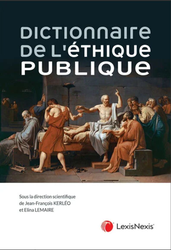
► Full Reference: M.-A. Frison-Roche, "Régulation" (Regulatory Law), in J.-Fr. Kerléo et E. Lemaire (dir.), Dictionnaire de l'éthique publique, LexisNexis, 2025, pp.
____
📗read the general presentation of the Dictionary.
____
📝read the article (in French)
_____
► English Summary of this article defining Regulation: To define Regulation (Regulatory Law), the article begins with its origins, which were a source of misunderstanding, since the term Regulation might refer to simple regulations, thus masking the real branch of Law which is the Law of Regulation. But this confusion with simple and formal regulations has diminished Regulatory Law its importance, its novelty and its originality, and, by placing it within Public Law, equated Regulation on the one hand with the transition from public monopolies to a competitive organisation, and on the other hand privileged the legal study of what fell within the remit of the Administrative Courts, i.e. telecommunications, transport and energy, leaving out the Regulatory Law of banking and financial sector . As a result, the unity and strength of Regulatory Law is still difficult to perceive and manage today, while its relationship with competition and Europe remains difficult.
Regulatory Law is all the more difficult to define because it is still common to oppose, as was the case in the 1980s, "Economic Regulatory Law", which would aim to set economic efficiency objectives within the State, and "Public Liberties Regulatory Law", which would be alternatives to each other, preventing the audiovisual, media and digital sectors in particular from being legally perceived as an industry. We are still paying for this initial conception. All the more so since Regulatory Law is the second pillar on which Europe is built, along with Competition, with which it is linked. It can be identified by the existence of a regulated 'sector', most often through the establishment of a regulatory authority, generally in the form of an Independent Administrative Body. But it is defined by the prevalence of the technical and political goals pursued, which are not spontaneously achieved and which aim to favour the human beings involved in economic organisations.
While the function of Competition Authorities is to maintain the dynamism of competitive markets and to punish behaviour that hinders them without creating that dynamism, Regulatory Law, through its own rules, principles, institutions, procedures and decisions, will create non-spontaneous équilibra and maintain them over time. To do this, it will inject non-spontaneous procedures, such as transparency, or generate obligations and powers because these are necessary for this balance to be achieved. This can take the form of exclusive rights, which can go as far as the creation of monopolies, particularly on transport infrastructures, or the form of pricing and tarification, which can go as far as free access. Access rights are essential, whether technical or political (access to networks, access to healthcare).
The political dimension of Regulatory Law is very much in evidence, as Europe is developing its own form of Regulation compared with the USA or China, demonstrating the link between Regulation and Sovereignty, the criterion? of the technical sector becoming less significant. This is illustrated by the clash over algorithmic systems (AI). In this way, regulation is not a technical reaction to a "market failure", but the manifestation of a zone's political power both internally and externally. The DSA (2022) is an example of this, imposing this same logic extraterritoriality in the digital space through the Digital Services Act (DSA) adopted in 2022.
____
📝read the presentation of the other article written by Marie-Anne Frison-Roche for this Dictionary: "Compliance"
________
May 12, 2025
Thesaurus : Doctrine
► Référence complète : L. Murphy, "Legal Practice et the Responsibility of Individuals", conférence au Collège de France,12 mai 2025.
____
____
► Présentation de la conférence (faite par le Collège de France) : Some legal practices, such as the private law of obligations and property, are justified by the good that general compliance with their rules bring about. It cannot be said, however, that each particular act of compliance by individuals itself contributes to that good outcome. And yet there is clearly an ethical tie between individuals and the rules of the practices. Leaving aside cases where the law simply protects independent moral rights, the same points can be made about compliance with law generally.
This lecture explores the question of how we should understand the ethical tie between individuals and legal practices that are justified in terms of the social good produced by general compliance. An imperfect duty of impartial beneficence will play a central role in the account.
________
May 10, 2025
Thesaurus : Doctrine
► Référence complète : G. Beaumier & L. Gjesvik, "Digital Governance in a Rubber Band: Structural Constraints in Governing a Global Digital Economy", Global Studies Quarterly, vol. 5, issue 2.
____
____
► Résumé de l'article (fait les auteurs) : L’on représente souvent les États-Unis, l’Union européenne et la Chine comme l’incarnation de trois modèles de gouvernance numérique qui s’opposent. Leurs approches « de marché », « démocratique » et « autoritaire » refléteraient leurs préférences respectives s’agissant des acteurs qui devraient contrôler le développement et l’utilisation des technologies numériques. Nous affirmons qu’outre le fait de représenter différentes préférences, chaque modèle se distingue par la façon dont il résout les tensions inhérentes au gouvernement d’une économie numérique dans un contexte mondial. Lors de la création de nouvelles politiques numériques, les juridictions doivent composer avec les tensions pour atteindre trois objectifs: le maintien d’une autonomie réglementaire, la promotion de la compétitivité sur le marché et le soutien d’écosystèmes numériques ouverts et interopérables. Chose remarquable, plus elles s’efforcent d’atteindre au moins l’un de ces objectifs, plus il est difficile de progresser sur les autres, mécanisme qui met en évidence un « effet d’élastique ». Nous utilisons cet argument pour comprendre les changements de politique numérique au cœur de chaque juridiction, soulignant ce faisant qu’elles font montre de plus de dynamisme que l’on ne l’imagine généralement.
____
The United States, the European Union, and China are often portrayed as representing three competing models of digital governance. Their so-called market, democratic, and authoritarian approach supposedly reflects their respective preferences over which actors should control the development and use of digital technologies. We argue that more than representing different preferences, each model differs in how it resolves inherent tensions associated with governing a digital economy in a global context. When devising new digital policies, jurisdictions must navigate tensions between achieving three policy objectives: maintaining regulatory autonomy, promoting market competitiveness, and supporting open and interoperable digital ecosystems. Significantly, the more they push to achieve one or more of these objectives, the harder it becomes to pursue the other(s), reflecting what we call a “rubber band” effect. We use this argument to make sense of changes in the digital policy in each jurisdiction, highlighting in the process their greater dynamism than often assumed.
____
Con frecuencia, se tiende a presentar a Estados Unidos, la Unión Europea y China como representantes de tres modelos de gobernanza digital que compiten entre sí. Sus respectivos enfoques (de mercado, democrático y autoritario) reflejan, supuestamente, sus respectivas preferencias con respecto a qué actores deben controlar el desarrollo y el uso de las tecnologías digitales. Argumentamos que, más que representar preferencias diferentes, cada modelo difiere en la forma en que resuelve las tensiones inherentes asociadas con la gobernanza de una economía digital en un contexto global. A la hora de diseñar nuevas políticas digitales, las jurisdicciones deben sortear las tensiones entre el logro de tres objetivos en materia de políticas: mantener la autonomía regulatoria, promover la competitividad del mercado y apoyar ecosistemas digitales abiertos e interoperables. Resulta significativo que cuanto más se esfuerzan los Gobiernos por lograr uno o más de estos objetivos, más difícil se vuelve perseguir el otro o los otros, lo que se refleja en lo que llamamos un efecto de «banda elástica». Utilizamos esta hipótesis con el fin de dar sentido a los cambios en materia de política digital de cada jurisdicción, destacando, en el proceso, que tienen un mayor dinamismo de lo que muchas veces se supone.
________
🦉Cet article est accessible en texte intégral pour les personnes inscrites aux enseignements de la Professeure Marie-Anne Frison-Roche
________

Sept. 8, 2024
Law by Illustrations

► Référence complète : M.-A. Frison-Roche., "Un martyr au service du Droit et de la Justice, caché sous un titre d'un quelconque thriller : 𝑴𝒆𝒏𝒂𝒄𝒆 𝒂𝒖 𝒔𝒐𝒎𝒎𝒆𝒕", billet septembre 2024.
► voir le film-annonce
___
En 2023, sort un film suédois.
Il est présenté comme un "thriller au suspense insoutenable", ce que son titre français soutient : 𝑴𝒆𝒏𝒂𝒄𝒆 𝒂𝒖 𝒔𝒐𝒎𝒎𝒆𝒕.
Ce n'est pas un thriller. Il n'y a pas une menace au sommet. Et cela n'est pa insoutenable.
C'est l'histoire d'un homme seul.
Pourtant quand il revient 3 jours à sa vie, en Suède, avec ses amis, il est comme vous et moi : il déjeune dans un jardin, respire l'air frais, voudrait bien acheter une jolie petite maison, demande des nouvelles de la famille.
Mais quand il remplit son office, il est seul.
Il a tout pour être absolument seul.
Nous sommes au début des années 60.
Il vit à New-York et travaille toute la journée. Lorsqu'on est le Secrétaire Général de l'ONU l'on a peu de temps pour aller dans des dîners, pour se promener avec un chien dans Central Park. Un chien, des enfants, une femme, il n'en a pas. Il a un petit singe, qu'il a ramené de Somalie, sans doute un des nombreux pays où il a été pour aider, aider, aider. Peut-être avec succès ou pas. Peut-être de la bonne façon ou pas. Cela n'est pas dit, ce que l'on voit, c'est son petit singe qui est sur son épaule, qui s'asseoit sur sa feuille où il peut enfin s'exprimer dans sa langue natale, qui court sur son table où il dine seul, toujours seul.
Il est toujours habillé pareil.
Chaque matin, il met une chemise blanche identique à celle de la veille. Chaque matin, il lace ses chaussures.
Car chaque matin, il va à son bureau pour que lui tombe dessus les catastrophes, les urgences, les drames, les situations insolubles.
A chaque fois, il essaie de trouver la moins pire des solutions, de trouver les moins pires des interlocuteurs. Et il rentre chez lui.
Pourquoi faire cela ?
Il écrit en suédois, avec son petit singe sur son épaule que dans sa solitude, qui n'est pas un drame, qui est son état, il faut trouver ce pourquoi il faut se sacrifier.
Il a déjà consacré toutes les années précédentes à accompagner la décolonisation ; il croit au droit des peuples à disposer d'eux-mêmes. Il fait tout ce qu'il peut pour que la décolonisation se passe le moins mal possible en Afrique à l'égard des pays européens et maintenant que les pays ne soient pas tenus par les Etats-Unis et l'Union Soviétique.
il ne fait que travailler.
Hegel appellerait cela un fonctionnaire, mais l'on nous dit que ce film n'est pas un cours de philosophie politique, puisque c'est un "thriller au suspense insoutenable".
Un jour, un coup d'Etat arrive dans un de ces pays d'Afrique.
Le Premier Ministre de ce pays vient le voir pour le dire, que le pays va être dépecé car une province aux ressources minières convoitée qui doit être détachée pour être mieux tenue par ceux d'avant, que lui-même est en danger, qu'il faut qu'il fasse quelque chose.
Il répond qu'il lui faut un peu de temps.
Le Premier Ministre revient dans son pays. Il est immédiatement assassiné.
Des massacres débutent.
Une guerre civile menace.
La province dans laquelle sont ces ressources minières considérables notamment pour la fabrication de la bombe atomique, déclare sa secession. Des industriels étrangers se réunissent. Des réunions se tiennent dans le pays avec le nouveau président avec des représentants des divers intérêts.
Le Secrétaire Général dit : nous allons envoyer des casques bleus et ensuite nous réunirons le Conseil de Sécurité.
En cela, il se condamne.
Il est critiqué de tous les côtés.
Le Conseil de sécurité se réunit.
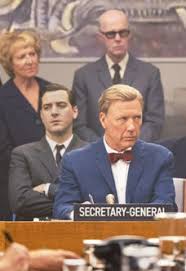
Lors de la réunion de celui-ci, l'URSS demande sa démission immédiate car en envoyant les casques bleus dans ce qui est en réalité une opération militaire il a excédé ses pouvoirs et il a pris parti.
Il répond qu'il a été mandaté pour que l'ONU accompagne la décolonisation et que les pays concernés soient en paix, que la paix est la mission de l'ONU, que la paix implique que les pays décolonisés ne soient pas soumis à la puissance de l'un ou l'autre des deux blocs qui sont à la manœuvre en alliance avec les industries impliquées.
En disant cela, il se condamne une deuxième fois.
Il revient dans son bureau où il apprend que son compagnon le petit singe s'est libéré de sa petite cage capitonnée de velours rouge où il demeure quand il attend son retour , a grimpé dans l'escalier, s'est étranglé par la fine laisse qui lui entourait le cou et qu'il est mort. Leur sort est parallèle, ce n'est qu'une anticipation. Il répond qu'il veut qu'on ôte son cadavre pour qu'il n'ait pas à voir son cadavre en rentrant (il n'est pas masochiste, juste dévoué à ce qu'il pense être juste).
Dans le pays les massacres continuent. Il décide d'aller lui-même rencontrer le président qui avait dans un premier temps accepté sa proposition de réunifier le pays puis a tout rejeté en bloc.
Il se condamne donc une troisième fois.
Il n'y a aucun suspense dans ce film.
Dans l'avion, son lacet de chaussure se casse. Il n'en a pris de rechange. Mais son collaborateur lui passe le sien.
Malgré toutes les précautions prises pour que son avion ne soit pas repéré, l'avion a un accident en plein vol. Il n'y a pas de survivant.
La Suède se met en silence pour lui rendre hommage : le film s'achève sur les images d'archives d'un peuple recueilli.
Plus tard à titre posthume il recevra le prix Nobel de la Paix.
____
Voilà la vie d'un homme droit ;
Appliquer le Droit, comme on peut, le moins mal possible donc.
Se faire menacer, injurier, sanctionner.
Etre inconnu du grand public
Exercer son pouvoir en se basant sur ce pour quoi il a été donné
Essayer de ne donner prise à personne, ni dans son habillement, ni dans son comportement (il aimerait se rapprocher de son ami qu'il aime depuis toujours, mais il ne le veut pas pour ne pas donner prise).
Travailler jusqu'à l'épuisement (il dort sur le canapé de son bureau, prend une douche pour partir au Conseil de sécurité)
Dire la vérité.
N'avoir de reconnaissance et de prix qu'une fois mort.
C'est un documentaire sur Dag Hammarskjöld, ce qu'est l'intégrité et l'amour du Droit (ici le Droit international public) en ce qu'il sert la Justice.
J'aurais volontiers appelé ce film : Le martyr , mais je ne sais pas faire de "thriller au suspense insoutenable".
Le titre suédois du film est simplement le nom de cette personne : 𝑯𝒂𝒎𝒎𝒂𝒓𝒔𝒌𝒋ö𝒍𝒅,
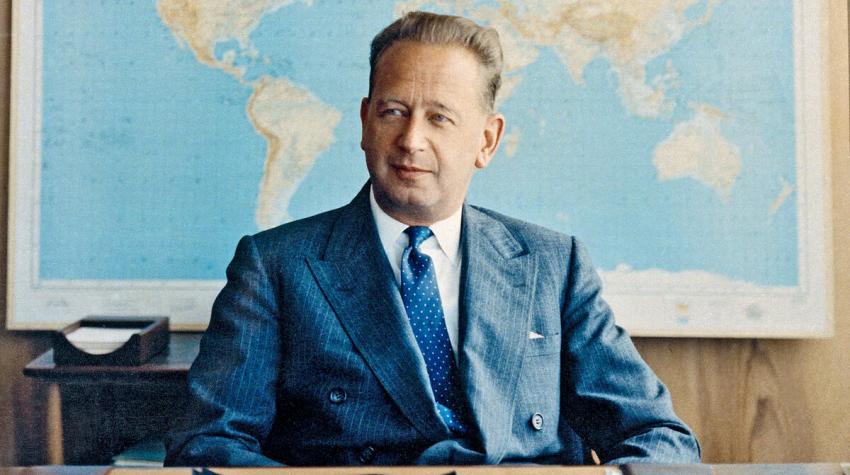

Dag Hammarskjöld,
____
June 19, 2024
Thesaurus : Soft Law
► Référence complète : Commission d'enquête du Sénat, Les moyens mobilisés et mobilisables par l’État pour assurer la prise en compte et le respect par le groupe TotalEnergies des obligations climatiques et des orientations de la politique étrangère de la France, juin 2024, 350 p.
____
📓lire les comptes rendus des auditions
____
________
June 5, 2024
Thesaurus : Doctrine
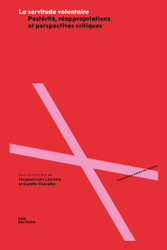
► Référence complète : J.-L. Lantoine et C. Chevalier, La servitude volontaire. Postérité, réappropriation et perspectives critiques , ENS Editions, 2024, 242 p.
____
Lire une présentation de l'ouvrage
____
► Résumé de l'ouvrage : (fait par les auteurs) : La « servitude volontaire » est une formule mobilisée tant dans le champ universitaire que dans le champ intellectuel ou journalistique. Ses usages, parfois référés au Discours de la servitude volontaire de La Boétie et, plus rarement, appuyés sur une lecture précise de ce texte, prétendent situer la source de la domination dans le libre consentement de ceux qui la subissent. Mais cette formule au caractère oxymorique, presque provocateur, occulte le plus souvent les véritables causes de cette apparente volonté de servir. Les explications de ce phénomène, telles que le désir, la coutume, la soumission consentie, la domination symbolique, l’obsequium ou la jouissance dans la servitude, doivent permettre de comprendre ce qui apparaît sinon comme une monstruosité et une énigme. L’étude du monde du travail montre notamment que les analyses en termes de servitude volontaire ne sont pas les plus adéquates. Enfin, si une telle formule peut susciter une prise de conscience, elle ne fournit pas pour autant la clé de l’émancipation.
Aug. 3, 2023
Publications
♾️follow Marie-Anne Frison-Roche on LinkedIn
♾️subscribe to the Newsletter MAFR Regulation, Compliance, Law
____
► Full Reference: M.-A. Frison-Roche, "La vigilance, pièce d'un puzzle européen" ("Vigilance, a piece of the European puzzle"), in I.Grossi (ed.), La société vigilante, JCP E, No. 31-35, 3 août 2023, pp.57-58.
____
📙this article is the conclusion of this special issue.
It is linked to the introductory article of this special issue: 📝Penser et manier la vigilance par ses buts monumentaux de compliance (Thinking and using Vigilance through its Compliance Monumental Goals)
____
🧮the 2 articles follow on from the introductory and concluding speeches in the colloquium La Société vigilante, held at the University of Aix Marseille on 24 March 2023
____
🚧read the bilingual Working Paper which is the basis of this article, with additional developments, technical references and hyperlinks
____
► Summary of the article: The contributions form a contrasted whole. It should not be concluded that some of them are correct and others false: through the reading that each one makes of the so-called French 2017 "Vigilance law," it is a vision of the world as it should be that each author proposes. Because Compliance Law, which Vigilance is a part, claims to draw the future, it is normal that each author should draw the present Law with a hand that bends in one direction or the other, following their conception of the future world. The whole contributions must be seen as a dialogue.
A lively dialogue, with this French 2017 law receiving a lot of "glory" and a lot of "indignity" on both sides, from which it is necessary to emerge in order to find solutions, because it is a fundamental movement of which this law is only a gateway (I). Whatever one thinks of it, it is all the branches of law that are used, affected, and transformed by Vigilance (II). To master this profound transformation, we must turn to Europe, to the great puzzle of texts recently adopted or in the process of being adopted in the European Union, of which Vigilance is the hallmark (III).
____
📝read the article (in French)
________
June 6, 2023
Thesaurus : Doctrine
► Référence complète : F. Daucé, B. Loveluck et F. Musiani. Genèse d’un autoritarisme numérique Répression et résistance sur Internet en Russie, 2012-2022, Presses des Mines, 2023.
________
Feb. 16, 2023
Thesaurus : Doctrine
► Référence complète : J. Habermas, Espace public et démocratie délibérative : un tournant, Gallimard, 2023, 144 p.
____
Lire la présentation de l'ouvrage par Jean-Pierre Gabrielli pour Non-Fiction.
Lire la présentation de Marc Lebiez pour EAN
____
📧Lire l'article écrit à partir de cet ouvrage dans la Newsletter MAFR Law, Compliance, Regulation ; 🔴𝑳'𝒆𝒔𝒑𝒂𝒄𝒆 𝒑𝒖𝒃𝒍𝒊𝒄 𝒅é𝒍𝒊𝒃é𝒓𝒂𝒕𝒊𝒇, 𝒎é𝒕𝒉𝒐𝒅𝒆 𝒎𝒐𝒅è𝒍𝒆 𝒑𝒐𝒖𝒓 𝒍𝒂 𝒎𝒊𝒔𝒆 𝒆𝒏 œ𝒖𝒗𝒓𝒆 𝒅𝒖 𝒅𝒆𝒗𝒐𝒊𝒓 𝒅𝒆 𝒗𝒊𝒈𝒊𝒍𝒂𝒏𝒄𝒆, 6 avril 2023.
________
March 26, 2021
Thesaurus : Soft Law
Référence complète : Haut Commissariat au Plan : Electricité : le devoir de lucidité , note du 26 mars 2021.
March 23, 2021
Thesaurus : Soft Law

Full reference: Bayrou, F., Electricité: le devoir de lucidité (Electricity: the duty of lucidity), note n°4 from the Haut-Commissariat au Plan (French government planification agency), 23rd of March 2021, 37 p.
Read the note (in French)
Read the summary of the note done by the Haut-Commissariat au Plan on is official website (in French)
Sept. 16, 2020
Publications

🌐follow Marie-Anne Frison-Roche on LinkedIn
🌐subscribe to the Newsletter MAFR Regulation, Compliance, Law
____
Full reference: M.-A. Frison-Roche, Se tenir bien dans l'espace numérique, in Penser le droit de la pensée. Mélanges en l'honneur de Michel Vivant, Lexis Nexis and Dalloz, 2020, pp. 155-168.
____
📝Read the article (in French)
____
English summary of the article: The digital space is one of the scarce spaces not framed by a specific branch of Law, Freedom also offering opportunity to its actors to not "behave well", that is to express and diffuse broadly and immediately hateful thoughts through Hate speechs, which remained before in private or limited circles. The intimacy of Law and of the legal notion of Person is broken: Digital permits to individuals or organizations to act as demultiplied and anonymous characters, digital depersonalized actors who carry behaviors that are hurtful to other's dignity.
Against that, Compliance Law offers an appropriate solution: internalizing in digital crucial operators the mission to disciplinary and substantially hold the digital space. The digital space has been structured by powerful firms able to maintain order. Because Law must not reduce digital space to be only a neutral market of digital prestations, these crucial operators, like social networks or search engines, must be forced to substantially control behaviors. It could be about an obligation of internet users to act with their face uncover, "real identity" policy controlled by firms, and to respect others' rights, privacy rights, dignity, intellectual property rights. In their Regulatory function, digital crucial firms must be supervised by public authorities.
Thus, Compliance law substantially defined is the protector of the person as "subject of law" in the digital space, by the respect that others must have, this space passing from the status of free space to the one of civilized space, in which everyone is obliged to behave well.
______
Read to go further:
- Frison-Roche, M.-A., L'apport du Droit de la Compliance à la gouvernance d'Internet, 2019
- Frison-Roche, M.-A. (dir.), Internet, un espace d'interrégulation, 2016
Feb. 13, 2019
Thesaurus : Doctrine

Référence générale : Patrick Wajsman (dir.), Politique internationale, dossier spécial, Investissement responsable : l'essor, n°162, hiver 2018-2019, 119 p.
Consulter le sommaire de la Revue.
Consulter la présentation des entretiens suivants :
Boujnah, S., Places boursières : promouvoir un modèle européen.
Jensen, S., Norvège : exemple d'un fonds souverain éthique.
Ribera, T., Faciliter la transition écologique : ce que peut l'État.

Dec. 5, 2018
Thesaurus : Doctrine
► Full Reference: L. Idot, "Brefs regards sur 60 ans de politique européenne de concurrence", Rev. UE, 2018, pp. 639-649
____
► English Summary of the article (made by the author) : "Among the most effective European policies, although often misunderstood, the competition policy is the subject of the same debates as the European construction itself. The deepening of the latter gives rise to permanent confrontation between the quest for efficiency and the quest for legitimacy. At the same time, this policy has spread widely first in the European Union, particularly as a result of modernization, but also beyond the borders of the Union. Sixty years later, the existence of a model that contributes significantly to the spread of a European competition culture is undeniable.".
____
🦉This article is available in full text to those registered for Professor Marie-Anne Frison-Roche's courses
________

Nov. 27, 2018
Publications
► Full Reference : Frison-Roche, M.-A., Droit de la concurrence et droit de la compliance ("Competition Law and Compliance Law), November 2018, in Revue Concurrences n° 4-2018, Art. n° 88053, pp. 1-4.
_____
► Summary: Compliance Law is a new branch of Law, still under construction. One can have a “narrow definition” of seeing it as the obligation of businesses to show that they are constantly and actively complying with the law. One can have a richer definition, of a substantive nature, defining it as the obligation or the own will of certain companies to achieve “monumental goals” that go beyond economic and financial performance. Competition Law partly integrates its two conceptions of Compliance: Precursor, Competition Law concretizes dynamically the first conception of Compliance Law. It is with more difficulties but also much more future that Competition Law can express in dialectic the second conception of Compliance Law as internationalization of these “monumental goals”, especially in the digital space.
____
📝 read the article (in French)
____
________
Feb. 28, 2018
Thesaurus : Doctrine
► Référence complète : A. Supiot, "De la citoyenneté économique", Entretien réalisé par Thibault Le Texier, in Démocratiser l'entreprise, Esprit n° 442, 2018.
____
____
Les étudiants de Marie-Anne Frison-Roche peuvent consulter l'article en texte intégral.
Feb. 22, 2018
Thesaurus : Doctrine
Référence complète : Malaurie-Vignal, M., Concurrence - Efficacité économique v/ politique de concurrence ? Réflexions à partir du marché du numérique, Contrats Concurrence Consommation n° 2, février 2018, repère 2.
L'article peut être lu par les étudiants de Sciences po via le Drive dans le dossier "MAFR - Régulation & Compliance"
Nov. 14, 2017
Thesaurus : Doctrine
Référence complète : Stirn, B., Les libertés en questions, coll."Clefs", LGDJ-Lextenso, 10ème édition, 2017, 312 p.
Lire la quatrième de couverture.
Consulter la table des matières.

May 20, 2017
Blog

Aucun film ne reprend mieux la description que Sade fait dans son œuvre, et plus particulièrement dans Justine ou les infortunes de la vertu , du rapport désespéré entretenu par ceux qui expriment et appliquent la Loi ont avec celle-ci.

Ce film d'Elio Petri, réalisé en 1969, sorti en 1970, qui reçut le prix spécial du Jury au Festival de Cannes, a retenu l'attention de tous, notamment pour sa dimension dramatique, esthétique et politique
Si on le prend davantage du côté du Droit, on observera que le titulaire de l'expression du Droit, celui qui doit concrétiser le Droit dans la société, ici le "chef" de la police, exprime ce qu'est pour lui la règle.
On se souvient que Carbonnier pose qu'à chacun d'entre nous le Droit d'une façon première et immédiate apparaît sous la forme d'un képi du gendarme. A cette formulation sociologique bienveillante correspond ainsi la forme terrifiante d'un commissaire, grand chef qui tue et punit, sans jamais porter d'uniforme.
Lorsqu'il veut être puni du crime qu'il a commis parce que la femme a dit la vérité, à savoir le caractère enfantin de la règle qui le gouverne et donc du caractère infantile de sa propre stature, sa mise en scène s'écroule, lui qui ultérieurement se déguisera en metteur en scène.
François Ost a consacré un ouvrage à la conception sadienne de la Loi. On la retrouve ici, car le personnage principale des fables de Sade, c'est la Loi et son auteur, Dieu. Si les titulaires de la loi, à savoir les juges, les évèques, les parlementaires, qui sont légions dans l'oeuvre de Sade, ceux qui l'expriment, ne peuvent que torturer l'innocent, comme le fait le personnage dans le film d'Elio Petri de la femme et du jeune homme, afin qu'ils avouent leur innocence, qu'ils la dégorgent, qu'ils n'aient pas à reconnaître que la Loi est vide, c'est-à-dire que ce Dieu dont ils appliquent la norme n'existe pas.
La provocation de ce Dieu, afin de le voir surgir, la provocation de la Loi afin de la voir apparaître, les héros sadiens l'opèrent en s'exténuant de torture en torture, de meurtre en meurtre. Dans le film d'Elio Petri, la méthode est plus juridique et revêt la même dimension probatoire : il organise la démonstration de sa culpabilité, afin de donner consistance à la Loi pénale dont il assure l'effectivité par la répression, pour que cette répression ne soit pas vide, pour que sa vie ait un sens.
Mais, comme dans Sade, cela n'adviendra pas.
Oui, il n'y a pas eu de meilleure adaptation au cinéma de Sade que par ce film-là.
Pour une analyse faite dans le festival du film d'Enghien, présentant ce film comme le "film le plus emblématique" des films politiques italiens des années de plond.

Updated: Feb. 6, 2017 (Initial publication: Jan. 5, 2015)
Publications

Bank and
If we plunge into this melting pot of incomprehension that engenders the violent clash between the banks, which evoke their mission, even their duty, and the
The more
It is therefore necessary to start from the undisputed existence of banking markets and the competitive mechanism which the law correlates with (I)). But the scale of the resistance reveals that it seems to have intentionally or not to have passed on the elementary and the essential: the very definition of what is a bank II. If it is accepted that the bank is the operator of the banking system, which fuels the economy as a whole, then