Food for thoughts

Feb. 3, 2023
Teachings

♾️ follow Marie-Anne Frison-Roche on LinkedIn
♾️subscribe to the Newsletter MAFR Regulation, Compliance, Law
____
► Full Reference: Ancel, F. & Frison-Roche, M.A., Droit de la compliance ("Compliance Law", French National School for the Judiciary (Ecole nationale de la magistrature - ENM),
This teaching is given in French.
_____
► Presentation of the Teaching: The two-day session is designed for magistrates and practicing lawyers who are not necessarily specialized, to enable them, based on concrete cases, to understand the issues, objectives, and methods of compliance mechanisms in companies, including the increasing judicialization and the supranational dimension strengthen, modifying the office of the judge and the role of lawyers.
The analysis is made from the angle of Civil Law (contract, tort), Company Law, Labor Law and Criminal Law, but also governance, financial markets, regulatory, climate and digital issues.
____
► Organisation of the Teaching: this teaching is open to all judicial members and lawyers. Enrollments are made at the French National School for the Judiciary.
________

Updated: Feb. 2, 2023 (Initial publication: June 23, 2021)
Thesaurus : Doctrine
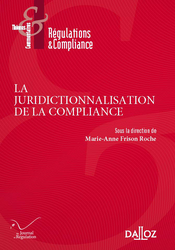
► Full Reference: J. Heymann, "La nature juridique de la "Cour suprême" de Facebook" ("The legal nature of Facebook's "Supreme court""), in M.-A. Frison-Roche (ed.), La juridictionnalisation de la Compliance, coll. "Régulations & Compliance", Journal of Regulation & Compliance (JoRC) and Dalloz, 2023, p. 151-167.
____
📕read a general presentation of the book, La juridictionnalisation de la Compliance, in which this article is published
____
► The summary below describes an article following the colloquium L'entreprise instituée Juge et Procureur d'elle-même par le Droit de la Compliance , co-organized by the Journal of Regulation & Compliance (JoRC) and the Faculté de Droit Lyon 3. This manifestation was designed under the scientific direction of Marie-Anne Frison-Roche and Jean-Christophe Roda and took place in Lyon on June 23, 2021.
In the book, the article will be published in Title I, devoted to: The Entreprise instituted Judge and Prosecutor of itself by Compliance Law.
____
► Summary of the article (done by the author): Taking place in the general theme aiming at making “words and things coincide”, the article offers some thoughts on the “conditions of the discourse” – in the sense in which Foucault understood it in his Archéologie des sciences humaines – relating to the phenomenon of “jurisdictionalization” of Compliance.
The thoughts are more specifically focusing on the nature of the so-called “Supreme Court” that Facebook instituted to hear appeals of decisions relating to content on the digital social networks that are Facebook and Instagram. Is this really a “Supreme Court”, designed in order to “judge” the Facebook Group?
A careful examination of the Oversight Board – i.e. the so-called “Supreme Court” created by Facebook – reveals that the latter, in addition to its advisory mission (which consists of issuing policy advisory opinions on Facebook’s content policies), exercises some form of adjudicative function. This is essentially conceived in terms of compliance assessment, of the content published on the social networks Facebook or Instagram with the standards issued by these corporations on the one hand, of content enforcement decisions taken by Facebook with the Law on the other hand. The legal framework of reference is yet rather vague, although its substantial content seems to be per se evolutive, based on the geographical realm where the case to be reviewed is located. An adjudicative function can therefore be characterized, even if the Oversight Board can only claim for a limited one.
The author can ultimately identify the Oversight Board as a preventive dispute settlement body, in the sense that it seems to aim at avoiding any referral to state courts and ruling before any court’s judgement can be delivered. Some questions are thus to be raised, relating with both legitimacy and authority of such a Board. But whatever the answers will be, the fact remains that the creation of the Oversight Board by a private law company already reveals all the liveliness of contemporary legal pluralism.
________

Feb. 2, 2023
Conferences

♾️ follow Marie-Anne Frison-Roche on LinkedIn
♾️subscribe to the Newsletter MAFR Regulation, Compliance, Law
____
► Full Reference : M.-A. Frison-Roche, "Droit de la compliance : Tour d'horizon" ("Compliance Law: Overview"), in Droit de la compliance (Compliance Law), French National School for the Judiciary (Ecole nationale de la magistrature - ENM), Paris, 2 February 2023.
This conference is given in French.
____
🧮See the full programme of this event
____
► Presentation of the conference:
Compliance Law is mysterious in itself, because it is still in creation, because its presence and power are felt, but it is difficult to grasp it. It is necessary, however, because it deals with the most important, even the most dramatic, facts and carries with it the greatest ambitions. Magistrates must also "make the effort" to participate in the "adventure of Compliance Law", because it affects, and even overturns, all subjects, and because the Prosecutor and the Judge play an increasing role in it.
Because the purpose of this conference is to introduce the two days of a training course designed for magistrates and open to lawyers, it only provides an "overview" of, so that we do not get lost in the sprawling regulations, the global mechanisms and the political ambitions that permeate them.
This is why, without going into any of the subjects, it is about opening up four ways of entering what is a branch of Law that is being born before our eyes:
1. Understanding Compliance Law through "regulations"
2. Understanding Compliance Law through "tools"
3. Understanding Compliance Law through "methods"
4. Understanding Compliance Law through "goals"
The four approches are legitimate because the four dimensions are articulated in positive Law.
But the more positive Law is consolidated, the more its normativity through the goals that give normativity, or even a simplicity without which the whole is not humanly controllable.
These Goals are monumental and Europe bears them more and better than other areas of the world.
____
🚧See the slides used as a support of the presentation (in French)
________

Feb. 2, 2023
Publications
🌐 follow Marie-Anne Frison-Roche sur LinkedIn
🌐 subscribe to the Newsletter MAFR Regulation, Compliance, Law
____
► Full Reference: M.-A. Frison-Roche, "Le jugeant-jugé. Articuler les mots et les choses face à l'éprouvant conflit d'intérêts" ("The Judge-Judged. Articulating words and things in the face of the testing conflict of interest"), in M.-A. Frison-Roche, (ed.), La juridictionnalisation de la Compliance, coll. "Régulations & Compliance", Journal of Regulation & Compliance (JoRC) and Dalloz, 2023, p. 59-80.
____
📝read the article (in French)
____
🚧read the bilingual Working Paper which is the basis of this article, with additional developments, technical references and hyperlinks
____
📕read a general presentation of the book, La juridictionnalisation de la Compliance, in which this article is published
____
► Summary of the article (done by the Journal of Regulation & Compliance): Since the topic of this article is part of a chapter devoted to the Company established as Prosecutor and Judge of itself by Compliance Law, chapter aiming to use the relevant qualifications, it is appropriate therefore to worry about the adjustment of words and things, of the way in which the relationship between ones and the others evolve, and of the more particular question of knowing if this evolution is radical or not when one speaks of "judge ".
because "judging" is a word that the Law has disputed with other disciplines, but that it has appropriated not so much to confer more powers on those who act in its name, for example that who supervise and punish, but on the contrary to impose limits, since to the one who judges it has put the chains of the procedure under foot, thus making bearable for the other the exercise of such a power. Therefore, those who want the power to judge would often want to not have the title, because having de jure the title of judge is being subject to the correlated regime, it is to be submitted to procedural correctness.
It is therefore to better limit that the Law sees who judges, for obliging this so-powerful character to the procedure. But the Law also has the power to appoint a judge and to fix the contours of all the characters in the trial. He usually does it with clarity, distinguishing the ones of the others, not confusing them. This art of distinction has constitutional value. Thus, not only the one who judges must be named "judge" but the procedural apparatus which goes with this character, and which constitutes a way of doing things and fundamental rights, are not "granted" by kindness or in a second step: it is a block. If you didn't want to have to endure procedural rights, you didn't have to want to be a judge. Admittedly, one could conclude that the procedure would therefore have become "substantial"; by this elevation, it is rather a fashion of saying that the procedure would no longer be a "servant": it is a kind of declaration of love for the procedure, as long as one affirms that at the acts of judging , or investigating, or prosecuting, are "naturally" attached the procedural rights for the one who is likely to be the object of these powers.
Compliance Law, in search of allies to achieve the Monumental Goals for the aims of which it was instituted, will require, or even demand, private companies to go and seek themselves, in particular through investigations. internal or active vigilance on others, for finding facts likely to be reproached to them. Compliance Law will also require that they prosecute those who have committed these acts. Compliance La will again demand that they sanction the acts that people have committed in their name.
This is clearly understood from the point of view of Ex Ante efficiency. The confusion of roles is often very efficient since it is synonymous with the accumulation of powers. For example, it is more efficient that the one who pursues is also the one who instructs and judges, since he knows the case so well... Besides, it is more efficient that he also elaborates the rules, so he knows better than anyone the "spirit" of the texts. This was often emphasized in Regulatory Law. When everything is Information and risk management, that would be necessary ... But all this is not obvious.
For two reasons, one external and the other internal.
Externally, the first reason is that it is not appropriate to "name" a judge who is not. This would be too easy, because it would then be enough to designate anyone, or even to do it oneself to appropriate the regime that goes with it, in particular for obtain a so-called legitimate power for obtaining that others obey even though they are not subordinate or from them they transmit information, even though they would be competitors: it would then be necessary to remember that only the Law is able to appoint judge ; in this new Compliance era, companies would be judges, prosecutors, investigators! Maybe, if the Law says it, but if it didn't, it would be necessary to come back to this tautology ... But are we in such a radicalism? Moreover, do judges have "the prerogative" of judgment and the Law has not admitted this power for companies to judge for a long time? As soon as the procedure is there in Ex Ante and the control of the judge in Ex Post?
The second reason, internal to the company, situation on which the article focuses, is that the company investigates itself, judges itself, sanctions itself. However, the legal person expressing its will only through its organs, we underline in practice the difficulties for the same human being to formulate grievances, as he/she is the agent of the legal person, addressed to the natural person that he/she himself/herself is. The two interests of the two are not the same, are often opposed; how the secrets of one can be kept with respect to the other, represented by the same individual? ... It is all the mystery, even the artifice of legal personality that appears and we understand better that Compliance Law no longer wants to use this strange classical notion. Because all the rules of procedure cannot mask that to prosecute oneself does not make more sense than to contract with oneself. This conflict of interest is impossible to resolve because naming the same individual X then naming him/her Y, by declaring open the dispute between them does not make sense.
This dualism, which is impossible to admit when it comes to playing these functions with regard to corporate officers, can come back to life by setting up third parties who will carry secrets and oppositions. For example, by the designation of two separate lawyers for the human being agent and the human being representative of the legal person, each lawyer being able to have secrets for each other and to oppose each other. These spaces of reconstitution of the so "natural" oppositions in procedure between the one who judges and the one who is judged can also take the technological form of platforms: where there is no longer anyone, where the process has replaced the procedure, there is no longer any human judgment. We can thus see that the fear of conflicts of interest is so strong that we resign ourselves to saying that only the machine would be "impartial", a derisory conception of impartiality, against which it is advisable to fight.
This then leads to a final question: can the company claim to exercise the jurisdictional power to prosecute and judge and investigate without even claiming to be a prosecutor, an investigating judge, or a court? The company's advantage would be to be able to escape the legal regime that classical Law attaches to its words, mainly the rights of the defense and the rights of action for others, the principle of publicity of justice for everyone, which expresses the link between procedure and democracy. When Facebook said on June 12, 2021 "react" to the decision of May 5, 2021, adopted by what would only be an Oversight Board to decide "as a consequence" of a 2-year suspension of Donald Trump's account, the art of qualifications seem to be used in order to avoid any regime constraint.
But this art of euphemism is very old. Thus, the States, when they wanted to increase repression, presented the transformation of the system as a softening of it through the "decriminalization" of Economic Law, transferred from the criminal courts to the independent administrative agencies. The efficiency was greatly increased, since the guarantees of the Criminal Procedure ceased to apply. But 20 years later, Words found their way back to Things: under Criminal Law, slept the "criminal matter", which requires the same "Impartiality". In 1996, a judge once affirmed it and everything was changed. Let us therefore wait for what the Courts will say, since they are the masters of qualifications, as Article 12 of the French Code of Civil Procedure says, as Motulsky wrote it in 1972. Law has time.
________
Updated: Feb. 2, 2023 (Initial publication: March 31, 2021)
Thesaurus : Doctrine
► Full Reference: M. Audit, "La position de l'arbitre en matière de compliance" ("The position of the arbitrator in matters of compliance"), in M.-A. Frison-Roche (ed.), La juridictionnalisation de la Compliance, coll. "Régulations & Compliance", Journal of Regulation & Compliance (JoRC) and Dalloz, 2023, p. 303-315.
____
📕read a general presentation of the book, La juridictionnalisation de la Compliance, in which this article is published
____
► The summary below describes an article that follows an intervention in the scientific manifestation Compliance et Arbitrage, co-organised by the Journal of Regulation & Compliance (JoRC) and the University Panthéon-Assas (Paris II). This conference was designed by Marie-Anne Frison-Roche and Jean-Baptiste Racine, scientific co-directors, and took place in Paris II University on March 31, 2021.
In the book, the article will be published in its Title III, devoted to: Compliance et Arbitrage.
____
► Summary of the article (done by the Journal of Regulation & Compliance): For the arbitrator to intervene in matters of Compliance, a "Compliance Obligation" must exist. The identification of this specific obligation is tricky because it cannot generally be identified per se, if it is grasped only through Criminal Law, which does not enter directly into the field of Arbitration, which has developed an autonomous conception of the facts, in particular facts of corruption, which are also criminally reproachable. But because the obligation of compliance is itself autonomous, since it is a question of detecting and preventing various offenses and breaches, the arbitrators rely on the detection and prevention mechanisms as such, distinct from the possible behaviors that the Law wants they don't happen.
But the question of the source of this compliance obligation is central because it must arise from a standard that can lead to Arbitration. This is the case of the contract, for example an intermediary contract which not only prohibits any corrupt practice but also provides for audit or control, or even the case of national laws, in particular the UK Bribery Act or the so-called French "Sapin 2" law, or even decisions imposing compliance programs or the unconstrained adoption of these by the company. According to its source, the arbitrator will take the Compliance obligation into account.
If a Compliance obligation, having a source giving its significance in an Arbitration proceeding, is considered by the arbitrator to be breached, the consequences often depend on this source. The solution is classic if it is the lex contractus, more difficult if it is a Law which has inserted this obligation in the lex societatis, the requirements of compliance being generally considered as mandatory laws. If the arbitrators cannot apply the sanctions attached by the repressive law, they can support their decision in consideration of the breach found to assess the legality of a behavior or the validity of a contract, the ICC Rules for combating corruption being able to serve them as an analysis guide.
________
Feb. 2, 2023
Thesaurus : Doctrine
► Full Reference: A. Bruneau, "L'entreprise juge d'elle-même : la fonction compliance dans la banque" ("The company judge of itself: the compliance function inside the bank"), in M.-A. Frison-Roche (ed.), La juridictionnalisation de la Compliance, coll. "Régulations & Compliance", Journal of Regulation & Compliance (JoRC) and Dalloz, 2023, p. 115-131.
____
📕read a general presentation of the book, La juridictionnalisation de la Compliance, in which this article is published
____
► Summary of the article (done by the author): First of all, it should be remembered that the compliance function was born within finance, and that by being structured, it has evolved to support the transition from regulatory law to compliance law. Through these changes, compliance has gone from an ex-post controlling function to an ex-ante binding function. The LIBOR crisis imperfectly illustrates the primacy of this transition. The evolution of this role is illustrated by concrete examples
Firstly, the management of reputational risk is a fundamental part of the company as prosecutor and judge of itself. Reputational risk is a significant element for a financial institution, because it can have negative consequences on its capitalization, or even culminate in a systemic crisis. Avoiding a large-scale financial crisis is also part of the monumental goals of compliance.
In order to avoid complex and inopportune scenarios, compliance law intervenes as early as possible and identifies issues that may impact reputation. The regulations require the implementation of certain ex ante mechanisms. The French law known as "Sapin 2" requires the implementation of tools that concern all companies (and not just banks). Indeed, beyond the risk of reputation, it is essential to consider the risk of corruption. Consideration of reputational risk may justify refusing to execute certain transactions. From this perspective, compliance must assess the potential consequences of entering into a relationship with a new client upstream, sometimes to decline the provision of services. The compliance function therefore unilaterally judges the relationship with a view to managing the company reputational risk.
Secondly, the internal sanction mechanism established by compliance law is also discussed in this article, in particular the internal sanctions adopted by compliance in a financial institution.
Compliance can act as a prosecutor via management committees set up within the business lines. In addition, compliance can determine and apply sanctions against employees. In this way, there is a dual role of prosecutor and judge for the compliance function within the framework of an extraordinary mechanism of ordinary law.
Finally, the analysis deals with the case of the "judge-judged": following a decision by the bank, the regulator may take an even stricter position by believing that the bank is applying its guidelines incorrectly. Thus, the compliance law, which takes hold within the banking enterprise, finds itself under the judgment of its own regulator. The company finds itself judged and comes to be a prosecutor and judge of itself, but also of its clients.
__________

Feb. 2, 2023
Publications
🌐 follow Marie-Anne Frison-Roche on LinkedIn
🌐 subscribe to the Newsletter MAFR Regulation, Compliance, Law
____
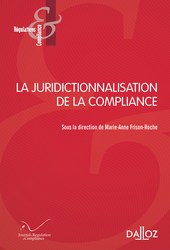
► Full Reference: M.-A. Frison-Roche (ed.), La juridictionnalisation de la Compliance, série "Régulations & Compliance", Journal of Regulation & Compliance (JoRC) and Dalloz, 2023, 490 p.
____
► Presentation of this book: Sanctions, controls, appeals, deals: judges and lawyers are everywhere in the Compliance mechanisms, creating unprecedented situations, sometimes without a solution yet available. Even though Compliance was designed to avoid the judge and produce security by avoiding conflict. This jurisdictionalisation is therefore new. Forcing companies to prosecute and judge, a constrained role, perhaps against their nature. Leading to the adaptation of major procedural principles, with difficulty. Confronting arbitration with new perspectives. Putting the judge at heart, in mechanisms designed so that he is not there. How in practice to organize these opposites and anticipate the solutions? This is the challenge taken up by this book.
____
📘 In parallel, the English version of this book, Compliance Jurisdictionalisation, is published in the series co-published by the Journal of Regulation & Compliance (JoRC) and Bruylant.
____
🧮 This book comes after a cycle of colloquia organised in 2021 by the Journal of Regulation & Compliance (JoRC) and its Academic Partners.
____
This volume is the continuation of the books dedicated to Compliance in the collection "Régulations & Compliance", founded and managed by Marie-Anne Frison-Roche, copublished by the Journal of Regulation & Compliance (JoRC) and Dalloz.
___
🏗️ General construction of this book:
The book begins by a double Introduction, the first (in free access) summarizing the book, the second, substantial, relating to the need to reinforce the Judge and the Lawyer to impose the Compliance Law as a characteristic of the Rule of Law.
The first Part is devoted to what is specific to Compliance Law. of Compliance: the transformation of companies into Prosecutors and Judges of themselves, even of others.
The second Part relates to Compliance general procedural Law, the procedure being the way between the dispute and the judgement.
The third Part continues this journey to the judge and aims to measure the influence of the reasoning and requirements of Compliance Law in dispute resolution methods where it was not, with some exceptions, present, but where it has a great future: Arbitration.
Because trial and judicial decision are inseparable, because legal techniques and the Rule of Law should not be divided but compliance techniques could paradoxically be the weapon of their dissociation, because the power to judge and the procedures surrounding the latter must not be dissociated, because therefore Compliance mechanisms and the Rule of Law must be thought out and practiced then, the rise in power of one must be the sign of the rise in power of the other, and not the price of the 'weakening of the Rule of Law, the fourth Part relates to the Judges in the Compliance mechanisms and culture.
____
► Read in free access the article: M.A. Frison-Roche, "Lignes de force de l'ouvrage La Juridictionnalisation de la Compliance" (Lines of Forces of the book La juridictionnalisation de la Compliance).
____
►Read below the summaries of each contribution of the book⤵️

Feb. 2, 2023
Organization of scientific events
► Full reference: M.-A. Frison-Roche, co-organisation de la formation ENM Droit de la Compliance, co-organisé entre l'École nationale de la magistrature et le Journal of Regulation & Compliance (JoRC), les 2 et 3 février 2023.
____
► General presentation of the course: The two-day session is designed for magistrates and practicing lawyers who are not necessarily specialized, to enable them, based on concrete cases, to understand the issues, objectives, and methods of compliance mechanisms in companies, including the increasing judicialization and the supranational dimension strengthen, modifying the office of the judge and the role of lawyers.
The analysis is made from the angle of Civil Law (contract, tort), Company Law, Labor Law and Criminal Law, but also governance, financial markets, regulatory, climate and digital issues.
____
► Brief bibliography:
- M.-A. Frison-Roche (dir.), Compliance Jurisdictionalisation, coll. "Régulations & Compliance", Journal of Regulation & Compliance (JoRC) and Dalloz, 2023.
- M.-A. Frison-Roche (dir.), Compliance Monumental Goals, coll. "Régulations & Compliance", Journal of Regulation & Compliance (JoRC) and Dalloz, 2022.
- M.-A. Frison-Roche (dir.), Compliance Tools, coll. "Régulations & Compliance", Journal of Regulation & Compliance (JoRC) and Dalloz, 2021.
- N. Borga, J.-Cl. Marin, J.-Ch. Roda (dir), Compliance : l'entreprise, le régulateur et le juge, coll. Régulations & Compliance, Journal of Regulation & Compliance (JoRC) and Dalloz, 2018.
- M.-A. Frison-Roche (dir.), Pour une Europe de la Compliance, coll. "Régulations & Compliance", Journal of Regulation & Compliance (JoRC) and Dalloz, 2019.
- M.-A. Frison-Roche (dir.), Régulation, Supervision, Compliance, coll. "Régulations", Journal of Regulation & Compliance (JoRC) and Dalloz, 2017.
____
► Will speak:
🎤François Ancel, Judge at the Première chambre civile de la Cour de cassation ( First civil chamber of the Court of Cassation)
🎤Guillaume Beaussonie, Professor at Toulouse 1 Capitole University
🎤Jean-François Bohnert, Procureur national financier
🎤Gilles Briatta, Group General Secretary of the Groupe Société Générale
🎤Marie-Anne Frison-Roche, Director of the Journal of Regulation & Compliance (JoRC)
🎤Cécile Granier, senior lecturer at Jean-Moulin Lyon 3 University
🎤Jean-Michel Hayat, Premier Président honoraire de la Cour d'appel de Paris
🎤Christophe Ingrain, Avocat à la Cour
🎤Anne-Valérie Le Fur, Professor at Versailles Saint-Quentin-en-Yvelines University
🎤Stanislas Pottier, Senior Advisor to the General Management of Amundi
🎤Jean-Baptiste Racine, Professeur à l'Université Panthéon-Assas (Paris II)
🎤Juliette Thery, Membre du Collège de l'Arcom
____
Lire une présentation détaillée de la manifestation ci-dessous⤵️
Feb. 2, 2023
Thesaurus : Doctrine
► Full Reference: N. Cayrol, "Des principes processuels en droit de la compliance" ("General Procedural Law in Compliance Law"), in M.-A. Frison-Roche (ed.), La juridictionnalisation de la Compliance, coll. "Régulations & Compliance", Journal of Regulation & Compliance (JoRC) and Dalloz, 2023, p. 213-224.
____
📕read a general presentation of the book, La juridictionnalisation de la Compliance, in which this article is published
____
► Summary of the article (done by the Journal of Regulation & Compliance): We could be satisfied with examining the reception of the principles of general Procedural Law in compliance litigation and the distortion that compliance techniques justify in procedural mechanisms. But the innovation that constitutes this emerging branch of law that is Compliance Law justifies going to more fundamental.
From this perspective, the pertinent question is the very legitimacy of procedural principles in this branch of law, in that Procedural Law is built on the notion of “Litigation” while Compliance Law deals with situation so enormous, concerning for example the fate of the planet, that this notion of litigation appears inadequate, and consequently the procedural law would be too limited in compliance matters.
If, however, this perspective is maintained of Compliance Law facing, in an almost warlike perspective, the greatest current challenges, general Procedural Law needs to be redesigned, in its very definition. Indeed, compliance trials call into question the future of systems and it is as such that they hold the entities, for instance the enterprises, that are at the heart of these systems. It is in this that liability trials are more “accountability” trials, allowing the judge to demand actions for the future, trials by which commitments are made and the “intentions” of the persons involved are challenged and required.
________
Feb. 2, 2023
Thesaurus : Doctrine
► Full Reference: O. Douvreleur, "Compliance et juge du droit" ("Compliance and Judge ruling only on points of Law"), in M.-A. Frison-Roche (ed.), La juridictionnalisation de la Compliance, coll. "Régulations & Compliance", Journal of Regulation & Compliance (JoRC) and Dalloz, 2023, p. 465-471.
____
📕read a general presentation of the book, La juridictionnalisation de la Compliance, in which this article is published
____
► Summary of the article (done by the Journal of Regulation & Compliance): Compliance maintains with the judge complex relations, and even more with the judge ruling only on points of Law (in France, the Court de Cassation in the judicial order, the one who, in principle, does not know the facts that he leaves to the sovereign appreciation of the judges ruling on the substance of the disputes. At first glance, compliance is a technique internalised in companies and the place occupied by negotiated justice techniques leave little room for intervention by the judge ruling only on points of Law
However, his role is intended to develop, in particular with regard to the duty of vigilance or in the articulation between the different branches of Law when compliance meets Labor Law, or even in the adjustment between American Law and the other legal systems, especially French legal system. The way in which the principle of Proportionality will take place in Compliance Law is also a major issue for the judge ruling only on points of Law.
________
Feb. 2, 2023
Thesaurus : Doctrine
► Full Reference: F. Raynaud, "Le juge administratif et la compliance" ("The Administrative Judge and the Compliance Law"), in M.-A. Frison-Roche (ed.), La juridictionnalisation de la Compliance, coll. "Régulations & Compliance", Journal of Regulation & Compliance (JoRC) and Dalloz, 2023, p. 473-478.
____
📕read a general presentation of the book, La juridictionnalisation de la Compliance, in which this article is published
____
► Summary of the article (done par the Journal of Regulation & Compliance): The author studies the close relationship between Compliance Law and Soft Law, such as the Administrative Judge has made room for it in his case law. This was particularly the case with the judgments of the Conseil d'État (French Council of State) in 2016, relating to legal topic of Regulatory Law, which is extended by Compliance Law.
This concern to internalize in companies what the public authorities want had also been taken into consideration by the Conseil d'État by small touches from 2010 and has continually expanded. This is particularly the case when the document issued is "de nature à produire des effets notables, notamment de nature économique, ou ont pour objet d'influer de manière significative sur les comportements des personnes auxquelles ils s'adressent" ("likely to produce significant effects, in particular of an economic nature, or are intended to significantly influence the behavior of the people to whom they are addressed"), which is related to compliance issues directly. This new concept adopted by the Conseil d'État has led it to review and control numerous "positions", "recommendations", "guidelines", etc., adopted by multiple authorities, to protect the persons on whom these acts have a "notable effect", the Conseil sometimes not hesitating to censor the issuing body. In Banking compliance, the Soft Law, more specifically issued by the European Banking Authority, gave the Administrative Judge the opportunity to adjust his control with that exercised by the Court of Justice seized by a preliminary question.
Thus, "Par sa jurisprudence sur la justiciabilité des actes de droit de souple, le Conseil d’Etat s’affirme donc comme un acteur de la compliance en permettant aux entités visées par ces actes et soumises à leur égard à une obligation de compliance de saisir le juge administratif d’un recours en annulation contre ces actes, afin qu’ils puissent être soumis à un contrôle de légalité et, le cas échéant, annulés" ("Through its case law on the justiciability of Soft Law acts, the Conseil d'État therefore asserts itself as a compliance actor by allowing the entities covered by these acts and subject to a compliance obligation in their regard to seize the administrative judge of an action for annulment against these acts, so that these acts can be subjected to a control of legality and, if necessary, annulled").
But must the administrative judge be seized. It can be the case in new fields, for example in climate matters, as he we in the Grande Synthe case. By its decision, "Le Conseil d’Etat va ainsi au bout de la logique du dispositif mis en place par le législateur et par le pouvoir réglementaire pour mettre en œuvre les accords de Paris, lesquels reposent sur une forme de compliance à l’échelle mondiale, chaque Etat signataire s’engageant, en quelque sorte, à faire le nécessaire pour atteindre un objectif commun à une date donnée, à charge pour chacun de s’organiser pour l’atteindre. En l’absence d’un juge international capable de vérifier le respect de ces engagements, le juge national apparait le plus naturel pour accepter de vérifier, lorsqu’il est saisi d’un litige en ce sens, que ces engagements ne restent pas lettre morte. " ("The Conseil d'État thus goes to the end of the logic of the system put in place by the legislator and by the administrative power to implement the Paris Agreements, which are based on a form of compliance at the worldwide scale, each signatory State undertaking, in a way, to do what is necessary to achieve a common goal by a given date, it being up to each to organize itself to achieve it. to verify compliance with these commitments, the national judge seems the most natural to accept to verify, when seized of a dispute in this sense, that these commitments do not remain a dead letter".).
Through this general movement, "La compliance est devenue un nouveau mode de régulation d’un nombre croissant d’activités. " ("Compliance has become a new way of regulating a growing number of activities.").
________
Updated: Feb. 2, 2023 (Initial publication: March 31, 2021)
Thesaurus : Doctrine
► Full Reference: E. Silva-Romero and R. Legru, "Quelle place pour la Compliance dans l'arbitrage d'investissement ?" ("What place for Compliance in investment arbitration?"), in M.-A. Frison-Roche (dir.), La juridictionnalisation de la Compliance, coll. "Régulations & Compliance", Journal of Regulation & Compliance (JoRC) and Dalloz, 2023, p. 281-293.
____
📕read a general presentation of the book, La juridictionnalisation de la Compliance, in which this article is published
____
► The summary below describes an article that follows an intervention in the scientific manifestation Compliance et Arbitrage, co-organised by the Journal of Regulation & Compliance (JoRC) and the University Panthéon-Assas (Paris II). This conference was designed by Marie-Anne Frison-Roche and Jean-Baptiste Racine, scientific co-directors, and took place in Paris II University on March 31, 2021.
In the book, the article will be published in Title II, devoted to: Compliance et Arbitrage.
____
► Summary of the article (done by the Journal of Regulation & Compliance): The authors emphasize the new and growing place of Compliance in International Arbitration, particularly in the requirement of respect for ethical values, since arbitrators can implement Ethics, sometimes lacking in international trade, or even must put their power only at the service of investors who respect the Rule of Law.
Thus, Compliance is deployed through the classic control by the arbitrators of the legality of the investment, which applies both to the establishment of the treaty itself and to the investor. In a more recent way, the arbitrator can control about an investment project a sort of "social license to operate" of the investor, concept related to the social responsibility of the companies, appeared for the protection of the peoples indigenous. Moreover, Compliance can justify a substantial assessment by the arbitrator of the effective respect of the human rights and the environment protection via an investment treaty, the State party remaining able to act for the effectiveness of these concerns.
________
Updated: Feb. 2, 2023 (Initial publication: June 23, 2021)
Thesaurus : Doctrine
► Full Reference: Ch. Lapp, "La compliance dans l'entreprise : les statuts du process" ("Compliance in the company: the statues of processes"), in M.-A. Frison-Roche (ed.), La juridictionnalisation de la Compliance, coll. "Régulations & Compliance", Journal of Regulation & Compliance (JoRC) and Dalloz, 2023, p.141-150.
____
📕read a general presentation of the book, La juridictionnalisation de la Compliance, in which this article is published
____
► The summary below describes an article following the colloquium L'entreprise instituée Juge et Procureur d'elle-même par le Droit de la Compliance (The Entreprise instituted Judge and Prosecutor of itself by Compliance Law) , co-organized by the Journal of Regulation & Compliance (JoRC) and the Faculté de Droit Lyon 3. This manifestation was designed under the scientific direction of Marie-Anne Frison-Roche and Jean-Christophe Roda and took place in Lyon on June 23, 2021. During this colloquium, the intervention was shared with Jan-Marc Coulon, who is also a contributor in the book (see the summary of the Jean-Marc Coulon's Article).
In the book, the article will be published in Title I, devoted to: L'entreprise instituée Juge et Procureur d'elle-même par le Droit de la Compliance (The Entreprise instituted Judge and Prosecutor of itself by Compliance Law ).
____
► Summary of the article (done by the author): The Company is caught in the grip of Compliance Law, the jaws of which are those of Incitement (1) and Sanction that the Company must apply to ensure the effectiveness of its processes to which it is itself subject (2 ).
First, the Company has been delegated to fabricate reprehensible rules that it must apply to itself and to third parties with whom it has dealings. To this end, the Company sets up "processes", that is to say verification and prevention procedures, in order to show that the offenses that it is likely to commit will not happened.
These processes constitute standards of behavior to prevent and avoid that the facts constituting the infringements are not themselves carried out. They are thus one of the elements of Civil Liability Law in its preventive or restorative purposes.
Second, the sanction of non obedience of Compliance processes puts the Company in front of two pitfalls. The first dimension place the company, with regard to its employees and its partners, in the obligation to define processes which also constitute the quasi-jurisdictional resolution of their non-compliance, the company having to reconcile the sanction it pronounces with the fundamental principles of classical Criminal Law, constitutional principles and all fundamental rights. The processes then become the procedural rule.
The second dimension is that the Company is accountable for the effectiveness of the avoidance by its processes of facts constituting infringements. By a reversal of the burden of proof, the Company is then required to prove that its processes are efficient. at least equivalent to the measures defined by laws and regulations, the French Anti-Corruption Agency (Agence Française Anticorruption - AFA), European directives and various communications on legal tools to fight breaches of probity, environmental attacks and current societal concerns. The processes then become the constitutive element, per se, of the infringement.
Thus, in its search for a balance between Prevention and Sanction to which it is itself subject, the Company will not then be tempted to favor the orthodoxy of its processes over the expectations of the Agence Française Anticorruption - AFA , regulators and judges, to the detriment of their efficiency?
In doing so, are we not moving towards an instrumental and conformist Compliance, paradoxically disempowering with regard to the Compliance Monumental Goals of Compliance?
________
Feb. 2, 2023
Publications
♾️ follow Marie-Anne Frison-Roche on LinkedIn
♾️ subscribe to the Newsletter MAFR Regulation, Compliance, Law
____
► Full Reference: M.-A. Frison-Roche, "Lignes de force de l'ouvrage La juridictionnalisation de la Compliance" ("Main lines of the book La juridictionnalisation de la compliance"), in M.-A. Frison-Roche (ed.), La juridictionnalisation de la Compliance, coll. "Régulations & Compliance", Journal of Regulation & Compliance (JoRC) and Dalloz, 2023, p. 1-28.
____
► This article constitutes the first part of the Introduction of the book; its access is free⤵️
____
📕read a general presentation of the book, La juridictionnalisation de la Compliance, in which this article is published
____
► Summary of the article (done by the Journal of Regulation & Compliance): This free access article ⤵️explains firstly the general purpose of the book and secondly how the book is structured in 4 parts.
Then, thirdly and following the table of contents, this article takes up in a few lines each of the contributions.
This is how the "main lines" of the book La juridictionnalisation de la compliance ("The Juridictionnalisation of Compliance") become even clearer
____
🔓read this article in full text (in French) ⤵️
Updated: Feb. 2, 2023 (Initial publication: March 31, 2021)
Thesaurus : Doctrine
► Full Reference: C. Kessedjian, "L'arbitrage au service de la lutte contre la violation des droits de la personne humaine par les entreprises" ("Arbitration in the service of the fight against the violation of human rights by companies"), in M.-A. Frison-Roche (ed.), La juridictionnalisation de la Compliance, coll. "Régulations & Compliance", Journal of Regulation & Compliance (JoRC) and Dalloz, 2023, p. 295-302.
____
📕read a general presentation of the book, La juridictionnalisation de la Compliance, in which this article is published
____
► Summary of the article (done par the author): By choosing the expression "Human Rights violations by Businesses", the Author is taking sides among the many possible titles for her article, that could portrait the field of law we are talking about here. Often acronyms are used: RBC (responsible business conduct), CSR (corporate social responsibility), ESG (environment, social and governance), to name only the three main ones.
Her preference would be to use RBC by far, as CSR has been discredited by many NGOs and ESG has too much of a "financial" connotation.
In any case, this article deals with the attitude of enterprises that, in the conduct of their activities, cause damage to stakeholders, whether "internal" (employees, customers, partners, subcontractors, etc.) or external (local civil society, communities in which the activity takes place, the environment, etc.).
Legally, each of these cases may be characterized differently and generate the application of different procedural and substantive rules. When these disputes are submitted to arbitrators, many questions arise, the most delicate of which relate to the delimitation of the power of the arbitral tribunal, particularly if one starts from the idea that compliance aims at a proactive attitude on the part of enterprises with a clear preventive purpose.
The objective of prevention will lead to changes in the conduct of the arbitration that, for example, cannot remain confidential, confidentiality being an obstacle to the preventive effect of the decision rendered.
________
Updated: Feb. 2, 2023 (Initial publication: March 31, 2021)
Thesaurus : Doctrine
► Full Reference: F.-X. Train, "Arbitrage et procédures parallèles exercées au titre de la compliance" ("Arbitration and parallel proceedings exercised in Compliance Procedure"), in M.-A. Frison-Roche (ed.), La juridictionnalisation de la Compliance, coll. "Régulations & Compliance", Journal of Regulation & Compliance (JoRC) and Dalloz, 2023, p. 355-368.
____
📕read a general presentation of the book, La juridictionnalisation de la Compliance, in which this article is published
____
► The summary below describes the article that follows an intervention in the scientific manifestation Compliance et Arbitrage, co-organised by the Journal of Regulation & Compliance (JoRC) and the University Panthéon-Assas (Paris II). This conference was designed by Marie-Anne Frison-Roche and Jean-Baptiste Racine, scientific co-directors, and took place in Paris II University on March 31, 2021.
In the book, the article will be published in the Chapter III, devoted to: Compliance et Arbitrage international.
____
► Summary of the article (done by the Journal of Regulation & Compliance): Firstly, the article insists on the principle of the autonomy of the international arbitration procedure, in relation to which parallel procedures remain watertight, whether they are criminal or done under Compliance Law. In the arbitral proceedings taking place independently, the arbitrators before whom the facts also referred to in these parallel proceedings, in particular the facts of corruption, are alleged before them as facts through their unlawful nature: it is at this title that they can and must apprehend them, using the standard of proof which is the bundle of clues.
Secondly, the article highlights the limits of the autonomy of international arbitration. These may be de facto limits because in the search for evidence by arbitrators, red flags are often insufficiently consistent evidence to establish a sentence, especially since this sentence may be subject to control by the judge of its conformity to international public order, the annulment by the judge being able to be based on external elements, even after the arbitration procedure. It may then be wise for the arbitrators, who are not forced to do so, to suspend their proceedings to wait the results of the parallel proceedings initiated under Compliance Law, so that the procedures and their results could be harmonious.
________
Updated: Feb. 2, 2023 (Initial publication: June 23, 2021)
Thesaurus : Doctrine
► Full Reference: S. Merabet, "La vigilance, être juge et ne pas juger" ("Vigilance, to be a judge and not judging"), in M.-A. Frison-Roche (ed.), La juridictionnalisation de la Compliance, coll. "Régulations & Compliance", Journal of Regulation & Compliance (JoRC) and Dalloz, 2023, p. 199-209.
____
📕read a general presentation of the book, La juridictionnalisation de la Compliance, in which this article is published
____
► Summary of the article (done by the author): Vigilance presents two diametrically opposed dangers. The company is caught in the crossfire. On the one hand, there is a risk that it exercises its role at a minimum, so that the obligations imposed on it are ineffective, thereby risking its own liability. On the other hand, the danger is that the company oversteps its role and takes the place of the Judge. Does Vigilance always present the same dangers? Does it systematically involve the same role of the company? To be vigilant, is it to judge? The answer to these questions depends on the content of the obligations involved in Vigilance. However, these now seem very diverse.
How to distinguish between the various duties of Vigilance? A first approach could consist in considering a formal identification which leads to distinguish stricto sensu Vigilance, that which is envisaged by the French so-called "Sapin 2" law and identified as such, and the related obligations, such as for example the duty of moderation of companies on social networks, which without being baptized "duty of vigilance", nevertheless come close. The extension of Compliance obligations blurs the line between what exactly falls under Vigilance and what not. A more substantial approach should be taken to consider the degree of control exercised by the company. Understood in this way, it is possible to distinguish two categories: Negative Vigilance, which implies the identification of a risk, and Positive Vigilance, which even more supposes the neutralization of the risk. The first assumes a limited role for the company, while the second encourages it to act positively, even before an Authority has spoken. In this case, the role of the company is closer to that of the judge. That shows that all the obligations of vigilance cannot therefore be understood in a unitary manner.
As soon as the company is led - if not to take the place of the Judge - to act before the Judge even has the opportunity to pronounce himself/herself, then it seems legitimate to supervise the implementation of the company's duty of Vigilance, through a form of proceduralisation of Compliance. The company, as its employees or partners, would benefit from more Vigilance supervision. Insofar as all Vigilance obligations do not call the same role of the company, it is necessary to consider guiding principles of Vigilance, more or less intense depending on whether it is Negative or Positive Vigilance.
________
Updated: Feb. 2, 2023 (Initial publication: June 23, 2021)
Thesaurus : Doctrine
► Full Reference: J.-M. Coulon, "Le droit de la compliance dans le secteur d'activité de la construction et les contradictions, impossibilités et impasses auxquelles les entreprises sont confrontées" ("Compliance Law in the construction sector and the contradictions, impossibilities and impasses facing companies"), in M.-A. Frison-Roche (ed.), La juridictionnalisation de la Compliance, coll. "Régulations & Compliance", Journal of Regulation & Compliance (JoRC) and Dalloz, 2023, p. 133-140.
____
📕read a general presentation of the book, La juridictionnalisation de la Compliance, in which this article is published
____
► The summary below describes an article following the colloquium L'entreprise instituée Juge et Procureur d'elle-même par le Droit de la Compliance (The Entreprise instituted Judge and Prosecutor of itself by Compliance Law) , co-organized by the Journal of Regulation & Compliance (JoRC) and the Faculté de Droit Lyon 3. This manifestation was designed under the scientific direction of Marie-Anne Frison-Roche and Jean-Christophe Roda and took place in Lyon on June 23, 2021. During this colloquium, the intervention was shared with Christophe Lapp, who is also a contributor in the book (see the summary of the Jean-Marc Coulon's Article).
In the book, the article will be published in Title I, devoted to: L'entreprise instituée Juge et Procureur d'elle-même par le Droit de la Compliance (The Entreprise instituted Judge and Prosecutor of itself by Compliance Law ).
____
► Summary of the article (done by the author): The construction industry is not a regulated sector. Its market is made up of a superposition of territorial strata which are all relevant markets, to which corresponds a specific microcosm of companies. Finally, the temporary association between companies for the purposes of carrying out a project or a work is consubstantial with this sector.
The penetration of Compliance in this sector is inevitably very heterogeneous and results from both exogenous factors (other partners within temporary associations, influence of economic operators from other sectors of activity, capital providers and lenders, incitations from professional organizations ) the endogenous (submission to a Financial Regulatory Authority because the company is listed ; application of the laws on duty of vigilance, and French Law called "Sapin 2"). For example, subject to all these factors combined, the Bouygues group is particularly sensitive to compliance.
Not only internal "legislator", the Bouygues group finds itself in turn "prosecutor and judge" both of itself and of others. Indeed, leading an investigation, filing a complaint, triggering an ethics alert, making use of the leniency program, this group is, however, no other than a sort of assistant for the Prosecutor. In addition, scrutinizing its stakeholders, sanctioning its employees, resorting to a Convention Judiciaire d'intérêt public (judicial agreement in the public interest) or negotiating its sanction within the framework of a procedure instituted by a multilateral bank, it fulfills the function of a judge. Legislator, prosecutor, judge, the Bouygues group is faced with a paradox, in a way encouraged to exercise “sovereignty”, yet it does not benefit from the attributes attached to it or from the unwavering support of the competent Public Authorities.
________
Updated: Feb. 2, 2023 (Initial publication: June 23, 2021)
Thesaurus : Doctrine
► Full Reference: C. Granier, "Réflexions sur l'existence d'une jurisprudence des entreprises" ("Reflections on the existence of a "Compagnies' case law""), in M.-A. Frison-Roche (ed.), La juridictionnalisation de la Compliance, coll. "Régulations & Compliance", Journal of Regulation & Compliance (JoRC) and Dalloz, 2023, p. 81-95.
____
📕read a general presentation of the book, La juridictionnalisation de la Compliance, in which this article is published
____
► Summary of the article (done by the author): Because Compliance shakes up established frameworks, Compliance forces to look at certain concepts in a new light, which until then seemed to be well tamed. This is particularly the case with the notion of "Jurisprudence". Recent developments in Compliance indeed raise questions about the possible existence of "jurisprudence" (case law) that would be produced by companies during the implementation of compliance procedures.
At first glance, the concept of "business jurisprudence" may appear unnatural because case law is traditionally understood as the fruit of the office of the Judge and, more particularly, of the State Judge. However, the observation that the company can position itself as a Judge with regard to itself and others in the context of the implementation of Compliance legitimately raises the question of the possibility for the latter. to produce case law. The example of Facebook's supervisory board and the first decisions rendered by this body increases the legitimacy of this crucial question.
Thinking about the concept of "Jurisprudence of companies" implies to compare the process of emergence of the case law standard emanating from the Judge with the process of emergence of a "Jurisprudence" that would be produced by companies during their "jurisdictional functions". On the material level, an analogy between State case law and company case law seems conceivable. It then remains to overcome an obstacle of an organic nature: can an institution other than the judge be understood as producing case law?
In view of contemporary developments in Law and the practical interest that exists in designing business case law, it seems appropriate to adopt a broader view of case law, which is detached from the traditional organic criterion. It therefore seems that it is possible but above all that it is necessary to think about the concept of "business case law" in order to highlight a new facet of the normative power of companies in the context of compliance, in particular with a view to its supervision.
________
Updated: Feb. 2, 2023 (Initial publication: June 23, 2021)
Thesaurus : Doctrine
► Full Reference: L.-M. Augagneur, "La juridictionnalisation de la réputation par les plateformes" ("The jurisdictionalisation of reputation by platforms"), in M.-A. Frison-Roche (ed.), La juridictionnalisation de la Compliance, coll. "Régulations & Compliance", Journal of Regulation & Compliance (JoRC) and Dalloz, 2023, p. 97-113.
____
📕read a general presentation of the book, La juridictionnalisation de la Compliance, in which this article is published.
____
► Summary of the article (done by the author): The large platforms are in the position of arbiter of the reputation economy (referencing, notoriety) in which they themselves act. Although the stakes are usually low on a unit basis, the jurisdiction of reputation represents significant aggregate stakes. Platforms are thus led to detect and assess reputation manipulations (by users: SEO, fake reviews, fake followers; or by the platforms themselves as highlighted by the Google Shopping decision issued by the European Commission in 2017) that are implemented on a large scale with algorithmic tools.
The identification and treatment of manipulations is itself only possible by means of artificial intelligence tools. Google thus proceeds with an automated downgrading mechanism for sites that do not follow its guidelines, with the possibility of requesting a review through a very summary procedure entirely conducted by an algorithm. Tripadvisor, on the other hand, uses an algorithm to detect false reviews based on "fraud modeling to identify electronic patterns that cannot be detected by the human eye". It only conducts a human investigation in limited cases.
This jurisdictionality of reputation has little in common with that defined by the jurisprudence of the Court of Justice (legal origin, contradictory procedure, independence, application of the Rules of Law). It is characterized, on the one hand, by the absence of transparency of the rules and even of the existence of rules stated in predicative form and applied by deductive reasoning. It is replaced by an inductive probabilistic model by the identification of abnormal behaviors in relation to centroids. This approach of course raises the issue of statistical bias. More fundamentally, it reflects a transition from Rule of Law, not so much to "Code is Law" (Laurence Lessig), but to "Data is Law", that is, to a governance of numbers (rather than "by" numbers). It also comes back to a form of collective jurisdictionality, since the sanction comes from a computational apprehension of the phenomena of the multitude and not from an individual appreciation. Finally, it appears particularly consubstantial with compliance, since it is based on a teleological approach (the search for a finality rather than the application of principles).
On the other hand, this jurisdictionality is characterized by man-machine cooperation, whether in the decision-making process (which poses the problem of automaticity bias) or in the contradictory procedure (which poses, in particular, the problems of discussion with the machine and the explicability of the machine response).
Until now, the supervision of these processes has been based essentially on the mechanisms of transparency, a limited adversarial requirement and the accessibility of appeal channels. The French Law Loi pour une République Numérique ("Law for a Digital Republic"), the European Legislation Platform-to-Business Regulation and the Omnibus Directive, have thus set requirements on the ranking criteria on platforms. The Omnibus Directive also requires that professionals guarantee that reviews come from consumers through reasonable and proportionate measures. As for the European Digital Services Act, it provides for transparency on content moderation rules, procedures and algorithms. But this transparency is often a sham. In the same way and for the moment the requirements of sufficient human intervention and adversarial processes appear very limited in the draft text.
The most efficient forms of this jurisdictionality ultimately emerge from the role played by third parties in a form of participatory dispute resolution. Thus, for example, FakeSpot detects false Tripadvisor reviews, Sistrix establishes a ranking index that helped establish the manipulation of Google's algorithm in the Google Shopping case by detecting artifacts based on algorithm changes. Moreover, the draft Digital Services Act envisages recognizing a specific status for trusted flaggers who identify illegal content on platforms.
This singular jurisdictional configuration (judge and party platform, massive situations, algorithmic systems for handling manipulations) thus leads us to reconsider the grammar of the jurisdictional process and its characteristics. If Law is a language (Alain Sériaux), it offers a new grammatical form that would be that of the middle way (mesotès) described by Benevéniste. Between the active and the passive way, there is a way in which the subject carries out an action in which he includes himself. Now, it is the very nature of this jurisdictionality of compliance to make laws by including oneself in them (nomos tithestai). In this respect, the irruption of artificial intelligence in this jurisdictional treatment undoubtedly bears witness to the renewal of the language of Law.
________
Feb. 2, 2023
Thesaurus : Doctrine
► Full Reference: S. Schiller, "Un juge unique en cas de manquement international à des obligations de compliance ?" ("A single judge in the event of an international breach of compliance obligations?"), in M.-A. Frison-Roche (ed.), La juridictionnalisation de la Compliance, coll. "Régulations & Compliance", Journal of Regulation & Compliance (JoRC) and Dalloz, 2023, p. 453-464.
____
📕read a general presentation of the book, La juridictionnalisation de la Compliance, in which this article is published
____
► Summary of the article (done by the author, translated by the Journal of Regulation & Compliance): Given the very international nature of the topic apprehended, the actors involved and therefore the compliance disputes, it is essential to know if a person can be implicated before several judges, attached to different states or even if he can be condemned by several jurisdictions. The answer is given by the non bis in idem principle, which is the subject of a abondant case law on the basis of Article 4 of Protocol n°7 of the ECHR, clearly inapplicable for jurisdictions emanating from different States.
To assess whether breaches of compliance obligations may be subject to multiple sanctions in different states, it will first be necessary to ascertain whether there is a textual basis to be invoked.
At European level, Article 50 of the Charter of Fundamental Rights now allows the principle of ne bis in idem to be invoked. Applicable to all areas of compliance, it provides very strong protection which covers not only sanctions, but also prosecutions. Like its effects, the scope of Article 50 is very broad. The procedures concerned are those which have a repressive nature, beyond those pronounced by criminal courts in the strict sense, which makes it possible to cover the convictions pronounced by one of the many regulatory authorities competent in matters of compliance.
Internationally, the situation is less clear. Article 14-7 of the International Covenant on Civil and Political Rights may be invoked, if several obstacles are overcome, including the decision of 2 November 1987 of the Human Rights Committee which restricted it to the internal framework, requiring a double conviction by the same State.
Even if these principles are applicable, two specificities of compliance situations risk hampering their application, the first related to the applicable procedural rules, in particular the rules of jurisdiction, the second related to the specificities of the situation.
The application of the non bis in idem rule is only formally accepted with regard to universal jurisdiction and personal jurisdiction, that is to say extraterritorial jurisdiction, which is only part of the jurisdiction. . The Cour de cassation (French Judiciary Supreme Court) confirmed this in the famous so-called “Oil for food” judgment of March 14, 2018. The refusal to recognize this principle as universal, regardless of the jurisdiction rule in question, deprives French companies of a defense. Moreover, the repression of breaches of compliance rules is more and more often resolved through transactional mechanisms. The latter will not always fall within the scope of European and international rules laying down the non bis in idem principle, for lack of being sometimes qualified as "final judgment" under the terms of Article 50 of the Charter of Fundamental Rights of the European Union and Article 14-7 of the International Covenant on Civil and Political Rights.
Breaches in terms of compliance are often based on multiple acts. This results from prescriptions the starting point of which is delayed at the last event and a facilitated jurisdiction for French courts when only one of the constitutive facts is found in France. In terms of compliance, the non bis in idem principle therefore generally does not protect companies and does not prevent them from being sued before the courts of two different countries for the same case. It nevertheless grants them another protection by obliging them to take into account foreign decisions in determining the amount of the penalty. The sanction against Airbus SE in the Judicial Convention of Public Interest (CJIP) of January 29, 2020 is a perfect illustration of this.
Breaches in terms of compliance are often based on multiple acts. This causes delays in the starting point of prescriptions, starting point delayed at the last event, and this facilitates judicial jurisdiction for French courts when only one of the constitutive facts is found in France. In terms of compliance, the non bis in idem principle therefore generally does not protect companies and does not prevent them from being sued before the courts of two different countries for the same case. It nevertheless grants them another protection by obliging them to take into account foreign decisions in determining the amount of the penalty. The sanction against Airbus SE in the Convention judiciaire d'intérêt public -CJIP (French Judicial Convention of Public Interest) of January 29, 2020 is a perfect illustration of this.
________
Feb. 2, 2023
Thesaurus : Doctrine
► Full Reference: A. Bavitot, "Le façonnage de l'entreprise par les accords de justice pénale négociée" ("Shaping the company through negotiated Criminal Justice Agreements"), in M.-A. Frison-Roche (ed.), La juridictionnalisation de la Compliance, coll. "Régulations & Compliance", Journal of Regulation & Compliance (JoRC) and Dalloz, 2023, p. 187-198.
____
📕read a general presentation of the book, La juridictionnalisation de la Compliance, in which this article is published
____
► Summary of the article (done by the author): Negotiated justice is "the situation in which the criminal conflict is the object of a trade in the etymological sense of the term negotio, i.e. a debate between the parties to reach an agreement".
Thus, the French legislator has succumbed to globalized mimicry by creating the Convention judiciaire d'intérêt public (Public Interest Judicial Agreement), first in matters of probity and then in environmental matters. What is the nature of this deal of justice? Validated by a judge's order, it does not entail any declaration of guilt, has neither the nature nor the effects of a judgment of conviction and is not registered in the judicial record. Possible at the investigation stage as well as at the pre-trial stage, the Public Interest Judicial Agreement is original in that it makes it possible to avoid either the prosecutor's proceedings or the judge's wrath.
A detailed study of the agreements signed shows that in order to negotiate in the best possible way, the company can and must shape itself. The company will shape the facts of its agreement, shape its charge and, finally, shape its sentence. The article offers a concrete analysis of these three dimensions of corporate shaping to better approach understanding the legal nature of negotiated criminal justice agreements.
________
Feb. 2, 2023
Thesaurus : Doctrine
► Full Reference: S. Scemla and D. Paillot, "La difficile appréhension des droits de la défense par les autorités de contrôle en matière de compliance" ("The supervisory authorities face difficulties to apprehend the rights of the defence in Compliance matters"), in M.-A. Frison-Roche (ed.), La juridictionnalisation de la Compliance, coll. "Régulations & Compliance", Journal of Regulation & Compliance (JoRC) and Dalloz, 2023, p. 241-249.
____
📕read a general presentation of the book, La juridictionnalisation de la Compliance, in which this article is published
____
► Summary of the article (done by the authors): Since 2016, French companies subject to the provisions of the so-called “Sapin 2” Law must implement eight stringent anti-corruption measures, such as a risk mapping, a whistleblowing procedure or a third-party due diligence procedure.
To ensure their compliance with these obligations, the Sapin 2 law created the Agence française anticorruption - AFA (French Anti-Corruption Agency), which had been assigned three missions: firstly, to help any person prevent and detect corruption; secondly, to control the quality and effectiveness of the anti-corruption programs deployed by the companies; and thirdly, to sanction any breaches, through its Sanctions Committee.
As pointed out by the French Conseil d’Etat, the powers devolved to the administrations have multiplied and became stratified. While the Conseil d'Etat suggests to improve both the conduct and the effectiveness of administrative controls by harmonising their practices and simplifying their prerogatives, it is urgent to remedy the numerous procedural failures that undermine the rights of defence.
In fact, the AFA exercises various powers when undertaking its controls. Some of these powers are not provided for by the Law, and most of them infringe fundamental rights and freedoms among which the adversarial principle and the freedom not to self-incriminate. For instance, the AFA does not necessarily draft minutes of the interviews it conducts, thus depriving the interviewee of the possibility to challenge the statements reported by the AFA to the Sanctions Committee.
From a more structural point of view, the scope of the AFA's mission is extremely broad. The Law allows the AFA to request the communication of "any professional document or any useful information", without defining the notion of usefulness. Also, the AFA considers that the entity cannot benefit from the legal privilege that would cover their documents, and considers that an entity who voluntarily hands over a document, without expressing any reserves, waives its right to the benefit of its legal privilege.
Apart from the severe consequences that could arise if another proceedings was to be initiated by a foreign authority, the concept of "voluntary handover" does not faithfully reflect the reality. Indeed, the controlled entities only cooperate under the threat of being prosecuted on the basis of an obstruction to the control, which compels them to communicate documents even when facing the risk of contributing to their own incrimination.
These many procedural deficiencies encountered during AFA controls must therefore be reformed, as recommended by the Conseil d’Etat, so as to require the authorities to take into account the rights of the defence.
________
Feb. 2, 2023
Thesaurus : Doctrine
► Full Reference: B. Silliman, "Secret professionnel et coopération : les leçons de procédure tirées de l’expérience américaine pour une application universelle" ("Privilege and cooperation, procedural lessons learned from the U.S for global application"), in M.-A. Frison-Roche (ed.), La juridictionnalisation de la Compliance, coll. "Régulations & Compliance", Journal of Regulation & Compliance (JoRC) and Dalloz, 2023, p. 231-234.
____
📕read a general presentation of the book, La juridictionnalisation de la Compliance, in which this article is published
____
► English summary of the article (done by the Journal of Regulation & Compliance): The French legal system is evolving, organizing interaction between lawyers with regulators and prosecutors, especially in investigations about corruption or corporate misconduct, adopting U.S. negotiated resolutions such as the Convention judiciaire d'intérêt public, which encourages "collaboration" between them.
The author describes the evolution of the U.S. DOJ doctrine and askes French to be inspired by the U.S. procedural experience, U.S. where this mechanism came from. Indeed, the DOJ released memoranda about what the "collaboration" means. At the end (2006 Memorandum), the DOJ has considered that the legal privilege must remain intact when the information is not only factual to maintain trust between prosecutors, regulators, and lawyers.
French authorities do not follow this way. The author regrets it and thinks they should adopt the same reasoning as the American authority on the secret professionnel of the avocat, especially when he intervenes in the company internal investigation.
____
🦉This article is available in full text for those registered for Professor Marie-Anne Frison-Roche's courses
Feb. 2, 2023
Publications
🌐 follow Marie-Anne Frison-Roche sur LinkedIn
🌐subscribe to the Newsletter MAFR Regulation, Compliance, Law
____
► Full Reference: M.-A. Frison-Roche, "Le juge, l'obligation de compliance et l'entreprise. Le système probatoire de la Compliance" ("The judge, the compliance obligation, and the company. The Compliance probationary system"), in M.-A. Frison-Roche (ed.), La juridictionnalisation de la Compliance, coll. "Régulations & Compliance", Journal of Regulation & Compliance (JoRC) and Dalloz, 2023, p 409-442.
____
📝read the article (in French)
____
🚧read the bilingual Working Paper which is the basis of this article, with additional developments, technical references and hyperlinks
____
📕read a general presentation of the book, La juridictionnalisation de la Compliance, in which this article is published
____
► Summary of the article (done by the Journal of Regulation & Compliance): the article aims to identify the link that must be established between the company in its relationship with the compliance obligations it assumes and the judges to whom it is accountable in this respect: this link is established by evidence. The evidentiary system of proof has yet to be constructed, and it is the purpose of this long study to lay the groundwork.
To this end, the article begins with a description of what is designated here as the "probatory square" in a "probatory system" that is superimposed on the system of rules of substantive legal system. This is all the more important because Compliance seems to be in frontal collision in its very principles with the general principles of the evidentiary system, in particular because it seems that the company would have to prove the existence of the Law or that it would have to bear in a definitive way the burden of proving the absence of violation, which seems to be contrary not only to the presumption of innocence but also to the principle of the freedom of action and of undertaking. In order to re-articulate Compliance Law, the obligations of compliance which legitimately weigh on the company, it is necessary to return to the probatory system specific to Compliance, so that it remains within the Rule of Law. This presupposes the adoption of a substantial definition of Compliance, which is not only compliance with the rules, which is only a minimal dimension, but implies that Compliance Law should be defined by the Monumental Goals on which the public authorities and the companies are in substantial alliance.
The evidentiary system of principle makes play between its four summits that are the burden of proof, the objects of proof this evidentiary square of principle, between the burden of proof, the means of proof and their admissibility. Compliance Law does not fall outside this evidential square, thus marking its full membership of the Rule of Law
In order to lay the foundations of the evidential system specific to Compliance Law, the first part of the article identifies the objects of proof which are specific to it, by distinguishing between the structural devices, on the one hand, and the expected behaviours, on the other. The first involves proving that the structures required to achieve the Monumental Goals of Compliance have actually been put in place. The object of proof is then the effectiveness of this implementation, which presents the effectiveness of the system. As far as behavioral obligations are concerned, the object of proof is the efforts made by the company to obtain them, the principle of proportionality governing the establishment of this proof, while the systemic efficiency of the whole reinforces the evidential system. However, the wisdom of evidence lies in the fact that, even though the principle remains that of freedom of evidence, the company must establish the effectiveness, efficiency, and effectiveness of the whole, independently of the burden of proof.
The second part of the article concerns those who bear the burden of proof in Compliance Law. The latter places the burden of proof on the company in principle, in view of its legal obligations. This burden comes from the legal origin of the obligations, which blocks the "round of the burden of proof". But in the interference of the different vertices of the evidentiary square, the question becomes more delicate when it comes to determining the contours of the compliance obligations that the company must perform. Moreover, the burden of proof may itself be the subject of proof, just as the company's performance of its legal obligations may also be the subject of contracts, which brings us back to the evidentiary system ordinarily applicable to contractual obligations. The situation is different when it comes to a "compliance contract" or when it comes to one or more compliance stipulations, concepts that are still not very well developed in Contract Law.
Furthermore, as all branches of Law belong to a legal system governed by the Rule of Law, other branches of law interfere and modify the methods and solutions of proof. This is the case when the fact, which is the object of proof, can give rise to a sanction, the Law of repression imposing its own solutions in the matter of the burden of proof.
In the third part of the article, the relevant means of proof in Compliance Law are examined, used in that Compliance Law is above all a branch of Law whose object is on the one hand information and on the other hand the Future. Open questions remain, such as whether companies could be forced by the Judge to build technologies to invent new means of proof. To show that they are indeed achieving the Monumental Goals they are charged with.
In the fourth part, the vital character of the pre-constitution of evidence is shown, which is the reflection of the Ex-Ante nature of Compliance Law: evidence must be pre-constituted to avoid the very prospect of having to use it, by finding all the means to establish the effectiveness, efficiency and even the effectiveness of the various Compliance Tools.
If companies do all this methodically, the Compliance evidence system will be established, in harmony with the general evidence system, Compliance Law and the Rule of Law.
________