
Definition

keynote address at a conference
► Full reference : M.-A. Frison-Roche, "Obligation de compliance et gouvernance bancaire (Compliance obligations and banking governance)", in Chair in Business Ethics: Compliance, ESG and Sustainability Reporting & National Association of Bank Lawyers (ANJB), Compliance et vigilance bancaire : la participation des acteurs du secteur bancaire et financier à la LCB/FT (Compliance and Banking Vigilance: the Participation of Banking and Financial Sector Players in AML/CFT) , Faculty of Law, Catholic University of Lille, Lille, 12 March 2026. - 🧮view the full programme for the event (in French) - 📶view the slides (in French) - 🌐read the summary of this conference and the colloquium on LinkedIn - 📝This lecture will form the basis of a contribution to a forthcoming book in the 📚[rubrique p='Responsabilités éditoriales > Direction de la collection "Régulations & Compliance", JoRC & Dalloz']Régulations & Compliance [/rubrique]series, co-published by the[rubrique p="JORC"] Journal of Regulation & Compliance (JoRC)[/rubrique] and Lefebvre-Dalloz. - ► English presentation of this introductory lecture of the symposium : Based on a specific method, three perspectives will be taken. In method, to shed light on the round tables making up the day's meetings without addressing the subject in their place or pretending to answer in advance the questions they will raise, or seeking to conclude in advance without having listened to anything, which is sometimes the flaw of introductions, which are so often a kind of disguised closing statement, with just a few question marks to give the impression of change, I have adopted the old, old method of the "triple funnel" introduction. This involves starting from a point other than the subject of the conference itself, Compliance and banking vigilance: the participation of banking and financial sector players in AML/CFT, in order to approach the subject from an external perspective and in a preliminary manner, nbsp;then moving on to a second external point, and doing so a third time, so that after this three-part presentation, the subject has been explored in sufficient depth to allow the following speakers to focus on the specific topic at hand. This is all the easier given that the chosen theme itself focuses on three points: a specific ambition (the "fight against money laundering and terrorist financing"), a specific sector (the "banking sector") and a specific activity carried out by individuals; three specific terms: one ambition (the "fighting agains AML/CFT""activity"). - one sectors (the "banking sector") and one active department (the "participation of stakeholders"). - My first starting point is to define what Compliance Law is in order to link Compliance Law to the subject it covers: the banking sector. Because if it were simply a matter of "being conform with applicable regulations", it is difficult to understand why the banking sector is so concerned, so constrained, so exposed to "compliance", which is simply the British way of saying "conformity". There must be more to it than simply obeying every rule and standards for preventing breaches for it, to be obliged to be so structuring and for the banking sector to be at the forefront. It therefore appears that Compliance Law is not simply mechanical obedience to a body of regulations, but rather the contribution made by systemic operators to the realisation of political ambitions that are essential for the future (the "Monumental Goals", both negative and positive). It is in this capacity that the banking sector, because it is composed of "crucial operators", is the natural subject of Compliance Law. Its power should not be criticised; it is indispensable. In an emerging branch of law that is systemic, that is Ex Ante, that is above all a Law of action whose object is the future. Techniques of conformity is only one tool. ⛏️Go further : 🕴🏻M.-A. Frison-Roche, 📝[lien a="le-droit-de-la-compliance-2"]Compliance Law[/lien], 2016 🕴🏻M.-A. Frison-Roche, 📝 [lien a="les-buts-monumentaux-cur-battant-du-droit-de-la-co"]Monumental goals, the beating heart of compliance law[/lien], in 🕴🏻M.-A. Frison-Roche, 📕[lien a="les-buts-monumentaux-de-la-compliance"]The monumental goals of compliance[/lien], 2022 🕴🏻M.-A. Frison-Roche, 📝[lien a="naissance-dune-branche-du-droit-le-droit-de-la-c-2"]The Birth of a New Branch of Law: Compliance Law[/lien], 2024 🕴🏻M.-A. Frison-Roche, 📝[lien a="compliance-et-conformite-les-distinguer-pour-les-a"]Compliance and conformity: distinguishing between them in order to articulate them[/lien], 2024 - My second starting point is to start with the "Monumental Goals", this normative foundation of Compliance Law, and link it to this present specific case, privileged ambition of combating money laundering and terrorist financing. Certain things are surprising. Indeed, if we refuse at the introductory stage to delve into the technicalities of the texts and the litigation surrounding them, we may wonder why these two subjects (money laundering and terrorist financing) are linked in this way. We can see the correlation between banking activitird and money laundering. Notaries, auctioneers, and, in short, anyone who handles money are also involved in the fight against it. Moreover, if we see the ratio legis, the idea remains that the one who is merely the conduit (to use the familiar basis distinction in the regulatory rule of essential network infrastructure) could also be the one who organises the content: the image remains of the money laundering banker. Even if the ex ante compliance diligence whitewashes in advance, this suspicion that remains of an ex post sanction. We pay dearly for this representation, which permeates the repressive, even Criminal, Law of banking supervision, particularly in matters of secrecy, transparency, information and risk-taking. But why extend it to terrorist financing? Because the suspicion of terrorist bankers no longer exists. The case becomes clear-cut again. It is a matter of internalising within banks the sovereign responsibility to intervene before it is too late, before people are killed. Financing is the weak and visible point of systemic evil. This is understandable. It has moved from ex post (financial processing after the crime) to ex ante (financial processing before the crime). It is of a different nature. But if this is of a different nature, there is no reason to stop this Ex Ante surveillance, because money movements provide so much information about collective and individual projects. For example, in the digital space. We must be careful about this, in light of the principle of freedom, of which the principle of non-interference is only one aspect. ⛏️Go further : 🕴🏻M.-A. Frison-Roche, 📝[lien a="62-le-couple-ex-ante-ex-post-justificatif-dun-droi"]The Ex Ante - Ex Post Couple, Justification of a Specific Regulatory Law[/lien], in 🕴🏻M. -A. Frison-Roche, 📕L[lien a="30-direction-de-louvrage-les-engagements-dans-les-"]es engagements dans les systèmes de régulation[/lien], 2006 🕴🏻M.-A. Frison-Roche, 📝[lien a="la-responsabilite-ex-ante-pilier-du-droit-de-la-co"]Ex Ante Responsability, a pillar of Compliance Law,[/lien] 2022 🕴🏻M.-A. Frison-Roche, 📝[lien a="la-responsabilite-ex-ante-pilier-du-droit-de-la-co"]Compliance, Vigilance and Civil Liability: Understanding and Keeping a Level Head, in 🕴🏻M.-A. Frison-Roche, 📕[/lien][lien a="lobligation-de-compliance"]The obligation of compliance[/lien], 2025 - My third starting point is "Governance", a rather mysterious term, as it relates more to the political art of mobilising human beings than to Law. Why is it necessary for "actors" to participate, when legal norms are binding and, in most cases, take the form of Criminal Law? The combination of the most violent norms, the application of financial penalties, and even deprivation of liberty, being often claimed as a victory for financial and banking regulatory and supervisatory bodies , even as procedural principles are being rolled back, could be a source of incomprehension. Moreover, in a legal system that would be challenged by this "Governance", it is up to the State to dictate and the banks to obey. But if banks take charge of everything, it becomes difficult to maintain this system, and it is undoubtedly no longer tenable if the Monumental Goal expands to dimensions that exceed those of the State but correspond to those of the banks. The risk then is to move from one governing body to another, which is a growing social and political risk. In practical terms, banking operators can achieve this reversal in two ways. Firstly, by effectively involving the human beings who make up their organisations, both internally and externally, their partners and stakeholders. This can be called "Governance" in an alliance based on explicitcommon goals, with contributions that are not taken at face value but are provided by "compliance structures", "credible behaviour" and "plausible trajectories". In this respect, mutual banks are in a better position than others. Training mechanisms, which are central to Compliance Law, play an essential role here. Secondly, alliances with public authorities and regional roots, with concrete assessments, are decisive. The contract then becomes not only the mandatory means by which the regulated bank fulfils its regulatory obligation, but also the most traditional legal tool by which it exercises its freedom to contribute, in its own way, to the achievement of Monumental Goals for the future of the social group, which is currently under threat. We are far beyond "conformity": this is called Compliance Law. ⛏️Find out more : 🕴🏻M.-A. Frison-Roche, 📝[lien a="un-droit-substantiel-de-la-compliance-appuye-sur-l"]A substantive Compliance Law, based on the European humanist tradition,[/lien]in 🕴🏻M. -A. Frison-Roche, 📕[lien a="pour-une-europe-de-la-compliance"]Towards a Europe of Compliance[/lien], 2019 🕴🏻M.-A. Frison-Roche, 📝Training: content and context of Compliance Law, in 🕴🏻M. -A. Frison-Roche, 📕[lien a="les-outils-de-la-compliance"]Compliance tools[/lien], 2020 🕴🏻M.-A. Frison-Roche, 📝[lien a="contrat-de-compliance-clauses-de-compliance-2"]Compliance Contract, compliance clauses[/lien], 2022 🕴🏻M.-A. Frison-Roche, ⚙️[lien a="coordination-scientifique-et-animation-du-cycle-de"]Compliance and Contracts[/lien], 2026 🕴🏻M.-A. Frison-Roche, 🏛️[lien a="mission-confiee-par-le-garde-des-sceaux-droit-de-l"]Official Mission given by the French Minister of Justice, [/lien][lien a="mission-confiee-par-le-garde-des-sceaux-droit-de-l"]Compliance Law[/lien], Work in progress, 2025 - 2026. - 🌐Follow Marie-Anne Frison-Roche on LinkedIn 🌐follow Marie-Anne Frison-Roche on Instagram 🌐Subscribe to the Newsletter MAFR Regulation, Compliance, Law 🌐Subscribe to the video newsletter MAFR Overhang 🌐Subscribe to the Newsletter MaFR Law & Art

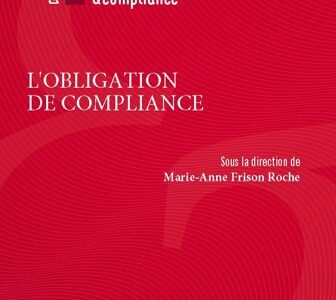
► Full Reference: [rubrique p="Présentation"]M.-A. Frison-Roche[/rubrique], "La Vigilance, pointe avancée et part totale de l’Obligation de Compliance" (Vigilance, the cutting edge and a full part of the Compliance Obligation), in M.-A. Frison-Roche (ed.), [lien a="lobligation-de-compliance"]L'Obligation de Compliance[/lien], Journal of Regulation & Compliance (JoRC) and Dalloz, coll. "[rubrique p='Responsabilités éditoriales > Direction de la collection "Régulations & Compliance", JoRC & Dalloz']Régulations & Compliance[/rubrique]" 2025, pp. 511-536. - 📝read the article (in French) - 🚧[lien a="la-vigilance-pointe-avancee-et-part-totale-de-lobl"]read the bilingual Working Paper on the basis this contribution has been built, with more developments, technical references and hyperlinks. [/lien] - 📕read a general presentation of the book, [lien a="lobligation-de-compliance"]L'Obligation de Compliance[/lien], in which this article is published - ► English summary of this contribution : The "duty of vigilance" unleashes all the more radical and passionate positions, sometimes among Law professors, because it has not been precisely defined. One word is used for another, either inadvertently or deliberately, deliberately if it can attract this or that element from one legal corpus and import it into another. The very exercise of definition is therefore required in practice. There are specific obligations of vigilance that come under such and such a body of regulations and are imposed on such and such a category of operators to fulfill such and such a function. These are precise circles which are not confused and must not be confused. This is superimposed on what the French 2017 law so-called "Vigilance law", which is much more encompassing since it applies to all large companies in the operation of the value chains they have set up. The European 2024 directive is in the same way. But there is no general duty or obligation of Vigilance. Such a claim would be based on confusing or shifting each of these 3 levels, which must be avoided because no positive law does support this (I). If the duty of vigilance is attracting so much attention, whether or not the European CS3D is fully effective, it is because Vigilance is the "cutting edge" of Compliance Obligation (II). Vigilance requires companies, by consideration of their power and without reproaching them for it or demanding that it be reduced, to detect risks of damage to the environment and climate, but also to human rights, because they are in a position to do so in order to prevent them from turning into disasters. In this respect, the Vigilance duty makes clearer the exact legal nature of the Compliance Obligation. Moreover, Vigilance appears as the Total Part of the Compliance Obligation (III). Indeed, although it is restricted to one area, the value chain, and to two types of risk, deterioration of the environment and deterioration of human rights, it expresses the totality of the Compliance Obligation by means of tools that the 2017 French "Vigilance law" had itself duplicated from the 2016 so-called "Sapin 2 law": to preserve systems today, but above all tomorrow, in order they do not collapse (Negative Monumental Goals), or even consolidate them (Positive Monumental Goals), so that the human beings who are willingly or unwillingly involved in them are not crushed by them but benefit from them. This is why large companies are subject to the Obligation of Compliance and Vigilance, particularly in the humanist conception that Europe is developing. The result is a new type of Litigation, of a systemic nature, for which the Courts have spontaneously become specialised, and for which the procedures will have to be adapted and the office of the Judge shall have to evolve. - 🌐follow Marie-Anne Frison-Roche on LinkedIn 🌐follow Marie-Anne Frison-Roche on Instagram 🌐subscribe to the Newsletter MAFR Regulation, Compliance, Law 🌐subscribe to the Video Newsletter MAFR Surplomb
► Full Reference: M. Séjean, "La définition de l’obligation de compliance confrontée au droit de la cybersécurité (The definition of the Compliance Obligation in Cybersecurity Law)", in [rubrique p="Présentation"]M.-A. Frison-Roche[/rubrique] (ed.), [lien a="lobligation-de-compliance"]L'obligation de Compliance[/lien], Journal of Regulation & Compliance (JoRC) and Dalloz, coll. "[rubrique p='Responsabilités éditoriales > Direction de la collection "Régulations & Compliance", JoRC & Dalloz']Régulations & Compliance[/rubrique]", 2025, pp. 109-117. - 📕read the general presentation of the book, [lien a="lobligation-de-compliance"]L'obligation de Compliance[/lien], in which this article is published. - ► English Summary of this contribution (done by the Journal of Regulation & Compliance - JoRC) : The contribution compares the general definition given by Marie-Anne Frison-Roche with the specific nature of the world of cybersecurity, its legal organisation and the principles that govern it. Taking up all the elements of this general definition, according to which the Compliance Obligation consists in "[lien a="concevoir-lunicite-de-lobligation-de-compliance-sa"]building a compliance structure producing credible effects in the perspective of the Monumental Goals targeted by the Legislator[/lien]", the author shows that beyond the specificities of cybersecurity rules, this corresponds in practice and in each of the elements of this definition, confronted with the various elements that constitute what is required in terms of cybersecurity, to what is technically required of the entities and persons concerned in terms of cybersecurity, which is actually thought out in these terms. - 🦉This article is available for people who follow the Professor Marie-Anne Frison-Roche teaching


opening speech
► Full Reference: [rubrique p="Présentation"]M.-A. Frison-Roche[/rubrique], "Compliance Law and Systemic Litigation", 15 September 2025, Madrid. - This speech is the opening speech of the event. 🧮 See the general program of the event - 📅See the slides (not used), basis for this speechs - ► Summary of the conference: This manifestation, made fo many interventions, is about the role and the evolution of the in-house lawyers in the Europe on the move. I opened the event by focusing on the importance of the Compliance which drives the companies now, in the future and for the future. It is quite difficile because currently Compliance Law is quite misunderstund by almost every. Therefore the first part of my intervention has been the explanation of what is the very new branch of Law, built of political Monumental Goals (Compliance Law is not just the obligation to be conform with, just to obey), the specificity of European Compliance Monumental Goals (not only the sustainability of systems, but also the concern for present and future human beins implied in them). This systemic new branch of Law, humanist branch of Law in Europe put the Judge at its center. Par translation, this is creating a new sort of Litigation : the Compliance Systemic Litigation. Its object is the future (as Compliance Law itselft). Contrary to the "conformity", which might be left to algorithms, Compliance Law, inseparable to Systemic Litigation, are giving new role for Judges, for external lawyers and for internal lawyers. - 🌐follow Marie-Anne Frison-Roche on LinkedIn 🌐follow Marie-Anne Frison-Roche on Instagram 🌐subscribe to the Newsletter MAFR Regulation, Compliance, Law 🌐subscribe to the Video Newsletter MAFR Surplomb 🌐subscribe to the Newsletter MaFR Droit & Art

article in a collective book
► Full Reference:: [rubrique p="Présentation"]M.-A. Frison-Roche[/rubrique], "Compliance", in J.-Fr. Kerléo & E. Lemaire (dir.), Dictionnaire de l'éthique publique, LexisNexis, 2025, pp. - 📗[lien a="dictionnaire-de-lethique-publique"] read the general presentation of the Dictionary[/lien]. - 📝read the article (in French). - ► English Summary of the article defining what is Compliance: The article explains Compliance in 7 points. Firstly, it states that Compliance oscillates between a weak and a strong definition. It can be defined weakly as the demonstration of obedience to all applicable regulations, or it can be defined strongly as active participation in the achievement of 'monumental' ambitions for the future of the social group. Positive legal rules and case law are increasingly revealing the relevance of the strong definition, with the weak definition referring only to conformity to the Law. Secondly, this understanding of the new branch of Law known as Compliance Law will enable us to master the regulations specifically relating to compliance (RGPD, French laws such as Sapin 2 Act and Vigilance Act, AML/FT, European AI Act, etc.), which are both more specific and more restrictive than the general obligation to comply with the applicable legal rules. Thirdly, everyone can see the move from "extraterritoriality" to another thing which is the indifference to territoryd: Compliance is the right instrument for the digital space and for chains of activities. Fourthly, this is due to the very nature of Compliance, which consists in internalising in companies in a position to be active the “Monumental Negative Goal” of preventing the collapse of systems (energy, climate, digital, banking, financial, algorithmic, etc.). Fifthly, this internalisation is carried out by States and public authorities in entities in a position to act, i.e. in concrete terms in companies in a position to be active to reach the “Monumental Goals” by contributing to the improvement of systems so that these systems benefit in the present and the future the people who are de jure and de facto involved in them. Sixthly, these goals become positive when it comes to educating people about probity and effective equality between human beings, notably through training policies. In this respect, Vigilance is the “cutting edge” of Compliance. Seventhly, an “ex ante responsibility” of Crucial Operators subject to Compliance is emerging, and is articulated by Systemic Litigation which aims to balance and maintain systems, carried by States and these crucial companies. - 📝read the preentation of the other article written by Marie-Anne Frison-Roche for this Dictionary: "[lien a="regulation-in-j-fr-kerleo-et-e-lemaire-dir-diction"]Régulation[/lien]" - 🌐follow Marie-Anne Frison-Roche on LinkedIn 🌐follow Marie-Anne Frison-Roche on Instagram 🌐subscribe to the Newsletter MAFR Regulation, Compliance, Law 🌐subscribe to the Video Newsletter MAFR Surplomb 🌐subscribe to the Newsletter MaFR Droit & Art
► Full Reference: [rubrique p="Présentation"]M.-A. Frison-Roche[/rubrique], "Régulation" (Regulatory Law), in J.-Fr. Kerléo et E. Lemaire (dir.), Dictionnaire de l'éthique publique, LexisNexis, 2025, pp. - 📗[lien a="dictionnaire-de-lethique-publique"]read the general presentation of the Dictionary[/lien]. - 📝read the article (in French) - ► English Summary of this article defining Regulation: To define Regulation (Regulatory Law), the article begins with its origins, which were a source of misunderstanding, since the term Regulation might refer to simple regulations, thus masking the real branch of Law which is the Law of Regulation. But this confusion with simple and formal regulations has diminished Regulatory Law its importance, its novelty and its originality, and, by placing it within Public Law, equated Regulation on the one hand with the transition from public monopolies to a competitive organisation, and on the other hand privileged the legal study of what fell within the remit of the Administrative Courts, i.e. telecommunications, transport and energy, leaving out the Regulatory Law of banking and financial sector . As a result, the unity and strength of Regulatory Law is still difficult to perceive and manage today, while its relationship with competition and Europe remains difficult. Regulatory Law is all the more difficult to define because it is still common to oppose, as was the case in the 1980s, "Economic Regulatory Law", which would aim to set economic efficiency objectives within the State, and "Public Liberties Regulatory Law", which would be alternatives to each other, preventing the audiovisual, media and digital sectors in particular from being legally perceived as an industry. We are still paying for this initial conception. All the more so since Regulatory Law is the second pillar on which Europe is built, along with Competition, with which it is linked. It can be identified by the existence of a regulated 'sector', most often through the establishment of a regulatory authority, generally in the form of an Independent Administrative Body. But it is defined by the prevalence of the technical and political goals pursued, which are not spontaneously achieved and which aim to favour the human beings involved in economic organisations. While the function of Competition Authorities is to maintain the dynamism of competitive markets and to punish behaviour that hinders them without creating that dynamism, Regulatory Law, through its own rules, principles, institutions, procedures and decisions, will create non-spontaneous équilibra and maintain them over time. To do this, it will inject non-spontaneous procedures, such as transparency, or generate obligations and powers because these are necessary for this balance to be achieved. This can take the form of exclusive rights, which can go as far as the creation of monopolies, particularly on transport infrastructures, or the form of pricing and tarification, which can go as far as free access. Access rights are essential, whether technical or political (access to networks, access to healthcare). The political dimension of Regulatory Law is very much in evidence, as Europe is developing its own form of Regulation compared with the USA or China, demonstrating the link between Regulation and Sovereignty, the criterion? of the technical sector becoming less significant. This is illustrated by the clash over algorithmic systems (AI). In this way, regulation is not a technical reaction to a "market failure", but the manifestation of a zone's political power both internally and externally. The DSA (2022) is an example of this, imposing this same logic extraterritoriality in the digital space through the Digital Services Act (DSA) adopted in 2022. - 📝read the presentation of the other article written by Marie-Anne Frison-Roche for this Dictionary: "[lien a="compliance-in-j-fr-kerleo-dir-dictionnaire-de-leth"]Compliance[/lien]" - 🌐follow Marie-Anne Frison-Roche on LinkedIn 🌐follow Marie-Anne Frison-Roche on Instagram 🌐subscribe to the Newsletter MAFR Regulation, Compliance, Law 🌐subscribe to the Video Newsletter MAFR Surplomb 🌐subscribe to the Newsletter MaFR Droit & Art

Working Paper for a Newsletter
► Full Reference : [rubrique p="Présentation"]M.-A. Frison-Roche[/rubrique], To master the regulatory mass of Compliance, think of it as a jigsaw puzzle, Working Paper , May 2025 - 📝 This Working Paper underpins the Newsletter MAFR Law -Compliance - Regulation of 2 June 2025 : - ► Summary of this Working Paper: People are rightly complaining that Europe's regulatory and compliance regulations are too numerous, too complicated and too changeable. As a result, they are said to be unmanageable. Three solutions are proposed: specialise lawyers, regulatory corpus by regulatory corpus; deregulate; entrust everything to algorithms. These are inadequate solutions, because regulations cannot be understood unless they are put into perspective with the rest of the legal rules .; we have entered a new world, and these new regulations reflect the need for a new Law (unless we want to destroy the Law itself, which is what some people are dreaming of doing); algorithms reproduce past solutions and do not produce the new legal conception required. For an appropriate solution, we need to move away from a word-by-word understanding of the regulatory and compliance regulations and understand them as a whole, not only in relation to the purpose that gives them meaning, but also in relation to each other. In the positive sense of the term, they form a European 'jigsaw puzzle'. We need to look at the overall picture in which each regulation fits and makes sense. It finds its simplicity in relation to its purpose. It is always a question of working towards the sustainability of systems by asking companies to contribute so that the systems do not crush human beings but benefit them. Thus, in practice, the Monumental Goals of Compliance Law give clarity to the body of regulations which, when seen as a whole, are manageable and practical. Judges interpret them in this way. - 🔓read the Working Paper below⤵️ - 🌐follow Marie-Anne Frison-Roche on LinkedIn 🌐follow Marie-Anne Frison-Roche on Instagram 🌐subscribe to the Newsletter MAFR Regulation, Compliance, Law 🌐subscribe to the Video Newsletter MAFR Surplomb 🌐subscribe to the Newsletter MaFR Droit & Art

Serie of videos on Regulation, Compliance and Vigilance 📺Surplomb/Overhang
► Full Reference: [rubrique p="Présentation"]M.-A. Frison-Roche[/rubrique], "Monumental Goals, normative anchoring of Compliance Law", in Series of videos Overhang / Surplomb, 1st February 2025 - 🌐watch on LinkedIn this video of the Series Surplomb/Overhang - 🌐watch on LinkedIn this video of the Serie Surplomb/Overhang, published in the Newsletter Surplomb/Overhang, by MAFR - 🎬watch below this video of the Serie Surplomb/Overhang⤵️ - Surplomb/Overhang, by mafr the Serie of videos dedicated to Regulation, Compliance and Vigilance - 🌐follow Marie-Anne Frison-Roche on LinkedIn 🌐follow Marie-Anne Frison-Roche on Instagram 🌐subscribe to the Newsletter MAFR. Regulation, Compliance, Law 🌐subscribe to the Video Newsletter MAFR. Overhang / Surplomb

Working Paper
► Full Reference: [rubrique p="Présentation"]M.-A. Frison-Roche[/rubrique], Compliance and conformity: distinguishing them to articulate them, Working Paper, February 2024. - 📝 this working paper was drawn up to serve as a basis for the [lien a="compliance-et-conformite-les-distinguer-pour-les-a"]article published in French in the Chronique MAFR - Compliance Law, published in the Recueil Dalloz[/lien]. - ► Summary of this Working Paper: The words "conformité" and "compliance" are sometimes used interchangeably, presenting "conformité" as the translation into good legal French vocabulary of "compliance", which would come from the American system. This is not true, however, because each of these terms refers to two distinct and even opposing concepts. "conformity"' would require companies to show that they are actively obeying all the 'regulations' applicable to them, regardless of their content. "Compliance Law" is a new substantial branch of Law that derives its normativity from the "Monumental Goals" targeted by the political and public authorities: these monumental goals are intended to ensure that systems do not collapse in the future (Negative Monumental Goals), or even improve (Positive Monumental Goals). The systems concerned are banking, finance, energy, health, transport, digital and climate systems. The scope of Compliance Law is therefore both much more limited and more ambitious. Distinguishing between the two allows us to put conformity back where it belongs, as a tool of Compliance Law. As such, conformity justifies the collation and correlation of information, with the algorithmic system playing a major role in this. On the other hand, the human concern that underpins Compliance Law justifies making training and the actions of in-house lawyers, attorneys and judges, central to it. The evidentiary system of Compliance that is currently being developed is based on evidentiary techniques rooted on the one hand in the tool of conformity and on the other in the culture of Compliance, which can be articulated as soon as they are no longer confused. - 🔓read the working paper below⤵️ - 🌐 follow Marie-Anne Frison-Roche on LinkedIn 🌐follow Marie-Anne Frison-Roche on Instagram 🌐subscribe to the Newsletter MAFR Regulation, Compliance, Law
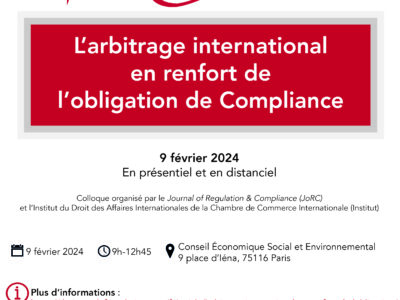
► Full Reference: [rubrique p="Présentation"]M.-A. Frison-Roche[/rubrique], "Préalable : ce qu'est l'obligation de Compliance" ("Prerequisite: the Compliance Obligation"), in L. Aynès, M.-A. Frison-Roche, J.-B. Racine and E. Silva-Romero (dir.), [lien a="larbitrage-international-en-renfort-de-lobligation"]L'arbitrage international en renfort de l'obligation de Compliance (International Arbitration in support of the Compliance Obligation)[/lien], Journal of Regulation & Compliance (JoRC) and Institute of World Business Law of the ICC (Institute), Conseil Économique Social et Environnemental (CESE), Paris, February 9, 2024 - 🧮[lien a="larbitrage-international-en-renfort-de-lobligation"]see the full programme of this event[/lien] - 🌐consult on LinkedIn a general presentation of this event, which links to a presentation of each speech (in French) - 🧱[lien a="co-organisation-du-colloque-larbitrage-internation"]consult the scientific direction sheet of this event, which gives an account of the various speeches made[/lien] - 🔲see the slides used to support the presentation (in French) - 🎤see a presentation of the conference [lien a="le-renforcement-des-engagements-de-compliance-par-"]"Préalable : ce qu'est un engagement" ("Prerequisite: the Commitment")[/lien], given at the same symposium - 🎤see a presentation of the conference "[lien a="le-renforcement-des-engagements-de-compliance-par-"]Le renforcement des engagements de Compliance par le renvoi Ex Ante à l'arbitrage international" ("Reinforcing Compliance commitments by referring Ex Ante to International Arbitration")[/lien] which was finally not pronounced but will be the subject of an 📝article in the forthcoming book 📘[lien a="publication-of-m-a-frison-roche-ed-compliance-obli"]Compliance Obligation[/lien] - ► Presentation of the conference: I have first dealt with the very definition of the Compliance Obligation. After showing that the relationship between Compliance Law and International Arbitration will naturally develop, because the companies subject to it are international, because they contractualise their legal Compliance obligations and because Compliance is being jurisdictionalised📎[note reference="n1"], the arbitrator being the natural judge since he is a global judge and the judge of the contract, I pointed out that Compliance Law does not simply entrust arbitration with the task of preventing evils, such as corruption pacts, but that it creates positive obligations for companies: to detect and prevent behaviour whose systemic effect is deleterious. This culture of compliance is achieved either through compliance contracts📎[note reference="n2"] (which outsource the handling of audits, alerts, the drawing up of plans, etc.), or through compliance clauses📎[note reference="n2"], which are inserted into distribution or supply contracts, etc.; arbitration clauses are linked to these. Thus, the alliance between Compliance and Contract is an indirect mode of alliance between Arbitration and Compliance Obligation. The obligation of Compliance which then takes concrete form consists for the company not in making effective Ex Ante all the regulations which apply to it (conception of conformity which is at once unreasonable, blind and impossible), but in making its best efforts, which it must make visible (see Compliance Evidence System📎[note reference="n3"]) to achieve Monumental Goals. These Monumental Goals are systemic. The aim is to protect systems from collapse (Negative Monumental Goals) or to make them better (Positive Monumental Goals)📎[note reference="n4"]. By making companies accountable, via this Ex Ante Law whose object is the future, the systemic evils of corruption, money laundering, discrimination, climate change and hatred are combated, thus finding substantial unity. The Positive Monumental Goals aim to engender sustainability, security, respect for human beings, etc. in systems, be they banking, financial, digital, climatic, etc. The role of the Judge, and therefore also that of the Arbitrator, is renewed. - 🌐follow Marie-Anne Frison-Roche on LinkedIn 🌐follow Marie-Anne Frison-Roche on Instagram 🌐subscribe to the Newsletter MAFR Regulation, Compliance, Law
► Full Reference: [rubrique p="Présentation"]M.-A. Frison-Roche[/rubrique], "Préalable : ce qu'est un engagement" ("Prerequisite: the Commitment"), in L. Aynès, M.-A. Frison-Roche, J.-B. Racine and E. Silva-Romero (dir.), [lien a="larbitrage-international-en-renfort-de-lobligation"]L'arbitrage international en renfort de l'obligation de Compliance (International Arbitration in support of the Compliance Obligation)[/lien], Journal of Regulation & Compliance (JoRC) and Institute of World Business Law of the ICC (Institute), Conseil Économique Social et Environnemental (CESE), Paris, February 9, 2024 - 🧮[lien a="larbitrage-international-en-renfort-de-lobligation"]see the full programme of this event[/lien] - 🌐consult on LinkedIn a general presentation of this event, which links to a presentation of each speech (in French) - 🧱[lien a="co-organisation-du-colloque-larbitrage-internation"]consult the scientific direction sheet of this event, which gives an account of the various speeches made[/lien] - 🔲see the slides used to support the presentation (in French) - 🎤see a presentation of the conference [lien a="prealable-ce-quest-lobligation-de-compliance-in-la"]"Préalable : ce qu'est l'Obligation de Compliance" ("Prerequisite: what is the Compliance Obligation")[/lien], given at the same symposium - 🎤see a presentation of the conference "[lien a="le-renforcement-des-engagements-de-compliance-par-"]Le renforcement des engagements de Compliance par le renvoi Ex Ante à l'arbitrage international" ("Reinforcing Compliance commitments by referring Ex Ante to International Arbitration")[/lien] which was finally not pronounced but will be the subject of an 📝article in the forthcoming book 📘[lien a="publication-of-m-a-frison-roche-ed-compliance-obli"]Compliance Obligation[/lien] - ► Presentation of the conference: Having defined the Compliance Obligation in [lien a="prealable-ce-quest-lobligation-de-compliance-in-la"]"Préalable : ce qu'est l'Obligation de Compliance" ("Prerequisite: what is the Compliance Obligation")[/lien], I set out to define what a commitment is. No one doubts that commitments, as words, constitute facts that can engage the liability of companies if there are inconsistencies or lies. The question today is whether a commitment can constitute a legal act, binding in ex ante. Companies make commitments either to fulfil their legal Compliance obligations, which is simply obeying the law, or to express their own wishes, either for themselves or for others. The cases are often confused, even though the scope is not the same. If the commitment takes the form of a contract, Compliance is concerned if the contract is used as an Ex Ante Compliance Tool📎[note reference="n1"], either if the entire contract has this purpose, or if a compliance clause is inserted, and an arbitration clause may be linked to it. The commitment, a concept that comes more from the Economics of Regulation, was conceived between a Regulatory Authority and a Company: it is the unilateral decision of the Authority that gives legal force to the commitment. Case law confirms this (Conseil d'État (French Council of State)📎[note reference="n2"] and Conseil constitutionnel (French Constitutional Council)📎[note reference="n3"]) and this is particularly clear in Competition Law, but it is also true of the convention judiciaire d'intérêt public - CJIP (French Judicial Public Interest Agreement). If commitment is central to Compliance, particularly Vigilance, it is because Compliance Law is an extension of Regulatory Law📎[note reference="n4"]. The company is forcibly instituted by the Compliance regulator, particularly in value chains, or on digital spaces (DSA). In drawing up a plan, the company is fulfilling its legal obligation. But if we were to consider that it is a commitment, then we would also have to consider that the plan is the result of its will, that it must consult the stakeholders in its preparation, but that the source of the plan is its will: the provisions are not stipulations, are not applications of the law, but unilateral voluntary provisions. In this respect, and because its source is the will of the company (which does not prevent its co-construction), a plan could contain a "graduated offer" of arbitration. This offer could be included in commitments that are less regulated by law, such as those made in the context of CSR. - 🌐follow Marie-Anne Frison-Roche on LinkedIn 🌐follow Marie-Anne Frison-Roche on Instagram 🌐subscribe to the Newsletter MAFR Regulation, Compliance, Law
► Full Reference: [rubrique p="Présentation"]M.-A. Frison-Roche[/rubrique], "Le renforcement des engagements de Compliance par le renvoi Ex Ante à l'arbitrage international" ("Reinforcing Compliance commitments by referring Ex Ante to International Arbitration"), in L. Aynès, M.-A. Frison-Roche, J.-B. Racine and E. Silva-Romero (dir.), [lien a="larbitrage-international-en-renfort-de-lobligation"]L'arbitrage international en renfort de l'obligation de Compliance (International Arbitration in support of the Compliance Obligation)[/lien], Journal of Regulation & Compliance (JoRC) and Institute of World Business Law of the ICC (Institute), Conseil Économique Social et Environnemental (CESE), Paris, February 9, 2024 - 🧮[lien a="larbitrage-international-en-renfort-de-lobligation"]see the full programme of this event[/lien] - 🌐consult on LinkedIn a general presentation of this event, which links to a presentation of each speech (in French) - 🧱[lien a="co-organisation-du-colloque-larbitrage-internation"]consult the scientific direction sheet of this event, which gives an account of the various speeches made[/lien] - 🔲see the slides used to support the presentation (in French) - 📝This conference and the Working Paper on which it is based are to be linked with the article to be published in the book📘[lien a="publication-of-m-a-frison-roche-ed-compliance-obli"]Compliance Obligation[/lien] - 🎤see a presentation of the conference [lien a="prealable-ce-quest-lobligation-de-compliance-in-la"]"Préalable : ce qu'est l'Obligation de Compliance" ("Prerequisite: what is the Compliance Obligation")[/lien], given at the same symposium - 🎤see a presentation of the conference [lien a="prealable-ce-quest-un-engagement-in-larbitrage-int"]"Préalable : ce qu'est un engagement" ("Prerequisite: the Commitment")[/lien], given at the same symposium - ► Presentation of the conference: It was initially planned that I would speak on the subject Le renforcement des engagements de Compliance par le renvoi Ex Ante à l'arbitrage international (Reinforcing Compliance commitments through the Ex Ante referral to International Arbitration), but it was agreed with the other organisers of the symposium that after defining the concept of the Compliance Obligation📎[note reference="n8"] I would refocus my second speech, mentioned above, on what a Commitment is📎[note reference="n9"], an essential prerequisite for dealing with the subject of International Arbitration in support of the Compliance Obligation. Developments on Reinforcing Compliance commitments through the Ex Ante referral to International Arbitration will appear in the forthcoming books: [lien a="lobligation-de-compliance"]L'obligation de Compliance[/lien] (in French), [lien a="publication-of-m-a-frison-roche-ed-compliance-obli"]Compliance Obligation[/lien] (in English). Nevertheless, if I had dealt with this subject, I would have raised the following points: The inclusion of an offer of arbitration in the field of Compliance implies considering it in a contract as well as in a non-contractual commitment, and studying which category of Compliance Obligation the offer may apply to. This insertion benefits from taking the form of a "graduated offer", in a crescendo organised by the company ex ante and offered to the stakeholders: conciliation, mediation and arbitration, in "circles of trust"📎[note reference="n5"]. This is supported by the current French amicable settlement policy. The result was that I had to prepare a long "preliminary" discussion of what a "commitment" is, without which it seemed difficult to talk in concrete terms about the effective insertion of an offer of arbitration if we did not know whether such links or words had a constraining effect on the person issuing them in relation to the person benefiting from them. After discussions with the other speakers, it became clear that it would be more effective to give a talk devoted solely to the question of the legal definition of commitment. We therefore decided to allocate this second speaking slot to the notion of commitment. Since the written words do not have the same constraints, it will take up the initial construction, insisting on the different supports, either compliance contracts, or associations with compliance clauses, relating to different Compliance obligations, in particular on information or audit or Vigilance📎[note reference="n6"], because the company must have the legal power corresponding to the mission that the State entrusts to it through Compliance📎[note reference="n7"]. The offer must be carefully drafted to explain its purpose, and its organisation must prove the reality of this purpose: to give access to a judge to people affected by the company's activity, and not to block it. This will therefore be available in detail in the forthcoming books: M.-A. Frison-Roche (ed.), 📕[lien a="lobligation-de-compliance"]L'obligation de Compliance[/lien] M.-A. Frison-Roche (ed.), 📘[lien a="publication-of-m-a-frison-roche-ed-compliance-obli"]Compliance Obligation[/lien] - 🌐follow Marie-Anne Frison-Roche on LinkedIn 🌐follow Marie-Anne Frison-Roche on Instagram 🌐subscribe to the Newsletter MAFR Regulation, Compliance, Law

► Full Reference: [rubrique p="Présentation"]M.-A. Frison-Roche[/rubrique], In Compliance Law, the legal consequences for Entreprises of their commitments and undertakings, June 2024. - 📝 This Working Paper is the basis for the contribution "In Compliance Law, the legal consequences for Entreprises of their commitments and undertakings", in📘[lien a="publication-of-m-a-frison-roche-ed-compliance-obli"]Compliance Obligation[/lien]. - ► Summary of this Working Paper: The innocents might believe, taking the Law and its words literally, that "commitments" are binding on those who make them. Shouldn't they be afraid of falling into the trap of the 'false friend', which is what the Law wants to protect them from (as stated in the prolegomena)? Indeed, the innocent persons think that those who make commitments ask what they must do and say what they will do. Yet, strangely enough, the 'commitments' that are so frequent and common in compliance behaviours are often considered by those who adopt them to have no binding value! Doubtless because they come under disciplines other than Law, such as the art of Management or Ethics. It is both very important and sometimes difficult to distinguish between these different Orders - Management, Moral Norms and Law - because they are intertwined, but because their respective standards do not have the same scope, it is important to untangle this tangle. This potentially creates a great deal of insecurity for companies (I). The legal certainty comes back when commitments take the form of contracts (II), which is becoming more common as companies contractualise their legal Compliance Obligations, thereby changing the nature of the resulting liability, with the contract retaining the imprint of the legal order or not having the same scope if this prerequisite is not present. But the contours and distinctions are not so uncontested. In fact, the qualification of unilateral undertaking of will is proposed to apprehend the various documents issued by the companies, with the consequences which are attached to that, in particular the transformation of the company into a 'debtor', which would change the position of the stakeholders with regard to it (III). It remains that the undertakings expressed by companies on so many important subjects cannot be ignored: they are facts (IV). It is as such that they must be legally considered. In this case, Civil Liability will have to deal with them if the company, in implementing what it says, what it writes and in the way it behaves, commits a fault or negligence that causes damage, not only the sole existence of an undertaking. - 🔓read the developments below ⤵️ - 🌐follow Marie-Anne Frison-Roche on LinkedIn 🌐follow Marie-Anne Frison-Roche on Instagram 🌐subscribe to the Newsletter MAFR Regulation, Compliance, Law 🌐subscribe to the Video Newsletter MAFR Surplomb
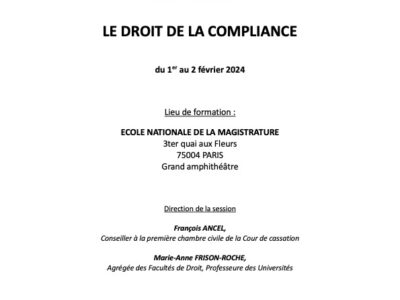
► Full Reference: [rubrique p="Présentation"]M.-A. Frison-Roche[/rubrique], "Droit de la compliance : tour d'horizon" ("Compliance Law: Overview"), in [lien a="droit-de-la-compliance-2"]Droit de la compliance (Compliance Law)[/lien], École nationale de la magistrature - ENM (French National School for the Judiciary) in collaboration with the École de Formation professionnelle des Barreaux du ressort de la cour d'appel de Paris - EFB (Paris Bar School), Paris, February 1, 2024. - ► This conference is given in French - 🧮see the full programme of this event (in French) - 🌐consult on LinkedIn a general presentation of this event, which links to a presentation of each speech (in French) - 🧱[lien a="droit-de-la-compliance-2"]consult the scientific direction sheet of this event, which gives an account of the various speeches made[/lien] - 🔲see the slides used to support the presentation (in French) - 🎤see a presentation of the other speech about [lien a="limpregnation-des-branches-du-droit-par-les-mecani"]"Compliance et Responsabilité civile : comprendre et raison garder" ("Compliance and Civil Liability: understanding and keeping our heads")[/lien], given at the same symposium - ► Presentation of the conference: Compliance Law is mysterious in itself, because it is still in creation[note reference="n1"], because its presence and power are felt, but it is difficult to grasp it. It is necessary, however, because it deals with the most important, even the most dramatic, facts and carries with it the greatest ambitions. Magistrates must also "make the effort" to participate in the "adventure of Compliance Law", because it affects, and even overturns, all subjects, and because the Prosecutor and the Judge play an increasing role in it[note reference="n2"]. Because the purpose of this conference is to introduce the two days of a training course designed for magistrates and open to lawyers, it only provides an "overview" of, so that we do not get lost in the sprawling regulations, the global mechanisms and the political ambitions that permeate them. Therefore, without going into any of the subjects, it is about opening up four ways of entering what is a branch of Law that is being born before our eyes: 1. Understanding Compliance Law through "regulations" 2. Understanding Compliance Law through "tools"[note reference="n3"] 3. Understanding Compliance Law through "methods" 4. Understanding Compliance Law through "goals"[note reference="n4"] The four approches are legitimate because the four dimensions are articulated in the legal system, notably case law. But the more positive Law is consolidated, the more its normativity through the goals that give normativity, or even a simplicity without which the whole is not humanly controllable. These Goals are Monumental and Europe bears them more and better than other areas of the world[note reference="n5"]. - 🌐follow Marie-Anne Frison-Roche on LinkedIn 🌐follow Marie-Anne Frison-Roche on Instagram 🌐subscribe to the Newsletter MAFR Regulation, Compliance, Law

Working Paper basis for an article
► Full Reference: [rubrique p="Présentation"]M.-A. Frison-Roche[/rubrique], Births of a branch of Law: Compliance Law, Working Paper, November 2023. - 📕This Working Paper was drawn up as a basis for a [lien a="naissance-dune-branche-du-droit-le-droit-de-la-c-2"]contribution to the collective book given to Professor Louis Vogel[/lien], published in 2024 - ► Summary of this Working Paper: The study looks at the various movements that have given birth to Compliance Law, with particular emphasis on Competition Law. After a preliminary reflection on the construction of the legal system into branches of Law, their classification in relation to each other, the difficulty encountered in this respect by Economic Law, and the various movements that give birth to one of them, the diversity of which the branch subsequently keeps track of, the study is constructed in 4 parts. To find out what gave rise to Compliance Law, the first part invites us to reject the narrow perspective of a definition that is content to define it by the fact of "being conform" with all the applicable regulations. This has the effect of increasing the efficacy of the regulations, but it does not produce a branch of Law, being just a set of tools like others. The second part of the study aims to shed some light on what appears to be an "enigma", as it is often claimed that this is the result of a soft method, or of an American political decision, or of as many regulations as there are occasions to make. Instead, it appears that in the United States, in the aftermath of the 1929 crisis, it was a decision of establishing an authority and rules to prevent another atrocious collapse of the system, while in Europe in 1978, in memory of the use of files of personal and racial information, it was a question of establishing an authority and rules to prevent an atrocious attack on human rights. A common element that aims for the future ("never again") but not the same object of preventive rejection. This difference between the two births explains the uniqueness and diversity of the two Compliance Laws, the tensions that can exist between the two, and the impossibility of obtaining a global Law. The third part analyses the way in which Competition Law has given rise to conformity: a secondary branch which is a guarantee of conformity with competition rules. Developed in particular through the soft law issued by the competition authorities, the result is a kind of soft obedience, a well-understood collaboration of the procedural type through which the firm educates, monitors and even sanctions, without leaving the cercle of Competition Law, of which conformity is an appendix. The distance between a culture of conformity and the substantial Compliance Law can be measured here. The fourth part aims to show that Competition Law and Compliance Law are two autonomous and articulated branches of Law. Since Compliance Law is a branch of Law built on Monumental Goals, in particular the sustainability of systems and the preservation of the human beings involved so that they are not crushed by them but benefit from them, the current challenge of European integration is to build the pillar of Compliance Law alongside the competitive pillar. Jurisdictions are in the process of doing this and of linking the two. - 🔓read the Working Paper below⤵️ - 🌐follow Marie-Anne Frison-Roche on LinkedIn 🌐follow Marie-Anne Frison-Roche on Instagram 🌐subscribe to the Newsletter MAFR Regulation, Compliance, Law 🌐subscribe to the Video Newsletter MAFR Surplomb