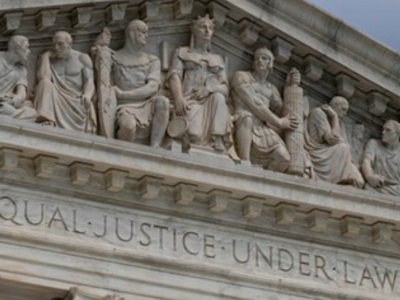
►Full Reference: J. Heymann, "The Legal Nature of the Facebook “Supreme Court”", in [rubrique p="Présentation"]M.-A. Frison-Roche[/rubrique] (ed.), [lien a="compliance-juridictionnalisation"]Compliance Jurisdictionalisation[/lien], Journal of Regulation & Compliance (JoRC) and Bruylant, "[rubrique p="Responsabilités éditoriales > Direction de la collection Compliance & Regulation, JoRC et Bruylant"]Compliance & Regulation[/rubrique]" Serie, 2024, pp. 167-182 - 📘read a general presentation of the book, [lien a="compliance-juridictionnalisation"]Compliance Jurisdictionalisation[/lien], in which this article is published - ►Summary of the article (done par the Author): Taking place in the general theme aiming at making “words and things coincide”, the article offers some thoughts on the “conditions of the discourse” – in the sense in which Foucault understood it in his Archéologie des sciences humaines – relating to the phenomenon of “jurisdictionalization” of Compliance. The thoughts are more specifically focusing on the nature of the so-called “Supreme Court” that Facebook instituted to hear appeals of decisions relating to content on the digital social networks that are Facebook and Instagram. Is this really a “Supreme Court”, designed in order to “judge” the Facebook Group? A careful examination of the Oversight Board – i.e. the so-called “Supreme Court” created by Facebook – reveals that the latter, in addition to its advisory mission (which consists of issuing policy advisory opinions on Facebook’s content policies), exercises some form of adjudicative function. This is essentially conceived in terms of compliance assessment, of the content published on the social networks Facebook or Instagram with the standards issued by these corporations on the one hand, of content enforcement decisions taken by Facebook with the Law on the other hand. The legal framework of reference is yet rather vague, although its substantial content seems to be per se evolutive, based on the geographical realm where the case to be reviewed is located. An adjudicative function can therefore be characterized, even if the Oversight Board can only claim for a limited one. The author can ultimately identify the Oversight Board as a preventive dispute settlement body, in the sense that it seems to aim at avoiding any referral to state courts and ruling before any court’s judgement can be delivered. Some questions are thus to be raised, relating with both legitimacy and authority of such a Board. But whatever the answers will be, the fact remains that the creation of the Oversight Board by a private law company already reveals all the liveliness of contemporary legal pluralism. - 🦉This article is available in full text to those registered for Professor Marie-Anne Frison-Roche's courses -
►Full Reference: J. Heymann, "La nature juridique de la "Cour suprême" de Facebook" ("The legal nature of Facebook's "Supreme court""), in [rubrique p="Présentation"]M.-A. Frison-Roche[/rubrique] (ed.), [lien a="la-juridictionnalisation-de-la-compliance"]La juridictionnalisation de la Compliance[/lien], coll. "[rubrique p='Responsabilités éditoriales > Direction de la collection "Régulations & Compliance", JoRC & Dalloz']Régulations & Compliance[/rubrique]", Journal of Regulation & Compliance (JoRC) and Dalloz, 2023, pp. 151-167. - 📕read a general presentation of the book, [lien a="la-juridictionnalisation-de-la-compliance"]La juridictionnalisation de la Compliance[/lien], in which this article is published - ►The summary below describes an article following the colloquium [lien a="lentreprise-instituee-tribunal-par-le-droit-de-la-"]L'entreprise instituée Juge et Procureur d'elle-même par le Droit de la Compliance[/lien] , co-organized by the Journal of Regulation & Compliance (JoRC) and the Faculté de Droit Lyon 3. This manifestation was designed under the scientific direction of Marie-Anne Frison-Roche and Jean-Christophe Roda and took place in Lyon on June 23, 2021. In the book, the article will be published in Title I, devoted to: The Entreprise instituted Judge and Prosecutor of itself by Compliance Law. - ►Summary of the article (done by the author): Taking place in the general theme aiming at making “words and things coincide”, the article offers some thoughts on the “conditions of the discourse” – in the sense in which Foucault understood it in his Archéologie des sciences humaines – relating to the phenomenon of “jurisdictionalization” of Compliance. The thoughts are more specifically focusing on the nature of the so-called “Supreme Court” that Facebook instituted to hear appeals of decisions relating to content on the digital social networks that are Facebook and Instagram. Is this really a “Supreme Court”, designed in order to “judge” the Facebook Group? A careful examination of the Oversight Board – i.e. the so-called “Supreme Court” created by Facebook – reveals that the latter, in addition to its advisory mission (which consists of issuing policy advisory opinions on Facebook’s content policies), exercises some form of adjudicative function. This is essentially conceived in terms of compliance assessment, of the content published on the social networks Facebook or Instagram with the standards issued by these corporations on the one hand, of content enforcement decisions taken by Facebook with the Law on the other hand. The legal framework of reference is yet rather vague, although its substantial content seems to be per se evolutive, based on the geographical realm where the case to be reviewed is located. An adjudicative function can therefore be characterized, even if the Oversight Board can only claim for a limited one. The author can ultimately identify the Oversight Board as a preventive dispute settlement body, in the sense that it seems to aim at avoiding any referral to state courts and ruling before any court’s judgement can be delivered. Some questions are thus to be raised, relating with both legitimacy and authority of such a Board. But whatever the answers will be, the fact remains that the creation of the Oversight Board by a private law company already reveals all the liveliness of contemporary legal pluralism. -
►Law is slow, but firm. By its judgment of June 15, 2021, Facebook , the European Union Court of Justice widely interprets the powers of National Authorities, since they serve the people protection in the digital space (➡️📝(CJEU, June 15, 2021, Facebook). Law is slow. The reproach is so often made. But the bottom line is that, in the noise of changing regulations, it establishes clear and firm principles, letting everyone know what to stand for. The more the world is changing, the more Law is required. When Law degenerates into regulations, then it is up to the Judge to make Law. "Supreme Courts" appear, de jure as in the United States, de facto as in the European Union by the Court of Justice of the European Union which lays down the principles, before everyone else, as it did for the "right to be forgotten" in 2014 (➡️📝[lien a="cour-de-justice-de-lunion-europeenne"]CJEU, Google Spain, May 13, 2014[/lien]), and then with the impossibility of transferring data to third countries without the consent of the people concerned (➡️📝[lien a="jugement-du-6-octobre-2015-maximillian-schrems-v-d"]CJEU, Schrems, October 6, 2015[/lien]). Facebook litigation is kind of a novel. The company knows that it is above all to the Courts that it speaks. In Europe, it is doing it behind the walls of the Irish legal space, from which it would like to be able not to leave before better dominating the global digital space, while national regulatory authorities want to take it to protect citizens. There is therefore a technical question of "jurisdictional competence". The texts have provided for this, but Law is clumsy because it was designed for a world still anchored in the ground: the GDPR of 2016 therefore organizes cooperation between national regulatory authorities through a "one-stop-shop", forcing the authorities to relinquish jurisdiction so that the case is only handled by the "lead" National Authority. This avoids splintering and contradiction. But before the adoption of the GDPR, the Belgian data protection regulator had opened a procedure against Facebook concerning cookies. The "one-stop-shop" mechanism, introduced in 2016, is therefore only mentioned before the Brussels Court of Appeal, which is asked to relinquish jurisdiction in favor of the Irish Regulatory Authority, since the company has in Europe its head office in this country. The Court of Appeal referred to the CJEU for a preliminary ruling. By its judgment of June 15, 2021 (➡️📝[lien a="arret-facebook-du-15-juin-2021"]CJUE, Facebook, June 15, 2021[/lien]), it follows the conclusions of its Advocate General and maintains the jurisdiction of the Belgian National Regulator because, even after the GDPR, the case still undergoes national treatment. In this decision, the most important is its reasoning and the principle adopted. The Court notes that the "one-stop-shop" rule is not absolute and that the national regulatory authority has the power to maintain its jurisdiction, in particular if cooperation between national authorities is difficult. Even more, will it not one day have to adjust Law more radically? We need to consider the fact that the digital space is not bound by borders and that the ambition of "cross-border cooperation" is ill-suited. It is of course on this observation of inefficiency, consubstantial with the digital space, that the European Public Prosecutor's Office (EPPO) was designed and set up, which is not a cooperation, nor a "one-stop shop", but a body of the Union, acting locally for the Union, directly linked to Compliance concerns (➡️📝Frison-Roche, M.-A. [lien a="le-parquet-europeen-est-un-apport-considerable-au-"]"The European Public Prosecutor's Office is a considerable contribution to Compliance Law"[/lien], 2021 and ., [lien a="entree-en-scene-du-parquet-europeen-lentreprise-et"]European Public Prosecutor's Office comes on stage: the company having itself become a private prosecutor, are we going towards an alliance of all prosecutors ?[/lien], 2021). So that's what we should be inspired by.
►Compliance Law and Competition: for building, is it necessary to legislate ? Example of quasi-public interest judicial agreement: the French Competition Authority's Statement of June 3, 2021 on Facebook The French law so-called "Sapin 2" of 2016, organized the "convention judiciaire d’intérêt public - CJIP" (Public Interest Judicial Agreement) which allows the prosecutor to undertake not to prosecute a company in returns for this company's commitments for the future. Is this mechanism reserved for this law, which only concerns corruption and bribery? The answer is often positive. Is it so obvious? Since the entity having the power to prosecute therefore always has the power not to prosecute. As the company always has the freedom to make commitments for the future. And everything stops. News in Competition Law illustrate this. On June 9, 2021, as part of a transaction, the Autorité de la concurrence (French Competition Authority) sanctions Google (➡️📝 Communiqué of the Autorité de la Concurrence , translated in English by the French Competition Authority) , which has not contested the facts, for abuse of dominant position for having privileged its services in the online advertising services. Similar facts were alleged against Facebook. But on June 3, 2021, the Autorité de la concurrence (French Competition Authority) published a "communiqué de presse" (➡️📝statement translated in English by the French Competition Authority) saying that Facebook has, during the investigation, proposed commitments regarding its future behavior. It is remarkable that this statement on Facebook is published as an “acte de régulation” (regulatory act). Yes, it is indeed an regulatory act about the future and structuring the online advertising area, internalized in this company which engages itself in its future behavior. With its statement, the Competition Authority invites the “acteurs du secteur” (actors of this sector) to make observations, for the development of what will be a sort of compliance program. In these negotiations which are akin to a game table, where everyone calculates without knowing if they enter into a negotiation or a confrontation, the first game assuming that one shows more cards than in the second, it is indeed towards a kind of Public Interest Judicial Agreement that they are going with a Competition Authority which is both Judge and Prosecutor, concludes the agreement and, through a later decision, gives it force. Under the various legal qualifications, it is indeed the same general mechanism of Compliance Law, well beyond the specific French law known as Sapin 2. Managed in this way, Compliance Law being an Ex Ante corpus, transforms the Competition Authority, an Ex Post Authority, into an Ex Ante Authority, openly taking "acte de régulation" (Regulatory Act), and allows it to rely on the power of companies, thus “committed”, to structure markets, which are however not regulated. Like advertising or retailing areas (➡️📝see Frison-Roche, M.-A., [lien a="from-competition-law-to-compliance-law-example-of-"]From Competition Law to Compliance Law: Example of French Competition Authority's decision on central purchasing body in mass distribution[/lien], 2020). Thus Compliance Law has achieved the autonomy of Regulatory Law with regards to the notion, which nevertheless seemed intimate to it, of "sector". ► [lien a="newsletter-mafr-compliance-tech"]register to the French Newsletter MaFR ComplianceTech®[/lien]
Read more
Competition lawIntellectual propertyNegotiationCompetition authorityTransactionRegulatory lawCommitmentsGoogleFaceBookdigitalCompliance ProgramJudicial Public Interest Agreement (CJIP)
Court of Justice of the European Union (CJEU), Grand Chamber
Full reference: Frison-Roche, M.-A., Facebook: Quand le Droit de la Compliance démontre sa capacité à protéger les personnes (Facebook: When Compliance Law proves its ability to protect people), interview with Olivia Dufour, Actu-juridiques Lextenso, 23rd of November 2020 Read the interview (in French) [lien a="due-process-and-personal-data-compliance-law-same-"]Read the news of the Newsletter MAFR - Law, Compliance, Regulation about this question[/lien]
Full reference: Frison-Roche, M.-A., Due process and Personal Data Compliance Law: same rules, one Goal (CJEU, Order, October 29, 2020, Facebook Ireland Ltd v/ E.C.), Newsletter MAFR - Law, Compliance, Regulation, 1st of November 2020 Read by freely subscribing other news of the Newsletter MAFR - Law, Compliance, Regulation [lien a="facebook-quand-le-droit-de-la-compliance-demontre-"]Read Marie-Anne Frison-Roche's interview in Actu-juridiques about this decision (in French)[/lien] Summary of the news: As part of a procedure initiated for anti-competitive behaviors, the European Commission has three times requested, between the 13th of March and the 11th of November 2019, from Facebook the communication of information, reitarated in a decision in May 2020. Facebook contests it alleging that the requested documents would contain sensitive personal information that a transmission to the Commission would make accessible to a too broad number of observers, while "the documents requested under the contested decision were identified on the basis of wideranging search terms, (...) there is strong likelihood that many of those documents will not be necessary for the purposes of the Commission’s investigation". The contestation therefore evokes the violation of the principles of necessity and proportionality but also of due process because these probatory elements are collected without any protection and used afterwards. Moreover, Facebook invokes what would be the violation of a right to the respect of personal data of its employees whose the emails are transferred. The court reminds that the office of the judge is here constraint by the condition of emergency to adopt a temporary measure, acceptable by the way only if there is an imminent and irreversible damage. It underlines that public authorities benefit of a presumption of legality when they act and can obtain and use personal data since this is necessary to their function of public interest. Many allegations of Facebook are rejected as being hypothetical. But the Court analyzes the integrality of the evoked principles with regards with the very concrete case. But, crossing these principles and rights in question, the Court estimates that the European Commission did not respect the principle of necessity and proportionality concerning employees' very sensitive data, these demands broadening the circle of information without necessity and in a disproportionate way, since the information is very sensitive (like employees' health, political opinions of third parties, etc.). It is therefore appropriate to distinguish among the mass of required documents, for which the same guarantee must be given in a technique of communication than in a technic of inspection, those which are transferable without additional precaution and those which must be subject to an "alternative procedure" because of their nature of very sensitive personal data. This "alternative procedure" will take the shape of an examination of documents considered by Facebook as very sensitive and that it will communicate on a separate electronic support, by European Commission's agents, that we cannot a priori suspect to hijack law. This examination will take place in a "virtual data room" with Facebook's attorneys. In case of disagreement between Facebook and the investigators, the dispute could be solved by the director of information, communication and medias of the Directorate-General for Competition of the European Commission. - We can draw three lessons from this ordinance: This decision shows that Procedural Law and Compliance Law are not opposed. Some often say that Compliance guarantees the efficacy and that Procedure guarantees fundamental rights, the protection of the one must result in the diminution of the guarantee of the other. It is false. As this decision shows it, through the key notion of sensitive personal data protection (heart of Compliance Law) and the care for procedure (equivalence between communication and inspection procedures; contradictory organization of the examination of sensitive personal data), we see once again that two branches of Law express the same care, have the same objective: protecting people. The judge is able to immediately find an operational solution, proposing "an alternative procedure" axed around the principle of contradictory and conciliating Commision's and Facebook's interests has shown that it was able to bring alternative solutions to the one it suspends the execution, appropriate solution to the situation and which equilibrate the interest of both parties. The best Ex Ante is the one which anticipate the Ex Post by the pre-constitution of evidence. Thus the firm must be able to prove later the concern that it had for human rights, here of employees, to not being exposed to sanctioning pubic authorities. This Ex Ante probatory culture is required not only from firms but also from public authorities which also have to give justification of their action. -
Read more
European UnionCourtProcedural LawProcedureEuropePersonal DataFaceBookGoalDataCompliance Law
Full reference: Frison-Roche, M.-A., Compliance by Design, a new weapon? Opinion of Facebook about Apple new technical dispositions on Personal Data protection, Newsletter MAFR - Law, Compliance, Regulation, 31st of August 2020 Read by freely subscribing other news of the Newsletter MAFR - Law, Compliance, RegulationSummary of the news: Personal Data, as they are information, are Compliance Tools. They represent a precious resource for firms which must implement a vigilance plan in order to prevent corruption, money laundering or terrorism financing, for examples. It is the reason why personal data are the angular stone of "Compliance by design" systems. However, the use of these data cannot clear the firm of its simultaneous obligation to protect these same personal data, that is also a "monumental goal" of Compliance Law. In order to be able to exploit these data in an objective of Compliance and protecting them in the same time, the digital firm Apple adopted for example new dispositions in order to the exploitation of the Identifier For Advertisers (IDFA) integrated in the iPad and in the iPhone and broadly used by targeted advertising firms, is conditioned to the consumer's consent. Facebook reacted to this new disposition explaining that such measures will restrict the access to data for advertisers who will suffer from that. Facebook suspects Apple to block the access to advertisers in order to develop its own advertising tool. Facebook guaranteed to advertisers who work with it that it will not take similar measures and that it will always favor consultation before decision making in order to concile sometimes divergent interests. We can sleep and already make some remarks: GDPR imposing to companies that they guarantee a minimal level of protection for personal data does not apply in the United-States. It is then possible that Apple acted through Corporate Social Responsibility (CSR), more than through legal obligation. The mode of regulation used here is the "conversational regulation" theorized by Julia Black. Indeed, regulators let the forces in presence discuss. This "conversational regulation" does not seem to be very efficient in this case and an intervention of administrative authorities or of judges could be justified via Competition Law, Regulation Law or Compliance Law, knowing that Competition Law will favor access right to information and Regulation or Compliance Law private life right. The whole paradox of Compliance Law rests in the equilibrium between circulation of information and secret.
Read more
ProtectionTechnicalInternetPersonal DataFaceBookDatadigitalTechnologyOpinionCompliance Law
Without any request, on his or her newsfeed, those who surfs on the social network built by Facebook, has found on 23 of March 2020, in the morning, the following message : « X (prénom de l'internaute), agissez maintenant pour ralentir la propagation du coronavirus (COVID-19) Retrouvez les actualités des autorités sanitaires et institutions publiques, des conseils pour ralentir la propagation du coronavirus et des ressources pour vous et vos proches dans le Centre d’information sur le coronavirus (COVID-19)" ("X (user's name), act now to slow down the spread of the Coronavirus (COVID-19). Find the health authorities and public institutions' news, advices to slow down the spread of the Coronavirus for you and your entourage in the Information Center about Coronavirus (COVID-19) »). This corresponds to the more general declaration done the same day by Kang-Xing Jin, director of Health at Facebook, who declares : "In response to the coronavirus outbreak, Facebook is supporting the global public health community’s work to keep people safe and informed. Since the World Health Organization declared the coronavirus a public health emergency in January, we’ve taken steps to make sure everyone has access to accurate information, stop misinformation and harmful content, and support global health experts, local governments, businesses and communities.". Thanks, Facebook to indicate how to do ; by the way, thanks to having invited me to do it. By the way, is it really an « invitation » ? Since the expression is « act now ». Just miss the exclamation point, and the pointed finger of Uncle Sam for « war effort ». If in Law, we can consider « invitation », it would be not to the "invitation" that in the past Bank of France did to shareholders banks to refinance a bank which risks to be soon into difficulties that we could consider, invitation from which the invited cannot really escape. No, obviously no, it is just the same message that you and me can write on our Facebook pages to tell similar things about the same purpose ! But, Facebook would be, like you and me, editor of contents ? Questions and difficulties which encourage to proceed to the legal analysis to know under which title Facebook posted such a message. The first hypothesis is that this firm has acted spontaneously, following its « Corporate Social Responsibility » (I) If it is the right qualification, with regards to the content of the message, legal consequences are important because this firm, without generalizing to others, by the expression of its care of common good, shows, by transitivity, that it is an editor. The second hypothesis starts from the observation that Facebook is a « crucial digital operator ». In this perspective, the firm is constraint to Compliance Law (II). It is the reason why, it is constraint by specific obligations, that excludes the spontaneous message emission qualification. If it is the right qualification, with regards to the content of the message, legal consequences are also important and of a totally different nature. Indeed, the qualification leads to develop the relation between the obligation to fight against fake news and malicious websites towards those of redirecting towards public websites, benefiting for the operator of a reliability presumption. Read the developments below.
Read more
Crucial operatorConstraintFaceBookCorporate Social Responsabilitydigital
Experience shows that in the digital the legal technique of consent is not protective enough. If only because a simplest technology neutralizes the link that should exist between the "consent" of the user and the "free will" of the latter: the consent of the user only protects the latter to the extent that this one can in Law and in fact to say "no. I. THE EXPERIENCE For example I found on my Facebook New an access to an unknown web site which puts online an article on "the rights of trees" ... I go. In accordance with the European Regulation (GDPR) transposed into French legal system, the site informs that there is possibility for the user to accept or refuse the use of their personal data for the benefit of "partners". If they continue reading, the user is supposed to accept everything, but they can click to "customize". I click: there I find two options: "accept everything" or "reject everything". But the "reject all" option is disabled. It is only possible to click on the "accept all" option. It is also possible, because the law obliges, to consult the list of the partners of this website: I click and find a list of unknown companies, with foreign denominations, which without doubt once will collect my personal data (and those of my contacts) , having their own head office outside the European Union. It is stated in a text, which can not be copied, that these "partners" can use my data without my consent and for purposes that they do not have to inform me. But, again, these things I can "refuse everything". Here again the "reject all" mention exists but the fonctionality is not active, while the mention "accept all" is an active fonctionality. As I can not refuse (since it's disabled), and as 99% of Internet users have never clicked on the first two buttons, all their data has been fed into the data market that allows the targeting of products that spill out in the digital space, to their detriment and that of their contact. While believing to read a free article on the "right of the trees". At the end, I do not read this article, since I did not click on the only active buttons: "accept everything". In more than 50% of cases, the "reject all" or "customize" options are only images but are not active. And data absorption is also about contacts. In exchange for a whimsical article about trees and their rights, or creams to be always young, or celebrities who change spouses, or about so-called tests to find what king or queen you should be if the all recognized all your merits, etc. Proposed on the digital news feed by unknown sites; in partnership with foreign companies that you will never reach. And mass-viewed by Internet users who are also told that "consent" is the proven solution for effective protection .... While these are just panels hastily built by new Potemkins ... II. WHAT TO DO ? 1. Not be satisfied with "consent" from the moment that it is a mechanism that may not be the expression of a free will: how could it be if the option "to refuse" is not active? 2. The link between will and consent must therefore be "presumed" only in a simple presumption and in a non-irrefutable way, because [lien a="oui-au-principe-de-la-volonte-non-aux-consentement"]we must refuse to live in a dehumanized society, operating on "mechanical consents"[/lien], to which the digital does not lead necessarily. 3. [lien a="lapport-du-droit-de-la-compliance-dans-la-gouverna"]Entrust by the Compliance Law to the "crucial digital operators" (in the case of Facebook thanks to which these proposals for free reading are made on the thread of news of the Net surfers) the care to verify in Ex Ante the effectiveness of the link between Will and Consent[/lien]: Here and concretely the possibility for the user to read while refusing the capture of all its data (for the benefit of operators who do not even have the concrete obligation to give the information of the use that will be made of these personal data). -
►Complete reference : Frison-Roche, M.-A., Having a good behavior in the digital space, working paper, April 2019. - 📝 [lien a="se-tenir-bien-dans-lespace-numerique-3"]This working document serves as a basis for a contribution to the collective book dedicated to Professor Michel Vivant, article written en French.[/lien] Summary: The jurist sees the world through the way he learns to speak[note reference="n1"], legal vocabulary build by Law itself, whether in common law or in civil law. Thus, we think we are dealing with the human being who does not move, taken by the legal notion expressed by the term "person", their body and their biological development in time, from the birth to the death, holding entirely in this hollow of that word "person", while the behavior of the human being with regard to the world, others and things, are grouped in other branches of Law: the Contract and Tort Law and the Property Law, which are only what people do with and about things. The Law of the Environment has already come to blur this distinction, so finally so strange because this classical conception refers to a person taken firstly in his immobility (Law of individuals), and then in his only actions (Contrats and Tort Law, Property Law). Indeed, the very notion of "environment" implies that the person is not isolated, that he/she is "surrounded", that he/she is what he/she is and will become because of what surrounds him/her ; in return the world is permanently affected by his/her personal action. On second thought, when once "Law of Individuals" was not distinguished from Family Law, the human being was more fully restored by this division in the legal system that not only followed him/her from birth to death but also in him/her most valuable interactions: parents, siblings, couples, children. Thus Family Law was finer and more faithful to what is the life of a human being.To have instituted Law of Individuals, it is thus to have promoted of the human being a vision certainly more concrete, because it is above all of their identity and their body about what Law speaks, astonishing that we have not noticed before that women are not men like the others. To have instituted the Law of the people, it is thus to have promoted of the human being a vision certainly more concrete, because it is above all of his identity and his body that one speaks to us, astonishing that the we have not noticed before that women are not men like the others[note reference="n2"] without however remembering that abstraction is sometimes the best of protections[note reference="n3"]. But it is also to have isolated human beings, split from what they do, what they touch, what they say to others. It is by taking legally a static perception of a "man without relationship". We have gone from the legal individualism of the Law of the sole man.From this concrete vision, we have all the benefits but Law, much more than in the eighteenth century, perceives the human being as an isolated subject, whose corporeality ceases to be veiled by Law[note reference="n33"], but for whom the relation to others or to things does not define him or her. Which brings the human being a lot closer to things. An human being who is a legal subject who does what they wants, as they can, limited by the force of things. But in fact things are so powerful and the human being, in fact, so weak. For example, the marks people leave are erased by time. Their grip on the world stops at the extent of their knowledge, the time and money they have, building to use better their own time and to reach projects that they designed, In this conception, Person and Liberty are one, returning the subject to their solitude.This freedom will come into conflict with the need for order, expressed by society, social contract, state, law, which imposes limits on freedom of one to preserve freedom of the other, as recalled by the French Déclaration des Droits de l'Homme of 1789. Thus, it is not possible de jure to transform every desire in action,, even though the means would be within reach of the person in question, because certain behaviors are prohibited in that they would cause too much disorder and if they are nevertheless committed, they are punished for order to return. Thus, what could be called "law of behavior", obligations to do and not to be put in criminal, civil and administrative Law, national and international Law, substantial Law and procedural Law :they will protect the human being in movment pushed by the principle of freedom forward others and thing, movement inherent in their status as a Person. The human being is therefore limited in what they want to do. In the first place by the fact: their exhausting forces, their death that will come, the time counted, the money that is lacking, the knowledge that they does not even know not holding, all that is to say by their very humanity; Secondly, by the Law which forbids so many actions ...: not to kill, not to steal, not to take the spouse of others, not to pass as true what is false, etc. For the human being on the move, full of life and projects, Law has always had a "rabat-joy" side. It is for that reason often ridiculous and criticized because of all its restraining regulations, even hated or feared in that it would prevent to live according to our desire, which is always my "good pleasure", good since it is mine. Isolated and all-powerful, the human being alone not wanting to consider other than its desire alone.Psychoanalysis, however, has shown that Law, in that it sets limits, assigns to the human being a place and a way of being held with respect to things and other persons. If one no longer stands themselves by the prohibition of the satisfaction of all desire (the first of which is the death of the other), social life is no longer possible[note reference="n34"]. Thank to the Law, everyone follows the same Rule at the table, from which a discussion can take place between guests and without which it can not[note reference="n4"]. You stand straight in your chair, you do not eat with your fingers, you do not speak with your mouth full, you do not interrupt the speaker. Admittedly, one often learns at the beginning of the learning of the Law that one should not confuse "politeness" and Law. That these rules are politeness and that this is not Law ...But this presentation aims to make it possible to admit that the criterion of Law would be in the effectiveness of a sanction by the public power: the fine, the prison, the confiscation of a good, which the rudeness does not trigger whereas Law would imply it: by this way we are thus persuaded of the intimacy between the public power (the State) and Law... But later, after this first lesson learned, the doubt comes from the consubstansuality between Law and State. Is it not rather appropriate to consider that Law is what must lead everyone to "behave well" with regard to things and people around them? The question of punishment is important, but it is second, it is not the very definition of Law. The French author Carbonnier pointed out that the gendarme's "kepi" is the "Law sign", that is to say what it is recognized without hesitation, but it is not its definition.The first issue dealt with by Law is then not so much the freedom of the person as the presence of others. How to use one's freedom and the associated deployment of forces in the presence of others? How could I not using it when I would like to harm them, or if the nuisance created for them by the use of my free strength is indifferent to me[note reference="n5"] How can Law lead me to use my means for their benefit while our interests do not converge? We do not use our force against others because we have interest or desire, we do not give him the support of our strength while he indifferent us, because Law holds us. If the superego was not enough. If Law and the "parental function of the States" did not make alliance. We do it because we hold ourselvesOr rather we were holding ourselves.Because today a new world has appeared: the digital world that allows everyone not to "hold" himself, that is to say to constantly abuse others, never to take them into consideration, to attack massively. It's a new experience. It is not a pathological phenomenon, as is delinquency (which simply leads to punishment), nor a structural failure in a principle otherwise admitted (which leads to regulatory remedies) but rather a new use, which would be a new rule: in the digital space, one can do anything to everyone, one is not held by anything or anyone, one can "let go" (I). This lack of "good behavior" is incompatible with the idea of Law, in that Law is made for human beings and protect those who can not afford to protect themselves; that is why this general situation must be remedied (II).
It is about a particular case that one can rephrase the general questions. If the case is hot, it is even more important to return to the general questions, which are always colder (more boring, too). Thus, Cambridge Analytica is a case of which everyone speaks a lot ... It is at the same time particular and very burning. So we talk about it a lot, and with vehemence, and in a way often definitive, as well in attack as in defense. For the prosecution, there are many advocacies, gathered for example in the Guardian's files. For the defense, we find less. But one can read for example the article that has been published in early April 2018:Why (almost) everything reported about the Cambridge Analytica Facebook 'hacking' controversy is wrong. The number of comments, and their more or less inflamed nature, in any case always definitive, does not mean anything in itself. The regulators took the floor a little later, both in a more concrete way, the "group of 29" (bringing together all the European Regulators personal data) establishing the 11 April 2018 a working group on this subject and publishing April 10, 2018 new guidelines on the place that must be made to "consent". But for the moment, if we loof at the media, it looks like a trial, because everyone claims to be entirely right and pretends that the other is entirely wrong. Trial to break the truth and virtue, say the accusers. Trial in witchcraft, says Facebook. And it's always up to us. Because all this is probably due to the fact that we are no longer spectators: we are placed in the judge's position. The financial market was the first judge. It has already condemned. Without really trying to find out. This is because the public good of the financial markets is Trust, it is enough that one can even suspect the wife of Caesar, and so it is not really matter of truth of the facts and goof application of Rule of Law. For the public opinion that we are, this is something else, because we could wait to know more. And we should, since we seek to remain a little attached to the "truth " of the facts and respect for the Rule of Law. However, this case is complex and is above all a matter of judicial analysis which will come and which we cannot lead ourselves, both in terms of the facts-which are complex-as well as the rules of law to be applied which are equally so. What turns us into a court, an ordinary sociological phenomenon, is a new legal mechanism: the "whistleblower". By nature, it gives the bonus to the Attack This logic of the legal mechanism of the whistleblower, a movement of fact to throw facts as one throws a buoy outside but one could also say stones on the firm that the insider denounces, logic today encouraged and protected by the Law, allows a person who knows something, most often because he participated, to let everyone know, without a filter. To denounce it. For the public good.. The successive texts on the whistleblower are nrms of a Compliance Law[note reference="n1"] which seek, in particular in French Law, to ensure a balance between this "monumental goal"[note reference="n2"] which is the respect of the truth, the fight against corruption, the protection of human beings, etc., and the risks to be endured by the company thus denounced. The case is exemplary of this, since Facebook is "denounced" only in second place, behind Cambridge Analytica, but the notoriety and power of the first makes that it is hit first. French law in the so-called "Sapin 2 Act " of 2016 has ensured to protect the company denounced, but British and American Law are more violent, probably because they encourage more the private enforcement. Temporality is therefore favorable to the attack. The time of the defense is always slower. It is usually the people in situations of weakness who suffer it: slowness of justice, justice outside courthouses, etc. With Compliance mechanisms, it is probably the very powerful who will live this. It is not a matter of rejoicing: the misfortune of some (here the difficulty of a company hasty "judged") does not console in any way the misfortune of others (the difficulty of ordinary beings accused or having only the right to protect themselves to reach concretely a judge and really get a judgment executed, even as they are in their right). But if we go to general questions, since on the facts of this case we don't have the means to appreciate them, nor on the rules which apply to them, we cannot apply them in an adequate way until a court will have exercised its office? However, the general perspectives highlighted by this singular case are two orders: Probationary order (I) and Accountability order (II). Read below.
Read more
Burden of proofSpecific caseResponsibilityPresumptionFaceBookCompliancedigital
Among all the things that were important to remember, one of the things that struck me most in the extraordinary conference of the President of the Court of Justice of the European Union Koen Lenaerts on "Europe of the Compliance "held on March 2, 2018 was his ability to make" live Europe ". Not only to make it understand but also to make it "live". Here is the challenge: that compliance is not an accumulation of processes without reason and without flesh, but a living whole taking its meaning into consideration of the human being, a person whose judge is concerned. On 2 March 2018, Koen Lenaerts therefore came to an amphitheater at the University Panthéon-Assas (Paris 2) to inaugurate the series of conferences organized by the[rubrique p="JORC"] Journal of Regulation & Compliance (JoRC)[/rubrique], a cycle that has the general title: [lien a="cycle-conferences-pour-une-europe-de-la-compliance"]Pour une Europe de la Compliance (For the Europe of Compliance)[/lien]. The School of Public Affairs of Sciences Po, the Department of Economics of Sciences Po, the Ecole doctorale de droit privé (Doctoral School of Private Law) at the Université Panthéon-Assas- Paris 2 (Panthéon-Assas University - Paris 2) and the School of Law of the University Panthéon-Sorbonne (Paris I), are associated with this cycle. [lien a="les-intervenants-du-cycle-de-conferences-pour-une-"]Many personalities will take the floor.[/lien] Presented by Professor Thierry Bonneau, the conference made by President Koen Lenaerts was extremely rich and solid, perfectly constructed. Everyone had known the quality of the conference to be delivered by the President of the CJEU. The content of his demonstration will be found in the article he will give for the book that will be published in the [rubrique p='Responsabilités éditoriales > Direction de la collection "Régulations & Compliance", JoRC & Dalloz']Régulations & Compliance Series[/rubrique] edited by [rubrique p="Présentation"]Marie-Anne Frison-Roche[/rubrique] at Éditions Dalloz. And the reader will find all the strength of this demonstration. This is necessary to venture into this area of "Compliance" : Koen Lenaerts recalled that we were still looking for the definition and a French term that would do justice to a satisfactory definition[note reference="n2"]. This [lien a="dans-la-conference-inaugurale-du-cycle-de-conferen"]question was echoed by Antoine Garapon in his discussion[/lien]. Embodying the firmness that must be shown when words are uncertain, President Koen Lenaerts emphasized that the European Union is based on "Rule of Law". This means that the behaviors must respect Law. For that, - and that is why it is necessary to take in the literal sense the English expression "to comply with", the enterprise must not be passive but to make sure that its behavior is actually respectful of legal prescriptions. In this, there is a general paradigm shift, which inverses the relation betwenn the operator and the rules, from the Ex Post to the Ex Ante[note reference="n3"] as the entreprise has to be itself active to secure the effectiveness of the rule of Law. This internalization of the rule by the company develops both a procedural culture and a behavioral culture, in which companies can express an ethical dimension and build a "Trust Pact" [note reference="n1"] with states and public authorities. This change has been brought about by globalization, since states no longer have the means to impose ethical norms of behavior on businesses through the Ex Post intervention of their jurisdiction, but States like companies are gaining the benefit of this internalisation of rules in compagnies because the Compliance is inseparable from the accountability by which the company is compelled to justify that it actually tends to achieve the overall goals assigned by the public authority. Thus, after exposing the general movement by which Europe opened up to this upheaval, President Koen Lenaerts took on three technical dimensions crossed by this new conception. The first is the Financial Markets Law. The second is Competition Law, about which the President has notably developed the Court's reflections on whether the adoption of a compliance program by an enterprise found to have violated Competition Law, in particular by "negligence" is neutral, or constitutes a mitigating circumstance or constitutes an aggravating circumstance. [lien a="dans-la-conference-inaugurale-du-2-mars-2018-sur-l"]This question was taken up after the presentation in the discussion with the room[/lien]. The third is that of personal data. Taking again as in a waltz with three times his remarks, the president of the Court of Justice found that the compliance, whereas it consists in transforming the Ex Post into Ex Ante becomes juridicalised and in this the Court of justice holds its not only in Europe but also in relation to the world, without however ever forgetting that it is the States that are drawing up the rules that are the foundation of Europe. We will find in the article that will be published all these precious elements and no doubt that the elegance of the pen will be equal to that of speech. But, written exercise requires, the reader will not find what we had the chance to attend: the story of two cases by the one I would prefer to name the "Professor Koen Lenaerts". Two famous cases, which we teachers, comment and remind in our courses, that students learn and recite, quote in their copies. But never that way. The first case is the Schrerms case, where the court said that Facebook could not transfer this person's personal data to the United States since he was opposed to it. To make it clear, the President revived it through the litigant, who was a student and for this reason he spoke directly to the students present in the amphitheater. He pointed out that the plaintiff at the origin of the case was a law student, like them. He detailed his situation in Austria, making some quotes in perfect German, pointing out that this student was now at the doctoral stage, inviting students to be brave, as he was. At each episode of the story, the speaker told the students, making some detours on his own student life because finally we were all in family ... Alma Mater. But his hands were telling the story even more: they were thrown themselves into the story, they brewed the space, it seemed as if they themselves were no more grandiloquent than the speaker but found their place exactly , in a magisterial position. Yes, here is a president in front of which companies have a hard time hiding the truth, a president with such firm hands and whose torso does not move but turns to the left and right to talk to everyone. The second story was even more beautiful. The Google Spain case, I know it. I even know it by heart. I read it, commented on it, cited it a lot of times ... But all of a sudden that's what happened to a small Spanish merchant: President Koen Lenaerts told us his story, and I rediscovered the case. A small Spanish shopkeeper, whose name the speaker uttered in perfect Spanish, obtained from the Court of Justice that his "right to be forgotten" was recognized. President underlined the apparent paradox of his insistence for the appearance of his surname in the judgment by which this person had thus obtained the erasing of his surname! Yes, I did not notice ... Why did he ask for the mention of his name in the right to have his name deleted? Because it's a matter of honor. This is what the speaker insisted: do not joke with honor. And if you do, even Google will lose. The merchant had been subject to a forced property sale procedure because of financial difficulty, which spanish newspapers had echoed. His honor was been trampled. Then, by a happy return of fortune, he had recovered his property, his prosperity, his reputation. But from that, the press had not talked about it. Some lines in a newspaper of legal announcements, but that it is nothing for the human soul. That's why he wanted these mechanical digital links to disappear, which always and for all end up with articles presenting him as a wretch without ever ending up with articles presenting him as a prosperous merchant (because of the non-existence of these second articles). The speaker emphasized this dimension very much. And we know that the General Regulations that will come into force in May 2018 on personal data, which intrigues so much the Americans, draws in the judgment Google Spain its main solution in the matter: this "right to be forgotten" , subjective right so strange. He emphasized this dimension very much. And we know that the General Regulations that will come into force in May 2018 on personal data, which intrigues so much the Americans, draws in the judgment Google Spain its main solution in the matter: this "right to be forgotten" , subjective right so strange. Listening to President Koen Lenaerts, how not to think of Carbonnier? to his articles of it, especially on sociological rule : "small causes, great effects"? From this conference, it will remain a great article, but as in the theater, where the ephemeral is part of the beauty of this art, what were these two stories, told by the one who knew how to listen when it was necessary to decide the two cases, stories told with the two firm hands that danced inviting students to enter this round, even as the President of the Court of Justice had to leave immediately to Luxembourg to hold such heavy obligations, yes it was simply beautiful .
Read more
DefinitionCompetition lawJudgeLiabilityStateGlobalizationResponsibilityEuropeAccountabilityBusinessGoogleConfidenceFaceBookComplianceDataCourt of Justice of the European UnionGlobal RegulationFinancial markets
► Full Reference: Frison-Roche, M.-A., Globalization from the point of view of Law, working paper, May 2017. - 🎤 This working paper initially served as a basis for a [lien a="le-droit-et-la-globalisation-rapport-de-synthese"]synthesis report made in French in the colloquium organized by the Association Henri Capitant in the International German Days on the subject of "Le Droit et la Mondialisation" (Law and Globalization)[/lien]. 📝 Il sert dans un second temps de base à [lien a="la-mondialisation-du-point-de-vue-du-droit"]l'article[/lien] paru dans l'ouvrage [lien a="la-mondialisation-2"]La Mondialisation[/lien].📝 it serves as a second basis for the article (written in English, with a Spanish Summary) to be published in the Brezilian journal Rarb - Revista de Arbitragem e Mediação(Revue d`Arbitrage et Médiation). It uses the [rubrique p="Dictionnaire bilingue"]Bilingual Dictionary of the Law of Regulation and Compliance[/rubrique]. - ► Summary of the Working: [lien a="mondialisation"]Globalization[/lien] is a confusing phenomenon for the jurist. The first thing to do is to take its measure. Once it has been taken, it is essential that we allow ourselves to think of something about it, even if we have to think about it. For example, on whether the phenomenon is new or not, which allows a second assessment of what is taking place. If, in so far as the law can and must "pretend" to defend every being, a universal claim destined to face the global field of forces, the following question - but secondary - is formulated: quid facere? Nothing ? Next to nothing ? Or regulate? Or can we still claim that the Law fulfills its primary duty, which is to protect the weak, including the forces of globalization? - read the Working Paper below⤵️
Read more
DefinitionLawyerNeutralityUnited KingdomForceCriminal LawStandardFinancial lawHumanityRegulationMarketWarMigrationMarket failureContractStateBrazilRepressionSovereigntyPublic International LawGlobalizationCommon lawCivil lawComparative LawPersonalityEuropePersonal DataCrucial firmPeaceSoft lawFaceBookCorporate Social ResponsabilityLaw & EconomicsFriendshiplanguagecolonizationHumanitarian LawGlobal LawMoneyTechnologyBaselMachineIFRSTeleologyMondialisationJurist
This Working paper will be used to support an French written article to be published in a book, set in the Regulations Series, Dalloz Publishing This working paper was the basis for intervention in the symposium organized by the [lien a="colloque-du-journal-of-regulation-internet-espace-"]Journal of Regulation, Internet, Space of Interregulation[/lien]. [lien a="la-consequence-regulatoire-dun-monde-repense-a-par"]View the slides used as support at the conference[/lien] (in French). - After emphasizing that the concept of "data" is uncertain, the first perspective is to draw the regulatory consequences of the fact that what is often referred to as the "object" of the data item (the person, the company for financial data, the economy for rating data, etc.), is only its source, "underlying", the data which is manufactured by a company : the real objet of the data is its purpose being the use for which the data is intended. The data is independent its underlying, is consolidated in the affected masses, takes an economic value based on the desires that have users, becomes available outside of time and space in the digital. This implies a specific interregulation. But the data is also the Janus of digital because new black gold, pure financial instrument, immaterial by nature, the data also keep a record of people, the underlying that would protect, that we would like inseparable, or the structure that one would want legitimately to attack thank to the new mechanism of compliance. This double-sided of the data item leads to shocks of regulatory mechanisms in Internet In addition, any Internet links back to the user, in whom we would gladly see "The Grand Interregulato" ". But is it so appropriate, legitimate and effective? The "consent" which refers this interregulation provided by the user himself raises doubts. However, as the displaced term of "right to be forgotten" hides a very effective weapon that can strike those who monopolize the data in a digital economy that seems to be in an ante-market mechanism. This regression pulverizes the market self-regulation itself to replace the legal acts of exchange by connective legal acts, that for now Law and Regulation are struggling to understand, lack of legal qualifications to do so.