Compliance Law

🎭To Each Their Place, To Each Their Role

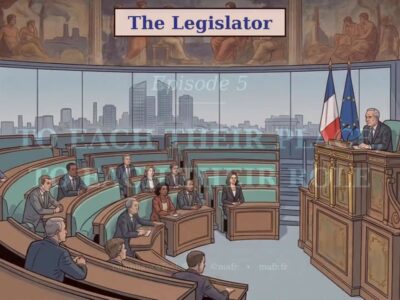
▶ click on the image to watch the episode on YouTube - ► Full reference: M.-A. Frison-Roche, “To Each Their Place, To Each Their Role”, in series of drawn videos Compliance in Motion, episode 5, 12 November 2026 - ► Summary of this episode of Compliance in Motion: In this fifth episode, Ogre Compliance gives the floor to four key characters of Compliance Law: the Legislator, systemic companies, the people concerned and the Judges. Each comes to say what place they hold and what is expected of them. The Legislator sets the Monumental Goals of protecting systems; companies give them concrete form through Compliance tools; the people concerned take part, and future generations are represented; the Judge ensures that everyone keeps to their place: the Judge is therefore central. Each time, Ogre Compliance draws the lesson. If everyone holds their place and plays their role, the alliance between these characters forms all the better: it serves the Monumental Goals of Compliance, which lie in the sustainability of systems and the protection of the human beings involved in them. In just over 3 minutes, to each their place, to each their role! One episode every two weeks, in French and in English. - 🌐 watch this episode of the series on YouTube: Compliance in Motion watch this episode of the series on LinkedIn: Compliance in Motion watch this episode of the series on Instagram: Compliance in Motion 🎬 watch this episode of the series below Compliance in Motion ⬇️ - Compliance in Motion, by mafr the series of drawn videos devoted to Compliance Law ComplianceTech®
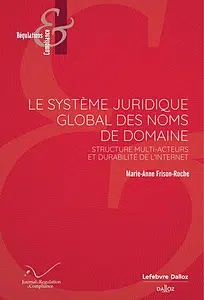
Couverture : Le système juridique global des noms de domaine. Structure multi-acteurs et durabilité de l’Internet

Publication director

🏗️ copublishing and direction of the collection: 📚Régulations & Compliance

📚Forthcoming: 🕴️M.-A. Frison-Roche, 📕Le système juridique global des noms de domaine. Structure multi-acteurs et durabilité de l’Internet (The Global Legal System of Domain Names. Multi-Stakeholder Structure and Sustainability of the Internet)

► Full reference: M.-A. Frison-Roche, Le système juridique global des noms de domaine. Structure multi-acteurs et durabilité de l’Internet (The Global Legal System of Domain Names. Multi-Stakeholder Structure and Sustainability of the Internet), Journal of Regulation & Compliance (JoRC) and Lefebvre-Dalloz, “Régulations & Compliance” series, forthcoming. - 📘 see also the presentation of the book published in English, in the “Compliance & Regulation” series: The Global Domain Name System in Law. Multi-Stakeholder Structure and Sustainability of the Internet, Journal of Regulation & Compliance (JoRC) and Lefebvre-Bruylant, forthcoming. - ► Read the presentations of the other books in the series: the following books: 🕴️M.-A. Frison-Roche (ed.), 📕Le système probatoire de la Compliance, forthcoming   the previous books: 🕴️L. Laref (ed.), 📕Compliance et vigilance bancaire, forthcoming 🕴️M.-A. Frison-Roche (ed.), 📕Compliance et Contrat, forthcoming 🕴️M.-A. Frison-Roche (ed.), 📕L’Obligation de Compliance, 2025 🕴️M.-A. Frison-Roche and M. Boissavy (eds.), 📕Compliance et droits de la défense. Enquête interne – CJIP – CRPC, 2024 🕴️M.-A. Frison-Roche (ed.), 📕La juridictionnalisation de la Compliance, 2023 🕴️M.-A. Frison-Roche (ed.), 📕Les Buts Monumentaux de la Compliance, 2022 🕴️M.-A. Frison-Roche (ed.), 📕Les outils de la Compliance, 2021 🕴️M.-A. Frison-Roche (ed.), 📕Pour une Europe de la Compliance, 2019 🕴️N. Borga, J.-Cl. Marin and J.-Ch. Roda (eds.), 📕Compliance : l’entreprise, le régulateur et le juge, 2018 🕴️M.-A. Frison-Roche (ed.), 📕Régulation, Supervision, Compliance, 2017 🕴️M.-A. Frison-Roche (ed.), 📕Internet, espace d’interrégulation, 2016 📚See all the books of the series. - ► English general presentation of the book: The Internet is a space based on a technical system consisting of IP addresses, all of which can reach one another. This simple technical principle is essential because it is the foundation on which the digital space rests, in that it allows anyone to enter it, move within it and reach others. It is this principle of the open Internet that made possible the construction of the digital space in which we live. This technical system of IP addresses was made easily manageable by domain names. This manageability of IP addresses made the open character of the Internet effective and enabled the expansion of a space that was global from the outset, forming the basis of the digital space. These technical elements were directly translated into the addressing system through domain names, which was built by the Law. The resulting legal system of addressing reflects this technical foundation, and no one can either deny or undo this link: indeed, the Law enables the domain name infrastructure to function effectively on a global scale and in an open manner, where everyone can reach the other. Technical architecture and legal architecture are thus inseparable. This freedom for everyone to create and circulate in the digital space is made possible by technology and guaranteed by the legal organisation of the domain name architecture. This study is structured in two parts. Its first part aims to describe the legal framework of the global domain name system. Its second part examines how to improve this system: it first examines the technical effects produced by scenarios involving changes to the legal framework of addressing, namely a high risk of capture and/or fragmentation of the domain name system by regional zone. It then aims to demonstrate that if the legal organisation of the global domain name system were significantly altered, notably through the establishment of legal addressing zones that are autonomous from one another, the technical imperative of globality remaining paramount, interconnection between the different zones would be necessary and would then be ensured by a public or private actor who could thus effectively seize control of the technical system via these proposed new legal structures of the system, thereby taking over the whole. - ENGLISH PRESENTATION OF THE PROVISIONAL TABLE OF CONTENTS Putting into Perspective PART ONE HOW THE GLOBAL LEGAL SYSTEM OF NAMING IS BUILT CHAPTER I: ICANN: A LEGAL STRUCTURE OF CLASSIC HARD-LAW FORM, REQUIRED BY THE TECHNICAL INFRASTRUCTURE OF THE ADDRESSING SYSTEM, TRANSPOSED THROUGH STATUTES THAT SEPARATE THE POWER TO PROPOSE FROM THE POWER TO ADOPT IN ORDER TO ESTABLISH A “MULTI-STAKEHOLDER” SYSTEM WHOSE PURPOSE AND EFFECT ARE TO PREVENT CAPTURE CHAPTER II: THE EXERCISE BY STATES OF THEIR PREROGATIVES THROUGH NATIONAL PUBLIC LAWS: ARTICULATION BETWEEN THE TWO GEOGRAPHICAL SPACES OF HARD LAW CHAPTER III: INTERNATIONAL SPACES OF HARD AND SOFT LAW: UN, WIPO, ITU, WSIS CHAPTER IV: MIRRORING THE TECHNICAL INFRASTRUCTURE OF THE ADDRESSING SYSTEM, THE INTERMESHED GLOBAL LEGAL STRUCTURE, ARTICULATING THE SPACE OF HARD LAW AND THE SPACE OF SOFT LAW CHAPTER V: INTERNALISATION WITHIN CRUCIAL OPERATORS THROUGH COMPLIANCE TECHNIQUES LINKED TO THE OBLIGATION OF SUSTAINABILITY PART TWO HOW TO IMPROVE THE GLOBAL LEGAL SYSTEM OF NAMING CHAPTER I: ASSESSMENT OF THE RADICAL TECHNICAL TRANSFORMATIONS THAT PROPOSALS TO CHANGE THE LEGAL SYSTEM OF ADDRESSING COULD BRING ABOUT Section 1 ♦️ Assessment of the technical consequences of the legal proposal to transfer the current complex and specific system into an ordinary mechanism of Public International Law Section 2 ♦️ Assessment of the technical consequences of the indirect proposal to establish separate blocks of systems by zone CHAPTER II: MAINTAINING THE LEGAL SYSTEM OF ADDRESSING, GLOBAL, PROTECTED FROM CAPTURE AND ABLE TO ENSURE TECHNICAL SUSTAINABILITY? BY FOSTERING AN INCREMENTAL PROCEDURAL IMPROVEMENT TOWARDS BETTER UNDERSTANDING AND THUS BETTER ACCOUNTABILITY Section 1 ♦️ A grievance, factual but central: the legal system of domain names is hard to understand. Causes and consequences Section 2 ♦️ Making the legal system of domain names more easily understandable to the parties concerned Ex Ante Section 3 ♦️ Explaining clearly, starting from the purposes, the share of technical sustainability and the share of societal sustainability, the former firmly preserved, the latter handled as a debated project Section 4 ♦️ Enhancing soft-law instruments for their discursive, that is explanatory, scope regarding the domain name system within the global governance of the Internet Section 5 ♦️ Making the legal system of domain names understandable to the parties concerned Ex Post: thereby increasing the value of accountability Selected Bibliographical Sources Index
Journal of Regulation & Compliance, Université Paris Cité, CEDAG

Organisation of events

🏗️2026 Colloquia Cycle: "Compliance & Contract"

🧮Compliance et stratégies d’entreprise dans l’organisation contractuelle des chaînes de valeur (Compliance and corporate strategies in the contractual organisation of value chains), in 🏗️Compliance and Contract

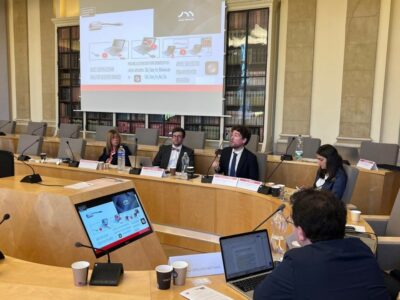
► Full reference: Journal of Regulation & Compliance (JoRC) and Université Paris Cité (Faculty of Law, Economics and Management – Centre de Droit des Affaires et de Gestion, CEDAG), Compliance et stratégies d’entreprise dans l’organisation contractuelle des chaînes de valeur (Compliance and corporate strategies in the contractual organisation of value chains), Malakoff, 16 November 2026, 3 pm – 6 pm. - 🏗️This colloquium is part of the 2026 cycle of colloquia “Compliance & Contract” organised by the Journal of Regulation & Compliance (JoRC) and its partner Universities. - The colloquium is under the scientific responsibility of 🕴️Marie-Anne Frison-Roche, 🕴️Etienne Maclouf and 🕴️Véronique Chanut.   To register, on site or online: Université Paris Cité registration form (free registration, required). - 🧮 The event will take place at Université Paris Cité, Faculty of Law, Economics and Management, Centre for Business Law and Management (CEDAG), 10, avenue Pierre-Larousse, 92240 Malakoff (France). - 📑 The programme of the conference of 16 November 2026 as a carousel - ► Presentation of the theme: “Value chains” have always existed, long before the legal system took hold of this reality, at once economic, financial and managerial, to bring it into the legal order. Their entry into it is recent, probably through the so-called “Vigilance” Act of 2017, the expression appearing in the preparatory works, while it is expressly referred to in the texts of the European Union. It is therefore a notion stemming from financial management, which developed alongside the very phenomenon of the firm and of trade, as a way of escaping the instability of the markets for goods and services. But Law has always been present through the natural use of contract. Contract thus came before the perspective of Compliance Law found its way into value chains, contract being an instrument of stability compared with the exchange contracts on which competitive markets are built, but also in those organisational contracts which regulate value chains and deploy the firm in its corporate form (“parent company”) and beyond its corporate form (“principal company”). Used in what might be called a “bare” way (a reference to the “nude pact” that contract constitutes when it is grasped by general law alone), contract has thus been the means for firms to deploy strategies through the organisation of value chains. The first aim of this colloquium is to show how this is done, and how it is valued, since the term “value” refers to the capacity to give value, in terms of return on investment, to such a contractual organisation. The legal system may remain more or less neutral towards these organisational contracts, which are so many “regulatory contracts”, either because it does not see them, or because it regards them as always beneficial and therefore as justifying neither specific regimes nor legislative or judicial intervention. It is then a matter of legislative or judge-made policy. The second aim of this colloquium is to show how legal systems react, to a greater or lesser extent, to these strategies, depending on whether they know them and whether they approve of them. The development of the law specific to this organisational strategy differs greatly from one area of the world to another, which creates considerable practical difficulties, because value chains are by nature structured in a unified way across the different areas of the world, for instance between Europe and the United States, and/or between Europe and Asia. By injecting regulation into these contracts, which are not governed by a single legal order, corporate strategies lose their stability. Yet stability is the very stake of corporate strategy in this field, and it is for this reason that contracts have been designed and adapted so as to differ from exchange contracts and to become the basis of the sustainability of value chains, which is today a major geopolitical issue. Moreover, and this is the third point of the colloquium, legislative provisions and case law are not hostile to contract, but they take it in another sense. Indeed, if one considers Europe (a position legally and politically contested in the United States, which calls for “deregulation” so as to return to contract as a “nude pact”), contract is rather taken as an instrument provided for by the texts to enable the firm subject to them to implement its Compliance Obligation. This raises no difficulty if the firm’s strategy matches the Monumental Goals that make up the normative foundation of the compliance corpus in question (e.g. DSA, DORA, GDPR, AI Act, CSRD, CS3D, etc.), but the articulation becomes more difficult, or even problematic, when the two strategies no longer match. One of the ambitions of this colloquium, which gives as much room to management science as to Law, is to seek how, in practice, these difficulties can be reduced. - 16 November 2026, 3 pm – 6 pm, followed by a cocktail reception at 6.30 pm, Salle des Actes, Université Paris Cité, Faculty of Law, Economics and Management, Centre for Business Law and Management (CEDAG), 10, avenue Pierre-Larousse, 92240 Malakoff Compliance and corporate strategies in the contractual organisation of value chains 🎤 Welcome on behalf of the CEDAG research centre: 🕴️Pauline Pailler, Professor of Private Law at Université Paris Cité, Director of the Centre for Business Law and Management (CEDAG), member of the Institut universitaire de France 🎤 How contract plays its part in strategy within companies seized by Compliance: 🕴️Marie-Anne Frison-Roche, Professor of Regulatory and Compliance Law, Director of the Journal of Regulation & Compliance (JoRC) and of the European School of Regulation and Compliance (EeRC) 🎤 Contractualisation within integrated value chains: 🕴️Véronique Chanut, Professor of Management Science, Université Paris Panthéon-Assas, Director of LARGEPA and CIFFOP 🎤 Beyond the Clause: Social Auditing and the Contractualisation of Decent Work in Value Chains: 🕴️Guillaume Delalieux, Professor of Management Science (HDR), La Rochelle University, Director of the EOLE research centre (Law and Management) 🎤 Emerging risks, sovereignty and vulnerabilities of value chains: 🕴️Rémy Février, Professor of Management Science (HDR), Conservatoire national des arts et métiers (Cnam) 🎤 Value chain dynamics and compliance: 🕴️Etienne Maclouf, Professor of Management Science, Université Paris Cité, Faculty of Law, Economics and Management 🎤 Structuring value chains: a driver of economic efficiency and strategy, and a matter of political responsibility: 🕴️Stanislas Pottier, Senior Advisor to the General Management, Amundi 🎤 Conclusion of the colloquium: 🕴️Mathias Naudin, Associate Professor (Maître de conférences) of Management Science, Université Paris Cité - The work of this colloquium will form the basis of a specific chapter in the books: Compliance et Contrat (Compliance and Contract), forthcoming in the Regulations & Compliance series, co-published by the Journal of Regulation & Compliance (JoRC) and Lefebvre-Dalloz.
Articles in a JoRC book

BRANELLEC, Gurvan🕴️

📝Compliance, performativité et RegTech : la reconfiguration des dispositifs de vigilance bancaire en matière de LCB-FT (“Compliance, performativity and RegTech: the reconfiguration of banking vigilance mechanisms in AML/CFT”), in 🕴️L. Laref (ed.), 📕Compliance et vigilance bancaire

► Full Reference: G. Branellec, “Compliance, performativité et RegTech : la reconfiguration des dispositifs de vigilance bancaire en matière de LCB-FT” (“Compliance, performativity and RegTech: the reconfiguration of banking vigilance mechanisms in AML/CFT”), in L. Laref (ed.), Compliance et vigilance bancaire. Contribution des acteurs bancaires et financiers à la LCB-FT (Compliance and Banking Vigilance. The Contribution of Banking and Financial Actors to AML/CFT), preface by N. Vasse, Journal of Regulation & Compliance (JoRC) and Lefebvre-Dalloz, “Régulations & Compliance” series, forthcoming. - read a general presentation of the book, Compliance et vigilance bancaire, in which this article is forthcoming - ► English Summary of this article (article written in French, English summary by the Journal of Regulation & Compliance – JoRC): Faced with regulatory inflation and growing requirements of traceability and justification, banks increasingly resort to technological solutions grouped under the term RegTech. The author analyses RegTech not as a mere compliance tool but as a hybrid co-regulation mechanism combining legal norms, technologies, organisational procedures and managerial responsibilities. Drawing on a reading of Compliance as a performative phenomenon and on the figure of the pharmakon, he shows its ambivalence, both a vector of rationalisation and a source of new organisational, ethical and legal risks, and examines the conditions for a legitimate governance of these mechanisms. -

Articles in a JoRC book

DEGRANDE, Cassandre🕴️

📝Uniformiser ce qui se module. Directive et règlement à l’épreuve de la modulation de l’obligation de vigilance LCB-FT (“Standardising what is modulated. Directive and regulation tested by the modulation of the AML/CFT obligation of vigilance”), in 🕴️L. Laref (ed.), 📕Compliance et vigilance bancaire

► Full Reference: C. Degrande, “Uniformiser ce qui se module. Directive et règlement à l’épreuve de la modulation de l’obligation de vigilance LCB-FT” (“Standardising what is modulated. Directive and regulation tested by the modulation of the AML/CFT obligation of vigilance”), in L. Laref (ed.), Compliance et vigilance bancaire. Contribution des acteurs bancaires et financiers à la LCB-FT (Compliance and Banking Vigilance. The Contribution of Banking and Financial Actors to AML/CFT), preface by N. Vasse, Journal of Regulation & Compliance (JoRC) and Lefebvre-Dalloz, “Régulations & Compliance” series, forthcoming. - read a general presentation of the book, Compliance et vigilance bancaire, in which this article is forthcoming - ► English Summary of this article (article written in French, English summary by the Journal of Regulation & Compliance – JoRC): From 10 July 2027, AML/CFT vigilance obligations will no longer be set by a national transposing law but by a directly applicable regulation. The author shows that the regime of modulation changes little, and that one must distinguish what results from the use of a regulation from what results from the content adopted in 2024. The specific effect of the instrument lies in the disappearance of the transposing act as the vehicle for the limits of modulation, the closing of the national interpretative relay and the direct enforceability of the European text. Each State’s exposure to risks does not leave modulation, but it now enters it as information to be taken into account, no longer as a written, foreseeable and debatable limit. -

Articles in a JoRC book

SEIXAS, Paula🕴️ et DUCATEZ, Romain🕴️

📝Le banquier face au défi de la vigilance : entre exigences contradictoires et responsabilités croissantes (“The banker facing the challenge of vigilance: between contradictory requirements and growing responsibilities”), in 🕴️L. Laref (ed.), 📕Compliance et vigilance bancaire

► Full Reference: P. Seixas & R. Ducatez, “Le banquier face au défi de la vigilance : entre exigences contradictoires et responsabilités croissantes” (“The banker facing the challenge of vigilance: between contradictory requirements and growing responsibilities”), in L. Laref (ed.), Compliance et vigilance bancaire. Contribution des acteurs bancaires et financiers à la LCB-FT (Compliance and Banking Vigilance. The Contribution of Banking and Financial Actors to AML/CFT), preface by N. Vasse, Journal of Regulation & Compliance (JoRC) and Lefebvre-Dalloz, “Régulations & Compliance” series, forthcoming. - read a general presentation of the book, Compliance et vigilance bancaire, in which this article is forthcoming - ► English Summary of this article (article written in French, English summary by the Journal of Regulation & Compliance – JoRC): Behind an apparent unity, “banking vigilance” covers a plural body of norms stemming from case law, European professional standards and legal obligations. The authors distinguish in particular the forms of vigilance that derive from the law and serve a general-interest goal – the fight against money laundering and terrorist financing, AMLA standards, the duty of vigilance in sustainability matters – and show how the banker must reconcile sometimes competing requirements: risk control, preservation of public economic order and protection of customers’ interests, in an environment where the banker’s responsibilities keep growing. -

Articles in a JoRC book

LE BESNERAIS, Patricia🕴️

📝L’obligation de compliance LCB-FT, moteur de transformation des pratiques en matière de crédits et de garanties (“The AML/CFT Compliance Obligation, a driver of transformation of practices in credit and guarantees”), in 🕴️L. Laref (ed.), 📕Compliance et vigilance bancaire

► Full Reference: P. Le Besnerais, “L’obligation de compliance LCB-FT, moteur de transformation des pratiques en matière de crédits et de garanties” (“The AML/CFT Compliance Obligation, a driver of transformation of practices in credit and guarantees”), in L. Laref (ed.), Compliance et vigilance bancaire. Contribution des acteurs bancaires et financiers à la LCB-FT (Compliance and Banking Vigilance. The Contribution of Banking and Financial Actors to AML/CFT), preface by N. Vasse, Journal of Regulation & Compliance (JoRC) and Lefebvre-Dalloz, “Régulations & Compliance” series, forthcoming. - read a general presentation of the book, Compliance et vigilance bancaire, in which this article is forthcoming - ► English Summary of this article (article written in French, English summary by the Journal of Regulation & Compliance – JoRC): Despite its strong intuitu personae, the credit agreement does not escape the AML/CFT Compliance Obligation. The author shows that it now permeates the pre-contractual phase (risk analysis distinct from creditworthiness assessment, know-your-customer, choice of distribution channels and intermediaries), the management of the relationship over time and the very content of contracts (KYC clauses, representations and undertakings, rights of suspension or termination, asset freezing). She analyses its effects both in relations with customers and in relations with the institutions’ partners and intermediaries. -

Articles in a JoRC book

LE GOANVIC, Marie🕴️

📝La réception de l’obligation de compliance par les professionnels du secteur bancaire : l’exemple de la LCB-FT (“The reception of the Compliance Obligation by banking sector professionals: the example of AML/CFT”), in 🕴️L. Laref (ed.), 📕Compliance et vigilance bancaire

► Full Reference: M. Le Goanvic, “La réception de l’obligation de compliance par les professionnels du secteur bancaire : l’exemple de la LCB-FT” (“The reception of the Compliance Obligation by banking sector professionals: the example of AML/CFT”), in L. Laref (ed.), Compliance et vigilance bancaire. Contribution des acteurs bancaires et financiers à la LCB-FT (Compliance and Banking Vigilance. The Contribution of Banking and Financial Actors to AML/CFT), preface by N. Vasse, Journal of Regulation & Compliance (JoRC) and Lefebvre-Dalloz, “Régulations & Compliance” series, forthcoming. - read a general presentation of the book, Compliance et vigilance bancaire, in which this article is forthcoming - ► English Summary of this article (article written in French, English summary by the Journal of Regulation & Compliance – JoRC): Beyond a set of specialised regulatory obligations, the fight against money laundering and terrorist financing has become a structuring element of the organisation, governance and operational processes of financial institutions. The author describes this progressive internalisation of Compliance: involvement of commercial functions in identifying risks, risk mapping, customer classification, transaction monitoring and an evidentiary logic. She also points out the questions this movement raises as to its operational acceptability and its reception by customers. -

Articles in a JoRC book

MARCHAND, Jennifer🕴️

📝La réception de la compliance LCB-FT par le secteur bancaire et financier. Modalités d’appropriation, dysfonctionnements structurels et éthique comme condition d’effectivité (“The reception of AML/CFT Compliance by the banking and financial sector. Methods of appropriation, structural dysfunctions and ethics as a condition of effectiveness”), in 🕴️L. Laref (ed.), 📕Compliance et vigilance bancaire

► Full Reference: J. Marchand, “La réception de la compliance LCB-FT par le secteur bancaire et financier. Modalités d’appropriation, dysfonctionnements structurels et éthique comme condition d’effectivité” (“The reception of AML/CFT Compliance by the banking and financial sector. Methods of appropriation, structural dysfunctions and ethics as a condition of effectiveness”), in L. Laref (ed.), Compliance et vigilance bancaire. Contribution des acteurs bancaires et financiers à la LCB-FT (Compliance and Banking Vigilance. The Contribution of Banking and Financial Actors to AML/CFT), preface by N. Vasse, Journal of Regulation & Compliance (JoRC) and Lefebvre-Dalloz, “Régulations & Compliance” series, forthcoming. - read a general presentation of the book, Compliance et vigilance bancaire, in which this article is forthcoming - ► English Summary of this article (article written in French, English summary by the Journal of Regulation & Compliance – JoRC): AML/CFT Compliance is one of the most accomplished forms of Compliance Law. The author shows that its reception by the banking sector brings about a twofold shift: normative, as the obligation of vigilance becomes a continuous requirement to justify the measures implemented; functional, as institutions are mobilised in the service of a general-interest goal without having all the corresponding legal means. Two symmetrical drifts result, compliance washing and de-risking, showing that Compliance driven solely by fear of sanctions may produce conformity without effectiveness or caution without surveillance. Ethics then appears as the condition for the model’s balance. -

Articles in a JoRC book

LASSERRE CAPDEVILLE, Jérôme🕴️

📝Quelques rappels terminologiques utiles… (“Some useful terminological reminders…”), in 🕴️L. Laref (ed.), 📕Compliance et vigilance bancaire

► Full Reference: J. Lasserre Capdeville, “Quelques rappels terminologiques utiles…” (“Some useful terminological reminders…”), in L. Laref (ed.), Compliance et vigilance bancaire. Contribution des acteurs bancaires et financiers à la LCB-FT (Compliance and Banking Vigilance. The Contribution of Banking and Financial Actors to AML/CFT), preface by N. Vasse, Journal of Regulation & Compliance (JoRC) and Lefebvre-Dalloz, “Régulations & Compliance” series, forthcoming. - read a general presentation of the book, Compliance et vigilance bancaire, in which this article is forthcoming - ► English Summary of this article (article written in French, English summary by the Journal of Regulation & Compliance – JoRC): This contribution clarifies the notions on which the book rests. More exposed than others to the risks of money laundering, terrorist financing, corruption and fraud, the banker is bound by an obligation of vigilance (Articles L. 561-4-1 et seq. of the French Monetary and Financial Code), whose importance has constantly grown under the effect of the Compliance Obligation. The author distinguishes regulation, Compliance and conformity, which the “average banker” tends to confuse, and specifies what “banking vigilance” covers, so that the reader can properly appreciate the analyses that follow. -

🎭The Friendship between Ogre Compliance and Sparrowhawk Vigilance

▶ click on the image to watch the episode on YouTube - ► Full reference: M.-A. Frison-Roche, “The Friendship between Ogre Compliance and Sparrowhawk Vigilance”, in series of drawn videos Compliance in Motion, episode 4, 29 October 2026 - ► Summary of this episode of Compliance in Motion: In this fourth episode, a new Character joins Ogre Compliance: Sparrowhawk Vigilance. From the top of his tower, his gaze reaches far and can also look very closely; ever since he was born, within States and companies, he has been looking inside and outside, to prevent harm and disasters. Ogre Compliance needs this gaze: he asks him to help detect and prevent disasters. The Sparrowhawk hesitates: his concern is above all for human beings, and that is why he flies far away. But since systems protect people, he agrees to help the Ogre. He thus becomes the spearhead of Compliance, the gaze through which the Ogre will be able to protect systems. Vigilance is not one more obligation: it is the gaze of Compliance, turned towards the human beings whom systems must protect. In under 2 minutes, a sparrowhawk and an ogre: Compliance truly gives rise to new friendships! One episode every two weeks, in French and in English. - 🌐 watch this episode of the series on YouTube: Compliance in Motion watch this episode of the series on LinkedIn: Compliance in Motion watch this episode of the series on Instagram: Compliance in Motion 🎬 watch this episode of the series below Compliance in Motion ⬇️ - Compliance in Motion, by mafr the series of drawn videos devoted to Compliance Law ComplianceTech®
Hémicycle de l’Assemblée nationale – © Assemblée nationale

📝What the Legislator can, or cannot, do: the example of the CJIP

► Full reference: M.-A. Frison-Roche, “What the Legislator can, or cannot, do: the example of the French judicial public interest […]

Forewords, prefaces

Foreword

📝Positioning Compliance Law in relation to other branches of Law: a practical necessity. The challenge for Business Law, foreword to 🕴️Annika Bauch's book: 📗Droit de l'entreprise et Compliance. Une relation symbiotique ? (Business Law and Compliance: a symbiotic relationship?)

► Full reference: M.-A. Frison-Roche, “Placer le droit de la compliance par rapport aux autres branches du droit : une nécessité pratique. L’enjeu du droit économique” (Positioning Compliance Law in relation to other branches of Law: a practical necessity. The challenge for Business Law), foreword to the book by A. Bauch, Droit de l’entreprise et Compliance. Une relation symbiotique ? (Business Law and Compliance: a symbiotic relationship?), forewords by L. Rass-Masson and M.-A. Frison-Roche, Lefebvre-Bruylant, coll. « Droit, Management & Stratégies », 2026, 578 p. - 🔓Read the English version of this foreword (published in French) below⤵️  

🎭Outside, Inside

- ► Full reference: M.-A. Frison-Roche, “Outside, Inside”, in series of drawn videos Compliance in Motion, episode 3, 16 October 2026 - ► Summary of this episode of Compliance in Motion: The law is passed, but what it targets is on the other side of the world. In this third episode, Ogre Compliance shows that the Compliance rule, legitimate because it was passed by Parliament, struggles to apply precisely because of its great ambition, when it seeks to eradicate corruption across a whole globalised system, or takes as its goal the dignity of persons throughout the digital space, or the protection of human beings all along the value chain. To that end, this ambitious rule is internalised in the crucial operators that are the large systemic companies, which thus enter into an alliance with States and international bodies in defending, today and tomorrow, systems and the human beings involved in them. The Ogre tells us so in three steps: “Outside, the rule is hardly effective.” — “Internalised, the rule reaches its Goal!” — “The rule aims further: the sustainability of systems.” Compliance internalises the ambitions of the Law within companies. In under 2 minutes, Ogre Compliance tells the story of the internalisation of the Monumental Goals (the safeguarding of systems) within systemic companies: enough to open the discussion for anyone who has to explain Compliance Law. One episode every two weeks, in French and in English. - watch this episode of the series on LinkedIn: Compliance in Motion 🎬 watch this episode of the series below Compliance in Motion ⬇️ - Compliance in Motion, by mafr the series of drawn videos devoted to Compliance Law ComplianceTech®
Convention nationale des avocats 2026, MEETT Toulouse, 21-23 octobre 2026

Conferences

🎤Les nouveaux territoires du droit (The new territories of Law), in 🧮Ce qui nous tient : le droit comme promesse collective (What holds us together: Law as a collective promise)

► Full reference: M.-A. Frison-Roche, “Les nouveaux territoires du droit” (The new territories of Law), keynote in Conseil national des barreaux (CNB – French National Bar Council), Convention nationale des avocats 2026 (2026 National Lawyers’ Convention), plenary session 2 Ce qui nous tient : le droit comme promesse collective (What holds us together: Law as a collective promise), Toulouse, MEETT, 23 October 2026. - 🧮 This ten-minute talk is part of the second plenary session of the National Lawyers’ Convention, devoted to Law as a collective promise. - 🖥️ Read the slides supporting this conference (English translation). The slides attached here are an English translation; the slides projected during the conference were in French. Read the original French slides. - ► Presentation of this conference: What happens now happens within companies, including for issues that are not “economic”, with new interlocutors, the “stakeholders”, and with a primary concern: the future, that of systems and that of the human beings who live within them. The new territories of Law are those where decisions are formed and which Compliance Law grasps: governance, conformity and vigilance, sustainability, data, value chains and the new contractual engineering, reputational risks; wherever long-term decisions are made, where responsibilities are allocated, where credible commitments are made. Everyone sees new missions there, for managers, stakeholders, politicians, auditors, judges, lawyers, and even professors, but everyone also feels overwhelmed by unmanageable regulations (NIS 2, DORA, FCPA, DSA, Sapin II, DMA, CSRD…). Lawyers must be present in this ex ante space, to bring out the humanism on which these compliance corpora are founded, to help build lasting alliances enabling companies to play their part in the compliance ambitions, and to organise the new evidentiary culture of all parties, so that the flow of information is credible in amicable, pre-litigation and litigation relationships. This requires particular qualities from the lawyer entering this new territory, which leads from the ex ante towards a new kind of litigation. Law appears there as an alliance, and the lawyer as the one who creates the link so that the European ambition of Law as the cement of systems holds.
Logo-partage-JoRC-Paris1-IRJS

Organisation of events

🏗️Cycle of colloquia 2026: Compliance and Contract

🧮 Compliance et Droit commun des contrats (Compliance and General Contract Law), in 🏗️Compliance and Contract

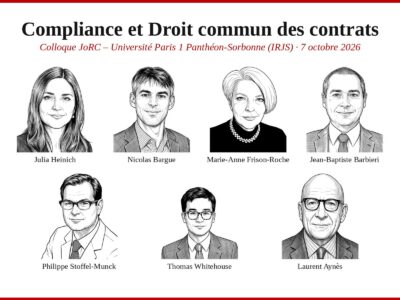
► Full reference: Journal of Regulation & Compliance (JoRC) and Université Paris 1 Panthéon-Sorbonne, Institut de recherche juridique de la Sorbonne (IRJS) (Sorbonne Legal Research Institute), Compliance et Droit commun des contrats (Compliance and General Contract Law), 7 October 2026. see on Instagram the carousel devoted to the conference (in French) see on Instagram the programme of the conference (in French) - 🏗️ This symposium is part of the series of symposiums organised by the Journal of Regulation & Compliance (JoRC) and its partner universities, focusing in 2026 on the general theme of Compliance and Contract. - The symposium is under the scientific responsibility of 🕴️Nicolas Bargue, Senior Lecturer (maître de conférences) at the Sorbonne Law School (Université Paris 1 Panthéon-Sorbonne), co-director of the Contract, Civil Liability and Insurance Department of the IRJS, 🕴️Marie-Anne Frison-Roche, Professor of Law (agrégée des Facultés de Droit), Director of the Journal of Regulation & Compliance (JoRC) and of the European School of Regulation and Compliance (EeRC), and 🕴️Julia Heinich, Professor at the Sorbonne Law School (Université Paris 1 Panthéon-Sorbonne). - Registration with the IRJS: Registration for the symposium « Compliance et droit commun des contrats » of 7 October 2026 | Labo – IRJS - 🧮The symposium, organised by the Journal of Regulation & Compliance (JoRC) and the Institut de recherche juridique de la Sorbonne (IRJS), will take place on Wednesday 7 October 2026, from 9:15 am to 1 pm, at Université Paris 1 Panthéon-Sorbonne, Room 6 of the Centre Panthéon, 12 place du Panthéon, 75005 Paris. It will be held in French. - Presentation of the topic: While Contract Law, in its common rules expressed by the “general theory of contracts”, is often considered to be the most developed branch of Law in practice and the most studied at university, at first glance it seems to be given little consideration when it comes to Compliance. The relationship between the contract and the documents, standards and ethical acts so numerous in Compliance techniques, to which is added the soft law produced by courts, regulators, supervisors and companies themselves, is an open question. Thus the “commitments” that punctuate the techniques and behaviours making up the “compliance culture” have a central place in Compliance Law; but their place, if not their equivalence with the Contract, is not established. To gain a firmer footing in the analysis of the practices of companies that insert compliance clauses into multiple contracts, to observe that Compliance can be the very subject of a specific contract — the “compliance contract” —, or even to assist in the conception that judges develop of their office when they hear contractual litigation involving Compliance, we must return to general Contract Law. If we stop viewing Compliance Law solely through the prism of repression, the Contract does not have the same place: the compliance obligation can be conceived as also having the contract as a legitimate source, a contract which, under general law, has its source in the autonomy of the will and all its consequences — contractual freedom, binding force, effect on third parties. This is the subject of this symposium which, following the classic diptych of formation and performance, takes up the contractual thread from the founding principles of autonomy and freedoms, binding force and its relativity, the meeting of wills, groups of contracts and regulatory contracts often drawn up to implement compliance policies. Specific performance and contractual liability under general law are themselves coloured in a singular way when a compliance concern has been inserted into the contract. - The proceedings of this symposium will form the basis of a specific chapter in the following publications: 📕Compliance et Contrat, forthcoming in the series 📚Régulations & Compliance, co-published by the Journal of Regulation & Compliance (JoRC) and Lefebvre-Dalloz. 📘Compliance and Contract, forthcoming in the 📚Compliance & Regulation Series, co-published by the Journal of Regulation & Compliance (JoRC) and Lefebvre-Bruylant. 🔻 See the programme below

Des étudiants perplexes autour d’une table, deux ouvrages rouges posés devant eux, la chatte Nobelle au premier plan

Videos

Series of drawn videos on Compliance Law — Compliance in Motion

🎭The Mystery of the Monumental Goals

▶ click on the image to watch the episode on YouTube - ► Full reference: M.-A. Frison-Roche, “The Mystery of the Monumental Goals”, in series of drawn videos Compliance in Motion, episode 2, 2 October 2026 - ► Summary of this episode of Compliance in Motion: Students sit around a table; on the table, two books. Three words are given to them — Compliance Monumental Goals — and nobody really sees what that means. The Compliance Ogre, of course, is certain: “Me, me, me! I know what the Monumental Goals are!” And yet, it is no riddle. A Monumental Goal is an edifice: protecting the climate, stopping corruption, respecting others. Compliance Law does not merely forbid, it aims; and because the goal is monumental, no one builds it alone — the judge, the lawyer, the company, the teacher, each brings a stone. That is where Compliance Law draws its normativity, and that is what separates it from mere conformity. They are not decreed. They are built. At the end, the Ogre: “Yes, yes, yes — I said so!” He had not said so. Less than a minute, not a word spoken. One episode every two weeks, in French and in English. - 🌐 watch this episode of the series on YouTube: Compliance in Motion watch this episode of the series on Instagram: Compliance in Motion 🎬 watch this episode of the series below Compliance in Motion ⬇️ - Compliance in Motion, by mafr the series of drawn videos devoted to Compliance Law ComplianceTech®
Séance du colloque « La contractualisation de la Compliance : clause après clause », Université Jean Moulin Lyon 3, 25 septembre 2026

Articles

Article in a MAFR newsletter

📝From Clause to Clause: the Emergence of a Contractual Compliance System

► Full reference: M.-A. Frison-Roche, “From Clause to Clause: the Emergence of a Contractual Compliance System”, Newsletter MaFR Law, Compliance, Regulation, 30 September 2026 (linkedin.com/pulse/from-clause-emergence-contractual-compliance-system-marie-anne-v52ie/) - 🌐 read the article published on LinkedIn - 📧 read other issues of the Newsletter MAFR – Law, Compliance, Regulation by free subscription - 🧮 read the presentation of the colloquium “La contractualisation de la Compliance : clause après clause” (Lyon, 25 September 2026) - 🏗️ read the presentation of the 2026 cycle of colloquia Compliance and Contract - 📕 read the presentation of the book Compliance et Contrat - 🇫🇷 read the French version of this newsletter - 📝 ⤵ read the article below ⤵