
Thesaurus : Doctrine
► Full Reference: D. Gutmann, "Tax Law and Compliance Obligation", in M.-A. Frison-Roche (ed.), Compliance Obligation, Journal of Regulation & Compliance (JoRC) and Bruylant, "Compliance & Regulation" Serie, to be published
____
📘read a general presentation of the book, Compliance Obligation, in which this article is published
____
► Summary of the article (done by the Journal of Regulation & Compliance - JoRC): The author takes up the hypothesis of a Compliance Law defined by its Monumental Goals, the realisation of which is entrusted to "crucial operators" and confronts it with Tax Law. The link is particularly effective since these operators possess what governments need in this area: relevant Information.
Going further, Compliance Law can give rise to two types of obligations on the part of these operators, either towards others operators who need to be monitored, corrected or denounced, or towards themselves, when they need to make amends.
In the first part of this contribution, the author shows that Compliance Obligation reproduces the mechanism of a Tax Law which, for large companies, is embroiled in a process of increasing Globalisation. It enables Governments to aspire to the "Monumental Goals" of combating tax optimisation and impoverishing governments, victims of the erosion of the tax base, in the face of the strategies of companies that are more powerful than they are themselves, by using this very power of firms to turn it against them. Companies become the willing or de facto allies of governments, particularly when it comes to recovering tax debts, or assist them in their stated ambition to achieve social justice. In this way, the State "manages" Tax Law by cooperating with companies.
In the second part, the author outlines the contours of this business Compliance Obligation, which is no longer simply a matter of paying tax. Beyond this financial obligation, it is more a question of mastering Information, particularly when multinational companies are subject to specific tax reporting obligations and are required to reveal their tax strategy, presumed to be transparent and coherent within the group : this legal presumption gives rise to obligations to seek information and ensure coherence, since a single tax strategy is not self-evident in a group.
The author emphasises that companies have accepted the principles governing these new compliance obligations and are tending to transform these obligations, particularly Transparency, into a communication strategy, in line with the ESG criteria that have been developed and a desire for fruitful relations with stakeholders. Therefore the tax relations developed by major companies are being extended not only to the tax authorities, but also to NGOs, by incorporating a strong ethical dimension. This is leading to new strategies, particularly in the area of Vigilance.
The author concludes: "A n’en pas douter, l’obligation de compliance existe bel et bien en matière fiscale." ("There is no doubt that the Compliance Obligation does exist in tax matters").
____
🦉This article is available in full text to those registered for Professor Marie-Anne Frison-Roche's courses
________

Thesaurus : Autorité de Contrôle Prudentiel et de résolution (A.C.P.R.)
Référence complète : Autorité de contrôle prudentiel et de résolution (ACPR), commission des sanctions, décision du 29 avril 2021, Cardif Assurance-Vie

March 12, 2026
Questions of Law

March 12, 2026
Conferences

🌐Follow Marie-Anne Frison-Roche on LinkedIn
🌐Subscribe to the Newsletter MAFR Regulation, Compliance, Law
🌐Subscribe to the video newsletter MAFR Overhang
🌐Subscribe to the Newsletter MaFR Law & Art
____
► Full reference : M.-A. Frison-Roche, "Obligation de compliance et gouvernance bancaire (Compliance obligations and banking governance)", in Chair in Business Ethics: Compliance, ESG and Sustainability Reporting & National Association of Bank Lawyers (ANJB), Compliance et vigilance bancaire : la participation des acteurs du secteur bancaire et financier à la LCB/FT (Compliance and Banking Vigilance: the Participation of Banking and Financial Sector Players in AML/CFT) , Faculty of Law, Catholic University of Lille, Lille, 12 March 2026.
____
🧮view the full programme for the event (in French)
____
____
🌐read the summary of this conference and the colloquium on LinkedIn
____
📝This lecture will form the basis of a contribution to a forthcoming book in the 📚Régulations & Compliance series, co-published by the Journal of Regulation & Compliance (JoRC) and Lefebvre-Dalloz.
____
► English presentation of this introductory lecture of the symposium : Based on a specific method, three perspectives will be taken.
In method, to shed light on the round tables making up the day's meetings without addressing the subject in their place or pretending to answer in advance the questions they will raise, or seeking to conclude in advance without having listened to anything, which is sometimes the flaw of introductions, which are so often a kind of disguised closing statement, with just a few question marks to give the impression of change, I have adopted the old, old method of the "triple funnel" introduction.
This involves starting from a point other than the subject of the conference itself, Compliance and banking vigilance: the participation of banking and financial sector players in AML/CFT, in order to approach the subject from an external perspective and in a preliminary manner, nbsp;then moving on to a second external point, and doing so a third time, so that after this three-part presentation, the subject has been explored in sufficient depth to allow the following speakers to focus on the specific topic at hand.
This is all the easier given that the chosen theme itself focuses on three points: a specific ambition (the "fight against money laundering and terrorist financing"), a specific sector (the "banking sector") and a specific activity carried out by individuals; three specific terms: one ambition (the "fighting agains AML/CFT""activity"). - one sectors (the "banking sector") and one active department (the "participation of stakeholders").
____
My first starting point is to define what Compliance Law is in order to link Compliance Law to the subject it covers: the banking sector. Because if it were simply a matter of "being conform with applicable regulations", it is difficult to understand why the banking sector is so concerned, so constrained, so exposed to "compliance", which is simply the British way of saying "conformity". There must be more to it than simply obeying every rule and standards for preventing breaches for it, to be obliged to be so structuring and for the banking sector to be at the forefront.
It therefore appears that Compliance Law is not simply mechanical obedience to a body of regulations, but rather the contribution made by systemic operators to the realisation of political ambitions that are essential for the future (the "Monumental Goals", both negative and positive). It is in this capacity that the banking sector, because it is composed of "crucial operators", is the natural subject of Compliance Law. Its power should not be criticised; it is indispensable. In an emerging branch of law that is systemic, that is Ex Ante, that is above all a Law of action whose object is the future. Techniques of conformity is only one tool.
⛏️Go further :
🕴🏻M.-A. Frison-Roche, 📝Compliance Law, 2016
🕴🏻M.-A. Frison-Roche, 📝 Monumental goals, the beating heart of compliance law, in 🕴🏻M.-A. Frison-Roche, 📕The monumental goals of compliance, 2022
🕴🏻M.-A. Frison-Roche, 📝The Birth of a New Branch of Law: Compliance Law, 2024
🕴🏻M.-A. Frison-Roche, 📝Compliance and conformity: distinguishing between them in order to articulate them, 2024
____
My second starting point is to start with the "Monumental Goals", this normative foundation of Compliance Law, and link it to this present specific case, privileged ambition of combating money laundering and terrorist financing. Certain things are surprising. Indeed, if we refuse at the introductory stage to delve into the technicalities of the texts and the litigation surrounding them, we may wonder why these two subjects (money laundering and terrorist financing) are linked in this way. We can see the correlation between banking activitird and money laundering. Notaries, auctioneers, and, in short, anyone who handles money are also involved in the fight against it. Moreover, if we see the ratio legis, the idea remains that the one who is merely the conduit (to use the familiar basis distinction in the regulatory rule of essential network infrastructure) could also be the one who organises the content: the image remains of the money laundering banker. Even if the ex ante compliance diligence whitewashes in advance, this suspicion that remains of an ex post sanction. We pay dearly for this representation, which permeates the repressive, even Criminal, Law of banking supervision, particularly in matters of secrecy, transparency, information and risk-taking.
But why extend it to terrorist financing? Because the suspicion of terrorist bankers no longer exists. The case becomes clear-cut again. It is a matter of internalising within banks the sovereign responsibility to intervene before it is too late, before people are killed. Financing is the weak and visible point of systemic evil. This is understandable. It has moved from ex post (financial processing after the crime) to ex ante (financial processing before the crime). It is of a different nature.
But if this is of a different nature, there is no reason to stop this Ex Ante surveillance, because money movements provide so much information about collective and individual projects. For example, in the digital space. We must be careful about this, in light of the principle of freedom, of which the principle of non-interference is only one aspect.
⛏️Go further :
🕴🏻M.-A. Frison-Roche, 📝The Ex Ante - Ex Post Couple, Justification of a Specific Regulatory Law, in 🕴🏻M. -A. Frison-Roche, 📕Les engagements dans les systèmes de régulation, 2006
🕴🏻M.-A. Frison-Roche, 📝Ex Ante Responsability, a pillar of Compliance Law, 2022
🕴🏻M.-A. Frison-Roche, 📝Compliance, Vigilance and Civil Liability: Understanding and Keeping a Level Head, in 🕴🏻M.-A. Frison-Roche, 📕The obligation of compliance, 2025
____
My third starting point is "Governance", a rather mysterious term, as it relates more to the political art of mobilising human beings than to Law. Why is it necessary for "actors" to participate, when legal norms are binding and, in most cases, take the form of Criminal Law? The combination of the most violent norms, the application of financial penalties, and even deprivation of liberty, being often claimed as a victory for financial and banking regulatory and supervisatory bodies , even as procedural principles are being rolled back, could be a source of incomprehension.
Moreover, in a legal system that would be challenged by this "Governance", it is up to the State to dictate and the banks to obey. But if banks take charge of everything, it becomes difficult to maintain this system, and it is undoubtedly no longer tenable if the Monumental Goal expands to dimensions that exceed those of the State but correspond to those of the banks. The risk then is to move from one governing body to another, which is a growing social and political risk.
In practical terms, banking operators can achieve this reversal in two ways. Firstly, by effectively involving the human beings who make up their organisations, both internally and externally, their partners and stakeholders. This can be called "Governance" in an alliance based on explicitcommon goals, with contributions that are not taken at face value but are provided by "compliance structures", "credible behaviour" and "plausible trajectories".
In this respect, mutual banks are in a better position than others. Training mechanisms, which are central to Compliance Law, play an essential role here. Secondly, alliances with public authorities and regional roots, with concrete assessments, are decisive. The contract then becomes not only the mandatory means by which the regulated bank fulfils its regulatory obligation, but also the most traditional legal tool by which it exercises its freedom to contribute, in its own way, to the achievement of Monumental Goals for the future of the social group, which is currently under threat.
We are far beyond "conformity": this is called Compliance Law.
⛏️Find out more :
🕴🏻M.-A. Frison-Roche, 📝A substantive Compliance Law, based on the European humanist tradition,in 🕴🏻M. -A. Frison-Roche, 📕Towards a Europe of Compliance, 2019
🕴🏻M.-A. Frison-Roche, 📝Training: content and context of Compliance Law, in 🕴🏻M. -A. Frison-Roche, 📕Compliance tools, 2020
🕴🏻M.-A. Frison-Roche, 📝Compliance Contract, compliance clauses, 2022
🕴🏻M.-A. Frison-Roche, ⚙️Compliance and Contracts, 2026
🕴🏻M.-A. Frison-Roche, 🏛️Official Mission given by the French Minister of Justice, Compliance Law, Work in progress, 2025 - 2026.
________
March 12, 2026
Questions of Law
Oct. 2, 2025
Thesaurus : Doctrine
► Full Reference: D. Gutmann, "Droit fiscal et obligation de compliance" (Tax Law and Compliance Obligation), in M.-A. Frison-Roche (dir.), L'Obligation de Compliance, Journal of Regulation & Compliance (JoRC) and Dalloz, coll. "Régulations & Compliance", 2025, pp.199-207.
____
► English summary of this contribution (done by the Journal of Regulation & Compliance): The author takes up the hypothesis of a Compliance Law defined by its Monumental Goals, the realisation of which is entrusted to "crucial operators" and confronts it with Tax Law. The link is particularly effective since these operators possess what governments need in this area: relevant Information.
Going further, Compliance Law can give rise to two types of obligations on the part of these operators, either towards others operators who need to be monitored, corrected or denounced, or towards themselves, when they need to make amends.
In the first part of this contribution, the author shows that Compliance Obligation reproduces the mechanism of a Tax Law which, for large companies, is embroiled in a process of increasing Globalisation. It enables Governments to aspire to the "Monumental Goals" of combating tax optimisation and impoverishing governments, victims of the erosion of the tax base, in the face of the strategies of companies that are more powerful than they are themselves, by using this very power of firms to turn it against them. Companies become the willing or de facto allies of governments, particularly when it comes to recovering tax debts, or assist them in their stated ambition to achieve social justice. In this way, the State "manages" Tax Law by cooperating with companies.
In the second part, the author outlines the contours of this business Compliance Obligation, which is no longer simply a matter of paying tax. Beyond this financial obligation, it is more a question of mastering Information, particularly when multinational companies are subject to specific tax reporting obligations and are required to reveal their tax strategy, presumed to be transparent and coherent within the group : this legal presumption gives rise to obligations to seek information and ensure coherence, since a single tax strategy is not self-evident in a group.
The author emphasises that companies have accepted the principles governing these new compliance obligations and are tending to transform these obligations, particularly Transparency, into a communication strategy, in line with the ESG criteria that have been developed and a desire for fruitful relations with stakeholders. Therefore the tax relations developed by major companies are being extended not only to the tax authorities, but also to NGOs, by incorporating a strong ethical dimension. This is leading to new strategies, particularly in the area of Vigilance.
The author concludes: "A n’en pas douter, l’obligation de compliance existe bel et bien en matière fiscale." ("There is no doubt that the Compliance Obligation does exist in tax matters").
____
📕read the general presentation of the book, L'obligation de Compliance, in which this contribution is published
________
June 19, 2025
Thesaurus : Autorité de Contrôle Prudentiel et de résolution (A.C.P.R.)
► Référence complète : ACPR, Comm. sanct., déc. n°2024-02, 19 juin 2025, Banque Delubac et Cie
____
_______

Jan. 2, 2025
MAFR TV : MAFR TV - Overhang

🌐suivre Marie-Anne Frison-Roche sur LinkedIn
🌐s'abonner à la Newsletter MAFR. Regulation, Compliance, Law
🌐s'abonner à la Newsletter Surplomb, par MAFR
____
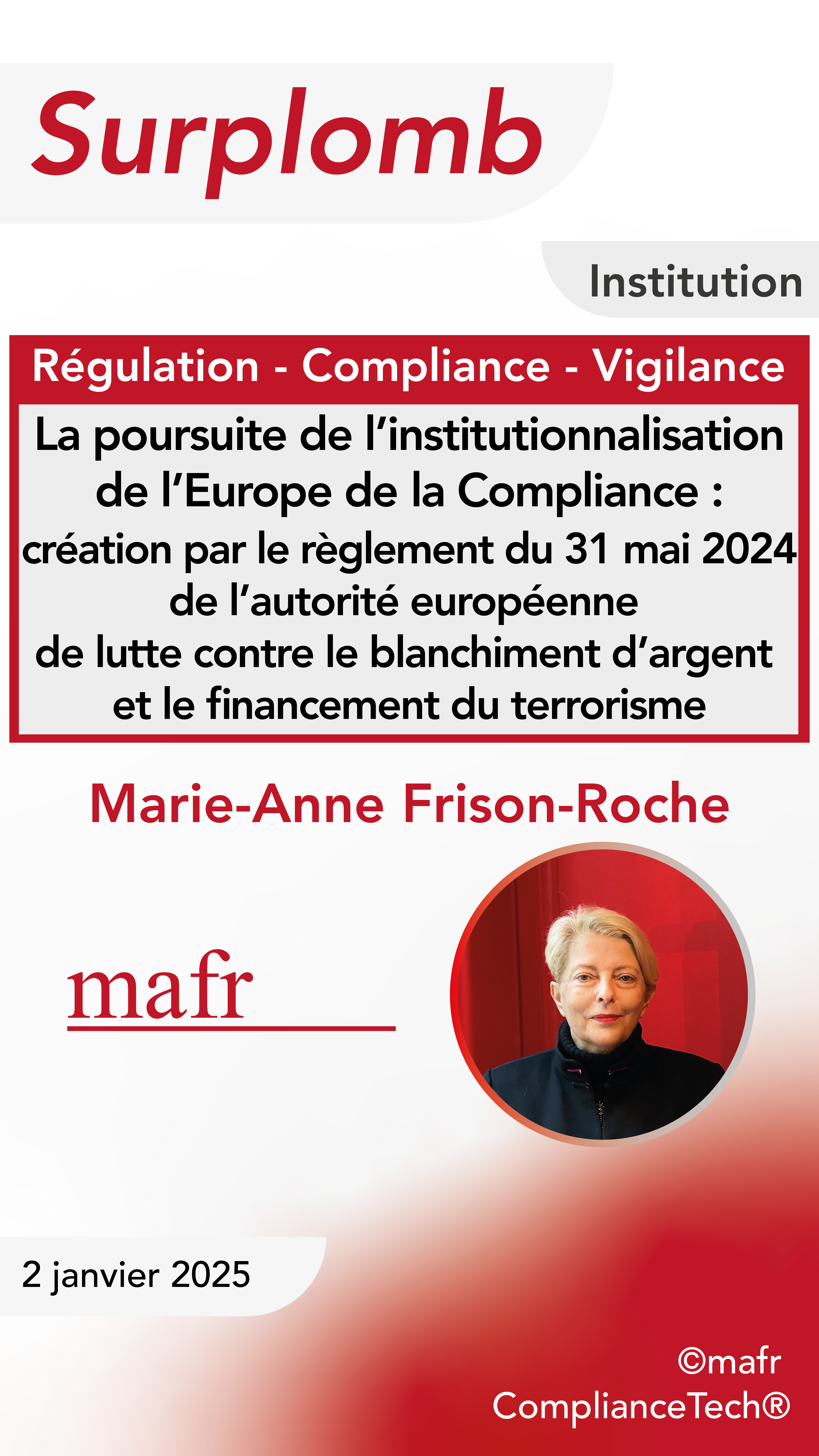
► Référence complète : M.-A. Frison-Roche, "La poursuite de l’institutionnalisation de l’Europe de la Compliance : création par le règlement du 31 mai 2024 de l’Autorité européenne de lutte contre le blanchiment d’argent et le financement du terrorisme (AMLA)", in série de vidéos Surplomb, 2 janvier 2025
____
🌐visionner sur LinkedIn cette vidéo de la série Surplomb
____
____
🎬visionner ci-dessous cette vidéo de la série Surplomb⤵️
____
Surplomb, par mafr
la série de vidéos dédiée à la Régulation, la Compliance et la Vigilance

Oct. 9, 2024
Publications

🌐follow Marie-Anne Frison-Roche sur LinkedIn
🌐subscribe to the Newsletter MAFR Regulation, Compliance, Law
🌐subscribe to the Video Newsletter MAFR Overhang/Surplomb
____
► Full Reference: M.-A. Frison-Roche, Monumental Goals, normative anchoring of Compliance, Working Paper, February 2025.
____
🎬This working document has been drawn up to serve as basis to
the video Overhang👁 of the 1st February 2025: click HERE
____
🎬🎬🎬In the collection of the Overhangs👁 It falls into the Notions category.
►Watch the complete collection of the Overhangs👁 : click HERE
____
► Summary of this Working Paper: Compliance, of which conformity is only one instrument (the 2 should not be confused), must be understood through the ‘Monumental Goals’ : political ambitions pursued by the public authorities and internalised in the entities in a position to achieve them, i.e. large companies.
These Goals are Monumental in that they concern systems: ensuring that these systems do not collapse in the future = ‘Negative Monumental Goals’ (e.g. fight against corruption, against climate change); more ambitious still, they may aim to improve systems = ‘Positive Monumental Goals’ (e.g. effective equality between women and men).
Their systemic nature gives rise to Systemic Litigation.
____
🔓read the developments below⤵️
June 19, 2024
Thesaurus : 02. Cour de cassation

May 31, 2024
Thesaurus : 06.1. Textes de l'Union Européenne
► Full Reference: Regulation (EU) 2024/1624 of the European Parliament and of the Council of 31 May 2024 on the prevention of the use of the financial system for the purposes of money laundering or terrorist financing
____
________
May 31, 2024
Thesaurus : 06.1. Textes de l'Union Européenne
► Référence complète : Règlement (UE) 2024/1624 du Parlement européen et du Conseil du 31 mai 2024 instituant l’Autorité de lutte contre le blanchiment de capitaux et le financement du terrorisme et modifiant les règlements (UE) no 1093/2010, (UE) no 1094/2010 et (UE) no 1095/2010.
____
________
May 31, 2024
Thesaurus : 06.1. Textes de l'Union Européenne
► Référence complète : Directive (UE) 2024/1640 du Parlement européen et du Conseil du 31 mai 2024, relative aux mécanismes à mettre en place par les États membres pour prévenir l’utilisation du système financier aux fins du blanchiment de capitaux ou du financement du terrorisme, modifiant la directive (UE) 2019/1937, et modifiant et abrogeant la directive (UE) 2015/849.
____
________
May 31, 2024
Thesaurus : 06.1. Textes de l'Union Européenne
► Référence complète : Directive (EU) 2024/1640 of the European Parliament and of the Council of 31 May 2024 on the mechanisms to be put in place by Member States for the prevention of the use of the financial system for the purposes of money laundering or terrorist financing, amending Directive(EU) 2019/1937, and amending and repealing Directive (EU) 2015/849
____
________
May 31, 2024
Thesaurus : 06.1. Textes de l'Union Européenne
► Référence complète : Règlement (UE) 2024/1624 du Parlement européen et du Conseil du 31 mai 2024 relatif à la prévention de l’utilisation du système financier aux fins du blanchiment de capitaux ou du financement du terrorisme.
____
________
May 31, 2024
Thesaurus : 06.1. Textes de l'Union Européenne
► Full Reference: Regulation (EU) 2024/1620 of the European Parliament and of the Council of 31 May 2024 establishing the Authority for Anti-Money Laundering and Countering the Financing of Terrorism and amending Regulations (EU) No 1093/2010, (EU) No 1094/2010 and (EU) No 1095/2010
____
________

Feb. 1, 2024
Teachings

🌐follow Marie-Anne Frison-Roche on LinkedIn
🌐subscribe to the Newsletter MAFR Regulation, Compliance, Law
____
► Full Reference: F. Ancel & M.-A. Frison-Roche, Droit de la compliance (Compliance Law), École nationale de la magistrature - ENM (French National School for the Judiciary), in collaboration with the École de Formation professionnelle des Barreaux du ressort de la cour d'appel de Paris - EFB (Paris Bar School), Paris, February 1 and 2, 2024
This teaching is given in French.
____
____
► Presentation of the Teaching: The aim of this two-day conference is to enable judges and lawyers to grasp the issues, objectives and methods that define Compliance Law as it is practised in companies.
The speakers will illustrate the growing trend towards litigation, which is difficult to reconcile with the supranational dimension, or even indifference to territories, for example when disputes concern systemic climate or digital issues: the result is a renewal of the role of the judge and the role of lawyers.
This must be set against the renewal of the role and operation of companies themselves.
This is analysed from the perspective of Civil Law, in particular Contract Law and Liability Law. Company Law and Criminal Law are also addressed, as well as the way in which the legal system now integrates governance, regulation, climate and digital issues and the smooth operation of financial markets through Compliance techniques.
____
► Organisation of the Teaching: This conference is divided into two parts.
The first day is designed as a presentation of the major themes through which Compliance Law crosses the branches of traditional Law. The speakers will be professors of Law who will successively summarise the branches of Law and put into perspective the way in which Compliance imperatives give rise to new situations, new difficulties and new solutions.
This enables the second day to focus on practical and topical issues and to debate controversial questions between people of different sensibilities. The participants tend to be judges, members of regulatory authorities, lawyers, members of associations and so on.
____
► Enrolment procedure: The course is open to all judicial and consular magistrates, as well as lawyers.
Registrations can be made directly with the ENM or with the EFB.
____
► Speakers :
🎤François Ancel, Judge at the Première Chambre civile de la Cour de cassation (First Civil Chamber of the French Court of cassation)
🎤Thomas Baudesson, Attorney at the Paris Bar, Partner at Clifford Chance
🎤Guillaume Beaussonie, Full Professor at Toulouse 1 Capitole University
🎤Jacques Boulard, Premier Président de la Cour d’appel de Paris (First President of the Paris Court of Appeal)
🎤Marie Caffin-Moi, Full Professor at Paris Panthéon-Assas University
🎤Malik Chapuis, Judge at the Tribunal judiciaire de Paris (Paris First Instance Civil Court)
🎤Lucie Chatelain, Advocacy and Litigation Manager - Civil Liability of Parent Companies, Sherpa
🎤Jean-Benoît Devauges, Directeur Juridique, Ethique et Gouvernance des entreprises (Legal, Ethics and enterprises governance Director), MEDEF
🎤Marie-Anne Frison-Roche, Professor of Regulatory and Compliance Law, Director of the Journal of Regulation & Compliance (JoRC)
🎤Arnaud Gossement, Attorney at the Paris Bar, Partner at Gossement Avocats
🎤Thibault Goujon-Bethan, Full Professor at Jean Moulin Lyon 3 University
🎤Christophe Ingrain, Attorney at the Paris Bar, Partner at Darrois Villey Maillot Brochier
🎤Isabelle Jegouzo, Director of the Agence française anticorruption - AFA (French Anti-Corruption Agency)
🎤Anne-Valérie Le Fur, Full Professor at Versailles Saint-Quentin-en-Yvelines University
🎤Charlotte Michon, Attorney at the Paris Bar, partner at Charlotte Michon Avocat
🎤Jean-Baptiste Racine, Full Professor at Paris Panthéon-Assas University
🎤 Jean-Christophe Roda, Full Professor at Jean-Moulin Lyon 3 University
🎤Jérôme Simon, 1er Vice-Procureur Financier (First Financial Vice-Prosecutor)
____
🧮read below the programme put together and organised by François Ancel and Marie-Anne Frison-Roche, as well as the reports of each presentation⤵️
Sept. 27, 2023
Thesaurus : 02. Cour de cassation
Sept. 21, 2022
Thesaurus : 02. Cour de cassation

Sept. 30, 2021
Thesaurus : Soft Law
► Référence complète : Parlement européen, Preventing money laundering in the banking sector reinforcing the supervisory and regulatory framework, 30 septembre 2021.
___
________

June 15, 2021
Compliance: at the moment

► Money Laundering, Cryptocurrency and the Art of Saying It: the Financial Conduct Authority (FCA) statement of June 3, 2021 and the Art of Saying It. Law is softer than ever.
The English have their way of saying things: thus the Financial Conduct Authority -FCA, the British financial market regulator, published on June 3, 2021 a press release whose expression is remarkable. Its subject matter is crypto-assets and, like in an essay plan à la française, it is built in two parts.
In the part I, it is just mentioned that the deadline for companies in this industry to obtain a registration, which was due to end soon, will be postponed to March 2022. Why? Because almost all of them have not been able to demonstrate their ability not to be resistant to money laundering and other criminal activities. This is in no way presented as a conviction, just the objective cause of a postponement of the date, the time for the Financial Regulatory Authority to better examine the files, themselves to be completed by applicants.
The part II concerns consumer protection. The Authority point out that the consumer can lose everything in an extremely risky products and underlines that it is unlikely that this ruined layman will even be able to access the ombudsman to obtain anything. It is purely informative.
This is how the English bodies formulate their opinion on cryptoasset.
It's elegant (the press is more direct).
This also makes it possible not to be covered with insults by the worshipers of these objects: are expressed just a technical delay granted and not a conviction that cryptoasset could be per se an instrument of criminality, just a probationary difficulty ; and just a regret on the non-access to the ombudsman for these cryptoassets consumers.
But if the evolution of the bubble leads these investors to ruine shows, the Regulator will have warned and expressed in advance the regrets he had of the lack of legal technique to protect them. And if the facts show that it is massively through cryptocurrency that the crime is whitewashed, the Regulator has shown everyone his prudence, the delay it will have take to examine the files and its kind foresight.
No one more than a British knows what Liability is.
_____
Feb. 24, 2021
Thesaurus : Jurisprudence
Full reference: Autorité de Contrôle Prudentiel et de Résolution (French Banking Regulator), Commission des sanctions (Commission of sanctions), 24th of February 2021, ING Bank France, procedure n°2020-02
Read the decision (in French)
In this decision, the ACPR Sanctions Commission condemns IGN Bank France to a reprimand and a financial penalty of 3 million euros because of the inadequacy of its measures to fight corruption, money laundering and financing of terrorism.
Extract from the decision summarizing ING France's breaches of its Compliance obligations to fight against corruption, money laundering and financing of terrorism:
"At the time of the on-site check, ING France's risk classification was incomplete and ineffective (grievance 1) and its system for monitoring its business relations (complaint 2) and their operations (grievance 4) presented serious deficiencies, as well as its organization and procedures for fund transfers (grievance 3). The updating of customer knowledge was insufficient (grievance 5), as were the detection of PEPs and the implementation of measures due diligence for this category of clientele (grievance 6). For the implementation of its due diligence obligations, numerous shortcomings were noted, whether these were breaches of the obligation to carry out a reinforced examination (grievance 7) or breaches of the obligation to send Tracfin a DS, initial (grievance 8) or additional (grievance 9). Finally, the detection of persons subject to an asset freezing measure was not fully effective (grievance 10) " (our translation of the decision which is only available in French).

Oct. 15, 2020
Interviews

Full reference: Frison-Roche, M.-A., Et si le secret de l’avocat était l’allié de la lutte contre le blanchiment ?, interview realized by Olivia Dufour for Actu-juridiques, Lextenso, 15th of October 2020
Read the interview (in French)
To go deeper on the place of the attorney in Compliance Law, read Marie-Anne Frison-Roche's working paper: The Attorney, Vector of Conviction in the New Compliance System
Oct. 9, 2020
Newsletter MAFR - Law, Compliance, Regulation

Full Reference : Frison-Roche, M.-A.,Attorney's Professional Secret & Filter mechanism in balance with fighting Money Laundering: constitutional analysis in favor of Attorney's Secret, Newsletter MAFR - Law, Compliance, Regulation, October 9, 2020.
Summary: By its judgment of September 24, 2020, the Constitutional Court of Belgium released an essential judgment which considers:
- Compliance Law which imposes obligations on entities to fight against money laundering and the financing of terrorism is legal requirements which must be analyzed on the basis of these goals
- the national transposition law is "broader" than the transposed European texts since it is anchored in the Constitution
- the provisions of the law imposing the declaration of suspicion on an employee of the Attorney or on a Compliance Officer concerning information covered by the professional secrecy of the Attorney, the basis of Democracy, must therefore be canceled.
This reasoning is remarkable and very solid.
It is not unique to Belgium.
Lire par abonnement gratuit les autres News dans la Newsletter MAFR - Law, Compliance, Regulation
Sept. 24, 2020
Thesaurus : 09. Juridictions étrangères
Full reference: Constitutional Court of Belgium, 24th of September 2020, Décision concernant le recours en annulation partielle de la loi du 18 septembre 2017 relative à la prévention du blanchiment de capitaux et du financement du terrorisme et à la limitation de l'utilisation des espèces (decision concerning the partial annulment appeal of the law of 18th of September 2017 related to money laundering and terrorism financing prevention and to the restriction of the use of cash), n°114/2020
Read the law of 18th of September 2017 (in French)