
Thesaurus : Doctrine
📝Compliance, Value Chains and Service Economy, in 🕴️M.-A. Frison-Roche (ed.), 📘Compliance Obligation
► Full Reference: L. Rapp, "Compliance, Value Chains and Service Economy", in M.-A. Frison-Roche (ed.), Compliance Obligation, Journal of Regulation & Compliance (JoRC) and Bruylant, "Compliance & Regulation" Serie, to be published
____
📘read a general presentation of the book, Compliance Obligation, in which this article is published
____
► Summary of the article (done by the author, translated by the Journal of Regulation & Compliance - JoRC): Based on an analysis of the value chains of companies in the space sector and their recent evolution, this contribution examine the role, place and current transformations of compliance policies and strategies in the context of an industrial transformation that has become essential: the transition from an industrial economy to a service economy.
____
🦉This article is available in full text to those registered for Professor Marie-Anne Frison-Roche's courses
________
Thesaurus : Doctrine
► Full Reference: D. Gutmann, "Tax Law and Compliance Obligation", in M.-A. Frison-Roche (ed.), Compliance Obligation, Journal of Regulation & Compliance (JoRC) and Bruylant, "Compliance & Regulation" Serie, to be published
____
📘read a general presentation of the book, Compliance Obligation, in which this article is published
____
► Summary of the article (done by the Journal of Regulation & Compliance - JoRC): The author takes up the hypothesis of a Compliance Law defined by its Monumental Goals, the realisation of which is entrusted to "crucial operators" and confronts it with Tax Law. The link is particularly effective since these operators possess what governments need in this area: relevant Information.
Going further, Compliance Law can give rise to two types of obligations on the part of these operators, either towards others operators who need to be monitored, corrected or denounced, or towards themselves, when they need to make amends.
In the first part of this contribution, the author shows that Compliance Obligation reproduces the mechanism of a Tax Law which, for large companies, is embroiled in a process of increasing Globalisation. It enables Governments to aspire to the "Monumental Goals" of combating tax optimisation and impoverishing governments, victims of the erosion of the tax base, in the face of the strategies of companies that are more powerful than they are themselves, by using this very power of firms to turn it against them. Companies become the willing or de facto allies of governments, particularly when it comes to recovering tax debts, or assist them in their stated ambition to achieve social justice. In this way, the State "manages" Tax Law by cooperating with companies.
In the second part, the author outlines the contours of this business Compliance Obligation, which is no longer simply a matter of paying tax. Beyond this financial obligation, it is more a question of mastering Information, particularly when multinational companies are subject to specific tax reporting obligations and are required to reveal their tax strategy, presumed to be transparent and coherent within the group : this legal presumption gives rise to obligations to seek information and ensure coherence, since a single tax strategy is not self-evident in a group.
The author emphasises that companies have accepted the principles governing these new compliance obligations and are tending to transform these obligations, particularly Transparency, into a communication strategy, in line with the ESG criteria that have been developed and a desire for fruitful relations with stakeholders. Therefore the tax relations developed by major companies are being extended not only to the tax authorities, but also to NGOs, by incorporating a strong ethical dimension. This is leading to new strategies, particularly in the area of Vigilance.
The author concludes: "A n’en pas douter, l’obligation de compliance existe bel et bien en matière fiscale." ("There is no doubt that the Compliance Obligation does exist in tax matters").
____
🦉This article is available in full text to those registered for Professor Marie-Anne Frison-Roche's courses
________

June 12, 2026
Conferences

🌐Follow Marie-Anne Frison-Roche on LinkedIn
🌐s'abonner à la Newsletter MAFR Regulation, Compliance, Law
🌐Subscribe to the video newsletter MAFR Overhang
🌐Subscribe to the MaFR Law & Art newsletter
____
► Full reference: M.-A. Frison-Roche, "La définition juridique du Contrat de compliance (The legal definition of the compliance contract)", in Journal of Regulation & Compliance (JoRC) published by the Centre for Research on Justice and Conflict Resolution (CRJ) and the Centre for Research in Economics and Law (CRED) at Panthéon-Assas University (Paris II), Le "Contrat de compliance" (The "Compliance Contract"), Paris II Lecture Theatre - 82 Rue Notre Dame des Champs, Paris, 12 June 2026.
____
🧮view the full programme for the event
____
📶view the slides (in French)
____
🌐read the presentation made on LinkedIn
____
🚧Read the bilingual working paper on which this conference is based
____
📝This lecture will form the basis of a contribution to the book, 📕Compliance et Contrat (Compliance and Contracts),
To be published in the 📚Regulations & Compliance series, a book co-published by the Journal of Regulation & Compliance (JoRC) and Lefebvre-Dalloz.
____
► Overview of this lecture : The lecture is divided into three parts.
In the first part, the aim is to describe the reality of the “Compliance Contract”, which can be defined as the decision taken by an entity subject to a “Compliance Obligation” (most often a company, but it may also be a administrative organisation) to entrust the fulfilment of that obligation to a third party. This does not diminish the entity’s obligation to be accountable for the compliance structure, nor for its ability to produce the expected outcomes, in particular the behaviours that will contribute to achieving the Monumental Systemic Goals for which the compliance frameworks were adopted. This outsourcing is lawful; its contractual form falls under Contract Law and the principle of contractual freedom.
Even if one considers that, since the subject matter of the contract is Compliance itself, it would constitute a ‘Systemic Contract’—just as Compliance Litigation is ‘Systemic Litigation’—its fundamental nature is indeed a bilateral relationship between a client and a professional (who is often subject to professional rules and codes of conduct).
Indeed, there are legal consequences to this practice of “Compliance Contracts”, because it is the Compliance System that is thereby served: on the one hand, “regulatory clauses” will be inserted, whilst others will be removed (“deemed unwritten”). Contractual freedom remains the guiding principle, however.
In Contract Law, it would be appropriate for the contracting parties to refer to this contribution to the Monumental Goals, which constitute the fundamental legal norm of the Compliance System, if only to guide the contract Judge who may be called upon in the event of a dispute, as the interpretation of the parties’ intentions must be carried out in a teleological manner.
In the second part, the relationship between this "Compliance Contract" and the various "Compliance Clauses" is analysed. The two should certainly not be confused, since, quite apart from these highly specific contracts through which the various compliance techniques are entrusted, in their drafting and management, to third parties, who thus become the experts, there are also clauses inserted into numerous contracts (sales, distribution, manufacturing, service, etc.), clauses which aim, amongst many other clauses serving different purposes, to incorporate compliance considerations into the contract.
But first and foremost, the Compliance Contract contains numerous clauses specific to it, which often derive from compliance system, since Compliance concretisation is the very purpose of this specific contract, et nothing else: it is therefore logical that, by way of a ‘transparency effect’, the legal Compliance Systemic requirements should be incorporated into the isolated contract.
Secondly, and more significantly, many various contracts contain clauses that provide for the triggering of a “Compliance Ccontract”. For example, when an audit clause is linked to a specific event and the provision stipulates that a contract will then be entered into with a particular expertal body or person, this will generate a Compliance Contract in a second time. The link between the two may give one of the contracting parties control over the other, notably if the expert is close to them. If the links between Compliance Contracts and Compliance Clauses are developping, this could lead to a return to vertical integration. Competition Law may be justified in looking into this.
It appears that, once we have distinguished between Compliance Contracts and Compliance Clauses, and then linked them together, we can arrive at a Contractual Compliance Strategy that is both legitimate and effective, provided that it contributes to the achievement of the Compliance Monumental Goals set by the political and public authorities.
Indeed, as soon as we distinguish between “conformity” – which is intended solely to compel the operator to obey all applicable regulations blindly and mechanically – and “Compliance Law”, which is legally guided by Monumental Systemic Goals, this contractual strategy becomes essential.
Part Three sets out to clarify the scope of this Compliance Contract.
The first implication concerns the Compliance System itself, of which it forms a part; the Compliance Contract having the welcome effect of increasing the operator’s contribution to the achievement of the Monumental Systemic Goals (ensuring that systems – banking, financial, transport, energy, climate, digital, etc.—do not collapse and do not crush human beings, but rather benefit the human beings who are involved in them, whether willingly or not).
To this end, the contract must enable the operator – where necessary by means of express provisions – to demonstrate its credibility in contributing to the achievement of these Monumental Goals. Reliable pathways and credible structures must be established. In the cas of technical implementation is outsourced by a Compliance Contract, this obligation to provide evidence may be undermined. To compensate for this, the Compliance Contract may itself include provisions relating to portable technical information, support available through the client's accountability mechanism, or even in the event of legal proceedings.
The second aspect concerns the contractors themselves, who adapt their intentions and are bound, above all, by this “little law” which is any contract for the parties. This perspective is surprisingly underdeveloped in practice, no doubt because in Law, when considering Compliance, reference is made to unilateral “regulations” and the vertical relationship of obedience that it engenders in the operator. This changes with the transformation of "conformity" (which is that) in "Compliance Law" (which is based on Monumental Systemic Goals and justifies contracts).
The third aspect concerns third parties, namely the stakedholders (and competitors...). These third parties benefit from Compliance Contracts because they are integrated into the Compliance System and because of the transparency between this system and the Compliance Contracts. In fact, and more technically speaking, this specific Cgreement provides them not only with a accountable(the company, the public body, the State), but also with a contractual debtor. Stakeholders may assert rights against the latter.
However, because the contracts themselves are also enforceable against third parties, they can anticipate these relationships with third parties – not only the competitors of the entity subject to the Compliance Obligation, but also its own relationship with stakeholders, and even its relationship with public authorities. Indeed, the object (and effect) of the Compliance Contract is to produce and build up Information that is of interest to everyone. The result is a ‘treasure trove of evidence’. A key question is how, and whether, this treasure trove can remain within the circle of the contracting parties or not.
Indeed, the fourth area concerns Public Authorities. As the bodies that “uphold” the compliance system, they consider the Compliance Contract to be legitimate and one of the most effective means of ensuring that regulations are effective, efficient and properly enforced; however, they also wish to benefit from the outcome of the contract’s implementation: to access the systemic information it generates. The contracting parties do not always share this view, but the Compliance Contract is not a means of “obeying” regulations. It is the Judge who will certainly address this question of principle, which relates to the very definition of Compliance Law.
This brings us to the fifth area of application, which concerns the Courts. Indeed, a number of courts are responsible for hearing such cases: the contract courts, the competition courts, the courts overseeing the various systems whose sustainability is thus safeguarded, and the courts specialising in vigilance legal duty (which is the cutting edge of Compliance Law).
The issue of the “natural judge” was examined at the symposium held on 29 May 2026 on: Contractual litigation involving compliance: procedural and jurisdictional aspects. The judge hearing the contract case (civil or commercial judge) will tend to refer first and foremost to the contract. This is also why the Compliance Contract conceptor would be well advised to include provisions in its terms regarding its relationship with the Compliance System, so that it is not the authorities of that system who do so in a too much discretionary manner.
In understanding the "Compliance Contract", as Iit was emphasised in 2022, in the judge’s interpretation of the contract, the judge is required to reconcile the parties’ intentions with a teleological approach, that is to say, to establish that the parties intended to serve the purpose of the expertise thus requested and developed (for the operator and ultimately for the stakeholders and for the system itself).
By establishing this convergence, the judge gives full effect to the Cmpliance Contract. Rather than framing the issue, as is so often done when reasoning in terms of ‘conformity’, as a conflict between contractual freedom and public policy (conformity serving a public policy that would be contrary to the contract, inferior norm in the vertical normative hiercharchy).
It must be accepted as a fundamental principle that contractual freedom, freedom of contract and a competitive market for compliance expertise are the most effective means of developing a Compliance System that will safeguard interconnected different systems and protect the people involved in them.
____
⛏️Find out more :
🕴🏻M.-A. Frison-Roche, 📝Compliance contract, compliance clauses, 2022
🕴🏻M.-A. Frison-Roche, ⚙️Compliance and Contracts,
________

May 29, 2026
Conferences

🌐suivre Marie-Anne Frison-Roche sur LinkedIn
🌐s'abonner à la Newsletter MAFR Regulation, Compliance, Law
🌐s'abonner à la Newsletter en vidéo MAFR Surplomb
🌐s'abonner à la Newsletter MaFR Droit & Art
____
► Référence complète : M.-A. Frison-Roche, "L'émergence du contentieux contractuel impliquant la Compliance par la convergence des matières", in Journal of Regulation & Compliance (JoRC) et Université Jean Moulin - Lyon 3 (,..), Le contentieux contractuel impliquant la Compliance : aspects procéduraux et juridictionnels, Faculté de droit, Lyon, 29 mai 2026.
____
🧮consulter le programme complet de la manifestation
____
____
🚧Lire le document de travail bilingue sur la base duquel cette conférence est bâti
____
Lire la présentation des deux autres interventions dans ce colloque :
🎥Le maniement du temps dans le contentieux contractuel impliquant la Compliance : de l’urgence au temps long
🎥Le jugement adéquat dans le contentieux contractuel impliquant la Compliance et son exécution efficace
____
🌐Lire le compte-rendu de la conférence et de la manifestation sur LinkedIn
____
📝Cette conférence sera la base d'une contribution dans l'ouvrage, 📕Compliance et Contrat,
à paraître dans la collection 📚Régulations & Compliance, ouvrage coédité par le Journal of Regulation & Compliance (JoRC) et Lefebvre-Dalloz.
____
► Présentation de cette conférence introductive du colloque : S'insérant dans un cycle de colloques sur Compliance et Contrat, ce colloque porte sur une hypothèse procédurale et juridictionnelle précise : celle d'un contentieux contractuel qui est porté devant le "juge du contrat", qu'il soit civil ou commercial, devant lequel est alléguée une obligation de compliance. Quels effets procéduraux et juridictionnels cela produit-il ?
⛏️Aller plus loin :
🕴🏻M.-A. Frison-Roche (codir.), ⚙️Compliance et Contrat, 2026
🕴🏻M.-A. Frison-Roche, 📝Obligation de Compliance : construire une structure de compliance produisant des effets crédibles au regard des Buts Monumentaux visés par le Législateur, in 🕴🏻M.-A. Frison-Roche, 📕L'obligation de compliance, 2025
De nature introductive, ce premier développement vise à décrive la façon dont la question systémique de la compliance doit entrer dans un litige contractuel (la question de la transformation de principe que cela entre sur ce litige est traité par Thibault Goujon-Béthan, qui en montre les spécificités que cela produit.
____
Après avoir rappelé en premier lieu ce qu'est l'obligation de compliance à laquelle certaines organisations sont assujetties et en second lieu souligné le mouvement de juridictionnalisation de la compliance, la conférence décrit tout d'abord la façon dont cette "obligation systémique de compliance va pénétrer dans le contentieux contractuel et va ensuite analyser comment de ce fait la "matière systémique de la compliance" va s'articuler au litige contractuel.
Cette hypothèse est encore assez peu étudiée car, en restreignant l'obligation de compliance à la "conformité", produit un rapport unilatéral à la "masse réglementaire", le contrat (et le contentieux lié) y aurait peu de place.
Au mieux, le contrat serait un "objet passif", la réglementation écrivant ou effaçant des clauses, ce qui est davantage un contentieux réglementaire qu'un contentieux contractuel.
Le développement des "contrats de compliance" et des "clauses de compliance", issus de l'autonomie de la volonté change cela, transposant leur nature systémique et téléologique dans le contentieux qu'un cocontractant ou un tiers va porter devant le juge ordinaire du contrat.
Ce sont surtout les stratégies d'un contractant qui vont insérer dans les éléments du litige la compliance, impliquant donc celle-ci. L'on trouve des décisions de justice qui l'illustrent. Une partie au contrat évoquera son obligation de compliance pour obtenir l'exécution d'une obligation que le contrat ne prévoit pas, ou pour obtenir l'engagement de la responsabiilité contractuelle du cocontractant, ou pour se soustraire à une demande d'exécution de son obligation contractuelle. Dans une stratégie plus globale, le litigant peut évoque son obligation systémique de compliance pour destituer le juge du contrat, ou au contraire pour conférer à celui des pouvoirs que celui-ci n'a pas d'ordinaire.
Cette pénétration stratégique va faire se rencontrer la "matière contractuelle et la "matière de la compliance", la matière étant aussi ce par quoi le juge est saisi. Alors la matière contractuelle est souvent bilatérale, singulière et belligueuse, alors que la "matière de la compliance" est de nature systèmique (ce dont les contentieux répressif et administratif rendent davantage compte) et comprend un part essentiel de gracieux.
⛏️Aller plus loin :
🕴🏻M.-A. Frison-Roche, 📝Contrat de compliance, clauses de compliance, 2022
🕴🏻M.-A. Frison-Roche, 📝 La part du gracieux dans le traitement juridictionnel de la compliance ,in 📗Mélanges en l'honneur de Dominique d'Ambra, 2026
🕴🏻M.-A. Frison-Roche, 📝Contrat de compliance, clauses de compliance, 2022
🕴🏻M.-A. Frison-Roche, 🏛️Mission donnée par le garde des Sceaux, ministre de la Justice, Droit de la Compliance, Travaux en cours, 2025 - 2026.
________
Oct. 2, 2025
Thesaurus : Doctrine
► Full Reference: L. Rapp, "Compliance, Chaines de valeur et Économie servicielle", ", in M.-A. Frison-Roche (dir.), L'obligation de Compliance, Journal of Regulation & Compliance (JoRC) and Dalloz, coll. "Régulations & Compliance", 2025, pp.153-172.
____
📕read the general contribution of the book, L'Obligation de Compliance, in which this contribution is published
____
► English summary of this contribution (done par its author) : Based on an analysis of the value chains of companies in the space sector and their recent evolution, this contribution examine the role, place and current transformations of compliance policies and strategies in the context of an industrial transformation that has become essential: the transition from an industrial economy to a service economy.
_____
🦉This article is available in full text to those registered for Professor Marie-Anne Frison-Roche's courses
________
Oct. 2, 2025
Thesaurus : Doctrine
► Full Reference: D. Gutmann, "Droit fiscal et obligation de compliance" (Tax Law and Compliance Obligation), in M.-A. Frison-Roche (dir.), L'Obligation de Compliance, Journal of Regulation & Compliance (JoRC) and Dalloz, coll. "Régulations & Compliance", 2025, pp.199-207.
____
► English summary of this contribution (done by the Journal of Regulation & Compliance): The author takes up the hypothesis of a Compliance Law defined by its Monumental Goals, the realisation of which is entrusted to "crucial operators" and confronts it with Tax Law. The link is particularly effective since these operators possess what governments need in this area: relevant Information.
Going further, Compliance Law can give rise to two types of obligations on the part of these operators, either towards others operators who need to be monitored, corrected or denounced, or towards themselves, when they need to make amends.
In the first part of this contribution, the author shows that Compliance Obligation reproduces the mechanism of a Tax Law which, for large companies, is embroiled in a process of increasing Globalisation. It enables Governments to aspire to the "Monumental Goals" of combating tax optimisation and impoverishing governments, victims of the erosion of the tax base, in the face of the strategies of companies that are more powerful than they are themselves, by using this very power of firms to turn it against them. Companies become the willing or de facto allies of governments, particularly when it comes to recovering tax debts, or assist them in their stated ambition to achieve social justice. In this way, the State "manages" Tax Law by cooperating with companies.
In the second part, the author outlines the contours of this business Compliance Obligation, which is no longer simply a matter of paying tax. Beyond this financial obligation, it is more a question of mastering Information, particularly when multinational companies are subject to specific tax reporting obligations and are required to reveal their tax strategy, presumed to be transparent and coherent within the group : this legal presumption gives rise to obligations to seek information and ensure coherence, since a single tax strategy is not self-evident in a group.
The author emphasises that companies have accepted the principles governing these new compliance obligations and are tending to transform these obligations, particularly Transparency, into a communication strategy, in line with the ESG criteria that have been developed and a desire for fruitful relations with stakeholders. Therefore the tax relations developed by major companies are being extended not only to the tax authorities, but also to NGOs, by incorporating a strong ethical dimension. This is leading to new strategies, particularly in the area of Vigilance.
The author concludes: "A n’en pas douter, l’obligation de compliance existe bel et bien en matière fiscale." ("There is no doubt that the Compliance Obligation does exist in tax matters").
____
📕read the general presentation of the book, L'obligation de Compliance, in which this contribution is published
________
Oct. 2, 2025
Thesaurus : Doctrine
► Référence complète : J.-Ph. Denis et N. Fabbe-Costes, "Contrainte légale et stratégie des entreprises en matière de Compliance", in M.-A. Frison-Roche (dir.), L'Obligation de Compliance, Journal of Regulation & Compliance (JoRC) et Éditions Lefebvre - Dalloz, coll. "Régulations & Compliance", 2025, pp.369-391.
____
📕lire une présentation générale de l'ouvrage, L'Obligation de Compliance, dans lequel cet article est publié
____
► Résumé de cet article (fait par le Journal of Regulation & Compliance - JoRC) : Dans une perspective de sciences de gestion, les auteurs replacent les lois successivement adoptées dans l'émergence du "développement durable" en matière environnementale, qui a façonné la façon de gérer les entreprises. Cela est venu d'une prise de conscience mondiale des "buts monumentaux" que constitue la préservation de la planète, reposant principalement sur les entreprises. Le changement n'est néanmoins opéré davantage sous la contrainte que d'une façon volontaire, des lois impératives relayant les pressions des parties prenantes.
Les auteurs montrent que les entreprises y ont réagi en intégrant les buts imposés mais n'ont pas pu suivre jusqu'au bout de telles ambitions, faute notamment de comprendre les réglementations très complexes, relayées par des responsabilités pénales et civiles. Les recherches croisant le Droit et la Gestion ont vocation à faciliter en pratique cette mise en oeuvre.
_________
🦉Cet article est accessible en texte intégral pour les personnes inscrites aux enseignements de la Professeure Marie-Anne Frison-Roche

May 28, 2025
Publications

🌐follow Marie-Anne Frison-Roche on LinkedIn
🌐subscribe to the Newsletter MAFR Regulation, Compliance, Law
🌐subscribe to the Video Newsletter MAFR Surplomb
____
► Full Reference: M.A. Frison-Roche, "100 fois remettre la Compliance sur le métier de la Stratégie" (100 times put Compliance back on the Strategy agenda), in Lettre d'information Compliance. Groupe SNCF, 100ième issue, 28 may 2025.
____
📝read the article (in French)
____
► English presentation of this article: This anniversary article sets out what Compliance is and should be in a large group. It expresses it in 4 points:
1. Actively master regulations by understanding their spirit
2. Improving risk detection without taking away the entrepreneurial spirit
3. Promoting convergence and managing conflict
4. Strengthen the company's identity by focusing on its strategic ambitions
________
Nov. 7, 2024
Thesaurus : Doctrine
► Référence complète : Th. Favario, "Le contenu du "rapport de durabilité"", JCP E, 7 nov. 2024, n° 45, doss. 1319, pp. 28-33
____
► Résumé de l'article (fait par l'auteur) : "Mesure emblématique de la directive du 14 décembre 2022 (directive CSRD) désormais transposée en droit interne, le « rapport de durabilité » complète l'information due par les sociétés les plus importantes. Tenues d'y rendre compte de la manière dont elles intègrent « les enjeux de durabilité », ce rapport impose en creux à ces sociétés de s'inscrire dans une dynamique de « durabilité » de nature à influer sur leur organisation et leur activité.".
____
🦉Cet article est accessible en texte intégral pour les personnes inscrites aux enseignements de la Professeure Marie-Anne Frison-Roche
________

Oct. 14, 2021
Thesaurus : Doctrine

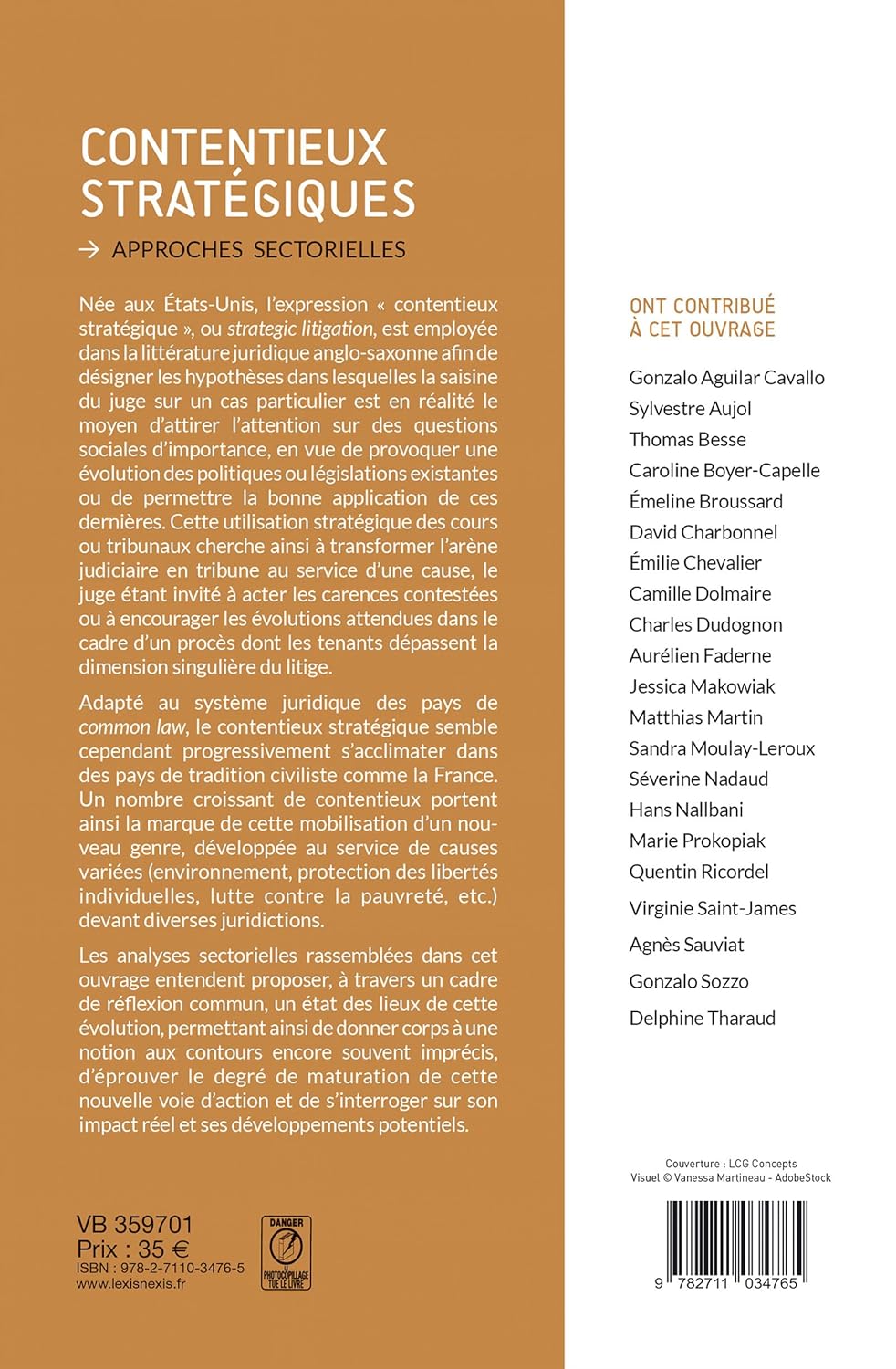
► Référence complète : C. Boyer-Capelle & E. Chevalier (dir.), Contentieux stratégiques. Approches sectorielles, LexisNexis, 2021, 220 p.
____
____
📗lire le sommaire de l'ouvrage
____
📗lire la table des matières de l'ouvrage
____
► Résumé de l'ouvrage (fait par l'éditeur) : "Née aux États-Unis, l'expression contentieux stratégique, ou strategie litigation, est employée dans la littérature juridique anglo-saxonne afin de désigner les hypothèses dans lesquelles la saisine du juge sur un cas particulier est en réalité le moyen d'attirer l'attention sur des questions sociales d'importance, en vue de provoquer une évolution des politiques ou législations existantes ou de permettre la bonne application de ces dernières. Cette utilisation stratégique des cours ou tribunaux cherche ainsi à transformer l'arène judiciaire en tribune au service d'une cause, le juge étant invité à acter les carences contestées ou à encourager les évolutions attendues dans le cadre d'un procès dont les tenants dépassent la dimension singulière du litige.Adapté au système juridique des pays de common law, le contentieux stratégique semble cependant progressivement s'acclimater dans des pays de tradition civiliste comme la France. Un nombre croissant de contentieux portent ainsi la marque de cette mobilisation d'un nouveau genre, développée au service de causes variées (environnement, protection des libertés individuelles, lutte contre la pauvreté, etc.) devant diverses juridictions.Les analyses sectorielles rassemblées dans cet ouvrage entendent proposer, à travers un cadre de réflexion commun, un état des lieux de cette évolution, permettant ainsi de donner corps à une notion aux contours encore souvent imprécis, d'éprouver le degré de maturation de cette nouvelle voie d'action et de s'interroger sur son impact réel et ses développements potentiels".
________

Feb. 6, 2020
Thesaurus : Doctrine
► Référence complète : G. Babinet et Th. Lenoir "Être souverain en 2030 : la gouvernance des infrastructures numériques", Revue internationale et stratégique 2020/2 N° 118 , pages 147 à 153 Éditions IRIS éditions.
____
► Résumé de l'article : Dans une projection sur ce qui est requis d'ici 20240, mes États doivent repenser leur souveraineté numérique en collaborant avec les entreprises. Ils doivent renforcer leur expertise, imposer transparence et audits, notamment en ce qui concerne la 5G et la modération des contenus.La sécurité, la régulation des données, la lutte contre la désinformation et la dépendance technologique sont clés pour protéger les citoyens et les intérêts nationaux.
🦉Cet article est accessible en texte intégral pour les personnes inscrites aux enseignements de la Professeure Marie-Anne Frison-Roche
________

Dec. 16, 2017
Thesaurus : Doctrine

Référence complète : Pons, L., Anonymat des sociétés par actions et transparence : une (r)évolution juridique, in Journal Spécial des Sociétés, Chronique du 16 dec. 2017, n°96, pp. 14-15.
July 2, 2014
Thesaurus : Doctrine

Référence complète : Petit, B., "Reporting" RSE : un nouveau coup d'épée dans l'eau..., in Revue Environnement et développement durable, Lexis-Nexis, juillet 2014, pp.1-16.
L'annonce d'une prochaine directive européenne instaurant un dispositif-cadre de "reporting" d'informations extra-financières paraît, à première vue, être une bonne nouvelle pour ceux qui défendent le concept de responsabilité sociétale des entreprises. L'espoir naît de voir évoluer le dispositif français, objectivement affecté de plusieurs malfaçons tenant notamment au périmètre trop restreint de l'obligation, à la piètre qualité des indicateurs à renseigner et à l'absence de toute sanction juridique directe en cas de manquement. Pourtant, à lire la proposition directive, l'espoir cède rapidement le pas à la déception, tant le texte européen manque d'ambition et de volonté de promouvoir sérieusement l’éthique d'entreprise. tout laisse à penser qu'une fois encore, les pouvoirs publics ont manqué une belle occasion de conférer, en droit, un peu de substance à ce concept pourtant déterminant pour l'avenir de la planète et le progrès social.
Les étudiants de Sciences-Po peuvent consulter l'article via le Drive, dossier "MAFR- Regulation & Compliance"

Sept. 15, 2010
Editorial responsibilities : Direction de la collection "Droit et Économie", L.G.D.J. - Lextenso éditions (30)

Références complètes : FRISON-ROCHE, Marie-Anne, Usage stratégique des droits et abus de droit dans l’application du droit de la concurrence au secteur du médicament, in FRISON-ROCHE, Marie-Anne (dir.), Concurrence, santé publique, innovation et médicament, coll. Droit et Economie, LGDJ, Paris, 2010, p.371-383.
Il s'agit de la 14ième édition de la collection
Le droit subjectif est un intérêt légitime juridiquement protégé. Dans sa définition classique, chacun en fait un usage égoïste. Sur un marché l’agent en fait un usage offensif, c’est à dire l’insert dans une action pour servir un but, ce qui correspond à la définition de la stratégie. Lorsque le rapport sectoriel de la Commission européenne sur le secteur du médicament reproche l’utilisation de droits, notamment de propriété intellectuelle, à des fins stratégiques, notamment lutter contre les concurrents, elle méconnait ce qu’est un droit subjectif et ce qu’est le marché. Là où il doit y avoir un contrôle, ce n’est pas sur l’usage stratégique, car tout entrepreneur est un stratège, mais sur l’abus de droit. L’abus doit être prouvé par les autorités de poursuite et les autorités de concurrence. Aller au-delà, c’est vouloir organiser le marché en se substituant au dynamisme de ses agents.