
Nov. 18, 2024
Conferences

🌐follow Marie-Anne Frison-Roche on LinkedIn
🌐subscribe to the Newsletter MAFR Regulation, Compliance, Law
🌐subscribe to the Newsletter Surplomb, par MAFR
____
► Full Reference: M.-A. Frison-Roche, "Choix et embranchements de compétences lorsqu'un enjeu de vigilance est allégué" ("Choice and Branching of Jurisdiction when a Vigilance issue is Alleged"), in Le Droit processuel de la Vigilance (Vigilance General Procedural Law), in cycle of conference-debates "Contentieux Systémique Émergent" ("Emerging Systemic Litigation"), organised on the initiative of the Cour d'appel de Paris (Paris Cour of Appeal), with the Cour de cassation (French Court of cassation), the Cour d'appel de Versailles (Versailles Court of Appeal), the École nationale de la magistrature - ENM (French National School for the Judiciary) and the École de formation des barreaux du ressort de la Cour d'appel de Paris - EFB (Paris Bar School), under the scientific direction of Marie-Anne Frison-Roche, November 18, 2024, 11h-12h30, Cour d'appel de Paris, Cassin courtroom
____
🕴️An other speaker to this conference is Natalie Fricero, Emeritus Professor at Côte d'Azur University
🧮see the full programme of this event
____
⚙️This event was conceived as part of the "Emerging Systemic Litigation" cycle of conference-debates, organized by the Paris Court of appeal, in conjunction with the French Court of cassation, the Versailles Court of appeal, the French National School for the Judiciary and the Paris Bar School, under the scientific direction of Marie-Anne Frison-Roche.
____
► English Summary of the conference: This speech opens the conference. It therefore logically focuses on the question of "jurisdictional competence". It is divided into successive points which are progressively linked to each other.
The first point consists to insist on this rule : the organisation of the courts and their jurisdiction can never be detached from the substance of the matter in dispute. This explains why the issue of jurisdiction is such a source of passion for as long as the very definition of Vigilance remains so contentious, and why the 2021 legislature's belief that it could put out the fire has only served to exacerbate it.
The second point relates to the first proposed solution, i.e. maintaining the exclusivity of the Paris First Judicial Court, which is acceptable in principle because by specialising judges acquire a "technical competence" but which presents a very damaging "Bibendum risk".
The third point relates to the second solution proposed, namely the reference to the Motulskian notion of the 'basis of demand', which provokes a fork in the road, with the risk of interminable conflicts and divergent interpretations.
The fourth point is the need to find the best solution, i.e. the least bad solution, consisting above all of forming practical alliances, without requiring new texts, for this particular type of litigation which does not come under any branch of Law and which justifies a dialogue between the heads of the courts.
____
🔓read the key points of this speech below ⤵️
________
Nov. 18, 2024
Conferences

🌐follow Marie-Anne Frison-Roche on LinkedIn
🌐subscribe to the Newsletter MAFR Regulation, Compliance, Law
🌐subscribe to the Newsletter Surplomb, par MAFR
____
► Full Reference: M.-A. Frison-Roche, "Les spécificités à concevoir dans l'audience publique des contentieux systémiques de vigilance" ("The Specific Features of Public Hearings to conceive on Vigilance Systemic Litigation"), in Le Droit processuel de la Vigilance (Vigilance General Procedural Law), in cycle of conference-debates "Contentieux Systémique Émergent" ("Emerging Systemic Litigation"), organised on the initiative of the Cour d'appel de Paris (Paris Cour of Appeal), with the Cour de cassation (French Court of cassation), the Cour d'appel de Versailles (Versailles Court of Appeal), the École nationale de la magistrature - ENM (French National School for the Judiciary) and the École de formation des barreaux du ressort de la Cour d'appel de Paris - EFB (Paris Bar School), under the scientific direction of Marie-Anne Frison-Roche, November 18, 2024, 11h-12h30, Cour d'appel de Paris, Cassin courtroom
____
🕴️An other speaker to this conference is Natalie Fricero, Emeritus Professor at Côte d'Azur University
🧮see the full programme of this event
____
⚙️This event was conceived as part of the "Emerging Systemic Litigation" cycle of conference-debates, organized by the Paris Court of appeal, in conjunction with the French Court of cassation, the Versailles Court of appeal, the French National School for the Judiciary and the Paris Bar School, under the scientific direction of Marie-Anne Frison-Roche.
____
► English Summary of the conference:
________
Nov. 15, 2024
Conferences

🌐follow Marie-Anne Frison-Roche on LinkedIn
🌐subscribe to the Newsletter MAFR Regulation, Compliance, Law
🌐subscribe to the Newsletter Surplomb, par MAFR
____
► Full Reference: M.-A. Frison-Roche, "Considérer la géographie pour réussir le Devoir de Vigilance" ("Taking Geography into account for a successful Vigilance Duty"), concluding speech in Devoir de vigilance, quelles perspectives africaines ? Regards croisés en droit international, droit comparé et droit OHADA (Vigilance Duty : what African perspectives? Cross-analysis of International Law, Comparative Law and OHADA Law), Institut de Recherche en Droit des Affaires et du Patrimoine (IRDAP), Bordeaux, 15 November 2024.
____
🧮see the full programme of this manifestation (in French)
____
► English summary of this concluding speech: This concluding speech was made "on the bench", i.e. directly after listening to all the day's speakers. It is not, therefore, based on an a priori conception of the subject, but on the impression that emerged from the whole, as one speaker followed another.
The general impression is that these compliance instruments, of which the vigilance tool is the spurred head, are only appropriate if they fulfill the purpose for which they were devised and imposed, which presupposes that they are appropriate to the concrete situations to which they apply: to the country, to the legislation that shapes and expresses this country, to its economy, to its population.
There is certainly room for improvement. But Vigilance legal instruments, like Compliance Law, are new mechanisms that are in the process of taking shape: we must seek to improve them and find solutions:
🧱🕴🏻mafr, 🚧Duty of Vigilance: the way forward, 2024
This is not easy, especially if we get lost in the jigsaw puzzle of texts and decisions in which the vigilance technique fits, particularly at French, European and international level:
🧱🕴🏻mafr, 🚧Vigilance, a piece of the European puzzle, 2023
Listening to all the many and varied speakers, it is clear that progress needs to be made to ensure that the Vigilance instrument takes greater account of the concrete situations reflected in the various legal systems of African countries, and in particular the unified OHADA legal system.
It can be done, as long as everyone is willing to bear it in mind.
🧱🕴🏻J.-B. Racine, 📝Geographical dominance in the choice and the use of compliance tools. Introductory remarks, in 🧱🕴🏻mafr (ed.), 📘Compliance Tools, 2021
The speakers demonstrated that the good feelings of Paris or Brussels can pave the way for African hell, for example when about the children labour. The same is true of the fight against corruption, as Mohamed Salah showed.
🧱🕴🏻M.M. Salah ,📝Conception and Application of Compliance in Africa, in 🧱🕴🏻mafr (ed.), 📘Compliance Tools, 2021
____
Meanwhile, listening to each other, it appears that often, despite using the same words, the speakers were not talking about the same thing, particularly not in terms of what the very term "Vigilance" refers to, the difference between the French and English being a challenge because "due diligences" are not the same than Vigilance duty . This is a sign that what we call a duty, or an obligation, or a spontaneous commitment, or a legal order criminally sanctioned, which are not at all the same thing, shows the immaturity of this notion of "Vigilance". What's more, we sometimes talk about the climate, or human rights, or the need to fight corruption or money laundering. These latter concerns are undoubtedly covered by texts classified under Compliance Law, some of which assert that Vigilance is the cutting edge, while others claim that Compliance is alien to or merely a component of Vigilance, because Vigilance embraces ethics, while Compliance is merely obedience to the norm ('conformity').
It is clear that the absence of an agreement on definitions is a handicap in practice, as we do not know which legal regime will apply. This uncertainty is problematic in practice because the regulations don't lay down definitions which alone make it possible to deduce the outline of the obligations of each party, particularly not those of the companies, which ask for instructions for use. Companies receive contradictory interpretations for the same situation, depending on who you are dealing with (a regulator or an NGO for example) or depending on the text (a text specific to the industrial activity, a text specific to the country, or a text from the country of the ordering company on the duty of vigilance, or a text from ordinary contract law or a text that will come from a soft law that remains rather mysterious).
This uncertainty feeds the passion that surrounds the issue of vigilance, with everyone speaking out, the specialists who want to talk about it being suspected of being a technocrat or captured, and those who don't speak out being the local population for whom others speak out.
As a result, two phenomena are set to persist, which we had hardly anticipated but which are set to increase: the contractualisation of all vigilance mechanisms and the jurisdictionalisation of all vigilance organisation.
____
The first phenomenon is the contracting of Vigilance. This contractualisation is the means by which companies have been carrying out their legal compliance obligations for years, using a contractual art that is becoming increasingly sophisticated.
We have very little information on these contracts, which are nonetheless what allow companies to obey the regulations and also to add to them, a combination of obedience and contractual freedom, the effects of which in practice have not yet been fully measured.
🧱🕴🏻mafr, 🚧Will, Heart and Calculation, the Three Traits Encercling the Compliance Obligation, 2024
🧱🕴🏻mafr (ed.), 📘Compliance and Contract, 2025
But they do raise essential questions. Firstly, they will bring back the jurisdiction of general courts , for example the commercial courts (tribunaux de commerce) in France, and the courts of the countries where the industrial operations take place: moreover, they are the natural route to international arbitration. They are a new type of contract, since they structure "value chains" (a managerial concept).
🧱🕴🏻mafr, 🚧Compliance Contract, Compliance Clauses, 2022
There are two key issues concerning these contracts: they directly concern African countries, their economic activity and their populations, as described throughout all the speeches.
The first is to know who governs the structural apparatus constituted by these 'regulatory contracts' through which chains of activity are built as durable structures. Who is strong and who is weak, between companies and states?
The second is to find out how much of the reality of the country and of local economic activity is taken into account by the subsidiary, and how much consideration is given to the local people involved: are the people who are actually involved really "taken into consideration" when we speak for them? Who is best placed to speak on their behalf, to defend them, to get to know them?
If we want to contextualise, refine and get to know the situation as closely as possible, in other words if we want to have definitions so that we know what we are talking about, but at the same time start from geographical and human realities, then it is the Judge who appears because the court starts from the facts.
____
This is the second phenomenon that has emerged and is set to increase: the jurisdictionalisation of Vigilance.
🧱🕴🏻mafr (ed.), 📘Compliance Jurisdictionalisation, 2023
This is understandable, since the judge is able to take cognisance of the facts, the situation in Uganda or Tanzania, and what is often referred to as the "extraterritoriality" of the Compliance mechanisms being thus compensated for.
However, the exclusive jurisdiction of the Paris Court of First Instance (decided in France by a 2021 law) may become more difficult, as it is even further away from Africa than the ordering company is. But it is precisely the contract judges who can be called upon to rule on the basis of Contract Law.
This central role of the judge raises a number of procedural difficulties that have either not yet been resolved, moreover are not still being perceive
🧱🕴🏻mafr (dir.), 🧮Le Droit processuel de la Vigilance (Vigilance Genreral Procedural Law), 2024
At the interface between procedure and substance, evidentiary issues require the development of a new evidentiary system. When the relevant facts are in Africa but the company accountable for them is in France under legislation adopted in Europe, this must be taken into account.
🧱🕴🏻mafr, 📝The Judge, the Compliance Obligation and the Company. The Compliance Evidence System, in 🧱🕴🏻mafr (ed.), 📘Compliance Jurisdictionalisation, 2023
What's more, since the Monumental Goal is to prevent, manage and detect risks, it is the future that is the main object of proof. A difficult subject by its very nature of the future, which calls for caution. Caution is to be expected from Judges, who may prefer the solution of an agreement: the contract and the commitment come back, for example through mediation, among the methods of conflict resolution.
But as close as possible to where it happens, OHADA's courts can then be called upon to hear States and populations.
What is more, in contractualisation (at which point the two major phenomena, contractualisation and jurisdictionalisation, enter into a dialectic), the clauses work together to activate the natural judge of the international contract, including vigilance clauses: the international arbitrator.
🧱🕴🏻L. Aynès, 📝How international arbitration can reinforce the Compliance Obligation, in 🧱🕴🏻mafr (ed.), 📘Compliance Obligation, 2025
OHADA has institutional arbitration mechanisms.
Now is the time to guide them so that they open up Africa to Vigilance and open up Vigilance to Africa.
In concrete terms.
________

Oct. 21, 2024
Thesaurus : Doctrine
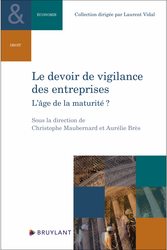
► Référence complète : Ch. Maubernard & A. Brès (dir.), Le devoir de vigilance des entreprises. L'âge de la maturité ?, Bruxelles, Bruylant, coll. "Droit & Économie", 2024, 258 p.
____
____
📗lire le sommaire de l'ouvrage
____
📗lire la table des matières de l'ouvrage
____
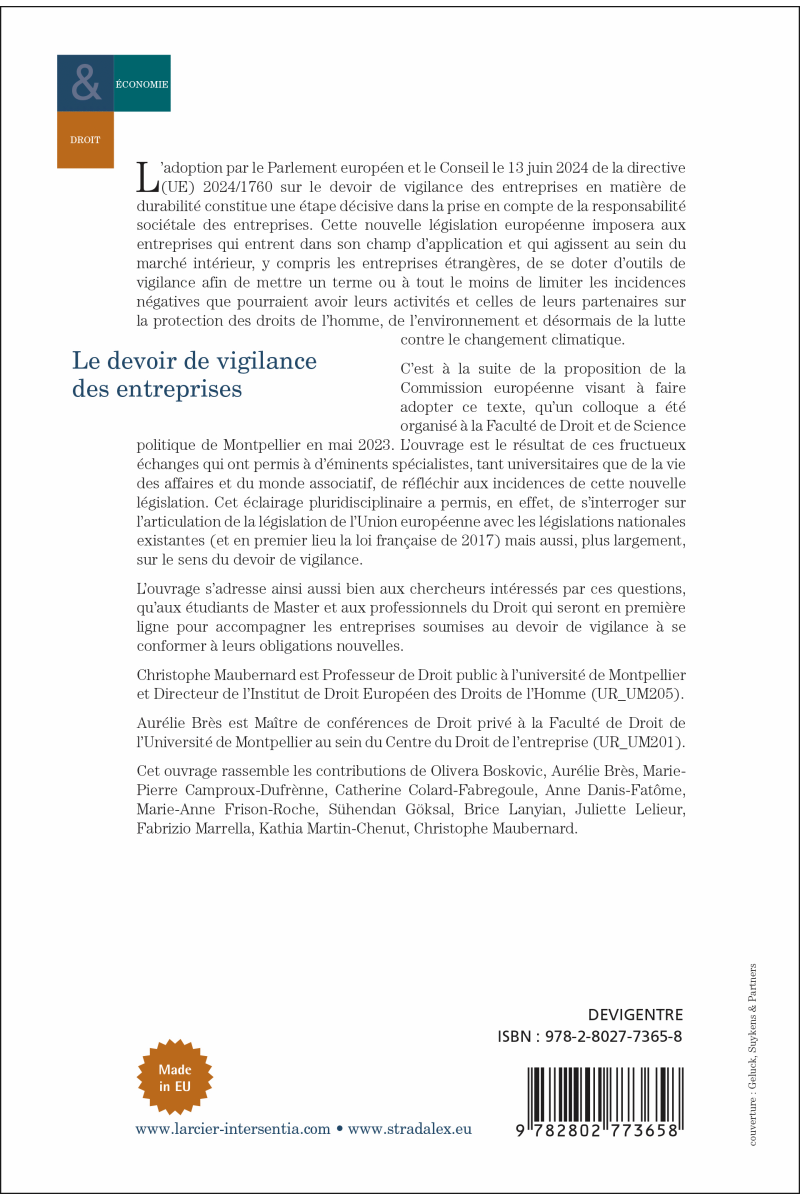
► Présentation de l'ouvrage (fait par l'éditeur) : "L’adoption par le Parlement européen et le Conseil le 13 juin 2024 de la directive (UE) 2024/1760 sur le devoir de vigilance des entreprises en matière de durabilité constitue une étape décisive dans la prise en compte de la responsabilité sociétale des entreprises. Cette nouvelle législation européenne imposera aux entreprises qui entrent dans son champ d’application et qui agissent au sein du marché intérieur, y compris les entreprises étrangères, de se doter d’outils de vigilance afin de mettre un terme ou à tout le moins de limiter les incidences négatives que pourraient avoir leurs activités et celles de leurs partenaires sur la protection des droits de l’homme, de l’environnement et désormais de la lutte contre le changement climatique.
C’est à la suite de la proposition de la Commission européenne visant à faire adopter ce texte, qu’un colloque a été organisé à la Faculté de Droit et de Science politique de Montpellier en mai 2023. L’ouvrage est le résultat de ces fructueux échanges qui ont permis à d’éminents spécialistes, tant universitaires que de la vie des affaires et du monde associatif, de réfléchir aux incidences de cette nouvelle législation. Cet éclairage pluridisciplinaire a permis, en effet, de s’interroger sur l’articulation de la législation de l’Union européenne avec les législations nationales existantes (et en premier lieu la loi française de 2017) mais aussi, plus largement, sur le sens du devoir de vigilance.
L’ouvrage s’adresse ainsi aussi bien aux chercheurs intéressés par ces questions, qu’aux étudiants de Master et aux professionnels du Droit qui seront en première ligne pour accompagner les entreprises soumises au devoir de vigilance à se conformer à leurs obligations nouvelles.".
____
📝consulter une présentation de l'article de Marie-Anne Frison-Roche : "Devoir de vigilance : progresser"
________

Oct. 21, 2024
Publications
🌐follow Marie-Anne Frison-Roche on LinkedIn
🌐subscribe to the Newsletter MAFR. Regulation, Compliance, Law
🌐s'abonner à la Newsletter Surplomb, par MAFR
____
► Full Reference: M.-A. Frison-Roche, "Devoir de vigilance : progresser" ("Duty of Vigilance: the Way Forward"), in Ch. Maubernard & A. Brès (eds.), Le devoir de vigilance des entreprises. L'âge de la maturité ? (The duty of vigilance. The age of maturity?), Bruylant, "Droit & Economie" Serie, 2024, pp. 221-251
____
📝read the article (in French)
____
🚧 read the bilingual Working Paper which is the basis of this article, with additional developments, technical references and hyperlinks
____
► English Summary of the article: In 2017 in France the so-called Vigilance law expressed great ambition. So did the draft directive. But in 2024 the European institutions moderated this ambition by refusing to increase either the type of companies subject and the constraints to which the duty of vigilance is associated. The directive has essentially halted what was for some the "march of progress". Does the ambition no longer exist? Does the future lie in an extension of the philosophy of the duty of vigilance, i.e. companies that should always be more concerned about others? This would undoubtedly be reaching the "age of maturity", where others see the age of madness, because it would be a contradiction in terms to ask a company to be concerned about anything other than its own development.
It is therefore appropriate to consider this very hypothesis of an "age of maturity" as being an ambition maintained despite a European directive which, in its adopted version, is weakened and while the oppositions are intact (I). First of all, it must be admitted that the notion of "maturity" most often conceals a value judgment when applied to a legal concept (I.A.) and that this is blatantly obvious with regard to the duty of vigilance, which is considered by some and by nature by some as a good and by others as an evil (I.B).
In order not to remain in what appears to be trench warfare, we must not get too bogged down in the reference French legislation of 2017 and what appears to be a European stutter in 2024, arguing so loudly that we can hear them reasoning in print, by paying attention to less visible and now more promising avenues of progress (II). In fact, the duty of vigilance can progress simply by the passage of time (II.A), by a better definition of the vocabulary (II.B), by the consolidation of the principles of Responsibility and Dialogue (II.C), by the uniqueness of the jurisdictional route (II.D).
This last perspective of the progress that will be made possible in France by the uniqueness of the judicial route leads to a final avenue of progress. By their very nature, laws are jolts, all the more violent for being disputed. At the moment, if we want to make progress, these two other sources - the contract and the judge - must be favoured (III). The European directive is rightly concerned with access to the courts and takes a measured view of the effectiveness of contracts as a means of making the duty of vigilance effective, with the courts having to ensure that the contract does not destroy the spirit of the system. This is what the law already organises about the relationship between the contract, the judge and the duty of compliance (III.A). What is new in Europe in 2024 is the introduction of a Supervisor (III.B). Here again, vigilance is the "cutting edge" of Compliance Law, as it is an extension of Regulatory Law.
The result is that, through interpretation and the handling of principles, and to formulate a more general conclusion, it is the judge who holds and will hold the balance of the duty of vigilance.
________

Oct. 17, 2024
Thesaurus : Doctrine
► Référence complète : G. Blanc, "Les chaînes de valeur mondiales : approche juridique", JCP E, 17 oct. 2024, n° 42, étude 1300, pp. 19-25
____
► Résumé de l'article (fait par l'auteur) : "Le cycle de vie des produits manufacturés s’inscrit aujourd’hui généralement dans le cadre de chaînes de valeur souvent mondiales. Ces chaînes de valeur sont structurées soit par des groupes de contrats, soit par le biais de groupes de sociétés, soit en ayant recours à ces deux outils. Ces chaînes de valeur étant transfrontières, leur activité se trouve soumise à des réglementations diverses, notamment aux nouvelles règles de RSE telles que celles issues de la récente directive sur le devoir de vigilance.".
____
🦉Cet article est accessible en texte intégral pour les personnes inscrites aux enseignements de la Professeure Marie-Anne Frison-Roche
________

Sept. 27, 2024
MAFR TV : MAFR TV - Overhang

🌐suivre Marie-Anne Frison-Roche sur LinkedIn
🌐s'abonner à la Newsletter MAFR. Regulation, Compliance, Law
🌐s'abonner à la Newsletter Surplomb, par MAFR
____
► Référence complète : M.-A. Frison-Roche, "La durabilité, coeur dynamique de la Régulation et de la Compliance", in série de vidéos Surplomb, 27 septembre 2024
____
🌐visionner sur LinkedIn cette vidéo de la série Surplomb
____
____
🎬visionner ci-dessous cette vidéo de la série Surplomb⤵️
____
Surplomp, par mafr
la série de vidéos dédiée à la Régulation, la Compliance et la Vigilance


Sept. 25, 2024
Organization of scientific events

🌐follow Marie-Anne Frison-Roche on LinkedIn
🌐subscribe to the Newsletter MAFR Regulation, Compliance, Law
____
► Full Reference: M.-A. Frison-Roche, coordination of the conference L'incidence du devoir de vigilance sur les litiges commerciaux (The impact of the duty of vigilance on commercial litigation), Tribunal de commerce de Paris (Paris Commercial Court), Droit & Commerce and Association Française en Faveur de l'Institution Consulaire (AFFIC), Tribunal de commerce de Paris, 25 September 2024, 5.15p.m. to 8p.m.
____
🧮see the full programme of this event
____
🌐consult on LinkedIn a general présentation of this event (in French)
____
► General presentation of the conference: The Duty of Vigilance reflects the new role of firms in the world. Vigilance sometimes existed on a sectoral basis, but the 2017 French law extended it to large companies that control value chains. The French so-called "confiance" law gave the Tribunal judiciaire de Paris (Paris First Instance Civil Court) jurisdiction to hear "actions relatives" ("actions relating") to this duty. This does not mean, however, that the commercial courts will no longer have jurisdiction.
Firstly, vigilance may go beyond the scope of the 2017 French law. Secondly, vigilance may concern not only the plan drawn up by the firm, but also Commercial Contract Law or Liability Law, special Distribution Law, etc.
Commercial courts will have to develop a doctrine for dividing up and coordinating disputes, in particular by staying proceedings within certain disputes. To build a unified or at least non-contradictory case law on vigilance, we need to imagine a dialogue between judges and new procedures.
____
🧮Programme of this event:
L'INCIDENCE DU DEVOIR DE VIGILANCE SUR LES LITIGES COMMERCIAUX
(THE IMPACT OF THE DUTY OF VIGILANCE ON COMMERCIAL LITIGATION)
Paris First Instance Commercial Court, room 1
🕰️5.15pm.-5.30pm. Welcome
🕰️5.30pm.-5.40pm. 🎤Mots d'ouverture (Opening words), by 🕴️Antoine Diesbecq, President of Droit & Commerce, attorney at the Paris Bar and 🕴️Marie-Hélène Huertas, President of AFFIC, Honorary President of Chamber of the Paris First Instance Commercial Court
🕰️5.40pm.-6pm. 🎤Devoir de vigilance et litiges commerciaux : Une compétence à partager ? (Duty of Vigilance and Commercial Litigation: A jurisdiction to share?), by 🕴️François Ancel, Judge at the Première Chambre civile de la Cour de cassation (First Civil Chamber of the French Court of cassation)
🕰️6pm.-6.20pm. 🎤Devoir de vigilance et litiges commerciaux : Expliciter les notions et qualifications en jeu (Duty of Vigilance and Commercial Litigation: Explain the concepts and qualifications involved?), by 🕴️Jean-Christophe Roda, Full Professor at Jean Moulin Lyon 3 University, Director of the Centre de Droit de l’entreprise
🕰️6.20pm.-6.40pm. 🎤Devoir de vigilance et litiges commerciaux : Anticiper l''incidence" et s’organiser (Duty of Vigilance and Commercial Litigation: Anticipating the "impact" and getting organised), by 🕴️Marie-Anne Frison-Roche, Professor of Regulatory Law and Compliance Law, Director of the Journal of Regulation & Compliance (JoRC)
🕰️6.40pm.-7pm. 🎤Conclusion (Conclusion), by 🕴️Patrick Sayer, President of the Tribunal de commerce de Paris (Paris First Instance Commercial Court)
🕰️7pm.-7.30pm. Discussion with the audience
🕰️7.30pm.-8pm. Cocktail
________
Sept. 25, 2024
Conferences
🌐follow Marie-Anne Frison-Roche on LinkedIn
🌐subscribe to the Newsletter MAFR Regulation, Compliance, Law
🌐subscribe to the Video Newsletter MAFR Surplomb
____
► Full Reference: M.-A. Frison-Roche, "Devoir de vigilance et litiges commerciaux : Anticiper l'"incidence" et s’organiser" ("Duty of vigilance and Commercial Litigation: Anticipating the "impact" and getting organised"), in L'incidence du devoir de vigilance sur les litiges commerciaux (The Impact of the Duty of Vigilance on Commercial Litigation), Tribunal de commerce de Paris (Paris Commercial Court), Droit & Commerce and Association Française en Faveur de l'Institution Consulaire (AFFIC), Tribunal de commerce de Paris, September 25, 2024, 17.15pm to 20pm
____
🌐read the report of this speech on LinkedIn (in French)
____
🧮see the full programme of this event (in French)
____
🧱consult the scientific coordination sheet of this event
____
🌐consult on LinkedIn a general presentation of this event (in French)
____
► English Summary of the conference: After listening to the enlightening speeches of François Ancel and Jean-Christophe Roda, I had the great opportunity to emphasise, as they did, that the duty of vigilance, in the respect of French laws of 2017 and 2021, with a view to the transposition of the CS3D, does not imply, so brutally as has been said, a lack of knowledge by judges other than those of the Tribunal judiciaire de Paris (Paris First Instance Civil Court) of this new Law, which is the extension of Compliance Law, as François Ancel reminded us.
Because Commercial Court judges deal with Contract Law on a daily basis, and because companies build their value chains through contracts that should be described as "regulatory contracts", the duty of vigilance has an "impact" on these disputes.
These disputes may be of a "systemic" nature.
This can only result not in jurisdictional trenches, but in "shared jurisdiction", along the lines drawn by François Ancel. This sharing must be built through a dialogue between judges, a necessary method on which Patrick Sayer concluded this elaborate conference on an essential and forward-looking subject.
________

Sept. 20, 2024
MAFR TV : MAFR TV - Overhang

🌐suivre Marie-Anne Frison-Roche sur LinkedIn
🌐s'abonner à la Newsletter MAFR. Regulation, Compliance, Law
🌐s'abonner à la Newsletter Surplomb, par MAFR
____
► Référence complète : M.-A. Frison-Roche, "De quoi la nouvelle chambre du TJ Paris est-elle le signe ?", in série de vidéos Surplomb, 20 septembre 2024
____
🌐visionner sur LinkedIn cette vidéo de la série Surplomb
____
____
🎬visionner ci-dessous cette vidéo de la série Surplomb⤵️
____
Surplomp, par mafr
la série de vidéos dédiée à la Régulation, la Compliance et la Vigilance
Sept. 18, 2024
Thesaurus : Doctrine
► Référence complète : C. Letoublon, "Responsabilité sociale et environnementale des entreprises multinationales : le devoir de diligence et la protection de l’environnement", L. Boisson de Chazournes dir.), L’Effectivité du droit international face à l’urgence écologique, Collège de France, 2024, pp. 127-146.
____
📝cet article est en libre accès : lire l'article
________

Sept. 17, 2024
Thesaurus : Soft Law
► Référence complète : TJ Paris, Présidence du tribunal judiciaire, Pôle activité économique et commerciale, 34ème chambre, Communiqué de presse relatif à la création de la 34ème chambre, intitulée "Chambre de la régulation sociale, économique et environnementale", 17 septembre 2024
____
____
🌐visionner sur LinkedIn la vidéo publiée par mafr à ce propos dans la série de vidéos Surplomb
____
📱consulter la vidéo publiée par mafr à ce propos dans la série de vidéos Surplomb
____
📧consulter sur LinkedIn l'article publié par Marie-Anne Frison-Roche dans la Newsletter MAFR. Regulation, Compliance, Law, à propos de la création de cette 34ième chambre du TJ Paris
________
Sept. 5, 2024
Thesaurus : Doctrine

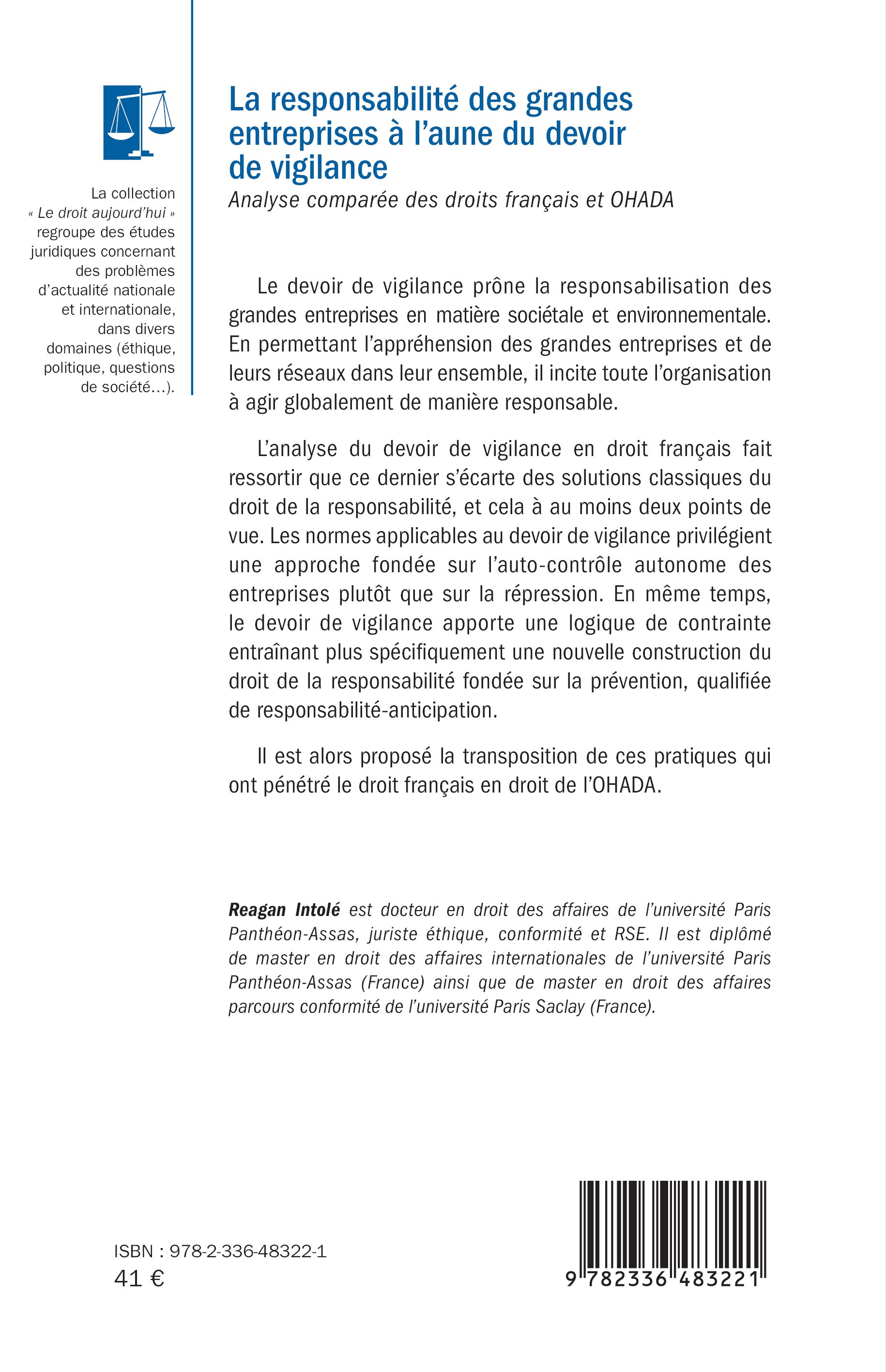
► Référence complète : R. Intolé, La responsabilité des grandes entreprises à l’aune du devoir de vigilance. Analyse comparée des droits français et OHADA, préf. M. Goré, L'Harmattan, coll. "Le Droit aujourd'hui", 2024, 412 p.
____
____
📗lire la table des matières de l'ouvrage
____
► Résumé de l'ouvrage (fait par l'éditeur) : "Le devoir de vigilance prône la responsabilisation des grandes entreprises en matière sociétale et environnementale. En permettant l’appréhension des grandes entreprises et de leurs réseaux dans leur ensemble, il incite toute l’organisation à agir globalement de manière responsable.
L’analyse du devoir de vigilance en droit français fait ressortir que ce dernier s’écarte des solutions classiques du droit de la responsabilité, et cela à au moins deux points de vue. Les normes applicables au devoir de vigilance privilégient une approche fondée sur l’auto-contrôle autonome des entreprises plutôt que sur la répression. En même temps, le devoir de vigilance apporte une logique de contrainte entraînant plus spécifiquement une nouvelle construction du droit de la responsabilité fondée sur la prévention, qualifiée de responsabilité-anticipation.
Il est alors proposé la transposition de ces pratiques qui ont pénétré le droit français en droit de l’OHADA."
________
Updated: Sept. 1, 2024 (Initial publication: )
Thesaurus : Doctrine
► Référence complète : M. Jehl, "The duty of vigilance in the face of practical challenges: audits, contractual assurances, and mediation", IBLJ, 2024, n°3/4, pp. 425-435
____
► Résumé de l'article :
____
🦉Cet article est accessible en texte intégral pour les personnes inscrites aux enseignements de la Professeure Marie-Anne Frison-Roche
________

Updated: July 8, 2024 (Initial publication: Dec. 15, 2023)
Publications

🌐follow Marie-Anne Frison-Roche on LinkedIn
🌐subscribe to the Newsletter MAFR Regulation, Compliance, Law
____
 ► Full Reference: M.-A. Frison-Roche, Duty of vigilance: the way forward, Working Paper, December 2023/July 2024.
____
🎤 This working paper has been drawn up to serve as a basis for the conclusions of the colloquium Le devoir de vigilance: l'âge de la maturité? ("The duty of vigilance: the age of maturity?") organised by the University of Montpellier on 25 May 2023.
_____
📝 Updated and developed, it serves as the basis for the article that concludes the book Le devoir de vigilance des entreprises : l'âge de la maturité? ("The duty of vigilance: the age of maturity?"), Editions Bruylant, 2024.
____
► Working Paper summary: In 2017 in France the so-called Vigilance law expressed great ambition. So did the draft directive. But in 2024 the European institutions moderated this ambition by refusing to increase either the type of companies subject and the constraints to which the duty of vigilance is associated. The directive has essentially halted what was for some the "march of progress". Does the ambition no longer exist? Does the future lie in an extension of the philosophy of the duty of vigilance, i.e. companies that should always be more concerned about others? This would undoubtedly be reaching the "age of maturity", where others see the age of madness, because it would be a contradiction in terms to ask a company to be concerned about anything other than its own development.
It is therefore appropriate to consider this very hypothesis of an "age of maturity" as being an ambition maintained despite a European directive which, in its adopted version, is weakened and while the oppositions are intact (I). First of all, it must be admitted that the notion of "maturity" most often conceals a value judgment when applied to a legal concept (I.A.) and that this is blatantly obvious with regard to the duty of vigilance, which is considered by some and by nature by some as a good and by others as an evil (I.B).
In order not to remain in what appears to be trench warfare, we must not get too bogged down in the reference French legislation of 2017 and what appears to be a European stutter in 2024, arguing so loudly that we can hear them reasoning in print, by paying attention to less visible and now more promising avenues of progress (II). In fact, the duty of vigilance can progress simply by the passage of time (II.A), by a better definition of the vocabulary (II.B), by the consolidation of the principles of Responsibility and Dialogue (II.C), by the uniqueness of the jurisdictional route (II.D).
This last perspective of the progress that will be made possible in France by the uniqueness of the judicial route leads to a final avenue of progress. By their very nature, laws are jolts, all the more violent for being disputed. At the moment, if we want to make progress, these two other sources - the contract and the judge - must be favoured (III). The European directive is rightly concerned with access to the courts and takes a measured view of the effectiveness of contracts as a means of making the duty of vigilance effective, with the courts having to ensure that the contract does not destroy the spirit of the system. This is what the law already organises about the relationship between the contract, the judge and the duty of compliance (III.A). What is new in Europe in 2024 is the introduction of a Supervisor (III.B). Here again, vigilance is the "cutting edge" of Compliance Law, as it is an extension of Regulatory Law.
The result is that, through interpretation and the handling of principles, and to formulate a more general conclusion, it is the judge who holds and will hold the balance of the duty of vigilance.
____
🔓read the Working Paper below⤵️
July 4, 2024
Thesaurus : Doctrine
► Référence complète : S. Schiller, "La directive sur le devoir de vigilance. Appréciation du champ d’application, des obligations imposées et des sanctions au regard de la loi française", JCP E, n°27, 4 juillet 2024, étude 1207, pp. 16-26
____
► Résumé de l'article (fait par l'auteure) : "Après 3 années de débats, la directive sur le Devoir de vigilance des entreprises en matière de durabilité a été adoptée par les parlementaires européens le 24 avril 2024. Texte de compromis, il contient des avancées majeures vers plus de sécurité, de fraternité et d’égalité. Vu la richesse de ce texte, seuls quelques points seront abordés dans cette étude : tout d’abord les entreprises concernées, puis les obligations imposées et, enfin, les sanctions prévues. La mise en perspective avec la loi vigilance applicable depuis 7 ans permet de mesurer l’importance de ce nouveau texte, même si de nombreux points sont en sus- pens dans l’attente de la transposition.".
____
🦉Cet article est accessible en texte intégral pour les personnes inscrites aux enseignements de la Professeure Marie-Anne Frison-Roche
________

July 1, 2024
Thesaurus : Doctrine
► Référence complète : M. Tirel, "Publication de la directive CS3D : consécration du devoir de vigilance européen", Dr. sociétés, n°7, juillet 2024, comm. 101, pp. 37-40
____
► Résumé (fait par l'auteure) : "Objet. – Après son adoption définitive par le Parlement européen et le Conseil le 24 mai dernier (avec 17 votes pour et 10 abstentions), la directive sur le devoir de vigilance (Corporate sustainability due diligence directive, dite CS3D), a été publiée au JOUE le13 juin 2024.
Portée. – Tel que l'ambitionnait la Commission européenne, ce texte s'inspire de la loi française du 27 mars 2017 tout en remédiant à certaines de ses lacunes, bien que les ambitions premières que le texte portait ont été nettement revues à la baisse.".
____
🦉Cet article est accessible en texte intégral pour les personnes inscrites aux enseignements de la Professeure Marie-Anne Frison-Roche
________

June 19, 2024
Thesaurus : 02. Cour de cassation
June 18, 2024
Thesaurus : 08. Juridictions du fond
► Référence complète : Cour d'appel de Paris, Pôle 5, Chambre 12, 18 juin 2024, n° RG 23/10583, Suez
____
____
🏛️consulter une présentation de l'arrêt rendu le même jour dans l'affaire dite TotalEnergies
____
🏛️consulter une présentation de l'arrêt rendu le même jour dans l'affaire dite EDF
____
📰lire le communiqué de presse accompagnant le prononcé de ces trois arrêts
____
📝Commentaires de cette décision :
- Rev. int. compliance, n°4, 30 juillet 2024, act. 135
________
June 18, 2024
Thesaurus : 08. Juridictions du fond
► Référence complète : Cour d'appel de Paris, Pôle 5, Chambre 12, 18 juin 2024, n° RG 21/22319, EDF
____
____
🏛️consulter une présentation de l'arrêt rendu le même jour dans l'affaire dite TotalEnergies
____
🏛️consulter une présentation de l'arrêt rendu le même jour dans l'affaire dite Suez
____
📰lire le communiqué de presse accompagnant le prononcé de ces trois arrêts
____
📝Commentaires de cette décision :
- Rev. int. compliance, n°4, 30 juillet 2024, act. 135
________
June 18, 2024
Thesaurus : 08. Juridictions du fond
► Référence complète : Cour d'appel de Paris, Pôle 5, Chambre 12, 18 juin 2024, n° RG 23/14348, TotalEnergies
____
____
🏛️consulter une présentation de l'arrêt rendu le même jour dans l'affaire dite Suez
____
🏛️consulter une présentation de l'arrêt rendu le même jour dans l'affaire dite EDF
____
📰lire le communiqué de presse accompagnant le prononcé de ces trois arrêts
____
📝Commentaires de cette décision :
- Rev. int. compliance, n°4, 30 juillet 2024, act. 135
________

June 13, 2024
Interviews

► Full reference: M.-A. Frison-Roche, "Entreprises et compliance : une justice et des juges plus offensifs" ("Companies and compliance: more aggressive courts and judges"), interview conducted by Jean-Philippe Denis as part of a series of interviews on Compliance Law, in Fenêtres ouvertes sur la gestion (Open windows on management), broadcast by J.-Ph. Denis, Xerfi Canal, recorded December 12, 2023, released on June 14, 2024.
____
🌐consult the December 2023 presentation of the interview on LinkedIn
____
🎥watch the interview video on LinkedIn, with English subtitles
____
🧱consult the general presentation of this series of interviews on Compliance Law
____
► Starting point: Since 2016, Marie-Anne Frison-Roche has been building Compliance Law, notably through a collection co-published in French with Editions Dalloz and co-published in English with Editions Bruylant:
🧱read the presentation in English of the series in French, Régulations & Compliance ➡️click HERE
🧱read the presentation of the series in English, Compliance & Regulation ➡️click HERE
____
► Summary of interview:
Jean-Philippe Denis. Question :
Marie-Anne Frison-Roche. Answer. :
____
J.-Ph D. Q. : Thus
MaFR. A. : Yes,
____
J.-Ph. D. Q. : Thus
MaFR. A. : Yes,
________

June 13, 2024
Thesaurus : 06.1. Textes de l'Union Européenne
► Full Reference: Directive (EU) 2024/1760 of the European Parliament and of the Council of 13 June 2024 on corporate sustainability due diligence and amending Directive (EU) 2019/1937 and Regulation (EU) 2023/2859 (CS3D)
____
► read the text of the directive
____
📧see on LinkedIn the article published by Marie-Anne Frison-Roche in the Newsletter MAFR. Regulation, Compliance, Law, on the occasion of the publication of this directive in the Official Journal of the European Union
________
May 18, 2024
Newsletter MAFR - Law, Compliance, Regulation

🌐follow Marie-Anne Frison-Roche on LinkedIn
🌐subscribe to the Newsletter MAFR Regulation, Compliance, Law
____
► Full Reference: M.-A. Frison-Roche, "Vigilance / sustainability due diligence (CSDD): new field of Systemic Litigation, crossroads of different branches of Law, notably contracts", Newsletter MAFR Law, Compliance, Regulation, April 30, 2024
____
📧Read by freely subscribing other news of the Newsletter MAFR - Law, Compliance, Regulation
____
🧱Vigilance as Systemic Litigation: when Contracts are everywhere
In this conference-debate on 26 April 2024, the systemic litigation that are emerging in vigilance (duediligence), the latest developments in Compliance Law, and the solutions that can be found, were examined by the speakers, and discussed by the audience.
One of the entry points to this Emerging Systemic Litigation is the contract, which is how the enterprise, encouraged by the soft law of the regulators and international organisations, implements its legal obligation. The judge will be confronted with new questions in this new type of litigation, a consequence of this new branch of Law, Compliance Law.
François Ancel, Jean-Christophe Roda and Cyril Cosme have spoken on what is going to happen.
____
📧read the article published on 18 May 2024 on this topic in the Newsletter MAFR - Law, Compliance, Regulation ⤵️
April 26, 2024
Organization of scientific events
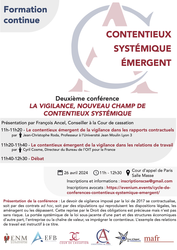
► Full Reference: La vigilance, nouveau champ de contentieux systémique (Vigilance, new field of Systemic Ligation), in cycle of conference-debates "Contentieux Systémique Émergent" ("Emerging Systemic Litigation"), organised on the initiative of the Cour d'appel de Paris (Paris Cour of Appeal), with the Cour de cassation (French Court of cassation), the Cour d'appel de Versailles (Versailles Court of Appeal), the École nationale de la magistrature - ENM (French National School for the Judiciary) and the École de formation des barreaux du ressort de la Cour d'appel de Paris - EFB (Paris Bar School), under the scientific direction of Marie-Anne Frison-Roche, 26 April 2024, 11am.-12.30am., Cour d'appel de Paris, Massé courtroom
____
🧮see the full programme of the cycle Contentieux Systémique Émergent (Emerging Systemic Litigation)
____
🌐see on LinkedIn the report of this event
____
🧱read below the report of this event⤵️
____
► Presentation of the conference: The duty of vigilance imposed by the 2017 French law is being contractualised, either by ad hoc contracts or by stipulations that reproduce the legal provisions, adjust them or go beyond them. This adoption by the Contract and Tort Law is valuable but not without risk. The systemic scope of the underlying law on the one hand and of economic structures on the other, the firm or the value chain, will permeate litigation. The example of labour relations is instructive in this respect.
____
🧮Programme of this event:
Second conference-debate
LA VIGILANCE, NOUVEAU CHAMP DE CONTENTIEUX SYSTÉMIQUE
(VIGILANCE, NEW FIELD OF SYSTEMIC LITIGATION)
Paris Court of Appeal, Massé courtroom
General presentation of the topic and moderation by 🕴️François Ancel, Judge at the Première Chambre civile de la Cour de cassation (First Civil Chamber of the French Court of cassation)
🕰️11am.-11.20am. 🎤Le contentieux émergent de la Vigilance dans les rapports contractuels (Emerging Vigilance Litigation in Contractual Relationships), by 🕴️Jean-Christophe Roda, Full Professor at Jean-Moulin Lyon 3 University
🕰️11.20am.-11.40am. 🎤Le contentieux émergent de la Vigilance dans les relations de travail (Emerging Vigilance Litigation in Employment Relationships), by 🕴️Cyril Cosme, Director of the French Office of the International Labour Organization (ILO)
🕰️11.40am.-12.30am. Debate
____
🔴Registrations and information requests can be sent to: inscriptionscse@gmail.com
🔴For the attorneys, registrations have to be sent to the following address: https://evenium.events/cycle-de-conferences-contentieux-systemique-emergent/
⚠️The conference-debates are held in person only, in the Cour d’appel de Paris (Paris Court of Appeal).
____
🧱read below a detailed presentation of this event⤵️
________