China

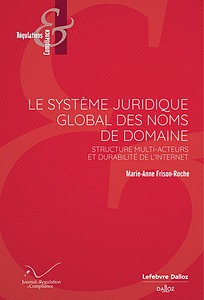
Couverture : Le système juridique global des noms de domaine. Structure multi-acteurs et durabilité de l’Internet

Publication director

🏗️ copublishing and direction of the collection: 📚Régulations & Compliance

📚Forthcoming: 🕴️M.-A. Frison-Roche, 📕Le système juridique global des noms de domaine. Structure multi-acteurs et durabilité de l’Internet (The Global Legal System of Domain Names. Multi-Stakeholder Structure and Sustainability of the Internet)

► Full reference: M.-A. Frison-Roche, Le système juridique global des noms de domaine. Structure multi-acteurs et durabilité de l’Internet (The Global Legal System of Domain Names. Multi-Stakeholder Structure and Sustainability of the Internet), Journal of Regulation & Compliance (JoRC) and Lefebvre-Dalloz, “Régulations & Compliance” series, forthcoming. - 📘 see also the presentation of the book published in English, in the “Compliance & Regulation” series: The Global Domain Name System in Law. Multi-Stakeholder Structure and Sustainability of the Internet, Journal of Regulation & Compliance (JoRC) and Lefebvre-Bruylant, forthcoming. - ► Read the presentations of the other books in the series: the following books: 🕴️M.-A. Frison-Roche (ed.), 📕Le système probatoire de la Compliance, forthcoming   the previous books: 🕴️L. Laref (ed.), 📕Compliance et vigilance bancaire, forthcoming 🕴️M.-A. Frison-Roche (ed.), 📕Compliance et Contrat, forthcoming 🕴️M.-A. Frison-Roche (ed.), 📕L’Obligation de Compliance, 2025 🕴️M.-A. Frison-Roche and M. Boissavy (eds.), 📕Compliance et droits de la défense. Enquête interne – CJIP – CRPC, 2024 🕴️M.-A. Frison-Roche (ed.), 📕La juridictionnalisation de la Compliance, 2023 🕴️M.-A. Frison-Roche (ed.), 📕Les Buts Monumentaux de la Compliance, 2022 🕴️M.-A. Frison-Roche (ed.), 📕Les outils de la Compliance, 2021 🕴️M.-A. Frison-Roche (ed.), 📕Pour une Europe de la Compliance, 2019 🕴️N. Borga, J.-Cl. Marin and J.-Ch. Roda (eds.), 📕Compliance : l’entreprise, le régulateur et le juge, 2018 🕴️M.-A. Frison-Roche (ed.), 📕Régulation, Supervision, Compliance, 2017 🕴️M.-A. Frison-Roche (ed.), 📕Internet, espace d’interrégulation, 2016 📚See all the books of the series. - ► English general presentation of the book: The Internet is a space based on a technical system consisting of IP addresses, all of which can reach one another. This simple technical principle is essential because it is the foundation on which the digital space rests, in that it allows anyone to enter it, move within it and reach others. It is this principle of the open Internet that made possible the construction of the digital space in which we live. This technical system of IP addresses was made easily manageable by domain names. This manageability of IP addresses made the open character of the Internet effective and enabled the expansion of a space that was global from the outset, forming the basis of the digital space. These technical elements were directly translated into the addressing system through domain names, which was built by the Law. The resulting legal system of addressing reflects this technical foundation, and no one can either deny or undo this link: indeed, the Law enables the domain name infrastructure to function effectively on a global scale and in an open manner, where everyone can reach the other. Technical architecture and legal architecture are thus inseparable. This freedom for everyone to create and circulate in the digital space is made possible by technology and guaranteed by the legal organisation of the domain name architecture. This study is structured in two parts. Its first part aims to describe the legal framework of the global domain name system. Its second part examines how to improve this system: it first examines the technical effects produced by scenarios involving changes to the legal framework of addressing, namely a high risk of capture and/or fragmentation of the domain name system by regional zone. It then aims to demonstrate that if the legal organisation of the global domain name system were significantly altered, notably through the establishment of legal addressing zones that are autonomous from one another, the technical imperative of globality remaining paramount, interconnection between the different zones would be necessary and would then be ensured by a public or private actor who could thus effectively seize control of the technical system via these proposed new legal structures of the system, thereby taking over the whole. - ENGLISH PRESENTATION OF THE PROVISIONAL TABLE OF CONTENTS Putting into Perspective PART ONE HOW THE GLOBAL LEGAL SYSTEM OF NAMING IS BUILT CHAPTER I: ICANN: A LEGAL STRUCTURE OF CLASSIC HARD-LAW FORM, REQUIRED BY THE TECHNICAL INFRASTRUCTURE OF THE ADDRESSING SYSTEM, TRANSPOSED THROUGH STATUTES THAT SEPARATE THE POWER TO PROPOSE FROM THE POWER TO ADOPT IN ORDER TO ESTABLISH A “MULTI-STAKEHOLDER” SYSTEM WHOSE PURPOSE AND EFFECT ARE TO PREVENT CAPTURE CHAPTER II: THE EXERCISE BY STATES OF THEIR PREROGATIVES THROUGH NATIONAL PUBLIC LAWS: ARTICULATION BETWEEN THE TWO GEOGRAPHICAL SPACES OF HARD LAW CHAPTER III: INTERNATIONAL SPACES OF HARD AND SOFT LAW: UN, WIPO, ITU, WSIS CHAPTER IV: MIRRORING THE TECHNICAL INFRASTRUCTURE OF THE ADDRESSING SYSTEM, THE INTERMESHED GLOBAL LEGAL STRUCTURE, ARTICULATING THE SPACE OF HARD LAW AND THE SPACE OF SOFT LAW CHAPTER V: INTERNALISATION WITHIN CRUCIAL OPERATORS THROUGH COMPLIANCE TECHNIQUES LINKED TO THE OBLIGATION OF SUSTAINABILITY PART TWO HOW TO IMPROVE THE GLOBAL LEGAL SYSTEM OF NAMING CHAPTER I: ASSESSMENT OF THE RADICAL TECHNICAL TRANSFORMATIONS THAT PROPOSALS TO CHANGE THE LEGAL SYSTEM OF ADDRESSING COULD BRING ABOUT Section 1 ♦️ Assessment of the technical consequences of the legal proposal to transfer the current complex and specific system into an ordinary mechanism of Public International Law Section 2 ♦️ Assessment of the technical consequences of the indirect proposal to establish separate blocks of systems by zone CHAPTER II: MAINTAINING THE LEGAL SYSTEM OF ADDRESSING, GLOBAL, PROTECTED FROM CAPTURE AND ABLE TO ENSURE TECHNICAL SUSTAINABILITY? BY FOSTERING AN INCREMENTAL PROCEDURAL IMPROVEMENT TOWARDS BETTER UNDERSTANDING AND THUS BETTER ACCOUNTABILITY Section 1 ♦️ A grievance, factual but central: the legal system of domain names is hard to understand. Causes and consequences Section 2 ♦️ Making the legal system of domain names more easily understandable to the parties concerned Ex Ante Section 3 ♦️ Explaining clearly, starting from the purposes, the share of technical sustainability and the share of societal sustainability, the former firmly preserved, the latter handled as a debated project Section 4 ♦️ Enhancing soft-law instruments for their discursive, that is explanatory, scope regarding the domain name system within the global governance of the Internet Section 5 ♦️ Making the legal system of domain names understandable to the parties concerned Ex Post: thereby increasing the value of accountability Selected Bibliographical Sources Index


Videos

concluding lecture

🖥️L’avenir de la compliance (The future of Compliance), in 🧮La compliance (Compliance)

► Full reference : M.-A. Frison-Roche, "The Future of Compliance", series Compliance, Centre Perelman, Brussels, 23 February 2026. - 🧮view the full programme for the series Compliance (in French) - ► English presentation of this concluding conference in the series Compliance : The future of Compliance: who knows what it holds? Anyone who practises and studies the texts, litigation, structures and behaviours will have to admit that they do not know what will become of what has emerged as a new branch of law. It is not easily recognised, probably for three reasons. Firstly, because the birth of a new branch of law is an unusual phenomenon, whose disruptive and regenerative waves are felt in all branches of law and other regulatory systems, accompanying and reflecting the new world we have already entered, whether we like it or not. Secondly, because it is unpleasant (especially if you are a professor…) to begin and conclude with the fact that you do not know. Thirdly, because it is not very marketable, and in today's large and growing "compliance market", it is not very smart, if you want to sell compliance products (whether they be algorithms, new services to be linked to the highest level of companies, specialities in law firms, new chairs in various schools), to say that you don't know. So the experts say they know. For my part, I meet many people who are "experts" and who are "knowledgeable". What is surprising is the diversity of their discourse, which casts doubt on the solidity of the projection, particularly on the meaning of words: for example, not only words that could be described as "new" (which we then try to anchor in old words) such as "compliance/conformity" and "governance", but also words that we are undoubtedly more familiar with, such as "commitment" and "responsibility" or "sanction", i.e. the very pillars of the matter. Why is this a cause for concern, apart from the fact that it is always better to know what we are talking about, rather than everyone talking in their own corner, for their own compliance corpus, for their like-minded friends, with the subject matter becoming increasingly siloed? Because the object of Compliance Law is the future. So, the future of this branch of law which its object is the future is by nature very uncertain.   It will therefore be assumed in advance that not knowing the future is a major difficulty when it comes to Compliance Law, in that this branch of law is unified in that it is ex ante and its object is the future. The difficulty is neither of the same nature nor of the same magnitude when it comes to the legislator, the "regulator", the regulated company (calculating or political), or the judge faced with systemic compliance litigation. That said, in a first part, one can imagine the future possibilities for Compliance (because that is what it boils down to, given the number of candidates eager to seize the instruments of power that are the " Compliance tools"). It is not a foregone conclusion that this future will be governed by Law. The consequences could take care of that. Or the order given by the leader (Trump, for instance), and that would go down all the better as he states that he certainly does not care about human beings but that he wields the power of Compliance to restore the climate balance (through Chinese regulations): except to say that there is no unified Compliance Law. That there would be one for the climate and another for human rights. So what about the future consistency of European Law, which links the two in the CSRD and the CS3D? Particularly in value chains. The question then is: what will be the uniqueness of Compliance Law in the future? -   In a second part, since we do not know how things will turn out, from omnibus to omnibus, from a government hostile to the Law to a government appealing to the Due Process, from case law to case law, from special law to common law, we must weigh up the advantages and disadvantages of the various perspectives. There is never one perspective where everything is good and another where everything is bad, because in that case there would be no choice and no policy: it would be enough to have information, to be "rational" and to go for the right solution rather than the wrong one. Beyond general statements that a combination of compliance and ethics is welcome, which is not in doubt in the superb statements made in this regard, it is necessary to look at the advantages and disadvantages of the direction we may take. Firstly, there is the disappearance of Compliance Law, with the advantage of reducing the regulatory burden on those subject to it and the disadvantage of abandoning altruistic and global ambitions (these two Monumental Goals may overlap). Secundly, it could involve the creation of a global empire, with the advantage of a simplified American empire, whether extraterritorialised by the state or by companies and their governance or technology, with the advantage of a Western model and the disadvantage of the crushing of "mondialisation" by globalisation and the disappearance of the specific ambitions of States. Thirdly, it may be a contribution to a war between powers, particularly through the European DSA and the data war, with the advantage of European maturity in Compliance Law as an extension of Regulatory Law and the disadvantage that we could move from a war in the metaphorical sense (never use metaphors in Law) to a war. Quaterly, it could be a new rule of Law in which systemic companies participate in an alliance to achieve Monumental political Goals decided by States and political authorities, preserving systems for the future ("sustainability") so that human beings are not crushed by them but benefit from them. The disadvantage is that we have to relearn the Law, because although it has nothing to do with conformity, which is only an instrument, Compliance Law changes all branches of Law and requires the integration of other techniques, particularly political and technological ones. -   In third part, in practice, we must strive in advance to reduce the disadvantages associated with the shortcomings of possible future developments in Compliance Law, just as we must strive in advance to increase the advantages associated with the qualities of possible future developments in Compliance Law. The disadvantage lies in the very nature of Compliance Law, namely its great power, because unlike Competition Law, it calls for and increases power. We must therefore counteract the prospect of compliance techniques, particularly those related to Information, being monopolised by those who only want to use them to consolidate or extend their power, laughing at Ethics and Monumental Goals. This means that supervision techniques on the one hand and a renewed role for judges on the other must be considered. The quality attached to possible futures stems from the fact that we could uphold a "Global Law" (reference to the work of Benoît Frydman, among others) and that, faced with the possible disappearance of Public International Law and the imperative preservation of value chains, particularly in the context of possible war, the alliance between supervised systemic companies and the political authorities in charge of the future of the social group that legitimises them may appear to be a legitimate, effective, efficiate and efficient system. -   ⛏️Go further  : 🕴🏻M.-A. Frison-Roche, 📝Compliance Law, 2016 🕴🏻M.-A. Frison-Roche, 📝Conceiving Power, 2021 🕴🏻M.-A. Frison-Roche, 📕Compliance Monumental Goals, 2022  🕴🏻M.-A. Frison-Roche, 📝The Birth of a New Branch of Law: Compliance Law, 2024 🕴🏻M.-A. Frison-Roche, 📝Compliance Law and conformity: distinguishing between them to better articulate them, 2024 🕴🏻M.-A. Frison-Roche, 📕Complianceo Obligation, 2025 🕴🏻M.-A. Frison-Roche, 📝Compliance Law and Systemic Litigation, 2025

Reports

DUCHÂTEL, Mathieu🕴🏻 & WRIGHT, Georgina🕴🏻

📓China’s Extraterritoriality: A New Stage of Lawfare

► Full Reference: M. Duchâtel & G. Wright, China’s Extraterritoriality: A New Stage of Lawfare, Institut Montaigne, Explainer, December 2024, 72 p. - 📓read the Explainer - 📓read the English Summary of the Explainer - 📓read the presentation of this Explainer made on the Institut Montaigne's website - ► English Summary of the Explainer (done by the Authors): "Extraterritoriality – the application of national laws abroad – is gaining traction. In a world characterized by strategic competition and weakened international organizations, many countries are turning to law to secure their interests. This includes China. Extraterritoriality has expanded under Xi Jinping. China no longer sees it as a relic of "the century of humiliation" during which foreign powers imposed consular jurisdiction on Chinese soil. Today, Chinese extraterritoriality has three aims: to defend against foreign interference and sanctions; to legitimize China’s foreign policy actions and strengthen its global influence; and as a way to deploy its public security agenda abroad. China is also exploring a more offensive approach to extraterritoriality in the form of economic sanctions  – though it has yet to use them. A more offensive use will depend on the willingness of the top leadership to employ such tactics during moments of international tension; a stronger international role for the renminbi and lower overall exposure to the dollar; and the countermeasures that third-countries could take to respond to Chinese extraterritorial norms. The EU must act. Europeans need to understand the risks associated with Chinese extraterritoriality and plan accordingly. The EU should continue working with like-minded partners and be ready to deny access to the EU single market in case of abuse. Losing access to the single market would be deeply damaging to China’s interests and constitute a powerful deterrent for the EU. Institut Montaigne’s latest issue paper provides a framework for understanding all dimensions of Chinese extraterritoriality and offers decision-makers and businesses a roadmap for an informed response. Understanding the implications of Chinese extraterritoriality is crucial for governments and businesses, and should be integral to the EU's approach to economic security.". -

Conferences

🎤Pourquoi le Droit de la Compliance (Why Compliance Law is needed)

► Full reference: M.-A. Frison-Roche, "Pourquoi le Droit de la Compliance ?" ("Why Compliance Law?"), in Roman Aydogdu et Hans De Wulf (dir.), Bruxelles, 15 march 2023.  - 🧮Read the full programme of this event -

Breaking news

📧 Compliance Law is central in an infrastructure policy program

► Compliance Law is essential for the future of Africa: this is also a lesson from the Juin 2021 G7 Summit in its Infrastructure Plan.  It emerges from the G7 summit which ends on June 13, 2021 in Carbis Bay in the United Kingdom, a common desire to increase infrastructures in Africa, in itself and because otherwise China will do it, and will do it differently. Compliance Law will be determinant in this common action for three reasons. First and because the issue is about infrastructures, the construction and the management of infrastructures falling more under Regulatory Law than Competition Law (📕Chevalier, J.-M., Frison-Roche, M.-A, Keppler, J.EPPLER, J.H. et Noumba, P. (ed.), Économie et droit de la régulation des infrastructures. Perspectives des pays en voie de développement, 2009). However, Compliance Law is not a simple process for the effectiveness of rules which are external to it, it is the extension in companies of Regulatory Law. Where companies must implement regulatory goals within themselves, they develop Compliance rules (➡️📝see Frison-Roche, M.A., From Regulation Law to Compliance Law, 2017.  Secondly and because the issue is about Africa, the Rule of Law is sometimes not very solid there. By internalizing Regulatory Law in companies (or even by associating Arbitration with it), Compliance Law makes it possible to get out of this dead end (➡️📝Salah, MM, Conception and Application of Compliance in Africa, in  Frison-Roche, M.-A. (ed.), Compliance Tools, 2021. Thirdly and because the topic si about China, Compliance Law in its European conception has the Monumental Goal of defending individuals while in its Chinese conception it aims to obtain their obedience to the rules (➡️📝Frison-Roche, M.-A., In China, Compliance Law deploys without, and even against democracy, China seeing Compliance only as an "efficiency process"; in Europe, it deploys with and even for democracy, 2021). On construction sites and in the human management of infrastructures, this changes everything. G7 members share the first conception. They must now implement it by their companies and thanks to them, private sector being in alliance with the political authorities which just expressed. Because Compliance Law is an alliance between political authorities and crucial economic operators.   ► register to French Newsletter MaFR ComplianceTech®

Breaking news

📧 In China, Compliance Law deploys without, and even against, democracy, China considering Compliance only as a “procedure of efficiency” ; in Europe, it deploys with and even for democracy

► Do Compliance and Democracy have a relationship? China replies: no. Europe responds and must respond: they are intimate. The definition of Compliance Law is therefore essential. In an interview of great clarity  given in French to the Newspaper Les Echos on June 2, 2021, about Brexit, China and Russia (➡️📝 "Brexit, Chine, Russie : les confidences de la diplomate Sylvie Bermann"), Sylvie Bermann reminds the evolution of China. She sums up the situation as follows: « La Chine ne veut pas dominer le monde, elle veut être la première et surtout qu'on ne puisse pas lui imposer un système, la démocratie » ("China does not want to dominate the world, it wants to be the first and above all that no one can impose on it a system, Democracy,"). This is reflected in China's conception of Compliance Law. If one defines Compliance Law only as a "method" for the effectiveness of rules, consisting of a kind of "Ex Ante enforcement process" leading to 100% effectiveness of regulations by subjects who must show to everyone the respect they have for these regulations and who are rewarded by this proof thus given, then China, in its current use of Law, illustrates exactly this definition: subjects, individuals and companies, prove their "obedience" to rules – whatever the rules" substantial content -, which is evaluated ("rating") and rewarded, in a mechanical reign of the Ex Ante, served by technologies. Democratic mechanisms are not required; they are even disturbed, because they interfere with the efficiency of the system. The technological and purely technocratic conception of Compliance ("Regulation by data", for example) uses the same definition of Compliance Law, which leads to choose algorithms’ efficiency. Europe must keep going to make another choice: European Compliance was born out of the Court of Justice of the European Union’s case law, in the 2014 judgment, Google Spain (➡️📝CJEU, Google Spain, May 13, 2021), to protect the person by inventing a subjective right: the right to be forgotten, in a digital space with infinite memory. Based on the Rule of Law, Compliance Law is then defined by its Monumental Goals, which are the protection of people and puts the judge at the center. It is the reverse of Chinese mechanics. Therefore, they are definitions that lead the world: about the definition of Compliance Law by "Monumental Goals", see ➡️📅 the 2021 cycle of colloquia co-organized by the Journal of Regulation & Compliance (JoRC) and its university partners on Monumental Goals; on the technical influence of this definition on "Compliance tools" ➡️📕see Frison-Roche, M.-A., Legal Approach to Compliance Tools: Building by Law the unity of Compliance Tools from the definition of Compliance Law by its "Monumental Goals", 2021.   ►subscribe to the MaFR ComplianceTech® Newsletter

Articles

SALAH, Mahmoud, Mohamed

The Legal Framework for New Silk Roads: a Globalized Law at the Service of a Global ambition. When China Discovers the Virtues of Globalization of Law

Full reference: Salah, M. M., The Legal Framework for New Silk Roads: a Globalized Law at the Service of a Global ambition. When China Discovers the Virtues of Globalization of Law, International Business Law Journal, n°3, 2020, pp. 319-351