Jan. 29, 2026
Conferences

🌐Follow Marie-Anne Frison-Roche on LinkedIn
🌐Subscribe to the Newsletter MAFR Regulation, Compliance, Law
🌐Subscribe to the video newsletter MAFR Overhang
🌐Subscribe to the Newsletter MaFR Law & Art
____
► Full reference : M.-A. Frison-Roche, "Le Droit de la Compliance, voie de la transition vers une égalité effective, efficace et efficiente entre les êtres humains (Compliance Law, for the transition towards the effectiveness, efficacy and efficiency of the equality between human beings)", in Chair "Mutualist and cooperative banking at the service of the economy", ESCP, Les banques coopératives et les transitions (Cooperative Banks and Transitions), 29 January 2026.
____
🧮view the general programme for the conference Cooperative banks and transitions (in French)
____
📶see the slides (in French)
____
► Presentation of this conference: The conference is not specifically aimed at lawyers, and even less so at specialists in Compliance Law. That is why it is divided into three parts, in order to show how Compliance Law is relevant in practice for creating effective, efficace and efficient equality between human beings.
The first part of the lecture sets out the ambition of equality between human beings. As this is a political principle and not a natural one. As it is an ambition, it justifies being placed first and after that this ambition must be concretised, in a sort of second place. This second place is built bay a tro : that of effectiveness (real application of the norm), efficacy (that the goal for which the norm was established is achieved) and efficiency (that the system is transformed so that, having become robust, it endures through sustainabily).
The second part of the conference will present the new branch of law known as Compliance Law. This should be distinguished from simple conformity, which consists of mechanically obeying a body of regulations that are constantly growing and becoming more complex. Compliance Law's Goal is to protect systems from risks that could cause them to disappear (all systems). "Sustainability" is the key principle, which is not limited to the climatic system (also digital system, banking system, and so on) and imposes the future as its object and the long term as its relevant time frame (unlike the market and Competition Law). "Transition" is also a key concept, as it involves moving from one state to another, from an expressed ambition to its realisation, through collaboration with others. These Goals are "Monumental" and are the normative legal basis of Compliance Law. In Europe, the Compliance Monumental Goal is to preserve systems for that the human beings who are involved in them, willingly or unwillingly, are not crushed by them, but rather benefit from them (for instance in banking sector). This is a "Monumental Negative Goal", to which is added a "Monumental Positive Goal", which a new conception of the "Ex Ante Responsability" (not liabily).
Dialectically, the third part of the conference explains how Compliance Law internalises the political ambition of equality between human beings, which develops in the three concentric circles of effectiveness, efficacy and efficiency, among the operators best placed to contribute to it.
Mutual banks belong to these circles more than the others. Firstly, because they are structured around the principle of taking human beings into consideration. Secondly, because they are rooted in their local areas. Thirdly, because they are driven by the long term, duration and sustainable. The transition est easer. The dificulty is the necessity to proof the effective and efficient will to do this transition.
____
⛏️Go further :
🕴🏻M.-A. Frison-Roche, 📝Drawing the circles of Compliance Law, 2017
🕴🏻M.-A. Frison-Roche, 📝Monumental goals, the beating heart of compliance law, 2021
🕴🏻C. Peicuti and 🕴🏻J. Beyssade, 📝The feminisation of management positions in companies as a compliance objective. The example of the banking sector, in 🕴🏻M. -A. Frison-Roche, 📘The Monumental Goals of Compliance, 2022
🕴🏻M.-A. Frison-Roche, 📝Births of a New Branch of Law: Compliance Law, 2024
________

Nov. 4, 2025
Thesaurus : Doctrine
► Référence complète : E. Hache, V. d'Herbemont, L.-M. Malbec et C. Roche, "Transition énergétique : une rupture dans la dynamique de demande mondiale en métaux ?", in Ch. Poinsso (dir.), Les métaux stratégiques, nouveau défi de la transition énergétique et de la réindustrialisation, Annales des Mines, coll. "Réalités industrielles", nov. 2025.
____
📗lire la présentation du numéro
____
► Résumé de cet article (faite par les auteurs) : "Les métaux stratégiques, nouveau défi de la transition énergétique et de la réindustrialisation En 2024, les investissements dans les technologies bas-carbone (énergies renouvelables, nucléaire, réseaux, stockage, efficacité énergétique, carburants peu émissifs et véhicules électriques) ont atteint près de 2 100 milliards de dollars, soit une hausse de 11 % par rapport à 2023 (BNEF, 2025). Si ces investissements représentent aujourd’hui quasiment le double de ceux observés dans le secteur des hydrocarbures, un objectif de limitation de la hausse des températures à 1,5°C à l’horizon 2050 nécessiterait une multiplication par 2,5 de ce niveau d’investissement annuel. Ce rythme d’investissement, bien qu’insuffisant au regard des enjeux climatiques, a ravivé l’intérêt pour la sécurisation des ressources minérales, mobilisées en grandes quantités par la transition énergétique. Ces ressources minérales constituent en effet la base des technologies bas-carbone. Elles sont ainsi essentielles pour les moteurs et batteries des véhicules électrifiés (cobalt, cuivre, lithium, nickel, terres rares, graphite), pour les divers composants des parcs éoliens (aluminium, cuivre, graphite, manganèse, molybdène, nickel, etc.), pour les panneaux solaires (argent, cuivre, indium, silicium, etc.) et pour les technologies de l’hydrogène (nickel, palladium, platine). La majeure partie de ces substances étant des métaux, on parle par abus de langage de métaux même si le lithium ou d’autres n’en sont pas. Le niveau de déploiement requis pour ces technologies à l’horizon 2050 pourrait entraîner une forte hausse de la demande en métaux et transformer en profondeur les marchés concernés.".
________
June 12, 2024
Conferences

🌐follow Marie-Anne Frison-Roche on LinkedIn
🌐subscribe to the Newsletter MAFR Regulation, Compliance, Law
____
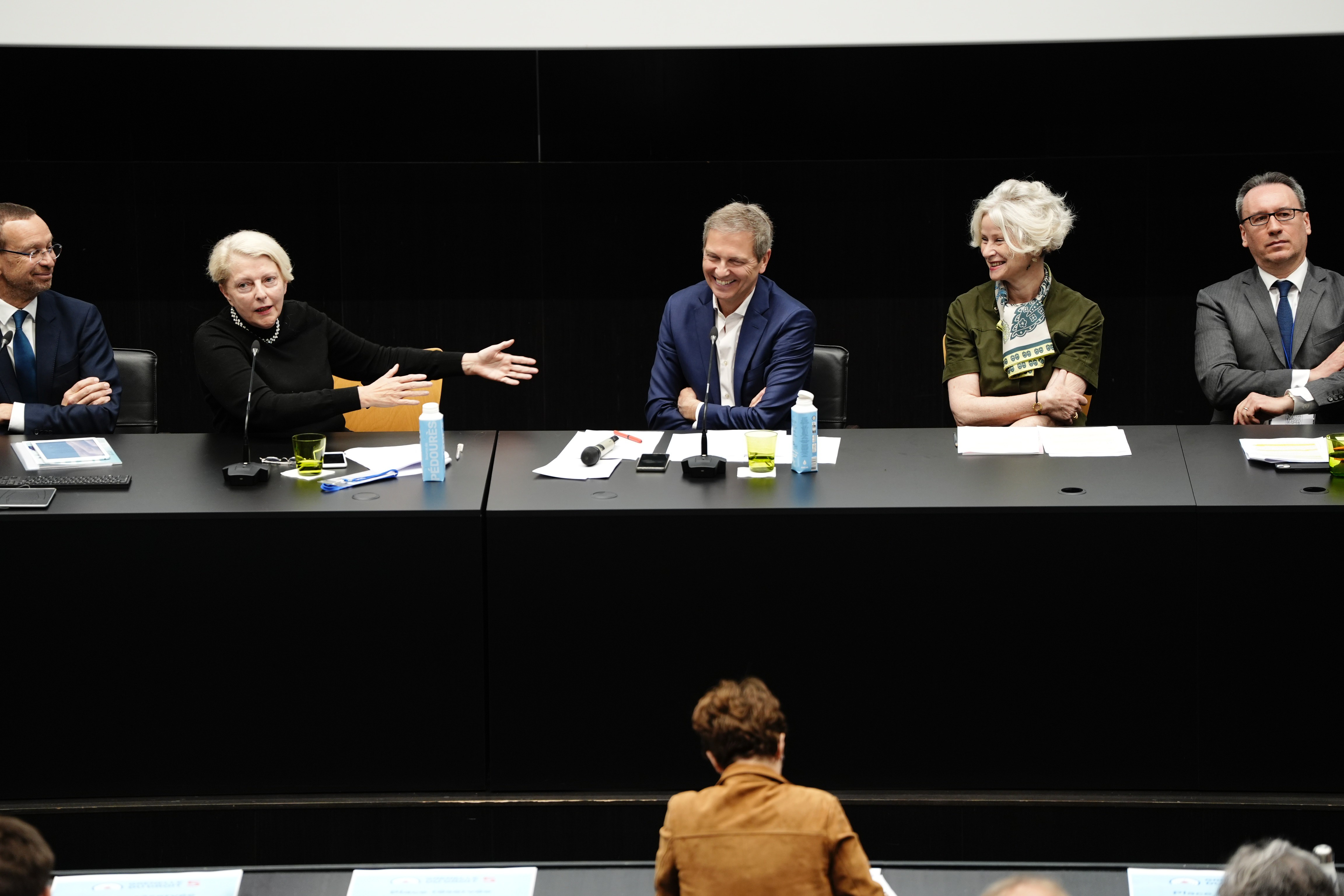
► Full Reference: M.-A. Frison-Roche, Participation in the panel "Une Gouvernance responsable : vers un mieux vivre ensemble ?" ("Responsible governance: towards a better way of living together"), in Grenelle du Droit 5. L'avenir de la filière juridique, Association française des juristes d'entreprise ("The future of the legal profession"), AFJE), Cercle Montesquieu and Paris Panthéon-Sorbonne University, Campus Port-Royal Université Paris 1 Panthéon-Sorbonne, 1 rue de la Glacière, 75013 Paris, June 12, 2024
____
🧮See the full programme of this event (in French)
____
🎥watch the interview made just after this round-table discussion (in French)
____
🪑🪑🪑🪑🪑 will also be taking part in this round-table discussion:
🕴️Yves Garagnon, Chairman of Dilitrust,
🕴️Pierrick Le Goff, lawyer, partner at De Gaulle Fleurance,
🕴️Sabine Lochmann, Chairman of Ascend,
🕴️Vincent Vigneau, President of the Commercial, Economic and Financial Chamber of the Cour de cassation (French Judicial Supreme Court)
____
► English presentation of my intervention in this event's opening plenary round-table: In this plenary round table which opens the event, devoted to the theme of 'responsible corporate governance', for my interventions based on my work I will have the opportunity to address more particularly these different perspectives:
- How the new Compliance Law, which gives concrete expression to the responsibility of enterprises in a new relationship with States and with civil society, constitutes a 'legal revolution
- 💡for the record, mafr,📝Compliance Law, 2016 ; (ed.) 📘Compliance Monumental Goals, 2022
- how the judgment handed down by the Tribunal judiciaire de Paris (Paris First Instance Civil Court) on 28 February 2023 (Total Ouganda case) is remarkable and already constitutes a turning point in case law
- 💡for the record, mafr, 🎤audition as amica curiae, hearing of 26 October 2022 before the first instance Paris Court; (ed)📘Compliance Jurisdictionalisation, 2024
- how the relationship between States and enterprises is being renewed by this profound legal movement expressed by Compliance Law
- 💡for the record, mafr et M. Boissavy (ed.), 📕Compliance et droits de la défense - Enquêtes internes, CJIP, CRPC, mafr (dir.), 📘 Compliance Obligation, 2025
- how internal lawyers have a decisive and central role to play in this movement, particularly in the mechanism of vigilance / corporate sustainability due diligence, the "cutting edge" of Compliance Law,
- 💡for the record, mafr, 📝Contract of Compliance, Compliance stipulations, 2023 ; (ed.), 📘Compliance and Contract, 2025
- what is meant by the "Ex Ante responsibility" of enterprises, which does not necessarily entail their Ex Post liability, a distinction which lawyers are the guardians of
- 💡for the record, mafr, 📝La responsabilité Ex Ante, pilier du Droit de la Compliance ("Ex-Ante Responsability, Compliance Law Pillar"), 2021
- how European Compliance Law is profoundly humanist, an identity that distinguishes European Compliance from American Compliance and, above all, from Chinese Compliance.
- 💡for the record, mafr (ed.), 📕Pour une Europe de la Compliance ("For the Europe of the Compliance"), 2017
________
read the article about this round table written by Delphine Bauer in Actu-Juridique (in French)