Food for thoughts

Thesaurus : Doctrine
Complete reference : Archives de Philosophie du Droit (APD), Droit et économie, tome 37, ed. Sirey, 1992, 426 p.
Read the summaries of the articles in english.
See the presentation of others volumes of Archives de Philosophie du Droit.

Compliance and Regulation Law bilingual Dictionnary

The notion of "Common Goods" refers to a political conception insofar as it concerns objectively commercial goods such as cultural goods or medical services, but which the community is going to demand that everyone should have access to it even though the individual does not have the ability to pay the exact price. It is then the taxpayer - present or future - or the social partners who bear the cost, or even some companies, through the corporal social social responsibility mechanism.
This protection of Common Goods can be done by the State in the name of the interest of the social group for which it is responsible and whose it expresses the will, particularly through the notion of the general interest. In this now restricted framework which is the State, this reference runs counter to the principle of competition. This is particularly clear in Europe, which is based on a Union built on an autonomous and integrated legal order in the Member States in which competition continues to have a principled value and benefits from the hierarchy of norms. The evolution of European Law has balanced the principle of competition with other principles, such as the management of systemic risks, for example health, financial or environmental risks and the creation of the banking union shows that the principle of competition is no longer an apex in the European system.
But it still remains to an economic and financial conception of Europe, definition that the definition of the Regulatory Law when it is restricted to the management of the market failures feeds. It is conceivable that Europe will one day evolve towards a more humanistic conception of Regulatory Law, the same one that the European States practice and defend, notably through the notion of public service. Indeed and traditionally, public services give people access to common goods, such as education, health or culture.
Paradoxically, even though Law is not set up on a global scale, it is at this level that the legal notion of "common goods" has developed.
When one refers to goods that are called "global goods", one then seeks goods that are common to humanity, such as oceans or civilizations. It is at once the heart of Nature and the heart of Human Being, which plunges into the past and the future. Paradoxically, the concept of "global goods" is still more political in substance, but because of a lack of global political governance, effective protection is difficult, as their political consecration can only be effective nationally or simply declaratory internationally. That is why this balance is at present only at national level, which refers to the difficulty of regulating globalization.
Thus, the "common goods" legally exist more under their black face: the "global evils" or "global ills" or "global failures", against which a "Global Law" actually takes place. The notion of "global evils" constitutes a sort of mirror of Common Goods. It is then observed that countries that develop legal discourse to regulate global evils and global goods thus deploy global unilateral national Law. This is the case in the United States, notably in financial regulatory Law or more broadly through the new Compliance Law, which is being born. Companies have a role to play, particularly through Codes of Conduct and Corporate Social Responsibility.
Compliance and Regulation Law bilingual Dictionnary

Le légicentrisme exprime avant tout une bataille de normes, puisque cette doctrine pose que la loi est la seule et unique expression de la souveraineté de la Nation. En cela, la loi dispose d'une autorité indépassable et c'est elle qui fonde l'État légal.
Ainsi, si l'on devait donner une figure au système juridique, ce serait un cercle avec en son cœur d'une façon unique la loi souveraine, à la fois autosuffisante dans son fondement (souveraineté) et dans sa production (principe de légalité).
Cette conception moniste (unité de la loi) a pour principale source la philosophie politique de Jean-Jacques Rousseau, c'est encore sur celui-ci que la France conserve le principe de souveraineté parlementaire (le Gouvernement est responsable devant le Parlement) et de souveraineté de la loi. Mais depuis la Révolution française, les esprits et les faits ont changé.
Ainsi, s'est construite une doctrine inverse : le "pluralisme juridique" qui pose en contradiction que le droit vient de nombreuses sources, comme la coutume, les pratiques, les jugements, etc. Il n'est pas étonnant que les auteurs qui affirment le pluralisme juridique ne viennent pas de la philosophie politique mais davantage de la sociologie comme Gurvitch ou Carbonnier.
En outre, les frontières nationales ont perdu de leur consistance, de fait et de droit. C'est pourquoi un auteur comme Mireille Delmas-Marty s'appuie sur le fait même de la construction de l'Europe des droits de l'homme d'une part et de la globalisation d'autre part pour affirmer que le légicentrisme a fait place à un pluralisme juridique généralisé.
Cependant, en droit positif les textes restent les mêmes. C'est ainsi que l'article 6 de la Déclaration des droits de l'homme et du citoyen de 1789, qui fait partie du bloc de constitutionnalité, dispose de la loi que "la loi est l'expression de la volonté générale".
De la même façon, l'article 5 du Code civil continue d'interdire au juge de rendre des jugements contraignants pour d'autres cas que celui particulier sur lequel il se prononce.
Cette permanence des textes les plus gradés, à savoir l'article 5 du Code civil et l'article 6 de la déclaration pose de nombreux problèmes aux juges. En effet, depuis l'arrêt du Tribunal des conflits Blanco, le droit administratif n'est plus lié par ce qui est posé par le Code civil et sans doute la puissance normative du Conseil d'Etat s'exprime plus ouvertement que celle de la Cour de cassation, qui feint de ne rendre que des arrêts de principe pour pouvoir affirmer qu'elle ne rend pas d'arrêt de règlement.
D'une façon plus complexe, le Conseil constitutionnel rappelle régulièrement que certes il est le gardien de la norme constitutionnelle supérieure à la loi mais quand le même temps, seul le législateur, puisque celui est le souverain, peut exprimer la volonté générale, ce à quoi le Conseil constitutionnel ne peut se substituer.
Mais le Droit de l'Union européenne, qui constitue un Ordre juridique à la fois autonome et dont les normes sont pourtant intégrées dans les ordres juridiques des Etats-membres, rend difficilement soutenable la conception du légicentrisme. Y a succédée une hiérarchie des normes complexes. Mais les fondements politiques de l'idée de légicentrisme alimente en grande partie l'hostilité à l'égard de l'Europe, aussi bien celle de l'Union que celle de la CEDH.
Compliance and Regulation Law bilingual Dictionnary

Legally, the State is a public law subject defined by territory, people and institutions. It acts in the international space and emits norms. Politically, it has the legitimacy required to express the will of the social body and to exercise the violence of which it deprives the other subjects of law. It is often recognizable by its power: its use of public force, its budgetary power, its jurisdictional power. These three powers, declining or being challenged by private, international and more satisfying mechanisms, some predicted the disappearance of the State, to deplore it or to dance on its corpse.
With such a background, in current theories of Regulation, primarily constructed by economic thought and at first sight one might say that the State is above all the enemy. And this for two main reasons. The first is theoretical and of a negative nature. The advocates of the theory of regulation deny the State the political qualities set out above. The State would not be a "person" but rather a group of individuals, civil servants, elected officials and other concrete human beings, expressing nothing but their particular interests, coming into conflict with other interests, and using their powers to serve the former rather than the latter as everyone else. The Regulation theory, adjoining the theory of the agency, is then aimed at controlling public agents and elected representatives in whom there is no reason to trust a priori.
The second reason is practical and positive. The State would not be a "person" but an organization. Here we find the same perspective as for the concept of enterprise, which classical lawyers conceive as a person or a group of people, while economists who conceive of the world through the market represent it as an organization. The state as an organization should be "efficient" or even "optimal". It is then the pragmatic function of the Regulation Law. When it is governed by traditional law, entangled by that it would be an almost religious illusions of the general interest, or even the social contract, it is suboptimal. The Regulation purpose is about making it more effective.
To this end, as an organization, the State is divided into independent regulatory agencies or independent administrative authorities that manage the subjects as close as possible, which is fortunate in reducing the asymmetry of information and in reviving trust in a direct link. The unitary, distant and arrogant State is abandoned for a flexible and pragmatic conception of a strategic state (without capital ...) that would finally have understood that it is an organization like any other ...
Competition law adopts this conception of the State, which it posed from the beginning that it was an economic operator like any other. This is how this conception which would be more "neutral" of the world is often presented.
Successive crises, whether sanitary or financial, have produced a pendulum effect.
Now, the notions of general interest or common goods are credited of an autonomous value, and the necessity of surpassing immediate interests and of finding persons to bear superior interests or to take charge of the interests of others, even a non-immediate one, emerged.
Thus, the State or the public authority, reappears in the globalization. The Compliance Law or the Corporal Social Responsibility of the crucial companies are converging towards a consideration of the State, which can not be reduced to a pure and simple organization receptacle of externalities.
Thesaurus : Doctrine
Référence complète : Gibert, M., Faire la morale aux robots. Une introduction à l'éthique des algorithmes, Flammarion, 2021, 168 p.

Thesaurus : Doctrine
► Référence complète : B. Frydman, "Comme l'IA transforme le droit et la justice", in Formes de l'intelligence, Collège de France, 16 octobre 2025
____
► Voir le colloque Formes de l'intelligence, dans lequel la conférence s'insère.
____
____
►Résumé par l'auteur : "Les techniques d’IA ont été introduites depuis longtemps dans le domaine du gouvernement et de la régulation, et se déploient désormais à grande vitesse dans toutes les branches du droit en transformant considérablement les outils et la logique de l’action administrative et judiciaire. Ce développement s’inscrit dans le projet formulé déjà par Leibniz au XVIIe siècle d’un droit mathématisé et calculable, mais recourt à des techniques, comme le profilage, qui trouvent leur source première dans l’usage normatif des probabilités au XIXe siècle. Leur déploiement à large échelle, souvent de manière prématurée et sans contrôle adéquat, met au défi les bases de l’État de droit, spécialement le contrôle des pouvoirs, la protection des droits et la motivation des décisions qui les affectent. En dépit de plusieurs catastrophes d’ampleur industrielle déjà causées par les erreurs qu’elles ont provoquées, ces innovations s’inscrivent dans un modèle de régulation qui est là pour durer et qui nécessite la mise en place de contre-feux et de garanties adaptées qui reposent également sur l’innovation technologique."
____
►Notes prises : Soulignant que la population est de plus en plus favorable à ce que les I.A. gouvernent et jugent à la place des êtres humains, l'orateur insiste sur le fait que le modèle auquel on se réfère est le modèle scientifique. Le gouvernement n'est plus adossé sur la légitimité politique mais sur la formalisation "scientifique". L'IA est le prolongement de cela et notamment Grotius demande un Droit laïc reposant sur la force de la Raison euclidienne reprise par le Droit à travers le syllogisme. Domat poursuit en mettant les lois dans leur "ordre naturel".
C'est surtout Leibniz qui revendique le caractère scientifiquement incontestable du droit et de son application, pouvant se passer de l'approximation des juges et des avocat. Cette conception est aujourd'hui reprise. L'analyse économique du droit, concevant celui-ci comme un mode de gestion de la société, reprend l'idée (Coase).
L'histoire de l'IA est construite de la même façon, tout d'abord en matière de "conforme / non-conforme", puis en profilage des personnages (pour détecter notamment les fraudes, avec des cas préoccupants d'erreurs). Or, on ne connait pas les critères de qualification utilisés par l'IA.
L'orateur proteste car l'IA connexionniste qui choisit la décision ne révéle pas la façon de choisir la décision. Or, c'est une autre IA qui motivera la décision. Et c'est encore une autre IA, agentique, qui mettra en oeuvre.
La Loi a interdit les décisions automatiques : loi 1978, RGPD (mais exceptions possibles et c'est de fait autorisé dans le privé et par des lois spécialtes cela est possible dans l'Etat si justifié), IA (exceptions pour le crédit social, IA à haut risque sont autorisés mais il faut des garanties).
________
Thesaurus : Doctrine

Complete reference : Archives de Philosophie du Droit (APD), La philosophie du droit aujourd'hui, tome 33, ed. Sirey, 1988, 467 p.
Read the summaries of the articles in English.
See the presentation of other volumes of Archives de Philosophie du Droit.
Thesaurus : Doctrine

Complete reference : Archives de Philosophie du Droit (APD), Le procès, tome 39, ed. Sirey, 1995, 545 p.
Read the summaries of the articles in English.
See the presentation of other volumes of Archives de Philosophie du Droit.

Thesaurus : Doctrine
Référence complète : Lebovici, S., C'est pas juste, in Baranès, W. et Frison-Roche, M.-A., La justice. L'obligation impossible, coll. " Nos valeurs", Éditions Autrement, 1994, p. 16-27.
Consulter la présentation générale de l'ouvrage.
Consulter une analyse dans laquelle cet article est cité.
« Les étudiants de Sciences po peuvent lire l’article via le Drive de Sciences po en allant dans le dossier « MAFR – Régulation ».
Thesaurus : Doctrine
► Référence complète : Th. Piketty et M.J. Sandel, Ce que l'égalité veut dire, Le Seuil, 2025, 141 p.
____
Il s'agit de la retranscription d'une discussion à l
► lire le résumé qui en a été fait par NonFiction
________

Editorial responsibilities : Responsabilités éditoriales antérieures
Rédacteur en chef de la revue des Archives de Philosophie du Droit, Sirey puis Dalloz, 1993-2003.
Consulter les volumes dont Marie-Anne Frison-Roche s'est plus particulièrement occupée :
- Tome 30, La jurisprudence, 1985
- Tome 31, Le système juridique, 1986
- Tome 32, Le droit international, 1987
- Tome 33, La philosophie du droit aujourd'hui, 1988
- Tome 34, Le sujet de droit, 1989
- Tome 35, Vocabulaire fondamental du droit, 1990
- Tome 36, Droit et science, 1991
- Tome 37, Droit et économie, 1992
- Tome 38, Droit et religion, 1993
- Tome 39, Le procès, 1995
- Tome 40, Droit et esthétique, 1996
- Tome 41, Le privé et le public, 1997
- Tome 42, L'argent et le droit, 1998
- Tome 43, Le droit et l'immatériel, 1999
- Tome 44, L'obligation, 2000
- Tome 45, L'américanisation du droit, 2001
- Tome 46, L'impôt, 2002
- Tome 47, La mondialisation entre illusion et utopie, 2003
- Tome 48, La laïcité, 2005
- Tome 49, Le pluralisme, 2006
- Tome 50, La création du droit par le juge, 2007
Thesaurus : Doctrine

Référence complète : Bossuet, sermon De l’éminente dignité des pauvres, 1659.
Édité par Alain Supiot, 64 p. , Éditions Mille et un nuits, 2015.
Thesaurus : Doctrine
Référence complète : Jeanneney, J.-N., XIXième siècle : la haine, un ressort puissant, émission "Concordance des temps", France Culture, 29 mai 2021.
L'émission est bâtie sur cet ouvrage :
Présentation du thème par Jean-Noël Jeanneney :
"Les messages de haine qui sont charriés sur les réseaux sociaux doivent-ils être censurés par les responsables de ceux-ci ? Et peuvent-ils l’être ? Une loi récente, portée au Parlement par Laetitia Avia, députée de Paris, le leur imposait, sous peine de lourdes amendes. Et même si ce texte a été censuré, pour une large part, par le Conseil constitutionnel, il témoigne d’une inquiétude qui est aujourd’hui répandue.
Il s’agit de la découverte que l’intensité des haines en circulation sur la Toile, qui figent le dialogue démocratique et qui exaspèrent les passions les plus sinistres et les plus délétères, constituent une grave menace pour la prédominance de la raison sur la passion, pour la sérénité des citoyens et pour la cohésion nationale.
Je ne songe certes pas à minimiser ce souci, qui peut devenir taraudant, mais seulement, pour resituer les choses, à rappeler la violence des imprécations que nos ancêtres ont déjà échangées entre eux, dans tout le champ de la politique, de la société et même de la vie familiale. Leur support a changé, mais leurs ressorts et leurs débordements probablement pas. ".
Compliance and Regulation Law bilingual Dictionnary

The distinction between "Public Law" and "Private Law" is important. In the systems of Continental Law, or still called under Roman-Germanic Law, or even called Civil Law systems, it is even around it that legal systems are built: it can be a basic distinction, a summa divisio, as it it in the Civil Law systems. In the so-called Common Law or Anglo-American systems, the distinction is less fundamental, but it remains, justifying in particular that the rules and disputes concerning the administration call for special rules and are apprehended by special tribunals.
In principle, this distinction is based on the nature of the persons whose legal situation is examined. Under"Public Law" a legal situation involving a person who is itself a public-law entity: the State, a local authority, a public undertaking, etc. That is why, for example, the contract which may be concluded will be of public law, and the judge who may be seized of it will be an administrative court. If the situation does not involve a person governed by public law, then it will be governed by "Private Law". There are a thousand exceptions, but this is the starting and basic and fondamental principle.
Two essential remarks, bearing a system of values, explaining that the systems of Civil Law and Common Law are in fact confronting each other.
The two bodies of rules and institutions are not of equal strength because one of the categories is "closed", corresponding to one criterion (the "public person"), while the other is open: Public Law is a closed category; on the contrary, Private law becomes "active" as soon as there is no public person (a "private person" who or which must define himself or itself as a "non-public person").
One can consider this articulation between Public Law and Private Law in two ways, radically opposed. It may express a mark of inferiority in disfavour of private law: we are all "ordinary" persons in "ordinary" situations with "ordinary" activities (this will be the French conception ....). On the contrary, Public Law is the mark of the State, of Public Order, of Sovereignty, of public power, of the general will, in the interstices of which individuals slip in to act and satisfy their small particular interests
On the contrary, Private Law can be considered as the expression of the "common law": people are free and do what they want, through ownership and contract. As an exception and because they have elected people to do so, the rulers (whom they control), by exception, enact norms that constrain them. But this is an exception, since repression - public law and criminal law, which has the same status in this respect - is only a tribute to the freedom of persons, since this freedom remains wholly in the form of the private enterprise on the market.
It is then measured that the articulation between Public and Private Law profoundly reflects a philosophy and a political position. If it is considered that Regulation is the underlying order by which the Sovereign allows the deployment of his subjects who also benefit from a long-term policy constructed by the autonomous and measured political will, then Public Law in Is the master, the Regulation Law expressing a renewed search for efficiency, this but only this. If we believe that Regulation is whereby economic rationality manages to protect persons and companies from risks and to compensate for market failures, a market whose liberal principle remains the ideal, then Private Law is the core, whith contract and private property as basis tools.
France and the Latin countries adhere rather to this metaphysics of values which entrusts to the Public Authorities and the State the legitimacy and the power to express the general interest by Public Law, Regulators and Constitutional Courts, expressing it on a technical form renewed by the Regulatory tools: incitations, soft law, etc. The legal systems whose history draws on British history put more trust in the person of the entrepreneur and conceive of Regulation Law as an efficient outsourcing of functions to administrations that are efficient, informed and impartial.
Certainly, in the technical daily of the Law of Regulation and following the different sectors, Public and Private Law mix up: public companies take the form of publicly traded companies under private law or private companies will be entrusted with missions of public service, instituting them as second-level regulators as are the infrastructure network operators.
But the fundamental conception of systems (rooted in the history of the people) and practice marry. In the silence of regulations (and the more they are gossiping and the more the judge must interpret them, which amounts to a "silence"), what sense to give to the system?
To take only a few questions, frequent in practice:
- What judge to seize? The administrative judge or the civil judge? What is the "natural judge" of the Regulatory Law?
- What standard to apply? The contractual will? The implicit will of the legislator? What is the "natural author" of the Law of Regulation?
- Does the silence of the text prohibit action for operators or on the contrary does silence mean their freedom to act?
The absence of a firm and shared definition of what is the Law of Regulation does not facilitate practice. Hesitations in translations from one language to another increase confusion.
For the time being, there is a tendency to refer to Public Law in the sectors where whe take precedence over public operators' monopolies, such as telecommunications, energy, railways, air and postal services, and to refer to Private Law in the sectors which have long been the subject of competition between operators, namely banking, finance and insurance.
It should be recognized that the criterion of distinction has little economic rationale. The notion of risk would be a clearer and more manageable criterion. But it would then lead to a greater challenge to the distinction between Public and Private Law. Because the Law of Regulation, impregnated with Economy and Economic Analysis of Law, has sometimes little basis of legal tradition, it put in question of this summa divisio. If this were to be the case, it would be the totality of the legal systems which would be upset, especially in its judicial organization, since the judicial civil and commercial system is so distinctly distinguished (that of "ordinary" persons, that of "common law ) and the administrative judge (the "natural judge" of the State). It is then realized that the Law of Regulation challenges the whole Law, especially in the Latin countries and the Civil Law systems.

Thesaurus : Doctrine
► Full Reference: R. Sève, "Compliance Obligation and changes in Sovereignty and Citizenship", in M.-A. Frison-Roche (ed.), Compliance Obligation, Journal of Regulation & Compliance (JoRC) and Bruylant, "Compliance & Regulation" Serie, to be published
____
📘read a general presentation of the book, Compliance Obligation, in which this article is published
____
► Summary of the article (done by the Journal of Regulation & Compliance - JoRC):
The contribution describes "les changements de philosophie du droit que la notion de compliance peut impliquer par rapport à la représentation moderne de l’Etat assurant l’effectivité des lois issues de la volonté générale, dans le respect des libertés fondamentales qui constituent l’essence du sujet de droit." ("the changes in legal philosophy that the notion of Compliance may imply in relation to the modern representation of the State ensuring the effectiveness of laws resulting from the general will, while respecting the fundamental freedoms that constitute the essence of the subject of law").
The contributor believes that the definition of Compliance is due to authors who « jouer un rôle d’éclairage et de structuration d’un vaste ensemble d’idées et de phénomènes précédemment envisagés de manière disjointe. Pour ce qui nous occupe, c’est sûrement le cas de la théorie de la compliance, développée en France par Marie-Anne Frison-Roche dans la lignée de grands économistes (Jean-Jacques Laffont, Jean Tirole) et dont la première forme résidait dans les travaux bien connus de la Professeure sur le droit de la régulation. » ( "play a role in illuminating and structuring a vast set of ideas and phenomena previously considered in a disjointed manner. For our purposes, this is certainly the case with the theory of Compliance, developed in France by Marie-Anne Frison-Roche in the tradition of great economists (Jean-Jacques Laffont, Jean Tirole) and whose first form was in her well-known work on Regulatory Law").
Drawing on the Principles of the Law of the American Law Institute, which considers compliance to be a "set of rules, principles, controls, authorities, offices and practices designed to ensure that an organisation conforms to external and internal norms", he stresses that Compliance thus appears to be a neutral mechanism aimed at efficiency through a move towards Ex Ante. But he stresses that the novelty lies in the fact that it is aimed 'only' at future events, by 'refounding' and 'monumentalising' the matter through the notion of 'monumental goals' conceived by Marie-Anne Frison-Roche, giving rise to a new jus comune. Thus, "la compliance c’est l’idée permanente du droit appliquée à de nouveaux contextes et défis." ("Compliance is the permanent idea of Law applied to new contexts and challenges").
So it's not a question of making budget savings, but rather of continuing to apply the philosophy of the Social Contract to complex issues, particularly environmental issues.
This renews the place occupied by the Citizen, who appears not only as an individual, as in the classical Greek concept and that of Rousseau, but also through entities such as NGOs, while large companies, because they alone have the means to pursue the Compliance Monumental Goals, would be like "super-citizens", something that the digital space is beginning to experience, at the risk of the individuals themselves disappearing as a result of "surveillance capitalism". But in the same way that thinking about the Social Contract is linked to thinking about capitalism, Compliance is part of a logical historical extension, without any fundamental break: "C’est le développement et la complexité du capitalisme qui forcent à introduire dans les entités privées des mécanismes procéduraux d’essence bureaucratique, pour discipliner les salariés, contenir les critiques internes et externes, soutenir les managers en place" ("It is the development and complexity of capitalism that forces us to introduce procedural mechanisms of a bureaucratic nature into private entities, in order to discipline employees, contain internal and external criticism, and support the managers in place") by forcing them to justify remuneration, benefits, and so on.
Furthermore, in the words of the author, "Avec les buts monumentaux, - la prise en compte des effets lointains, diffus, agrégés par delà les frontières, de l’intérêt des générations futures, de tous les êtres vivants - , on passe, pour ainsi dire, à une dimension industrielle de l’éthique, que seuls de vastes systèmes de traitement de l’information permettent d’envisager effectivement." ("With the Monumental Goals - taking into account the distant, diffuse effects, aggregated across borders, the interests of future generations, of all living beings - we move, so to speak, to an industrial dimension of ethics, which only vast information processing systems can effectively envisage").
This is how we can find a division between artificial intelligence and human beings in organisations, particularly companies, or in decision-making processes.
In the same way, individual freedom does not disappear with Compliance, because it is precisely one of its monumental goals to enable individuals to make choices in a complex environment, particularly in the digital space where the democratic system is now at stake, while technical mechanisms such as early warning will revive the right to civil disobedience, invalidating the complaint of "surveillance capitalism".
The author concludes that the stakes are so high that Compliance, which has already overcome the distinctions between Private and Public Law and between national and international law, must also overcome the distinction between Information and secrecy, particularly in view of cyber-risks, which requires the State to develop and implement non-public Compliance strategies to safeguard the future.
____
🦉This article is available in full text to those registered for Professor Marie-Anne Frison-Roche's courses
________
Thesaurus : Doctrine
► Référence complète : L. d'Avout, La cohérence mondiale du droit, Cours général de droit international privé, Académie de droit international de La Haye, t.443, 2025, 692 p.
____
Thesaurus : Doctrine
Référence complète : Archives de Philosophie du Droit (APD), L'argent et le droit, tome 42, ed. Sirey, 1998, 465 p.
Lire la quatrième de couverture.
Lire les résumés des articles en langue anglais.
Voir la présentation d'autres tomes des Archives de Philosophie du Droit.
Thesaurus : Doctrine

Complete reference : Archives de Philosophie du Droit (APD), Droit et religion, tome 38, ed. Sirey, 1993, 397 p.
Read the summaries of the articles in English.
See the presentation of other volumes of Archives de Philosophie du Droit.
Thesaurus : Doctrine
► Référence complète : O. Jouanjan, "L’Ecole historique du Droit en Allemagne : entre histoire et philosophie du droit", Université de Poitiers", conférence du 8 février 2023
____
Thesaurus : Doctrine

Complete reference : Archives de Philosophie du Droit (APD), Le privé et le public, tome 41, ed. Sirey, 1997, 585 p.
Read the summaries of the articles in english.
See the presentation of other volumes from the Archives of Philosophy of Law.
Compliance and Regulation Law bilingual Dictionnary

Paradoxically, the notion of conflict of interest seems to be at the center of Economic Law only recently in Economic Law, in both Corporate and Public Law. This is due to the philosophy which animates these two branches of Law, very different for each, and which has changed in each.
In fact, and in the first place in Public Law, in the Continental legal systems and especially in French legal tradition, on the side of the State, the one who serves it, by a sort of natural effect,, makes the general interest incarnated by the State pass before its personal interest. There is an opposition of interests, namely the personal interest of this public official who would like to work less and earn more, and the common interest of the population, who would like to pay less taxes and for example benefit trains that always arrive on time and the general interest which would be for example the construction of a European rail network.
But this conflict would be resolved "naturally" because the public official, having "a sense of the general interest" and being animated by the "sense of public service", sacrifices himself to serve the general interes. He stays late at his office and gets the trains on time. This theory of public service was the inheritance of royalty, a system in which the King is at the service of the People, like the aristocracy is in the "service of the King." There could therefore be no conflict of interest, neither in the administration nor in the public enterprises, nor to observe, manage or dissolve. The question does not arise ...
Let us now take the side of the companies, seen by the Company Law. In the classical conception of corporate governance, corporate officers are necessarily shareholders of the company and the profits are mandatorily distributed among all partners: the partnership agreement is a "contract of common interest". Thus, the corporate officer works in the knowledge that the fruits of his efforts will come back to him through the profits he will receive as a partner. Whatever its egoism - and even the agent must be, this mechanism produces the satisfaction of all the other partners who mechanically will also receive the profits. Selfishness is indeed the motor of the system, as in the classical theory of Market and Competition. Thus, in the corporate mechanism, there is never a conflict of interest since the corporate officer is obligatorily associated: he will always work in the interest of the partners since in this he works for himself. As Company Law posits that the loss of the company will also be incurred and suffered by all partners, he will also avoid this prospect. Again, there is no need for any control. The question of a conflict of interest between the mandatary and those who conferred this function does not structurally arise...
These two representations both proved inaccurate. They were based on quite different philosophies - the public official being supposed to have exceeded his own interest, the corporate officer being supposed to serve the common interest or the social interest by concern for his own interest - but this was by a unique reasoning that these two representations were defeated.
Let us take the first on Public Law: the "sense of the State" is not so common in the administration and the public enterprises, that the people who work there sacrifice themselves for the social group. They are human beings like the others. Researchers in economics and finance, through this elementary reflection of suspicion, have shattered these political and legal representations. In particular, it has been observed that the institutional lifestyle of public enterprises, very close to the government and their leaders, is often not very justified, whereas it is paid by the taxpayer, that is, by the social group which they claimed to serve. Europe, by affirming in the Treaty of Rome the principle of "neutrality of the capital of enterprises", that is to say, indifference to the fact that the enterprise has as its shareholder a private person or a public person, validated this absence of exceeding of his particular interest by the servant of the State, become simple economic agent. This made it possible to reach the conclusion made for Company Law.
Disillusionment was of the same magnitude. It has been observed that the corporate officer, ordinary human being, is not devoted to the company and does not have the only benefit of the profits he will later receive as a partner. He sometimes gets very little, so he can receive very many advantages (financial, pecuniary or in kind, direct or indirect). The other shareholders see their profits decrease accordingly. They are thus in a conflict of interest. Moreover, the corporate officer was elected by the shareholders' meeting, that is to say, in practice, the majority shareholder or the "controlling" shareholder (controlling shareholder) and not by all. He may not even be associated (but a "senior officer").
The very fact that the situation is no longer qualified by lawyers, through the qualifications of classical Company Law, still borrowing from the Civil Contract Law, the qualifications coming more from financial theories, borrowing from the theory of the agency, adically changed the perspective. The assumptions have been reversed: by the same "nature effect", the conflict of interest has been disclosed as structurally existing between the manager and the minority shareholder. Since the minority shareholder does not have the de facto power to dismiss the corporate officer since he does not have the majority of the voting rights, the question does not even arise whether the manager has or has not a corporate status: the minority shareholder has only the power to sell his securities, if the management of the manager is unfavorable (right of exit) or the power to say, protest and make known. This presupposes that he is informed, which will put at the center of a new Company Law information, even transparency.
Thus, this conflict of interests finds a solution in the actual transfer of securities, beyond the legal principle of negotiability. For this reason, if the company is listed, the conflict of interest is translated dialectically into a relationship between the corporate officer and the financial market which, by its liquidity, allows the agent to be sanctioned, and also provides information, Financial market and the minority shareholder becoming identical. The manager could certainly have a "sense of social interest", a sort of equivalent of the state's sense for a civil servant, if he had an ethics, which would feed a self-regulation. Few people believe in the reality of this hypothesis. By pragmatism, it is more readily accepted that the manager will prefer his interest to that of the minority shareholder. Indeed, he can serve his personal interest rather than the interest for which a power has been given to him through the informational rent he has, and the asymmetry of information he enjoys. All the regulation will intervene to reduce this asymmetry of information and to equip the minority shareholder thanks to the regulator who defends the interests of the market against the corporate officers, if necessary through the criminal law. But the belief in managerial volunteerism has recently taken on a new dimension with corporate social responsability, the social responsibility of the company where managers express their concern for others.
The identification of conflicts of interests, their prevention and their management are transforming Financial Regulatory Law and then the Common Law of Regulation, because today it is no longer believed a priori that people exceed their personal interest to serve the interest of others. It is perhaps to regain trust and even sympathy that companies have invested in social responsibility. The latter is elaborated by rules which are at first very flexible but which can also express a concern for the general interest. In this, it can meet Compliance Law and express on behalf of the companies a concern for the general interest, if the companies provide proof of this concern.
To take an example of a conflict of interest that resulted in substantial legal changes, the potentially dangerous situation of credit rating agencies has been pointed out when they are both paid by banks, advising them and designing products, While being the source of the ratings, the main indices from which the investments are made. Banks being the first financial intermediaries, these conflicts of interest are therefore systematically dangerous. That is why in Europe ESMA exercises control over these rating agencies.
The identification of conflicts of interest, which most often involves changing the way we look at a situation - which seemed normal until the point of view changes - the moral and legal perspective being different, Trust one has in this person or another one modifying this look, is today what moves the most in Regulation Law.
This is true of Public and Corporate Law, which are extended by the Regulation Law, here itself transformed by Compliance Law, notably by the launchers of alerts. But this is also true that all political institutions and elected officials.
For a rule emerges: the more central the notion of conflict of interest becomes, the more it must be realized that Trust is no longer given a priori, either to a person, to a function, to a mechanism, to a system. Trust is no longer given only a posteriori in procedures that burden the action, where one must give to see continuously that one has deserved this trust.
Thesaurus : Doctrine
Thesaurus : Doctrine
► Référence complète : K. Eller, "Is Value Chain a Legal Concept", European Review of Contract Law, vol. 16, 2020, pp.3-24.
____

Thesaurus : Doctrine
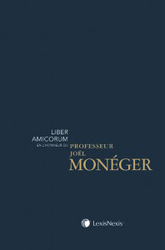
Référence complète Fox, E., The new world order, in Mélanges Joël Monéger, Liber Amicorum en l'honneur du Professeur Joël Monéger, LexisNexis, 2017, 818 p.
Thesaurus : Doctrine
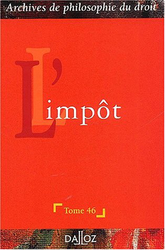
Complete reference : Archives de Philosophie du Droit (APD), L'impôt, tome 46, Dalloz, 2002, 547 p.
Read the summaries of the articles in English.
See the presentation of other volumes of Archives de Philosophie du Droit.