The recent news

Organization of scientific events

🌐suivre Marie-Anne Frison-Roche sur LinkedIn
🌐s'abonner à la Newsletter MAFR Regulation, Compliance, Law
🌐s'abonner à la Newsletter en vidéo MAFR Surplomb
🌐s'abonner à la Newsletter MaFR Droit & Art
____
► Référence complète : M.-A. Frison-Roche, Mission confiée par le garde des Sceaux, Droit de la compliance souveraineté juridique et attractivité économique, 2025-2026.
____
📜lire la lettre de mission du garde des Sceaux du 5 septembre 2025 saisissant Marie-Anne Frison-Roche
____
► Présentation méthodologique de la menée de cette mission : À
Organization of scientific events

► Full reference : M.-A. Frison-Roche, Scientific coprdination and co-hosting of the colloquia series Compliance and Contract, organised on the initiative of the Journal of Regulation & Compliance (JoRC) and its academic partners
____
____
► The Symposium Series in a nutshell : As a direct continuation of the previous symposium series co-organised by the Journal of Regulation & Compliance and its partner universities on "Compliance Obligation", which served as the basis for the publication of the book 📘Compliance Obligation, The series, some elements of which began in 2024 and others are already present in this book, explored in depth the specific theme of the links between compliance law and contracts. Indeed, compliance law is often analysed as the construction of laws and regulations to achieve "📘 Monumental Goals " of a political nature desired by States and public authorities, to the achievement of which systemic economic operations contribute through 📘Compliance Tools that are now well documented. Contracts are still relatively little studied, or even developed, in compliance systems that are often perceived through the orders issued, the technologies put in place and the 📘sanctions to be avoided or endured. On the contrary, the future of compliance law, particularly in its European conception, which places human beings at the centre of concerns for the sustainability of systems and the use of contracts, is the new conception that we must adopt. Contracts then appear to be both the means by which the subject company fulfils its legal obligations, forges relationships with other actors and deploys the necessary innovations. Contract law is both used and renewed as a result. The series of symposiums will examine various aspects of this general issue. It will result in the publication of a 📘book Compliance and Contrat.
____
► Presentation of symposiums in development :
- 29 May 2026🧮THE JUDGE CONFRONTED WITH CONTRACTS OF COMPLIANCE AND COMPLIANCE CLAUSES: read the presentation
- 12 June 2026🧮THE "CONTRACT OF COMPLIANCE" : read the presentation
- 25 Septembre 2026🧮COMPLIANCE: CLAUSE BY CLAUSE: read the presentation
- 2 October 2026🧮COMPLIANCE AND COMMON CONTRACT LAW : read the presentation
- September 2026🧮COMPLIANCE, VALUE CHAINS AND CONTRACT: read the presentation
- 2 November 2026 🧮COMPLIANCE AND THE STRATEGIC CONTRACTUAL ORGANISATION OF CHAINS VALUE BY ENTERPRISES: read the presentation
________

July 8, 2026
Publications
🌐Follow Marie-Anne Frison-Roche on LinkedIn
🌐subscribe to the Newsletter MAFR Regulation, Compliance, Law
🌐Subscribe to the Video Newsletter MAFR Surplomb
🌐Subscribe to the MaFR Law & Art Newsletter
____
► Full reference: M.A. Frison-Roche, “Si l'heureux stratagème probatoire du Roi Salomon n'avait pas fonctionné (If King Solomon's probationary strategy hadn't worked)”, in Collective Book dedicated to Professor Pierre Crocq, Liber Amicorum, LGDJ-Lextenso, 2026, pp. 713–723.

____
📝Read the article (in French)
____
🚧Read the bilingual working document on which this article is based
____
► Introduction to the article:
As renowned and significant in biblical scholarship as it is in legal culture and imagination, Solomon’s Judgement is a procedural measure, an evidential stratagem (I). But even a King cannot be certain of the success of an investigative measure that his authority allows him to impose; nothing guarantees the success of the evidential stratagem he has devised, that is to say, the discovery of the truth. The investigative measure he devised presupposes a maternal love that leads the woman—who might prefer to continue disputing—to choose instead not to keep the child and to leave him in a state of death, a mere inert prey to the claim of appropriation made by the plaintiff. It is the woman’s virtue that enables the Judge’s wisdom. The evidence stratagem might not have worked (II). This is scarcely considered, as King Solomon is always portrayed as wise and the mother as preferring the child to herself. But if we step outside the Book of Kings, where virtue reigns—that of the mother as well as that of the judge—to confront the passion of the woman who smothered her newborn in the night and now seeks the force of justice to seize the second, one might reflect, whilst wandering through the lobby of a courthouse, that it is all too often the case that adults put themselves before children. What if the second mother had put herself before the child? What would have happened if the judge’s order, already being carried out, had not been halted by the virtue of the defendant? (III). What would the King then have done to exercise his office as Judge justly, since the truth would not have been accessible to him? (IV). If one changes an element of the narrative, because justice is human, because passions drive the parties, because children are often the silent victims on both sides, is justice still possible?
________

July 7, 2026
Interviews

🌐suivre Marie-Anne Frison-Roche sur LinkedIn
🌐s'abonner à la Newsletter MAFR Regulation, Compliance, Law
🌐s'abonner à la Newsletter en vidéo MAFR Surplomb
____
► Référence complète : M.-A. Frison-Roche, « GPA, "le monde des contrats a pris le pouvoir"», interview réalisée par Olivia Dufour pour Actu-juridique, Lextenso, 7 juillet 2026
___
► lire l'entretien : 💬 Lire l'interview
🌐lire la présentation de l'entretien sur LinkedIn
____
► présentation de l'entretien par Actu-Juridique : Par deux arrêts rendus en assemblée plénière le 3 juillet dernier, la Cour de cassation a attribué, par le mécanisme de l’exequatur, l’effet d’une filiation à l’égard de deux personnes qui ne sont ni parents biologiques ni adoptants de deux enfants conçus par GPA (gestation pour autrui). Ce faisant, elle introduit une filiation par contrat qui bouleverse notre droit, analyse le professeur Marie-Anne Frison-Roche pour qui le système de l’adoption, compatible avec la loi française, aurait pu ici parfaitement s’appliquer. C’est une très mauvais nouvelle pour les femmes et les enfants, estime cette juriste. .
___
Q. Comment analysez-vous les arrêts du 3 juillet ?
Résumé de la réponse de MAFR : El
Q. Quelles ont été les étapes de cette marche jurisprudentelle ?
Résumé de la réponse MAFR : l'
Q. Quelle est la nouveauté contenue dans les arrêts du 3 juillet ?
Résumé de la réponse MAFR : Le
Q. Pourtant, le législateur est intervenu en 2021 pour rappeler l’exigence de réalité biologique ?
Résumé de la réponse MAFR : Le
Q. La CEDH impose-t-elle cette solution jurisprudentielle ?
Résumé de la réponse MAFR : Le
Q. La Cour de cassation affirme que le refus d’exequatur du jugement de filiation engendrerait un préjudice disproportionné pour l’enfant, dont l’intérêt doit primer sur l’interdiction de principe de la GPA, laquelle relève pourtant de l’ordre public international français…
Résumé de la réponse MAFR : Le
Q. On assiste donc à l’émergence d’une nouvelle filiation, purement contractuelle…
Résumé de la réponse MAFR : Le
_________
July 6, 2026
Publications

🌐Follow Marie-Anne Frison-Roche on LinkedIn
🌐subscribe to the Newsletter MAFR Regulation, Compliance, Law
🌐Subscribe to the Video Newsletter MAFR Surplomb
🌐Subscribe to the MaFR Law & Art Newsletter
____
► Full reference: M.A. Frison-Roche, “Considérer la géographie juridique africaine pour y réussi l'obligation de vigilance" (Taking into account the legal landscape in Africa to fulfil the Vigilance Obligation), in E. Da Allada (ed.), Devoir de vigilance, quelles perspectives africaines ? (The Vigilance Duty: what African perspectives?), Lefebvre-Dalloz, “Thèmes et Commentaires” series, 2026, pp. 235–235.
____
📝Read the article (in French)
____
🚧read the bilingual working document on which this article is based
____
🎤read the presentation of the conference which summarised this topic
____
► Summary of the article: The French ‘Vigilance’ Act of 2017 incorporated the technical provisions and the spirit of the ‘Sapin 2’ Act of 2016. They share a common ambition. They have been, and remain, a source of both controversy and fervour. At their heart lies the establishment of a “compliance obligation”, for which vigilance techniques form the “vanguard” in serving a grand ambition: to protect systems from present and future risks in order to safeguard the people involved in them.
The passion that continues to surround the Vigilance Act – which gave rise to the CS3D Directive – is not a good thing, because the law and passion are never allies. Some are passionately committed to the triumph of vigilance by forcing companies to perform miracles, whilst others are passionately committed to the destruction of all the legislation that has established the very concept of this compliance law, built upon these monumental humanist goals.
But let us recognise that in these debates on the Duty of Care, which is being legally implemented across value chains, Africa is often cited as an example in a general discussion. It is not often considered as a distinct case in its own right. No account is taken of its strengths or its own legal mechanisms, even though value chains – particularly industrial ones – so often lead to it, both now and in the future. Through analyses of the duty of care, Africa is perceived as a place of retribution or of a new form of paternalism, and when its future is considered, prospects seem to be lacking, even though the very purpose of compliance – and therefore of due diligence – is the future.
If we take a less confrontational view and focus more on the ‘legal geography’ of African countries and their social and inter-state structures social and inter-state structures, we can see that concern for others – both present and future – which ultimately constitutes the Monumental Aim of Compliance Law and thus of the Duty of Vigilance – is more prevalent in Africa than it is in Europe, which is now built upon legal individualism. This concern for others is reflected in legal mechanisms akin to mediation and various legal structures that our own institutions would do well to take on board – our legislators before adopting legislation, and our judges, who could listen to them as amici curiae before always reaching a decision.
If we turn our attention to the African continent, where a segment of the value chains operates, and to the way work is organised, it becomes clear that here too, legislation and sanctions are not the whole story. Compliance techniques that make use of soft law and the contractual arrangements underpinning the chains themselves can remove the element of abstraction that is, by its very nature, inherent in general legislation. Making progress through contracts, under the scrutiny and with the support of the courts, is an approach that could prove more fruitful than well-intentioned legislation – which served as a catalyst – given the prominent role of Contract Law within OHADA.
This serves to enhance the judge’s importance. The judicialisation of compliance is also linked to the growing connection between compliance and contracts. However, it appears that not only can European judges specialising in due diligence thus rule on matters concerning Africa – a continent they can only know from a distance (though it is the lot of every judge to be an outsider) – but African and inter-state courts, notably through OHADA, can address the duty of care because value chains are constituted by contracts. By developing it not as a foreign concept to be assimilated, but as something that expresses the very heart of the law in Africa: concern for others, solidarity, and the search for compromises and solutions to ensure that the social and environmental – that is to say, human – system continues to thrive tomorrow.
________
June 25, 2026
Publications

🌐 follow Marie-Anne Frison-Roche on LinkedIn
🌐subscribe to the Newsletter MAFR Regulation, Compliance, Law
🌐subscribe to the Video Newsletter MAFR Surplomb
🌐subscribe to the Newsletter MaFR Droit & Art
____
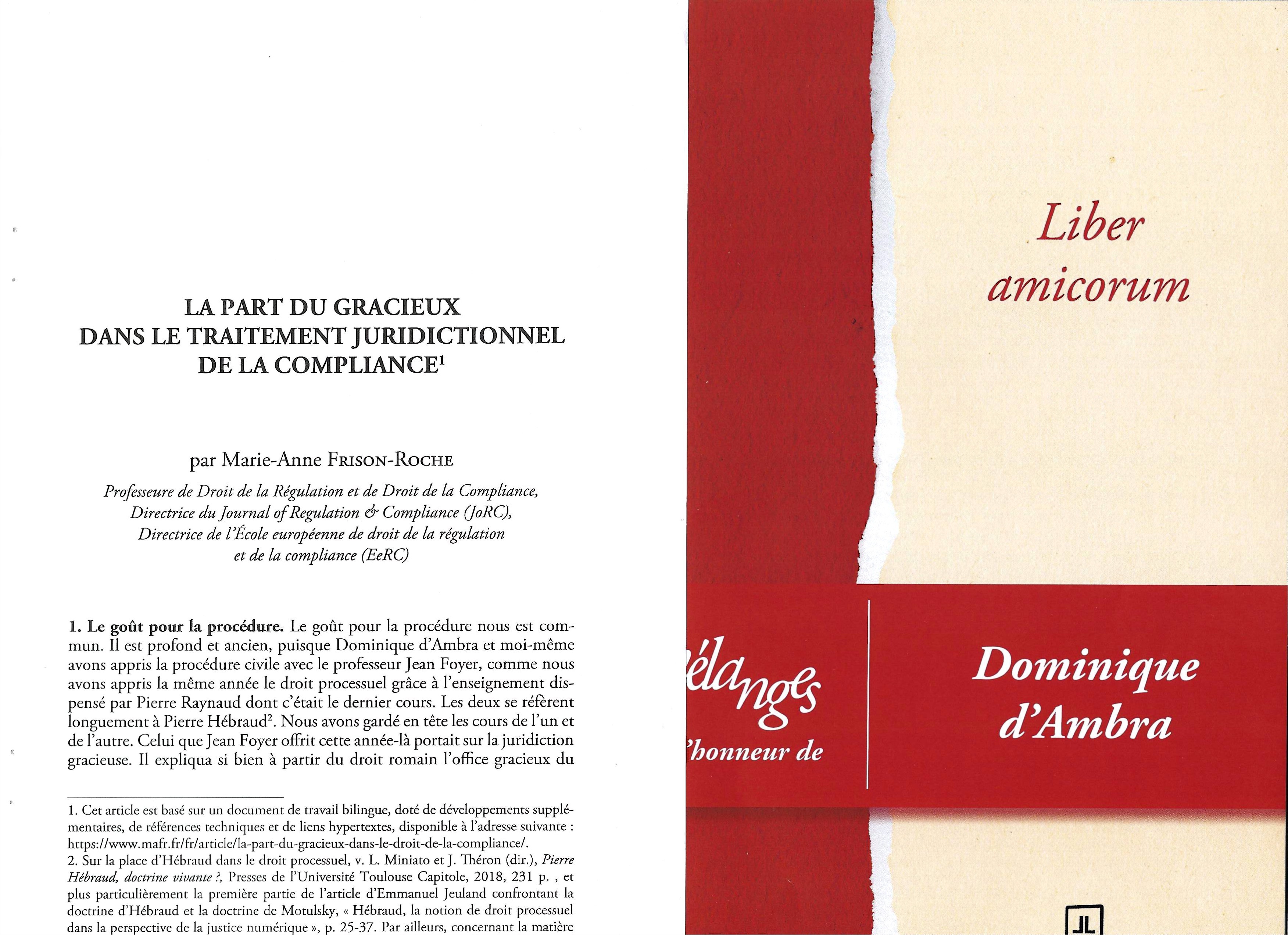
► Full Reference: M.A. Frison-Roche, "La part du gracieux dans le traitement juridictionnel de la compliance (The role of Discretionary Jurisdictio in the judicial treatment of Compliance cases)", in Mélanges Dominique d'Ambra, Liber Amicorum, Lefebvre-Dalloz, 2026, pp.175-196.
____
📝read this article (in French)
____
🚧read the bilingual Working Paper, base of this article
____
► English summary of this article: Based on the definition of Judicial Office, the procedural principles that derive from it and the consequent powers that judges exercise, the objet of this study is to measure the degree of discretion that exists in the judicial treatment of compliance, without direct consideration for the dispute between litigants. This part is very ignored, when it should be given top priority. Indeed, because Systems are involved in compliance cases brought before civil or commercial judges, we are seeing a development of this discretionary element in judicial fonction. Discretionary matters differ from unilateral discretionary procedures, and this discretionary element relates to what the judge examines, possibly in the context of a dispute.
The first part of this contribution therefore aims to describe the natural development of the discretionary power of the judge to deal with compliance cases brought before them. This role stems from the fact that, even when triggered by a dispute, what is submitted to the judge is a situation composed of a system, which cannot defend its interests before the civil or commercial judge in this Systemic Litigation arising from the very nature of Compliance Law and the Compliance Obligations it engenders on systemic entites. Moreover, it is the Future whose interests must be considered and protected, which the judge must do directly.
This leads to the second part of the contribution, calling for a rethinking of the procedure and the role of the Compliance Judge, so that ex gratia matters can be dealt with. The judge must therefore verify that there are no conflicts of interest between the litigants, including hidden ones, and must learn about the systems involved. The inquisitorial principle must therefore be strengthened. But at the same time, since the primary aim is not to settle a dispute but to resolve a systemic problematic situation, the judge must facilitate the movements of the parties, and the adversarial principle must also be strengthened. Must be encouraged this activation of a powerful and discretionary approach, not as an exception but as a principle fully articulated with a contentious principle, with the dispute being only a means used by the necessary parties to enable systemic compliance situations to be resolved.
________

June 12, 2026
Conferences

🌐Follow Marie-Anne Frison-Roche on LinkedIn
🌐s'abonner à la Newsletter MAFR Regulation, Compliance, Law
🌐Subscribe to the video newsletter MAFR Overhang
🌐Subscribe to the MaFR Law & Art newsletter
____
► Full reference: M.-A. Frison-Roche, "La définition juridique du Contrat de compliance (The legal definition of the compliance contract)", in Journal of Regulation & Compliance (JoRC) published by the Centre for Research on Justice and Conflict Resolution (CRJ) and the Centre for Research in Economics and Law (CRED) at Panthéon-Assas University (Paris II), Le "Contrat de compliance" (The "Compliance Contract"), Paris II Lecture Theatre - 82 Rue Notre Dame des Champs, Paris, 12 June 2026.
____
🧮view the full programme for the event
____
📶view the slides (in French)
____
🌐read the presentation made on LinkedIn
____
🚧Read the bilingual working paper on which this conference is based
____
📝This lecture will form the basis of a contribution to the book, 📕Compliance et Contrat (Compliance and Contracts),
To be published in the 📚Regulations & Compliance series, a book co-published by the Journal of Regulation & Compliance (JoRC) and Lefebvre-Dalloz.
____
► Overview of this lecture : The lecture is divided into three parts.
In the first part, the aim is to describe the reality of the “Compliance Contract”, which can be defined as the decision taken by an entity subject to a “Compliance Obligation” (most often a company, but it may also be a administrative organisation) to entrust the fulfilment of that obligation to a third party. This does not diminish the entity’s obligation to be accountable for the compliance structure, nor for its ability to produce the expected outcomes, in particular the behaviours that will contribute to achieving the Monumental Systemic Goals for which the compliance frameworks were adopted. This outsourcing is lawful; its contractual form falls under Contract Law and the principle of contractual freedom.
Even if one considers that, since the subject matter of the contract is Compliance itself, it would constitute a ‘Systemic Contract’—just as Compliance Litigation is ‘Systemic Litigation’—its fundamental nature is indeed a bilateral relationship between a client and a professional (who is often subject to professional rules and codes of conduct).
Indeed, there are legal consequences to this practice of “Compliance Contracts”, because it is the Compliance System that is thereby served: on the one hand, “regulatory clauses” will be inserted, whilst others will be removed (“deemed unwritten”). Contractual freedom remains the guiding principle, however.
In Contract Law, it would be appropriate for the contracting parties to refer to this contribution to the Monumental Goals, which constitute the fundamental legal norm of the Compliance System, if only to guide the contract Judge who may be called upon in the event of a dispute, as the interpretation of the parties’ intentions must be carried out in a teleological manner.
In the second part, the relationship between this "Compliance Contract" and the various "Compliance Clauses" is analysed. The two should certainly not be confused, since, quite apart from these highly specific contracts through which the various compliance techniques are entrusted, in their drafting and management, to third parties, who thus become the experts, there are also clauses inserted into numerous contracts (sales, distribution, manufacturing, service, etc.), clauses which aim, amongst many other clauses serving different purposes, to incorporate compliance considerations into the contract.
But first and foremost, the Compliance Contract contains numerous clauses specific to it, which often derive from compliance system, since Compliance concretisation is the very purpose of this specific contract, et nothing else: it is therefore logical that, by way of a ‘transparency effect’, the legal Compliance Systemic requirements should be incorporated into the isolated contract.
Secondly, and more significantly, many various contracts contain clauses that provide for the triggering of a “Compliance Ccontract”. For example, when an audit clause is linked to a specific event and the provision stipulates that a contract will then be entered into with a particular expertal body or person, this will generate a Compliance Contract in a second time. The link between the two may give one of the contracting parties control over the other, notably if the expert is close to them. If the links between Compliance Contracts and Compliance Clauses are developping, this could lead to a return to vertical integration. Competition Law may be justified in looking into this.
It appears that, once we have distinguished between Compliance Contracts and Compliance Clauses, and then linked them together, we can arrive at a Contractual Compliance Strategy that is both legitimate and effective, provided that it contributes to the achievement of the Compliance Monumental Goals set by the political and public authorities.
Indeed, as soon as we distinguish between “conformity” – which is intended solely to compel the operator to obey all applicable regulations blindly and mechanically – and “Compliance Law”, which is legally guided by Monumental Systemic Goals, this contractual strategy becomes essential.
Part Three sets out to clarify the scope of this Compliance Contract.
The first implication concerns the Compliance System itself, of which it forms a part; the Compliance Contract having the welcome effect of increasing the operator’s contribution to the achievement of the Monumental Systemic Goals (ensuring that systems – banking, financial, transport, energy, climate, digital, etc.—do not collapse and do not crush human beings, but rather benefit the human beings who are involved in them, whether willingly or not).
To this end, the contract must enable the operator – where necessary by means of express provisions – to demonstrate its credibility in contributing to the achievement of these Monumental Goals. Reliable pathways and credible structures must be established. In the cas of technical implementation is outsourced by a Compliance Contract, this obligation to provide evidence may be undermined. To compensate for this, the Compliance Contract may itself include provisions relating to portable technical information, support available through the client's accountability mechanism, or even in the event of legal proceedings.
The second aspect concerns the contractors themselves, who adapt their intentions and are bound, above all, by this “little law” which is any contract for the parties. This perspective is surprisingly underdeveloped in practice, no doubt because in Law, when considering Compliance, reference is made to unilateral “regulations” and the vertical relationship of obedience that it engenders in the operator. This changes with the transformation of "conformity" (which is that) in "Compliance Law" (which is based on Monumental Systemic Goals and justifies contracts).
The third aspect concerns third parties, namely the stakedholders (and competitors...). These third parties benefit from Compliance Contracts because they are integrated into the Compliance System and because of the transparency between this system and the Compliance Contracts. In fact, and more technically speaking, this specific Cgreement provides them not only with a accountable(the company, the public body, the State), but also with a contractual debtor. Stakeholders may assert rights against the latter.
However, because the contracts themselves are also enforceable against third parties, they can anticipate these relationships with third parties – not only the competitors of the entity subject to the Compliance Obligation, but also its own relationship with stakeholders, and even its relationship with public authorities. Indeed, the object (and effect) of the Compliance Contract is to produce and build up Information that is of interest to everyone. The result is a ‘treasure trove of evidence’. A key question is how, and whether, this treasure trove can remain within the circle of the contracting parties or not.
Indeed, the fourth area concerns Public Authorities. As the bodies that “uphold” the compliance system, they consider the Compliance Contract to be legitimate and one of the most effective means of ensuring that regulations are effective, efficient and properly enforced; however, they also wish to benefit from the outcome of the contract’s implementation: to access the systemic information it generates. The contracting parties do not always share this view, but the Compliance Contract is not a means of “obeying” regulations. It is the Judge who will certainly address this question of principle, which relates to the very definition of Compliance Law.
This brings us to the fifth area of application, which concerns the Courts. Indeed, a number of courts are responsible for hearing such cases: the contract courts, the competition courts, the courts overseeing the various systems whose sustainability is thus safeguarded, and the courts specialising in vigilance legal duty (which is the cutting edge of Compliance Law).
The issue of the “natural judge” was examined at the symposium held on 29 May 2026 on: Contractual litigation involving compliance: procedural and jurisdictional aspects. The judge hearing the contract case (civil or commercial judge) will tend to refer first and foremost to the contract. This is also why the Compliance Contract conceptor would be well advised to include provisions in its terms regarding its relationship with the Compliance System, so that it is not the authorities of that system who do so in a too much discretionary manner.
In understanding the "Compliance Contract", as Iit was emphasised in 2022, in the judge’s interpretation of the contract, the judge is required to reconcile the parties’ intentions with a teleological approach, that is to say, to establish that the parties intended to serve the purpose of the expertise thus requested and developed (for the operator and ultimately for the stakeholders and for the system itself).
By establishing this convergence, the judge gives full effect to the Cmpliance Contract. Rather than framing the issue, as is so often done when reasoning in terms of ‘conformity’, as a conflict between contractual freedom and public policy (conformity serving a public policy that would be contrary to the contract, inferior norm in the vertical normative hiercharchy).
It must be accepted as a fundamental principle that contractual freedom, freedom of contract and a competitive market for compliance expertise are the most effective means of developing a Compliance System that will safeguard interconnected different systems and protect the people involved in them.
____
⛏️Find out more :
🕴🏻M.-A. Frison-Roche, 📝Compliance contract, compliance clauses, 2022
🕴🏻M.-A. Frison-Roche, ⚙️Compliance and Contracts,
________

May 29, 2026
Conferences

🌐Follow Marie-Anne Frison-Roche on LinkedIn
🌐s'abonner à la Newsletter MAFR Regulation, Compliance, Law
🌐Subscribe to the video newsletter MAFR Overhang
🌐Subscribe to the MaFR Law & Art newsletter
____
► Full reference: M.-A. Frison-Roche, "Le maniement du temps dans le contentieux contractuel impliquant la Compliance : de l’urgence au temps long (The management of time in contractual litigation involving compliance: from urgency to the long term)", in Journal of Regulation & Compliance (JoRC) and Jean Moulin – Lyon 3 University, Contractual disputes involving compliance: procedural and jurisdictional aspects, Faculty of Law, Lyon, 29 May 2026.
____
🧮view the full programme for the event (in French)
____
📶view the slides (in French)
____
🚧Read the bilingual working paper on which this conference is based
____
Read the présenation of the other two papers presented at this conference:
🎥The emergence of contractual disputes involving compliance due to the convergence of legal areas
🎥Appropriate adjudication in contractual disputes involving compliance and its effective enforcement
____
📝This lecture will form the basis of a contribution to the book, 📕Compliance et Contrat with English summaries)
To be published in the 📚Regulations & Compliance series, a book co-published by the Journal of Regulation & Compliance (JoRC) and Lefebvre-Dalloz.
____
► Overview of this conference :
⛏️Find out more :
🕴🏻J.-M. Coulon and 🕴🏻M.-A. Frison-Roche (eds.), Le temps dans la procédure (Time in Legal Proceedings), 19966
🕴🏻M.-A. Frison-Roche, ⚙️Compliance and Contracts,
________