Food for thoughts

March 11, 2026
Thesaurus : Doctrine
► Référence complète : L. d'Avout, "Sauvegarder les interdits législatifs au sein d’un ordre juridique ouvert", D.2026,
____
🦉Cet article est accessible en texte intégral pour les personnes inscrites aux enseignements de la Professeure Marie-Anne Frison-Roche

Feb. 26, 2026
Thesaurus : Doctrine
► Référence complète : S. Grosbon et S. Robert (dir.), Critique écosystémique des droits humains, éd. DICE, 2026.
____
► Accéder à l'ouvrage : cliquer ICI

Feb. 22, 2026
Questions of Law

Updated: Feb. 20, 2026 (Initial publication: Aug. 28, 2025)
Publications

🌐Follow Marie-Anne Frison-Roche on LinkedIn
🌐Subscribe to the newsletter MAFR Regulation, Compliance, Law
🌐Subscribe to the video newsletter MAFR Surplomb
🌐Subscribe to the newsletter MaFR Law & Art
____
 ► Full reference : M.-A. Frison-Roche, Taking African legal geography into account to achieve an efficient vigilance system, working paper, August 2025/February 2026
____
🎤This working paper follows on from the closing address at the symposium Devoir de vigilance, quelles perspectives africaines ? Regards croisés en droit international, droit comparé et droit OHADA (Vigilance Duty: what are the prospects in Africa? Perspectives from international law, comparative law and OHADA Law, organised by the Faculty of Law of Bordeaux, through its Institut de Recherches en Droit des Affaires et du Patrimoine - IRDAP (Institute for Research in Business and Property Law), held on 15 November 2024.
____
📝This working paper forms the basis of the article "Considérer la géographie juridique africaine pour y réussir l'obligation de vigilance", which concludes the volume edited by Eustache da Allada in 2026 by Éditions Lefebvre-Dalloz, in the “Thèmes & Commentaires” collection,📗Devoir de vigilance, quelles perspectives africaines ? Regards croisés en droit international, droit comparé et droit OHADA (Vigilance Duty: what are the African perspectives? Comparative perspectives in international law, comparative law and OHADA Law).
To this end, following an initial draft in August 2025, it was revised a second time to better incorporate the written contributions that make up the book, since the article on which it is based sets out a personal approach drawing on external research whilst also needing to synthesise these contributions.
____
► Summary of the working paper : The French “Vigilance” Act of 2017 incorporated the technical provisions and the spirit of the “Sapin 2” Act of 2016. They share a common goal. They have been and remain a common source of controversy and passion. At their heart lies the establishment of a “compliance obligation”, for which vigilance techniques form the “edge ” in serving a grand ambition: to protect systems from risks, both now and in the future, in order to protect the people involved in them.
The passion that continues to surround the Vigilance Act, which gave rise to the European CS3D , is misguided, because the law and passion are never allies. Some would passionately want to see vigilance triumph by condemning companies to perform miracles; others would passionately want to see the destruction of all the texts that established the very concept of this Compliance Law, built upon these Humanist Monumental Goals.
But let us acknowledge that in these debates on the Vigilance Obligation, which is being legally implemented across value chains, Africa is often cited as an example in a general discussion. It is not often considered as a distinct case with its own legal landscape. No reliance is placed on its strengths or on its own legal mechanisms, even though value chains – particularly industrial ones – so often lead to it, both now and in the future. Through analyses of the Vigilance Obligation, Africa is perceived as a place of retribution or of a new form of paternalism, and when its future is envisaged, prospects seem to be lacking, even though the very essence of compliance—and therefore of Vigilance—is the future.
If we take a less confrontational view and focus instead on the ‘legal geography’ of African countries and their social and inter-state structures, we see that the concern for others, both present and future – which ultimately constitutes the Monumental Goal of Compliance Law and thus of the Vigilance Obligation – is more prevalent in Africa than it is in Europe, which is now built upon legal individualism. This concern for others is reflected in legal mechanisms akin to mediation and various legal structures that our own institutions would do well to heed: our legislators before adopting bills, and our judges who might listen to them as amici curiae before reaching a decision.
If we turn our attention to the African continent, which is exploited by certain segments of value chains, and to labour organisations, it becomes clear that here too, legislation and sanctions are not the whole story. Compliance techniques that make use of soft law and the contractual frameworks underpinning the chains themselves can remove the element of abstraction that is, by nature, inherent in general legislation. Moving forward through contracts under the supervision and with the support of the courts is an approach that could prove more fruitful than well-intentioned legislation, which has served as a catalyst, in line with the privileged position of contract law within OHADA.
This serves to enhance the judge’s authority. The Compliance Judicialisation is also linked to the growing connection between Compliance and Contracts. However, it appears that not only can European judges specialising in Compliance Law and Vigilance Obligation thus rule on matters concerning Africa, which they can only know from a distance – though it is the lot of every judge to be an outsider – but African and inter-state Courts, notably through OHADA, can address the Vigilance Obligation because value chains are constituted by contracts. By developing it not as a foreign concept to be assimilated, but as that which expresses the very heart of the Law in Africa: concern for others, solidarity, the search for compromises and solutions so that the social and environmental system – that is to say, the human system – may endure into the Future.
___
🔓Read the developments below⤵️

Feb. 4, 2026
Thesaurus : Doctrine
► Référence complète : J.Y. Heurtebise, "Taiwann, l'archipel des possibles. Introduction", Revue Esprit, avril 2026.
___
►Lire l'introduction au dossier : Taïwan, l’archipel des possibles | Revue Esprit
_______
Jan. 27, 2026
Questions of Law
Jan. 22, 2026
Newsletter MAFR - Law, Compliance, Regulation

🌐Follow Marie-Anne Frison-Roche on LinkedIn
🌐Subscribe to the Newsletter MAFR Regulation, Compliance, Law
🌐Subscribe to the video newsletter MAFR Overhang
🌐Subscribe to the Newsletter MaFR Law & Art
____
► Full reference: M.-A. Frison-Roche, "Asset freezing in the legal saga between American power and Venezuelan wealth", MAFR Law, Compliance, Regulation Newsletter, 23 January 2026
____
🌐read this article published on LinkedIn the 23 January 2026
____
📧Read other articles from the MAFR Newsletter - Law, Compliance, Regulation for free with a subscription.
____
► Summary of this article : It is often emphasised that the law is merely a masquerade in the series of events we are witnessing.
This is not entirely true.
For three reasons.
1. Much will depend on the judge who will rule on the Madura couple's case. The energy sector has always similarly mixed regulation, public policies of states and businesses, both articulated by States and companies, both articulated by international contracts, always organising international arbitration
3. If ExxonMobil now refuses to make the investments desired by Trump, it is also because this enterprise remembers that many years ago the freeze of assets granted by the arbitrators was not very successful, and now the company manager believes that investment in Venezuala's infrastructure is therefore "impossible".
And given the current state of the law in the US, there is little Trump can do about it..
____
📝⤵Read the complete article below⤵
Jan. 9, 2026
Thesaurus : Doctrine
► Référence complète : Y. Kerbrat et S. Maljean-Dubois, "Legal consequences of breaching international climate obligations in the ICJ Advisory Opinion on climate change", Review of European, Comparative & International Environmental Law (RECIEL), opinion, janvier 2026.
____
🦉Cet article est accessible en texte intégral pour les personnes qui suivent les enseignements de la professeure Marie-Anne Frison-Roche.
_________

Nov. 19, 2025
Publications

🌐follow Marie-Anne Frison-Roche on LinkedIn
🌐subscribe to the Newsletter MAFR Regulation, Compliance, Law
🌐subscribe to the Video Newsletter MAFR Surplomb
🌐subscribe to theNewsletter MaFR Droit & Art
____
► Full Reference: M.-A. Frison-Roche, « L'invention du "droit à l'enfant". Les conséquences de la pratique contractuelle comme source d'engendrement de l'enfant (The invention of the "right to a child". The consequences of the contractual practice as a source of childbearing)", in Special Issue Nouvelles filiations (New Filiations), AJ Famille, Lefebvre Dalloz, Nov. 2025, pp.568-571.
____
📗read the table of content of the special issue in which this article is published (in French)
____
📝read this article (in French)
____
____
► English summary of this article: Every legal system is built on concepts that form its pillars. Filiation is one such concept. A cas-law solution, presented as pragmatic and casuistic, can overturn this concept. Whether one agrees with it or not, it must first be acknowledged and assessed.
Through a series of rulings on surrogacy, notably a ruling by its First Civil Chamber granting exequatur to a judgment recognising the filiation established by surrogacy between a child and persons with no biological link to the child and without recourse to adoption, the French Cour de Cassation has introduced the possibility of creating parentage by contract. This not only changes the concept of filiation but also changes the very structure of the French legal system, which is based on the distinction between persons and things. One may agree or disagree with this, but it must be said.
Since the judge gives force to such a contract establishing filiation, with the foreign judge simply recognising it and the French judge ensuring only that the contract is balanced, the prospect opens up of a society in which individuals will be able to contractually create institutions at their disposal, within the private normative space of the contract, with the State's only function being to give effect to their right to legal recognition of their unique "project". Parentage is only a first example.
Thus constructed on what was "inconceivable", i.e. a "right to a child", thanks to the contractual power to which the State should lend its force a posteriori, the judge makes parentage resulting .the judge technically declares a parentage arising from a contract to be "admissible". Is opening a society in institutions were contractually governed.
_________

Oct. 15, 2025
Thesaurus : Soft Law
► Référence complète : Speech of HE Judge Iwasawa Yuji, President of the International Court of Justice, before the Sixth Committee of the United Nations General Assembly, 15 octobre 2025
____
📝Lire la prise de parole (en anglais)
____
► Résumé de la prise de parole : L
________
Oct. 5, 2025
Newsletter MAFR - Law, Compliance, Regulation

🌐follow Marie-Anne Frison-Roche on LinkedIn
🌐subscribe to the Newsletter MAFR Regulation, Compliance, Law
🌐subscribe to the Video Newsletter MAFR Surplomb
🌐subscribe to the Newsletter MaFR Droit & Art
____
► Full Reference: M.-A. Frison-Roche, ""Juge modeste" ou "check and balance" :alternative aux Etats-Unis, alternative en France" ("modest judge" or "check and balance": alternative in the United States, alternative in France), Newsletter MAFR Law, Compliance, Regulation, 6 October 2025..
____
📧Read by free subscription other news from the MAFR Newsletter - Law, Compliance, Regulation
____
► Summary of this article: Recent, if not forthcoming, decisions by the US Supreme Court show that the American political system that was based on the unwritten principle of Check and Balance, requiring the Justices to constitute one Power facing the other two could be replaced by a political system based on the principle of a "modest Justice" enforcing decisions made by the Federal Executive. They would then have a new Constitution.
In Western Europe and especially in France, it is possible that the letter of the Constitution, which states that judges are not an autonomous power vis-à-vis the other two powers, will be abandoned and that, in the name of an unwritten principle, the Rule of Law, its transformation into an autonomous Power facing the executive in its own right will be adopted. The path would be exactly the opposite. We would then have changed the Constitution.
That's conceivable, and there are many arguments in favour of it.
We have to say so. And draw all the consequences.
____
📧read below the article published the 6 October dans the Newsletter MAFR - Law, Compliance, Regulation ⤵️

Oct. 2, 2025
Thesaurus : Doctrine
► Full Reference: B. Frydman & A. Briegleb, "L'obligation de compliance en Droit global ("Compliance Obligation in Global Law)", in M.-A. Frison-Roche (ed.), L'Obligation de Compliance, Journal of Regulation & Compliance (JoRC) and Éditions Lefebvre - Dalloz, coll. "Régulations & Compliance", 2025, pp.299-311.
____
📕read a general presentation of the book, L'Obligation de Compliance, in which this contribution is published
____
► English summary of this contribution (done by the Journal of Regulation & Compliance - JoRC): The authors stress that the Contracts Law and Tort Law are essential in Compliance Law, particularly in its global legal perspective, since it goes beyond the legal systems of States and develops new normativities, at the level of each company, but also allows a new expression of public power through the Monumental Goals that Compliance Law claims to achieve globally. The weaker the States, the greater the delegation to the first level is operating.
In concrete terms, the authors examine a series of situations in which various organisations use compliance techniques to appropriate global power over things or people, which has the effect, and sometimes the purpose, of reducing the freedoms of people controlled in this way. Thus CSR, which was initially non-binding, is now the source of binding obligations, and the moral obligation expressed in codes of conduct can become a civil obligation, as the Supreme Court of California decided in 2002 in the Nike case.
In addition, "Comply or Explain" clauses are now commonplace, allowing the person subject to the legislation not to comply if they can justify it, which is the basis of the many information reports that companies are now required to publish.
Then, returning to the issue of liability, particularly in the digital environment, the article stresses the importance of 'conditional immunity from liability', taking the view from the European DSA that certain operators, such as hosting providers, are not liable unless they take on obligations, such as monitoring functions on contents published.
Finally, with regard to the duty of vigilance, it tends for the first time to align the scope of "responsibility" with the scope of "power", moral responsibility thus becoming legal responsibility, which would be like a new responsibility for others.
The result of all this is an "obligation to regulate others".
________
🦉This article is available for people who follow the Professor Marie-Anne Frison-Roche teaching
Oct. 2, 2025
Thesaurus : Doctrine
► Référence complète : L. Aynès, "Comment l’arbitrage international peut être un renfort de l’Obligation de Compliance", in M.-A. Frison-Roche (dir.), L'Obligation de Compliance, Journal of Regulation & Compliance (JoRC) et Dalloz, coll. "Régulations & Compliance", 2025, pp.503-506.
____
📕lire une présentation générale de l'ouvrage, L'Obligation de Compliance, dans lequel cet article est publié
____
► Résumé de l'article (fait par le Journal of Regulation & Compliance - JoRC) : L'auteur part du constat premier comme quoi l'arbitrage international et la compliance sont naturellement ajustés puisqu'ils sont tous deux une manifestation de la mondialisation, expriment un dépassement des frontières, l'arbitrage pouvant reprendre les buts monumentaux de la compliance puisqu'il a engendré un ordre arbitral substantiellement global.
Mais l'obstacle réside dans la source de l'arbitrage demeure le contrat, l'arbitre n'exerçant qu'une juridiction temporaire dont la mission est donnée par ce contrat. Pourtant l'avènement de l'ordre global arbitral permet ce dépassement, l'arbitre puisant dans des normes dont les buts monumentaux de la compliance et les engagements des entreprises peuvent faire partie. Ce faisant l'arbitre devient un organe indirect de ce droit de la compliance dont on voit l'émergence.
Puis la contribution évoque une seconde évolution, qui pourrait faire de l'arbitre un organe direct de concrétisation de la compliance. Pour cela, il faut que l'arbitre non seulement contraigne à l'exécution d'obligation de faire, ce qui est déjà le mouvement au titre des mesures provisoire, mais encore ait une conception plus ample ce qu'est le conflit pour lequel une solution est requise, voire se libère un peu de cette source contractuelle qui le cerne. Cela est possiblement en train de se dessiner, en miroir de la transformation profonde de l'office du juge.
________
🦉Cet article est accessible en texte intégral pour les personnes inscrites aux enseignements de la Professeure Marie-Anne Frison-Roche
Oct. 2, 2025
Thesaurus : Doctrine
► Full Reference: R. Gauvain & B. Balian, "Opposition et convergence des systèmes juridiques américains et européens dans les règles et cultures de compliance" ("Opposition and Convergence of American and European Legal Systems in Compliance Rules and Cultures"), in M.-A. Frison-Roche (ed.), L'Obligation de Compliance, Journal of Regulation & Compliance (JoRC) and Editions Lefebvre - Dalloz, "Régulations & Compliance" Serie, 2025, pp.401-417.
____
📕read the general presentation of the book, L'Obligation de Compliance, in which this article is published
____
► English Summary of this contribution (done by the Journal of Regulation & Compliance - JoRC) : The authors approach Compliance Law through its tools, mainly compliance programmes through which companies comply with regulations and investigations conducted by companies at the request of public authorities to identify risks and new modes of defence consisting of entering into agreements with prosecuting authorities.
The article highlights the American inspiration behind this movement, whereby the State, primarily for the sake of efficiency, transfers the responsibility for pursuing "Monumental Goals" to businesses. Based on this, the article first shows how American mechanisms have been imported into Europe, particularly France, with the Convention judiciaire d'intérêt public, taking on many of the characteristics of the DPA, even if some specific features remain, for example in the alert mechanisms. Secondly, the convergence between the two systems is shown, because through the compliance obligations that form the core of these compliance tools, it is always Western values that are expressed, values that are common to American Law and European Law and European countries. It has enabled this importation, and we can now see that these values are more strongly upheld by Europe, particularly through the Vigilance duty and the DSA.
____
🦉This article is available in full text (in French) to those registered for Professor Marie-Anne Frison-Roche's courses
________

Oct. 2, 2025
Editorial responsibilities : Direction of the collection "Regulations & Compliance", JoRC & Dalloz
🌐follow Marie-Anne Frison-Roche on LinkedIn
🌐subscribe to the Newsletter MAFR Regulation, Compliance, Law
🌐subscribe to the VideoNews MAFR Surplomb
🌐subscribe to the Newsletter MaFR Law & Art
____
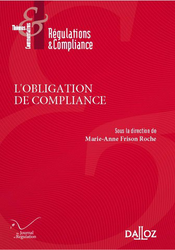
► Full Reference: M.-A. Frison-Roche (dir.), L'Obligation de Compliance, coll."Régulations & Compliance", Journal of Regulation & Compliance (JoRC) and Dalloz, 2025.
____
📘 At the same time, a book in English, Compliance Obligation, is published in the collection copublished by the Journal of Regulation & Compliance (JoRC) and the Éditions Bruylant.
____
🧮the book follows the cycle of colloquia organised by the Journal of Regulation & Compliance (JoRC) and its Universities partners in 2023 and 2024.
____
📚this volume is one of a series of books devoted to Compliance in this collection.
► read the presentations of the other books:
- further books:
🕴️M.-A. Frison-Roche (ed.), 📕Le système probatoire de la Compliance, 2027
🕴️M.-A. Frison-Roche (ed.), 📕Compliance et Contrat, 2026
- previous books:
🕴️M.-A. Frison-Roche & M. Boissavy (eds.), 📕Compliance et droits de la défense. Enquête interne - CJIP - CRPC, 2024
🕴️M.-A. Frison-Roche (ed.), 📕La juridictionnalisation de Compliance, 2023
🕴️M.-A. Frison-Roche (ed.), 📕Les Buts Monumentaux de la Compliance, 2022
🕴️M.-A. Frison-Roche (ed.), 📕Les outils de la Compliance, 2021
🕴️M.-A. Frison-Roche (ed.), 📕Pour une Europe de la Compliance, 2019
🕴️N. Borga, 🕴️J.-Cl. Marin and 🕴️J.-Ch. Roda (eds.), 📕Compliance : l'Entreprise, le Régulateur et le Juge, 2018
🕴️M.-A. Frison-Roche (ed.), 📕Régulation, Supervision, Compliance, 2017
🕴️M.-A. Frison-Roche (ed.), 📕Internet, espace d'interrégulation, 2016
📚see the global presentation of all the books of the collection.
___
► General presentation of this book: Compliance is sometimes presented as something that cannot be avoided, which is tantamount to seeing it as the legal obligation par excellence, Criminal Law being its most appropriate mode of expression. It is sometimes presented as something that the company does out of ethical concern, self-regulation which is the opposite of legal obligation. For the moment, therefore, there is no single vision of the Compliance Obligation. This is all the less the case because of the multitude of texts, themselves constantly evolving and changing, which inject such a wide range of compliance obligations that we give up trying to establish any unity, thinking that, on a case-by-case basis, we will define a regime and a legal constraint of greater or lesser strength, aimed at one subject or debtor or another, for the benefit of one or other.
This lack of unity, due to the absence of a definition of the Compliance Obligation, makes the application of the texts difficult to foresee and therefore makes the Judge fearful, even though he/she is going to take on more and more importance.
This book asks the practical questions: What is Compliance obliging? Who is obliged to comply? and How far are we obliged to comply? and provides answers, Compliance practices, constraints and innovations will be better mastered and anticipated by all those they affect: companies, stakeholders, technicians, lawyers, consultants, institutions and courts.
____
🏗️general construction of this Book: The book opens with a double Introduction. The first, which is freely accessible, consists of a summary of the book, while the second, which is substantial, deals with the unified conception that we can, and indeed should, have, of the "Compliance Obligation", without losing the concrete and active character that characterises this branch of law.
The first Part of the book aims to define the Compliance Obligation. To this end, Chapter I deals with the Nature of this obligation. Chapter II deals with the Spaces of the Compliance Obligation.
The Part II aims to articulate the Compliance Obligation with other branches of Law.
The Part III of the book looks at the way in which the possibility of obliging and the means of obliging are provided. To this end, Chapter I deals with the Convergence of the Sources of the Compliance Obligation. Chapter II considers International Arbitration as a reinforcement of the Compliance Obligation. To this end, Chapter I deals with the Convergence of the Sources of the Compliance Obligation. Chapter II considers International Arbitration as a reinforcement of the Compliance Obligation.
The last Part of the book is devoted to Vigilance, the leading edge of the Compliance Obligation. Chapter I is devoted to a study of the various sectors, and analyses the Intensities of the Vigilance Obligation. Chapter II deals with the Variations in Tension generated by the Vigilance Obligation. Finally, Chapter III deals with the New Modalities of the Compliance Obligation, highlighted by the Vigilance Imperative.
____
TABLE OF CONTENTS
ANCRER LES OBLIGATIONS DE COMPLIANCE SI DIVERSES
DANS LEUR NATURE, LEURS REGIMES ET LEUR FORCE
POUR DEGAGER L'UNITE DE L'OBLIGATION DE COMPLIANCE
LA RENDANT COMPREHENSIBLE ET PRATIQUABLE
(ANCHOR COMPLIANCE OBLIGATIONS, SO DIVERSE
IN THEIR NATURE, THEIR REGIMES AND THEIR FORCE,
TO BRING OUT THE UNITY OF THE COMPLIANCE OBLIGATION
MAKING IT COMPREHENSIBLE AND PRACTICABLE)
TITRE I.
CERNER L’OBLIGATION DE COMPLIANCE
(IDENTIFYING THE COMPLIANCE OBLIGATION)
CHAPITRE I : LA NATURE DE L’OBLIGATION DE COMPLIANCE (THE NATURE OF THE COMPLIANCE OBLIGATION)
Section 1 ♦️ La volonté, le cœur et le calcul, les trois traits cernant l'Obligation de Compliance (Will, Heart and Calculation, the three traits encercling the Compliance Obligation), by 🕴️Marie-Anne Frison-Roche
Section 2 ♦️ De la dette à l’obligation de compliance (From the Debt to the Compliance Obligation), by 🕴️Bruno Deffains
Section 3 ♦️ Obligation de Compliance et droits humains (Compliance Obligation and Human Rights), by 🕴️Jean-Baptiste Racine
Section 4 ♦️ L'Obligation de Compliance et les mutations de la souveraineté et de la citoyenneté (Compliance Obligation and changes in Sovereignty and Citizenship), by 🕴️René Sève
Section 5 ♦️ La définition de l''obligation de compliance confrontée au droit de la cybersécurité (The definition of the Compliance Obligation in Cybersecurity Law) by🕴️Michel Séjean
CHAPITRE II : LES ESPACES DE L’OBLIGATION DE COMPLIANCE (SPACES OF THE COMPLIANCE OBLIGATION)
Section 1 ♦️ Entités industrielles et Obligation de compliance (Industrial entities and Compliance Obligation), by 🕴️Etienne Maclouf
Section 2 ♦️ L'Obligation de Compliance dans les chaînes de valeur (The Compliance Obligation in Value Chains), by 🕴️Lucien Rapp
Section 3 ♦️ Compliance et conflits de lois. Le droit international de la vigilance-conformité à partir de quelques applications récentes sur le continent européen (Compliance and conflict of laws. International Law of Vigilance-Conformity, based on recent applications in Europe), by 🕴️Louis d'Avout
TITRE II.
ARTICULER L’OBLIGATION DE COMPLIANCE AVEC DES BRANCHES DU DROIT
(ARTICULATING THE COMPLIANCE OBLIGATION WITH BRANCHES OF LAW)
Section 2 ♦️ Droit fiscal et obligation de compliance (Tax Law and Compliance Obligation), by 🕴️Daniel Gutmann
Section 3 ♦️ Le droit processuel, prototype de l'Obligation de Compliance (General Procedural Law, prototype of the Compliance Obligation), by 🕴️Marie-Anne Frison-Roche
Section 4 ♦️ Le droit des sociétés et des marchés financiers face à l'Obligation de Compliance (Corporate and Financial Markets Law facing the Compliance Obligation), by 🕴️Anne-Valérie Le Fur
Section 4 ♦️ Transformation de la gouvernance et obligation de vigilance, by 🕴️Véronique Magnier
Section 5 ♦️ Le rapport entre le Droit de la responsabilité civile et l'Obligation de Compliance (The link between Tort Law and Compliance Obligation), by 🕴️Jean-Sébastien Borghetti
Section 6 ♦️ Dimensions environnementales et climatiques de l'Obligation de Compliance (Environmental and Climatic Dimensions of the Compliance Obligation), by 🕴️Marta Torre-Schaub
Section 7 ♦️ Droit de la concurrence et Droit de la Compliance (Competition Law and Compliance Law), by 🕴️Jean-Christophe Roda
Section 8 ♦️ L'Obligation de Compliance en Droit global (The Compliance Obligation in Global Law), by 🕴️Benoît Frydman & 🕴️Alice Briegleb
Section 9 ♦️ Les juges du droit des entreprises en difficulté et les obligations de compliance (Judges of Insolvency Law and Compliance Obligations), by 🕴️Jean-Baptiste Barbièri
TITRE III.
COMPLIANCE : DONNER ET SE DONNER LES MOYENS D’OBLIGER
(COMPLIANCE : GIVE AND TAKE THE MEANS TO OBLIGE)
CHAPITRE I : LA CONVERGENCE DES SOURCES (CONVERGENCE OF SOURCES)
Section 1 ♦️ Obligation sur obligation vaut (Compliance Obligation on Obligation works), by 🕴️Marie-Anne Frison-Roche
Section 2 ♦️ Les technologies disponibles, prescrites ou proscrites pour satisfaire Compliance et Vigilance (Technologies available, prescribed or prohibited to meet Compliance and Vigilance requirements), by 🕴️Emmanuel Netter
Section 3 ♦️ Contrainte légale et stratégie des entreprises en matière de Compliance (Legal Constraint and Company Strategies in Compliance matters), by 🕴️Jean-Philippe Denis & Nathalie Fabbe-Costes
Section 4 ♦️ La loi, source de l’Obligation de Compliance (The Law, source of the Compliance Obligation), by 🕴️Jean-Baptiste Blanc
Section 5 ♦️ Opposition et convergence des systèmes juridiques américains et européens dans les règles et cultures de compliance (Opposition and Convergence of American and European Legal Systems in Compliance Rules and Cultures), by 🕴️Raphaël Gauvain & 🕴️Blanche Balian
Section 6 ♦️ Ce à quoi les engagements engagent qu'est un engagement (What a ), by 🕴️Marie-Anne Frison-Roche
CHAPITRE II : L’ARBITRAGE INTERNATIONAL EN RENFORT DE L’OBLIGATION DE COMPLIANCE (INTERNATIONAL ARBITRATION IN SUPPORT OF THE COMPLIANCE OBLIGATION)
Section 1 ♦️ Comment l'arbitrage international peut être un renfort de l'Obligation de Compliance (How International Arbitration can reinforce the Compliance Obligation), by 🕴️Laurent Aynès
Section 2 ♦️ La considération par l'Arbitrage de l'Obligation de Compliance pour une place d'arbitrage durable (Arbitration' consideration of Compliance Obligation for a Sustainable Arbitration Place), by 🕴️Marie-Anne Frison-Roche
Section 3 ♦️ L’usage de l’arbitrage international pour renforcer l’obligation de Compliance : l’exemple du secteur de la construction (The use of International Arbitration to reinforce the Compliance Obligation: the example of the construction sector), by 🕴️Christophe Lapp
Section 4 ♦️ L’arbitre, juge, superviseur, accompagnateur ? (The Arbitrator, Judge, Supervisor, Support) , by 🕴️Jean-Baptiste Racine
TITRE IV.
LA VIGILANCE, POINTE AVANCÉE DE L’OBLIGATION DE COMPLIANCE
(VIGILANCE, SPEARHEAD OF THE COMPLIANCE OBLIGATION)
Section 1 ♦️ La Vigilance, pointe avancée et part totale de l'Obligation de Compliance (....), by 🕴️Marie-Anne Frison-Roche
CHAPITRE I : LES INTENSITÉS DE L’OBLIGATION DE VIGILANCE, POINTE AVANCÉE DU SYSTÈME DE COMPLIANCE (INTENSITIES OF THE VIGILANCE OBLIGATION, SPEARHEAD OF THE COMPLIANCE SYSTEM)
Section 2 ♦️ L’intensité de l’Obligation de Vigilance selon les secteurs : le cas des opérateurs financiers (Intensity of the Vigilance Obligation by Sectors: the case of Financial Operators), by 🕴️Anne-Claire Rouaud
Section 3 ♦️ L’intensité de l’Obligation de Vigilance selon les secteurs : le cas des opérateurs bancaires et d’assurance (Intensity of the Vigilance Obligation by Sectors: the case of Banking and Insurance Operators), by 🕴️Mathieu Françon
Section 4 ♦️ L’intensité de l’obligation de vigilance selon les secteurs : le cas des opérateurs numériques (Intensity of the Vigilance Obligation by Sectors: the case of Digital Operators), by 🕴️Grégoire Loiseau
Section 5 ♦️ L’Obligation de vigilance des opérateurs énergétiques (The Vigilance obligation of Energy Operators), by 🕴️Marie Lamoureux
CHAPITRE II : LES DISPUTES AUTOUR DE L'OBLIGATION DE VIGILANCE, POINTE AVANCÉE DU SYSTÈME DE COMPLIANCE, DANS SON RAPPORT AVEC LA RESPONSABILITÉ
Section 1 ♦️ Le rapport entre le droit de la responsabilité civile et l'obligation de compliance, by 🕴️Jean-Sébastien Borghetti
Section 2 ♦️ Repenser le concept de responsabilité civile à l’aune du devoir de vigilance, pointe avancée de la compliance (Rethinking the Concept of Civil Liability in the light of the Duty of Vigilance, Spearhead of Compliance), by 🕴️Mustapha Mekki
Section 3 ♦️ Tensions et contradictions entre les instruments relatifs à la vigilance raisonnable des entreprises, by 🕴️Laurence Dubin
Section 4 ♦️ Compliance, Vigilance et Responsabilité civile : mettre en ordre et raison garde (Compliance, Vigilance and Civil Liability: put in order and keep the Reason), by 🕴️Marie-Anne Frison-Roche
CHAPITRE III : LES MODALITÉS NOUVELLES DE L'OBLIGATION DE COMPLIANCE, MISES EN LUMIÈRE PAR L'IMPÉRATIF DE VIGILANCE (NEW MODALITIES OF THE COMPLIANCE OBLIGATION, HIGHLIGHTED BY THE VIGILANCE IMPERATIVE)
Section 1 ♦️ Clauses et contrats, modalités de l’obligation de vigilance (Clauses and Contracts, terms and conditions of implementation of the Vigilance Obligation), by 🕴️Gilles J. Martin
Section 2 ♦️ La preuve de la bonne exécution de la Vigilance au regard du système probatoire de Compliance (Proof that Vigilance has been properly carried out with regard to the Compliance Evidence System), by 🕴️Jean-Christophe Roda
TITRE V.
LE JUGE ET L'OBLIGATION DE COMPLIANCE
(THE JUDGE AND THE COMPLIANCE OBLIGATION)
Section 1 Section 1 ♦️ Devoir de vigilance et litiges commerciaux : une compétence à partager ?, par 🕴️François Ancel
Section 2 ♦️ Les enjeux présents à venir de l’articulation des principes de procédure civile et commerciale avec la logique de compliance (Present and Future Challenges of Articulating Principles of Civil and Commercial Procedure with the Logic of Compliance), by 🕴️Thibault Goujon-Bethan
Section 3 ♦️ Le juge de l’amiable et la compliance (The amicable settlement judge and compliance), by 🕴️Malik Chapuis
Section 4 ♦️ Le Juge requis pour une Obligation de Compliance effective (The Judge required for an Effective Compliance Obligation), by 🕴️Marie-Anne Frison-Roche
L’OBLIGATION DE COMPLIANCE : VISION D’ENSEMBLE
(COMPLIANCE OBLIGATION : OVERVIEW)
♦️ L'obligation de compliance, charge portée par les entreprises systémiques donnant vie au Droit de la Compliance. - lignes de force de l'ouvrage (The Compliance Obligation, a burden borne by Systemic Companies giving life to Compliance Law - key points of the book (free access) by 🕴️Marie-Anne Frison-Roche
________
Aug. 20, 2025
Thesaurus : Doctrine
► Référence complète : R. Rioux, Th. Melonio, A. Schwerer, "Le pouvoir des alliances", Le Grand Continent, août 2025.
_______
► Résumé de l'article :
June 5, 2025
Thesaurus : Doctrine
► Référence complète : A. Supiot, "Droit du travail et dette de vie", Revue internationale du travail. 2025,165(1).
____
____
May 10, 2025
Thesaurus : Doctrine
► Référence complète : G. Beaumier & L. Gjesvik, "Digital Governance in a Rubber Band: Structural Constraints in Governing a Global Digital Economy", Global Studies Quarterly, vol. 5, issue 2.
____
____
► Résumé de l'article (fait les auteurs) : L’on représente souvent les États-Unis, l’Union européenne et la Chine comme l’incarnation de trois modèles de gouvernance numérique qui s’opposent. Leurs approches « de marché », « démocratique » et « autoritaire » refléteraient leurs préférences respectives s’agissant des acteurs qui devraient contrôler le développement et l’utilisation des technologies numériques. Nous affirmons qu’outre le fait de représenter différentes préférences, chaque modèle se distingue par la façon dont il résout les tensions inhérentes au gouvernement d’une économie numérique dans un contexte mondial. Lors de la création de nouvelles politiques numériques, les juridictions doivent composer avec les tensions pour atteindre trois objectifs: le maintien d’une autonomie réglementaire, la promotion de la compétitivité sur le marché et le soutien d’écosystèmes numériques ouverts et interopérables. Chose remarquable, plus elles s’efforcent d’atteindre au moins l’un de ces objectifs, plus il est difficile de progresser sur les autres, mécanisme qui met en évidence un « effet d’élastique ». Nous utilisons cet argument pour comprendre les changements de politique numérique au cœur de chaque juridiction, soulignant ce faisant qu’elles font montre de plus de dynamisme que l’on ne l’imagine généralement.
____
The United States, the European Union, and China are often portrayed as representing three competing models of digital governance. Their so-called market, democratic, and authoritarian approach supposedly reflects their respective preferences over which actors should control the development and use of digital technologies. We argue that more than representing different preferences, each model differs in how it resolves inherent tensions associated with governing a digital economy in a global context. When devising new digital policies, jurisdictions must navigate tensions between achieving three policy objectives: maintaining regulatory autonomy, promoting market competitiveness, and supporting open and interoperable digital ecosystems. Significantly, the more they push to achieve one or more of these objectives, the harder it becomes to pursue the other(s), reflecting what we call a “rubber band” effect. We use this argument to make sense of changes in the digital policy in each jurisdiction, highlighting in the process their greater dynamism than often assumed.
____
Con frecuencia, se tiende a presentar a Estados Unidos, la Unión Europea y China como representantes de tres modelos de gobernanza digital que compiten entre sí. Sus respectivos enfoques (de mercado, democrático y autoritario) reflejan, supuestamente, sus respectivas preferencias con respecto a qué actores deben controlar el desarrollo y el uso de las tecnologías digitales. Argumentamos que, más que representar preferencias diferentes, cada modelo difiere en la forma en que resuelve las tensiones inherentes asociadas con la gobernanza de una economía digital en un contexto global. A la hora de diseñar nuevas políticas digitales, las jurisdicciones deben sortear las tensiones entre el logro de tres objetivos en materia de políticas: mantener la autonomía regulatoria, promover la competitividad del mercado y apoyar ecosistemas digitales abiertos e interoperables. Resulta significativo que cuanto más se esfuerzan los Gobiernos por lograr uno o más de estos objetivos, más difícil se vuelve perseguir el otro o los otros, lo que se refleja en lo que llamamos un efecto de «banda elástica». Utilizamos esta hipótesis con el fin de dar sentido a los cambios en materia de política digital de cada jurisdicción, destacando, en el proceso, que tienen un mayor dinamismo de lo que muchas veces se supone.
________
🦉Cet article est accessible en texte intégral pour les personnes inscrites aux enseignements de la Professeure Marie-Anne Frison-Roche
________
May 7, 2025
Thesaurus : Doctrine
► Référence complète : J.-L. Halpérin et A.D. Kessler, Les échanges en matière de droit pénal entre les Etats-Unis et l'Europe / Transatlantic Engagement with Criminal Law, Clio Thémis, Open Edition, mai. 2025, en numérique et accès libre.
____
____
► sommaire :
-
Jean-Louis Halpérin et Amalia D. KesslerIntroduction [Texte intégral]
-
Jean-Louis Halpérin
-
Sylvia Kesper-Biermann
-
Amalia D. Kessler
-
Luigi Lacchè
-
Aniceto Masferrer
________
May 4, 2025
Publications

🌐follow Marie-Anne Frison-Roche on LinkedIn
🌐subscribe to the Newsletter MAFR Regulation, Compliance, Law
🌐subscribe to the Video Newsletter MAFR Overhang
🌐subscribe to the Newsletter MaFR Droit & Art
____
► Full Reference: M.-A. Frison-Roche, Compliance law as a Royal Road for regulating the Digital Space, Working Paper, May 2025
____
📝 This Working Paper is the English basis for an article written in French "Le Droit de la compliance, voie royale pour réguler l'espace numérique", in 📕
____
► Summary of this Working Paper: In order to describe the role of Compliance Law in regulating the digital space and to conclude that this new branch of Law is the 'royal road' to this end, this study proceeds in 6 stages. Firstly, at first sight and conceptually, there is a gap between the political idea of Regulating and the ideas (freedom and technology as 'law') on which the digital space has been built and is unfolding. Secondly, in practice, there is such a huge gap between the ordinary methods of Regulatory Law, which are backed by a State, and the organisation of the Digital Space by these economic operators, that are both American and global. Thirdly, the political claim to civilise the Digital Space remains and is growing, relying on the very strength of the entities capable of realising this ambition, these entities being the crucial digital operators themselves, seized as Ex Ante. Fourthly, it corresponds to the conception and practice of a new branch of Law, Compliance Law, which should not be confused with "conformity" and which is normatively anchored in its "Monumental Goals". Fifthly, Compliance Law internalises Monumental Goals in the digital operators which disseminate them through structures and behaviours in the digital space. Sixthly, through the interweaving of legislation, court rulings and corporate behaviour, the Monumental Goals are given concrete expression, willingly or by force, in ways that can civilise the digital space without undermining the primacy of freedom.
____
🔓read the Working Paper below⤵️

April 9, 2025
Thesaurus : Soft Law

► Référence complète : Perspectives de l'OCDE sur la politique de la réglementation 2025, Editions OCDE.
____
_____
____
►Présentation par l'OCDE de son rapport : Le rapport met en exergue que 82% des pays de l’OCDE imposent une participation systématique des parties prenantes pour élaborer les réglementations, que 41% doivent envisager des modes de conception agiles et flexibles pour formuler les réglementations, que 30% doivent tenir systématiquement compte de l’effet de leurs réglementations sur d’autres pays.
(commentaire : ce qui est présenté comme des "chiffres-clés" souligne ce qui est important pour l'OCDE, la façon dont les questions et les réponses ont été formulées par les pays).
Le dialogue pourrait être plus inclusif et les retours d’informations restent difficiles
L’obligation de mener des consultations sur les projets de réglementations est courante dans la zone OCDE. Quand un problème survient, les pays sont plus susceptibles de procéder à des consultations sélectives que de lancer un vaste dialogue. Les citoyens veulent aussi savoir en quoi ils ont aidé à une meilleure élaboration des normes, même si seul un tiers des Membres de l’OCDE leur procure un retour d’informations post-consultation, sachant que cette pratique n’a guère changé au cours des dix dernières années.
Intégrer des approches fondées sur les risques aux politiques de la réglementation peut améliorer les résultats
Les pouvoirs publics sont chargés de mettre en œuvre les réglementations en exerçant des fonctions d’orientation, de suivi, de conformité et de mise en œuvre des textes. Pour déployer ces efforts en fonction des risques éventuels, de leur probabilité et de leur impact, il convient d’accorder une plus grande priorité aux activités à haut risque qu’à celles qui le sont moins, ce qui fait gagner du temps et des ressources aux entreprises et aux pouvoirs publics tout en améliorant les résultats. Les approches fondées sur les risques peuvent fortement favoriser les transitions écologique et numérique.
Les pouvoirs publics peuvent renforcer leur politique de la réglementation afin de soutenir l’innovation au sein de la société
L’ampleur et le rythme de l’innovation sont en train de bouleverser le fonctionnement des sociétés et des économies, mais le processus d’élaboration des règles n’a pas toujours suivi. Si les pouvoirs publics évaluent de plus en plus les effets de l’innovation, il faut que beaucoup aillent encore plus loin pour gagner en flexibilité par l’expérimentation, par l’utilisation de bacs à sable réglementaires et par l’adoption d’autres approches non réglementaires. De même, il est possible d’améliorer la coordination entre les administrations – y compris entre leurs différents niveaux – pour partager informations et compétences sur les défis de l’innovation.
________
April 8, 2025
Conferences

🌐suivre Marie-Anne Frison-Roche sur LinkedIn
🌐s'abonner à la Newsletter MAFR Regulation, Compliance, Law
🌐s'abonner à la Newsletter en vidéo MAFR Surplomb
🌐s'abonner à la Newsletter MaFR Droit & Art
____
► Référence complète : M.-A. Frison-Roche, "Traduire dans l'institution judiciaire l'articulation entre l'international et le systémique" in CREDIP, Faculté de Droit de l'Université Jean Moulin - Lyon 3, Le contentieux systémique émergent, un contentieux international justifiant la création de juridictions spécialisées, cycle de conférences sur Le contentieux international et la spécialisation des juges, Lyon , 18 avril 2025, 10h-12h.
____
🪑🪑🪑Participent aussi à cette manifestation :
🪑Jacques Boulard, Premier président de la Cour d'appel de Paris
🪑Brigitte Brun-Lallemand, Première présidente de chambre de la Cour d'appel de Paris (Pôle économique)
🪑Jérémy Heymann, professeur de droit à l'Université Jean Moulin - Lyon 3
🪑Sabine Abravanel-Jolly, Professeure de droit au sein de l'Equipe Louis Josserand
🪑Marylou Françoise, maîtresse de conférences à l'Université Jean Moulin - Lyon 3
____
🧮consulter le programme complet de cette manifestation
____
► Résumé de l'intervention : cette intervention ayant eu lieu après les présentations du Premier Président Jacques Boulard et Madame la Première Présidente Brigitte Brun-Lallemand, elle s'articule sur ces deux interventions.
I. Contentieux systémique et Contentieux international. On peut ainsi se demander si la nature d'un "contentieux systémique" se prête à ce qu'est un "contentieux international" ? A première vue, non. L'on pourrait poser que, d'une part, si le "contentieux systémique émergent" était "nécessairement international", alors l'on ne comprendrait pas pourquoi la Chambre spéciale internationale de la Cour d'appel de Paris ne suffisait pas et d'autre part, l'on ne comprendrait pas comment deux jugements ont été rendus sur le Devoir de Vigilance, dont on ne conteste pas qu'il appartient au Contentieux Systémique Emergent, alors qu'ils ne portent pas sur une chaine internationale de valeur : jugement TJ Paris 5 décembre 2023 dit La Poste, cas systémique actuellement devant la chambre spécialisée de la Cour d'appel de Paris ; TJ Paris 13 février 2025, dit SNCF, cas systémique, n'ayant pas fait l'objet d'appel.
II. Deux chambres spécialisées en miroir Dès lors, l'on pourrait dire que le contentieux systémique est de fait international mais pas par nature. Parce que cela n'est pas une subdivision du contentieux international, cela explique certes que la chambre 5-12 soit autonome par rapport à la chambre 5-16 (chambre internationale), mais parce que la perspective est de fait souvent transnationale, ces 2 chambres ont vocation à fonctionner en miroir. Car le système est un fait global. Et c'est plus en terme de fait global qu'il convient de le traiter, ce qui est plus facile dans des systèmes qui ne sont pas construit sur cette summa divisio du fait et du droit, qui convient mal au contentieux systémique.
III. Par nature, un contentieux dans lequel un système est "impliqué". Cela nous amène donc vers la définition du "Contentieux Systémique Emergent". Elle est simple : c'est un Cause dans laquelle un système est impliqué, dans lequel les intérêts de celui-ci sont en jeu, le premier de ses intérêts étant sa survie. C'est pourquoi la durabilité est une notion-clé, que l'on retrouve quelque soit le système impliqué. C'est pourquoi l'avenir est présent dans le contentieux systémique. C'est pourquoi l'office du juge est renouvelé car il s'agit d'un office Ex Ante, renouvellement à la fois procédural et substantiel qui conduit en pratique à un Droit processuel. Le fait systémique mène donc de droit à une dialogue des juges qui se spécialisent sur des faits globaux et les obligent, sauf à méconnaître ceux-ci, à se prendre en considération. Cela donne un nouveau statut au "droit comparé".
IV. Un contentieux émergent par le fait de systèmes nouveaux, globaux, saisis par des opérateurs locaux qui en fixent la stratégie. Les systèmes ont déjà donné lieu à des contentieux : c'est la juridictionnalisation du Droit de la Régulation. Mais la Régulation a quitté ce prérequis des systèmes pour entrer à l'intérieur des opérateurs économiques dont le pouvoir de stratégie est situé localement. Le Droit de la Compliance internalise les besoins systémiques. Le Droit de la Compliance dont on affirma, parce qu'Ex Ante, qu'il allait dispenser du Juge, s'est lui-même juridictionnalisé. L'obligation de vigilance étant elle-même la pointe avancée de la Compliance, ne pouvait que donner une large place au Juge. Tandis que le système est l'enjeu du procès et de sa bonne solution, la partie au litige est l'opérateur cruciale : non seulement les entreprises régulées (comme les banques) mais encore les entreprises maîtresses des chaines de valeur (ce qui fait sortir le Droit de la Régulation des secteurs régulés). Or, les chaines de valeur sont un espace global contractuellement structuré transnational rattachées à un juge local qui est confronté à un office renouvelé avec le DIP.
V. Une culture juridictionnelle propre à des zones distinctes. Le Droit de la Vigilance, de la Compliance et de la Régulation tel qu'on le voit manier par les juges dépasse nos distinctions entre droit public et droit privé, entre les systèmes juridique, mais les décisions que l'on lit expriment trois cultures, procédurales et substantielles, différentes : l'Asie, les Etats-Unis et l'Europe. Cette culture de place porteuse d'une identité européenne de Vigilance, de Compliance et de Régulation repose notamment sur une culture juridictionnelle propre à cette zone-là.
________
April 5, 2025
Publications

🌐follow Marie-Anne Frison-Roche sur LinkedIn
🌐subscribe to the Newsletter MAFR Regulation, Compliance, Law
🌐subscribe to the Video Newsletter MAFR Surplomb
____
► Full Reference: M.-A. Frison-Roche, Arbitration, a highly appropriate technique for deploying Compliance Law, in particular to satisfy the Vigilance Obligation, Working Paper, March 2025.
____
🎤 This Working Paper was developed as a basis for the Overhang👁 video on ... April 2025 : click HERE
____
🎬🎬🎬In the collection of the Overhangs👁 It falls into the Notion category.
►Watch the complete collection of the Overhangs👁 : click HERE
____
► Summary of this Working Paper: If Arbitration has so far not developed much in Compliance Law, it is because this new branch of Law is not well known. Indeed, if it were simply a matter of 'conformity' with mandatory regulations, then Arbitration involving rights that are freely available to the parties and Compliance would be 2 worlds that must ignore each other.
But Compliance Law is defined quite differently. Its normativity lies in the Monumental Goals set by the political authorities, which oblige large companies, because these compagnies are in a position to do so, to contribute to achieving these Goals, namely the future preservation of the Systems (banking, digital, climate, energy, etc.) and human beings involved. While the Goal is constrained, the company is free to choose the means, as long as these means are credible. Arbitration is one of them. From the arbitration clause to the appropriate award.
One example is the Duty of Vigilance, the cutting edge of Compliance. In order to effectively find solutions in the value chain that the company governs, Arbitration is a suitable means of achieving the Monumental Goals of environmental protection and human rights, under the control of the Judge.
____
🔓read the developments below⤵️
April 3, 2025
Thesaurus : Doctrine
► Référence complète : M. Trespeuch, "Parents ou clients ? Construire et guider la demande sur le marché transnational de la GPA", in C. Senik (dir.), Enfanter : Natalité, démographie et politiques publiques, La Découverte, pp. 34-54.
____
► Résumé de l'article (fait par le Journal of Regulation & Compliance - JoRC) : L'auteur
________
🦉Cet article est accessible en texte intégral pour les personnes inscrites aux enseignements de la Professeure Marie-Anne Frison-Roche
________