The recent news

June 2, 2021
Publications
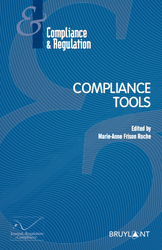
► Full reference : Frison-Roche, M.-A., Building by Law the Unicity of Compliance Tools from the Definition of Compliance Law by its "Monumental Goals", in Frison-Roche, M.-A. (ed.), Compliance Tools, serie "Régulations & Compliance", Journal of Regulation & Compliance (JoRC) and Bruylant, 2021, pp. 35-46
Summary of the article : The "tools of Compliance" do not stack on top of each other. They form a system, thanks to a unity drawn from the goals that all these multiple and different tools serve: the "Monumental Goals" by which Compliance Law is defined.
All these tools are configured by these goals and for mastering all these techniques, it is essential to put them all in perspective of what Compliance Law is, which is designed teleologically with regard to its goals. Extension of Regulatory Law and like it, Compliance Law is built on a balance between the principle of competition and other concerns that public authorities claim to take care of. Compliance Law has moreover more "pretensions" in this respect, for example in environmental matters. All the means are then good, the violence of the tools marrying without difficulty with the voluntary commitments since it is the goals which govern this branch of Law.
As legal solutions adopted show, a common method of interpretation and common levels of constraint for all Compliance Tools result from this definition. Starting from the goals (in which legal normativity is housed), the interpretation of the different tools is thus unified. Moreover, the different degrees of constraint do not operate according to the consideration of sources (traditional legal criterion) but by the goals, according to the legal distinction between obligations of means and obligations of results which result from the articulation between tools, of which the establishment is an obligation of result, and the goal, of which the achievement is only an obligation of means.
____
📝 Read the bilingual working paper on which rely this article.
📝 Read a general presentation of the book in which this article has been published.
____

June 2, 2021
Publications
Full Reference: Frison-Roche, M.-A. (ed.), Compliance Tools, serie "Régulations & Compliance", Journal of Regulation & Compliance (JoRC) & Bruylant, 2021.
This book in English is the first title of this collection integrally dedicated to Compliance Law, in that it is the extension of Regulation Law.
Read the titles of this series in English co-published by Bruylant.
This collection in English is articulated with a collection co-published between the Journal of Regulation & Compliance and Dalloz.
Thus, in parallel, a book in French, Les Outils de la Compliance is published.
Read the titles of the series in French co-published with Dalloz.
This book is published after a cycle of colloquiums organised by the Journal of Regulation & Compliance (JoRC) and Partners Universities.
___
General Presentation of the collective book
The political dimension of Compliance Law lies in the goals it aims to achieve. To achieve them, the concern for these goals is internalized in "crucial operators", which may be obliged to concretize "monumental goals" set by public authorities. These public bodies control the Ex Ante reorganization that this implies for these companies and sanction Ex Post the possible inadequacy of the companies, which have become transparent to this end. The effectiveness and efficiency of this internalization, without which the statement of these goals is worth nothing, is based on the Compliance tools that are deployed.
These appear to be very diverse but their substantial unity (topic which will be the subject of a forthcoming book) makes it possible to study the tools put in place from a unique perspective, by not isolating them in a particular branch of Law, Criminal law or International Law for example, but by measuring what is common to them, notably Anticipation, Trust, Commitment, Responsibility, Incentive, and so on. If the Compliance tools vary, it is rather not only according to the sectors, finance and banking appearing then as the advanced point of the general Compliance Law, for example in environmental matters, but also according to the countries and the cultures. It is in fact about them that legal cultures seem to oppose.
The book aims to understand these "tools" by going beyond the description of each instrument, for which we already have many monographs, for analyzing them through the issues of Risks, required Expertises, Training. Sovereignty claims, Incentives, mechanical aptitude of Technologies. It is through these themes that are analyzed by the authors, experts in the field, what we always want to understand better: Compliance Programs, Whistle blowing, Mapping, Sanctions, Extraterritoriality, etc.
____
Read the summary of the book.
Read the foreword, summarizing all the contributions.
Présentation of the book contributions:
-
Amico, Th., Compliance or the passage from ex post to ex ante: A Copernican revolution for the criminal lawyer?
-
Banck, A., The maturity of the Compliance tool’s user, first criterion of the choice of the salient tool
- Burlingame, Coppens R., Power, N, Lee, D.H., Anti-Corruption Compliance: Global Dimension of Enforcement and Risk Management
-
Calandri, L., Incentive(s) and Self-Regulation(s): which place for Compliance Law in the Audiovisual Sector?
-
Causse, H., Compliance Training: Through and Beyond Traditional Legal Training
- Frison-Roche, M.-A., Describing, designing and correlating Compliance Tools to have a better use of it
-
Frison-Roche, M.-A., Building by Law the Unicity of Compliance Tools from the Definition of Compliance Law by its "Monumental Goals"
- Frison-Roche, M.-A., Drawing up Risk Maps as an obligation and the paradox of the "Compliance risks"
- Frison-Roche, M.-A., Incentives and Compliance, a couple to propel
- Frison-Roche, M.-A., Resolving the contradiction between sanctions and incentives under the fire of Compliance Law
- Frison-Roche, M.-A., Rights, primary and natural Compliance tools
-
Frison-Roche, M.-A., Training: content and container of Compliance Law
-
Galland, M., The Regulator's Inspection of the Effectiveness of the Compliance Tools Implemented by the Company
- Granier, C., The Normative Originality of Compliance by Design
-
Guillaume, N., Compliance risk mapping: first insights of challenges, limits and good practices
-
Guttierez-Crespin, A., Audit of Compliance Systems
-
Koenigsberg, S. and Barrière, F., The Development of Attorney's Compliance Expertise
-
Larouer, M., The Manifestation of Incentives Mechanisms in French Compliance Law
-
Merabet, S., Morality by Design
-
Pailler, L., Technological Tools, Compliance by Design and GDPR: the Protection of Personal Data from Design
-
Racine, J.-B., Geographical dominance in the choice and the use of Compliance Tools. Introductory remarks
-
Rapp, L., Incentive Theory and Governance of Space Activities
-
Roda, J.-C., Compliance by design in antitrust: between innovation and illusion
-
Salah, M., Conception and Application of Compliance in Africa
-
Tardieu, H., Data Sovereignty and Compliance
-
Thouret, T., Training and Compliance, Two Correlated Information Transmission Tools
June 2, 2021
Publications
Full Reference: Frison-Roche, M.-A., Training: content and container of Compliance Law, in Frison-Roche, M.-A. (ed.), Compliance tools, series "Régulations & Compliance", Journal of Regulation & Compliance (JoRC) and Bruylant, 2021, p. 245-264
___
Summary of the article
Firstly, as Training is a specific Compliance tool, it is supervised by Regulators. It becomes mandatory when it is contained in Compliance programs or sanction decisions. Since effectiveness and efficiency are legal requirements, what is the margin of companies to design them and how to measure the result?
Secondly, as long as each Compliance tool includes, more and more, an educational dimension, we can take each of them to identify this perspective. So even condemnations and prescriptions are so many lessons, lessons given, lessons to be followed. The question is then to know who, in this so pedagogical Compliance Law, are the "teachers"?
____
This article is based on a bilingual Working Paper, including additional technical developments, pop-up notes and hypertext links.
Consult an overview of the volume in which the article was published.
____
June 2, 2021
Publications
Full reference : Frison-Roche, M.-A., Incentives and Compliance, a promising couple to increase the Compliance Law utility, in Frison-Roche, M.-A. (ed.), Compliance Tools, series "Régulations & Compliance", Journal of Regulation & Compliance and Bruylant, 2021, p. 141-148
___
Summary of the article: The theory of incentives targets the mechanisms which do not use directly constraint (except to present sanctions themselves as incentives) but which leads nevertheless to expected behaviors. To appreciate the links which must or must not be done between incentives and Compliance, we should proceed in two times.
First, the association appears natural between incentive mechanisms and "Compliance Law" since the later is defined in a dynamic way. Indeed, if it is defined placing its legal normativity in its "monumental goals", as the end of corruption, the detection of money laundering in order to underlying criminality disappears, or as the effective protection of environment or the concrete care of human beings, then what matters is not the means in themselves but the effective tension towards these "monumental goals". In this perspective, what was related to public policies led by States, because they are definitively not able to do it, the charge is internalized in the firms which are able to tend towards this goals: "crucial operators" because they have the geographical, technological, informational and financial means.
In this perspective, the internalization of public willingness provoking a split with the concept of State linked to a territory which deprives Politics of its constraint power, incentive mechanisms appear as the most efficient mean to reach these monumental goals. They appear as this "natural" mean both negatively and positively defined. Negatively in which they do not need in Ex Ante institutional localizable sources and sanction power in Ex Post: it is enough to substitute the interest to obligation. Positively, incentives relay through operators' strategies what was the so critical and joked form of public action: the "plan". The duration is thus injected thanks to Compliance mechanisms, as we can see it through the development of it in the care for environment ("plan climat") or through the educational mechanism, which could be conceived only in duration.
However, the opposition seems radical between Compliance Law and Incentives. And this because of three convictions often developed and that we have to overcome. First, the idea that in a general way, there would be a Law only if there is a mechanism of immediate constraint which is associated to the norm. As long as the incentive is not based on obligation, then it will be nothing... Secondly, and as if that were a kind of consolation ..., Compliance would not be really Law either ... We so often say that it is only about a methodology, a range of processes without sense, procedures to follow without trying to understand, process that algorithms integrate in a mechanic without end and without sense or that on the contrary, Compliance would be full of sense by Ethics and Morality, which are far from Law. While incentives talk to the human spirit which calculate, Compliance would be so a process through which machines will be connected to other machines, so an extra soul, where calculation has no place... Thirdly, solutions would be to be find in Competition Law because it can do without States, submit them and approach what is a-sectorial, especially finance and digital, the world being financialized and digitalized. The violence of Competition Law which comes in Ex Ante thanks to "Compliance sanctions" applying for example to essential infrastructures Law, by continuing to deny the salience of the duration and taking care of the "market power" would be also not compatible with a marriage with incentive mechanisms which rely on duration and power of those to which it is applied, converging towards goals, which are set by what Competition Law ignores: the project. This project which pretends to build the future is the one of politics and of companies, which use their deployed power in time to concretize it. It is without any doubt there that the future of Europe is.
To overcome this triple difficulty, it is thus necessary, in a second time, to modify our conception of Law, especially thanks to Compliance Law, in which this new branch is autonomous from Competition Law, and even sometimes opposed to it, in order to the insertion of incentive mechanisms permit to unknown or against Competition Law organizations to reach "monumental goals" which are imperative to take into consideration. For example, the taking into consideration of climate challenges or the building of a sovereign identity of the data. This is expressly set by European Commission which supervises such initiatives, supervision being what is articulated with Compliance, in a couple that go beyond Regulation, and replaces in Ex Ante Competition Law, salient branch for Ex Post. All the texts which are in the process of expressing it are based on this reformed couple: Compliance and Incentive.
This couple supposes that we recognize as such the existence of companies as project carriers, project which is the creation of marketed wealth circulating on a market, which could be an industrial project specific to a geographical zone both economical and political. Regulation is deployed to go away from the notion of sector and to transform itself in supervision of crucial firms in the correspondance between the project and the action, what refers to the notion of "plan". In this, banking supervision is just the advanced bastion of all thematic, energetic, climatic and health plans, or more broadly industrial and technological that could by incentive be implemented, this conception of Compliance permitting to build zones which are not reduced to immediate market exchange. The incentive corresponds to the fact that Compliance Law relies on the power of the firm to reach its own political goals, for example fighting against disinformation in the digital space or obtaining a healthy environnement. This supposes that Compliance stops to be only conceived as a model of rules effectivity, for example of Competition Law, to be recognized as a substantial branch of Law. A branch which expresses political goals. A branch which is anchored in crucial firms whose it recognizes the autonomy with regards to markets. This makes it possible, in particular through the coupling with incentive mechanisms leading to long-term collaborative operations supervised by public authorities, not to be governed by simple Competition Law, inapt to bring projects to fruition.
____
Read a general presentation of the book in which the article has been published.
____
June 2, 2021
Publications
Full reference: Frison-Roche, M.-A., Resolving the contradiction between "sanction" and "incentive" under the fire of Compliance Law, in Frison-Roche, M.-A. (ed.), Compliance Tools, series "Regulations & Compliance", Journal of Regulation & Compliance (JoRC) and Bruylant, 2021, p. 101-112
___
Summary of the article: Compliance and Incentives appear at first glance to be totally opposite. For two major reasons. Firstly, because sanctions have a central place in Compliance Law and that the incentives suppose an absence of constraint on the operators. Secondly, because the incentives are linked to self-regulation and that Compliance Law assumes a strong presence of public authorities. Thus, one should choose: either Compliance or Incentives! Either the effectiveness of one or the effectiveness of the others; either the techniques of one, or the techniques of others; either the philosophy of one or the philosophy of the other. Resign oneself to the waste that such a necessary choice would imply. But to put the terms in this way amounts to thinking poorly about the situations and reducing the fields of the solutions they call for. If we take a rich definition of Compliance Law, we can on the contrary articulate Compliance and Incentives. From this perspective, sanctions can no longer become what blocks the use of incentives but, on the contrary, what constitutes them. Even more, the coupling between the Incentives and the requirements of Compliance Law must be strongly encouraged, as soon as the public authorities supervise in Ex Ante all the initiatives taken by the "crucial operators".
This working document deals with the first issue. Indeed, the so-called incentive theory targets mechanisms which do not directly resort to constraint. They would therefore have little place in Compliance Law. But it seems saturated with sanction procedures. We can even say that it seems to put them at the center, the public authorities presenting the number of sanctions as a sign of success, while the companies seem obsessed with their prospects, the two concerns ending in such a strange convergence that are the Convention Judiciaire d'Intérêt Public (non-prosecution agreement).
The honest observer cannot help but be immediately uneasy. Indeed, it can only raise the definition of the sanction as a "constraint" triggered Ex Post, at the very heart of a Compliance Law which is presented as a set of Ex Ante mechanisms. Based on this contradiction in terms, should we give up the association and think that it would be wrong against the spirit to think of the sanction as an incentive?
It is undoubtedly in this connection that one perceives most clearly the clash of two cultures, which do not communicate, while technically they apply to the same situations. Indeed, because Compliance was designed by Finance, everything is a tool for it. Therefore, the tendency to think of the sanction only as an incentive is very strong in Compliance Law, manifests itself continuously and will not stop (I). But whatever the reasons for conceiving it this way, the principles of the rule of law cannot disappear and if we do not want them to be erased, then they must be articulated (II). This is an essential game (II).
This is why we can literally say that Compliance has set Criminal Law on fire by its conception, logical but closed in on itself, of sanctions as simple incentives. In order for Law to remain, however, we must hold a very firm definition of Compliance Law centered on its Monumental Goal, which is the protection of the person.
____
Read a general presentation of the book in which this article is published.
____

May 17, 2021
Conferences

 Référence complète: Frison-Roche, M.-A., La place des entreprises dans la création et l'effectivité du Droit de la Compliance en cas de crise in (dir.) Les normes publiques et la Compliance en temps de crise : les buts monumentaux à l'épreuve, colloque coorganisé par le Journal of Regulation & Compliance (JoRC) et la Faculté de droit de Montpellier, 17 mai 2021.
Consulter les slides sur lesquelles s'appuie cette conférence.
Regarder la vidéo de cette conférence.
Lire le programme général de ce colloque
Lire le document de travail sur la base duquel la conférence a été élaborée.
___
Ce colloque s'insère dans le cycle de colloques 2021 organisé par le Journal of Regulation & Compliance (JoRC) et ses partenaires autour des Buts monumentaux de la Compliance.
Les interventions serviront de première base à la réalisation d'un ouvrage dirigé par Marie-Anne Frison-Roche, dont la version française, Les Buts monumentaux de la Compliance, est co-éditée par le JoRC et Dalloz et dont la version anglaise, Compliance Monumental Goals, est co-éditée par le JoRC et Bruylant.
____
Résumé de la conférence : Il s'agit d'observer la façon dont les entreprises agissent lorsque la crise advient et l'impact produit sur les "Buts Monumentaux de la Compliance". Il apparaît que les entreprises ont aidé, soit sur l'ordre des Autorités publiques, soit de leur propre initiative. Toute "épreuve" étant une "preuve", la leçon à tirer de la preuve sanitaire est à retirer face à la crise environnementale dont nous sommes déjà informés.
La crise montre la place et le rôle des entreprises pour que tout d'abord survive l'effectivité du Droit de la Compliance par le souci maintenu de ses buts, grâce à l'aide requise ou spontanée des entreprises.
Mais plus encore l'on a pu observer des entreprises actives en raison de leur "position" pour des buts qui n'étaient pas les leurs, comme l'environnement. L'on retrouve alors la définition générale du Droit de la Compliance comme l'alliance en Ex Ante entre Autorités publiques et opérateurs privés cruciaux, pour maîtriser le futur. Ce sont les juges qui les assignent à cette alliance, ici et maintenant. La crise sanitaire en accélère la construction.

May 17, 2021
Organization of scientific events
This scientific manifestation is placed under the scientific direction of Marie-Anne Frison-Roche, Pascale Idoux, Antoine Oumedjkane and Adrien Tehrani. It is organized by the Journal of Regulation & Compliance (JoRC) and by the Faculté de Droit et de Science Politique de l'Université de Montpellier (Centre de Recherches et d'Etudes Administratives de Montpellier and Centre du Droit de l'Entreprise).
This manifestation is part of the cycle of colloquia organized in 2021 around the general topic of Compliance Monumental Goals.
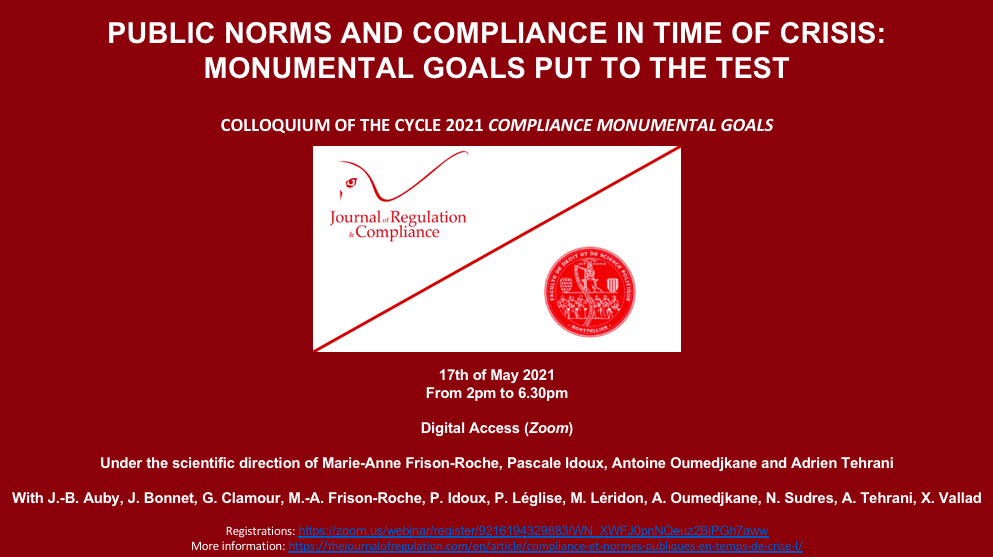
The interventions will give rise to the production of articles which will be part of the books Les bus monumentaux de la Compliance and Compliance Monumental Goals which will be published in the Series Regulations & Compliance, coedited by the JoRC and Dalloz for the French version and by the JoRC and Bruylant for the English version.
This manifestation will take place on Zoom on 17th of May 2021.
Registrations: anouk.leguillou@mafr.fr
Assistance to this event may be validated as part of the continuing education of lawyers.
In addition, scientific videos will be extracted and disseminated later.
Presentation of the topic: In the overall problematic of "Monumental goals", this conference retains a particular case: that of the crisis and the emergency situation that it generates.
First of all, in general, does the importance of public norms in the emergency context engendered by a crisis situation imply a marginalization of Compliance? Don't private actors also have their place in these circumstances, at the service of the "monumental goals" that the public authorities want to maintain, or even which appear specifically?
Secondly, more concretely, we have been living for many months in a health crisis. By taking it as a framework and, within it from particular cases, how public and private actors react, act, adjust? and how do the courts assess these movements?
Going from the most general to the most specific, this conference aims to identify criteria, limits, of what could be specific rules when the emergency of a crisis meets Compliance, and will examine specific situations.
Working method: The conference is therefore built on a general issue, which was the subject of a "working paper", written by Antoine Oumedjkane, Adrien Tehrani and Pascale Idoux, on which the speakers will have thought in advance and from which they are intended to study the question from their particular perspective.
The conference, which is essentially interactive, therefore begins with an outline of the main lines of this general work. It is followed by the examination of concrete practical cases.
They are as follows:
1️⃣ hydroalcoholic gel, its manufacture, price, availability,
2️⃣ information and regulation on all media in Covid period
3️⃣ the use of the bicycle during the state of health emergency
A first conclusion, thematically limited, will relate to Revealed by the crisis situation, the place of private initiative in Compliance Law.
A second, more general, undoubtedly open-ended conclusion is drawn from this confrontation between general reflection and concrete cases which must be resolved in a particular crisis.
Will speak:
- Jean-Bernard Auby, Emeritus Professor of Sciences po (Paris)
- Julien Bonnet, Professor at Montpellier University and member of the CERCOP
- Guylain Clamour, Dean of Montpellier Law School
- Marie-Anne Frison-Roche, agrégée des Facultés de droit, Professor of Regulation and Compliance Law at Sciences Po (Paris) and Director of the Journal of Regulation & Compliance (JoRC)
- Pascale Idoux, Professor at Montpellier University
- Pascale Léglise, adjointe au directeur des libertés publiques et des affaires juridiques (Deputy Director of Civil Liberties and Legal Affairs) of the Ministère de l'intérieur (Home Ministry)
- Michèle Léridon, Member of the Conseil supérieur de l'audiovisuel (French Media Regulator), President of the working group Pluralisme, déontologie, supervision des plateformes en ligne (Pluralism, Deontology, Supervision of Online Platforms)
- Antoine Oumedjkane, Researcher of the Centre de recherche et d'études administratives (Research and Administrative Studies Center) of Montpellier University
- Nelly Sudres, Maître de conférences at Montpellier University and member of the Centre de Recherches et d'Etudes Administratives (Research and Administrative Studies Center) of Montpellier University
- Adrien Tehrani, Professor at Montpellier University and member of the Centre du Droit de l'Entreprise (Company Law Center)
- Xavier Vallad, Group Legal Director, Intermarché
⤵️Read a more detailed presentation of the manifestation below:

May 15, 2021
Publications

Full Reference: Frison-Roche, M.-A. Place and Role of Companies in the Creation and Effectiveness of Compliance Law in Crisis, Working Paper, May 2021.
____
This Working Paper has been elaborated as basis for a conference in the colloquium of Mai 17, 2021 (done in French: Normes publiques et Compliance en temps de crise : les buts monumentaux à l'épreuve.
This video is made with English substitutes.
It is also the basis for an article in the book Compliance Monumental Goals, the English version of which is co-published by the Journal of Regulation & Compliance (JoRC) and Bruylant.
Summary: This article has a very topic: the place of private Companies, with regard to the chapter's issue: "the ordeal of a crisis". The crisis constitutes a "test", that is to say, it brings evidence. Let us take it as such.
Indeed, during the health crisis, it appears that Companies have helped the Public Authorities to resist the shock, to endure and to get out of the Crisis. They did so by force, but they also took initiatives in this direction. From this too, we must learn lessons for the next crisis that will come. It is possible that this has already started in the form of another global and systemic crisis: the environmental crisis. In view of what we have been able to observe and the evolution of the Law, of the standards adopted by the Authorities but also by the new case law, what can we expect from Companies in the face of this next Crisis, willingly and strength
Lire ci-dessous les développements.