
Dec. 8, 2022
Conferences

♾️ suivre Marie-Anne Frison-Roche sur LinkedIn
♾️s'abonner à la Newsletter MAFR Regulation, Compliance, Law
____
► Référence complète : M.-A. Frison-Roche, "La compliance, perspective dynamique pour exprimer la raison d'être des commissaires de justice", in Table-ronde sur "Professions réglementées, ambitions et enjeux", Congrès annuel national des Commissaires de justice, Paris, 8 décembre 2022.
____
►lire le programme complet du congrès et 🎥regarder la présentation du colloque par le président du Congrès
____
____
►présentation de l'intervention : Ce premier congrès annuel national des Commissaires de justice, réunissant pour la première fois la profession réformée, a débuté par un débat de 2 heures animé par une journaliste, débat entre les autres professions, les autorités publiques (Autorité de la concurrence, Chancellerie), ayant pour ma part à y apporter le regard académique :
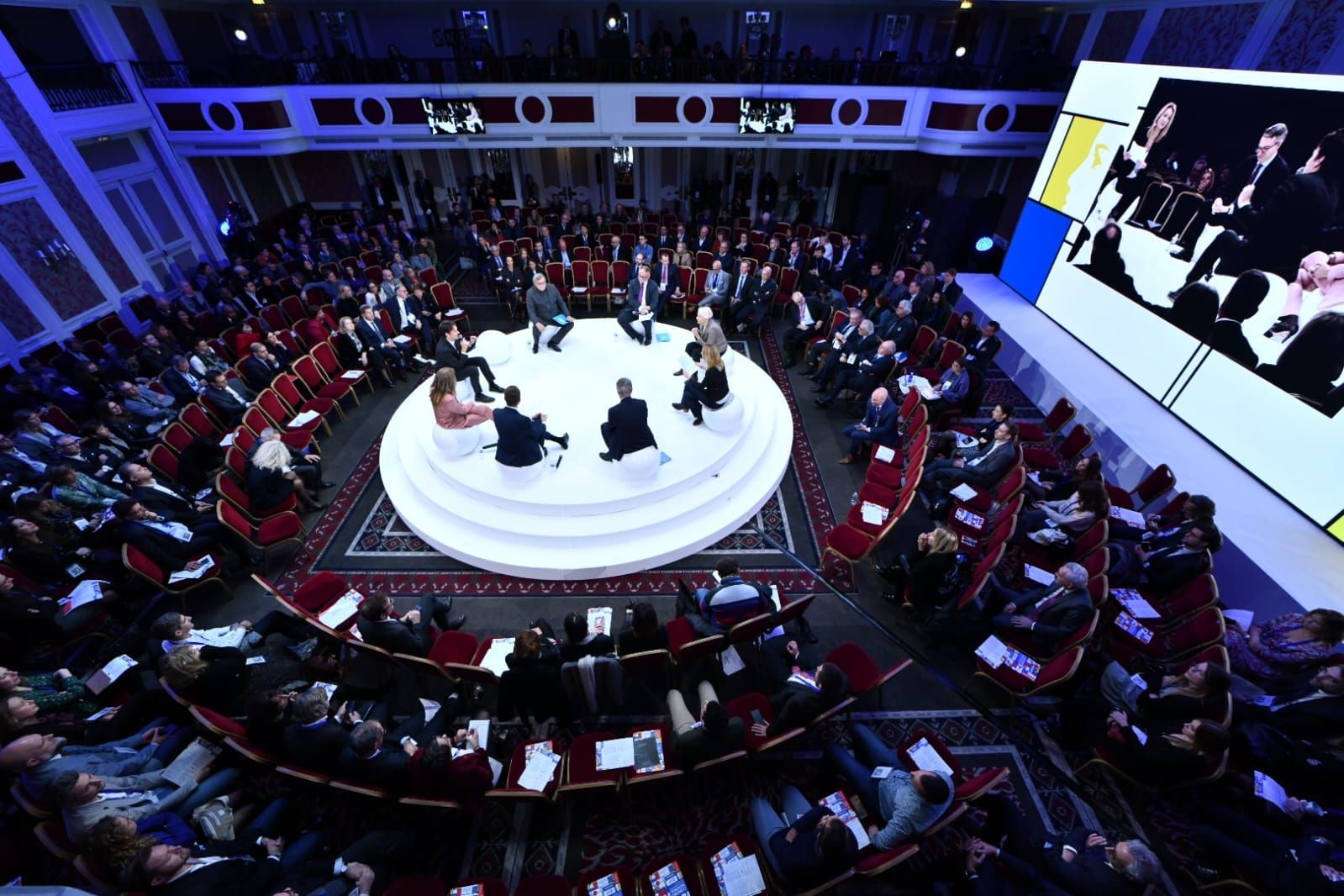
Ce débat fut particulièrement animé et vivant, ne serait-ce qu'en raison de la configuration des lieux, chacun étant placé pour entrer dans un dialogue :
🎤 J'y pris la parole en premier pour insister sur le fait que les "professions" sont des structures qui ont un grand avenir, en ce qu'elles s'articulent avec le système économique libéral, qu'elles sont par nature régulées et porteuses de régulation, dans des systèmes qui, pour demeurer libéraux, vont en avoir de plus en plus besoin. Cela est pertinent pour la profession des Commissaires de justice qui procurent de la sécurité, via de l'incontestabilité reposant aussi sur le lien entre celle-ci et les faits, et qui assurent l'effectivité des engagements en gardant le souci du lien social.
🎤 J'ai repris la parole lorsque la place de la Compliance fut évoquée. Dépassant l'exigence de "conformité", qui n'est qu'un outil de la Compliance, j'ai montré l'avenir du Droit de la Compliance, notamment dans l'Europe qui associe dynamisme économique, souci des personnes et de l'environnement, et l'alliance que cela implique entre les Autorités politiques et publiques et les entités susceptibles de participer à la concrétisation de ces Buts Monumentaux de la Compliance.
📕 Pour aller plus loin : M.-A. Frison-Roche (dir.), Les buts monumentaux de la compliance, 2022.
________

regarder la présentation du colloque par le président du Congrès

Aug. 2, 2018
Publications

► Complete reference: Frison-Roche, M.-A., Yes to the principle of the will, No to the pure consents, working document for an article written in French Oui au principe de volonté, Non aux consentements purs, to Mélanges dedicated to Pierre Godé, 2018, available at http://mafr.fr/ en / article / yes-in-principle-of-the-desire-not in the consent /
► Summary: Pierre Godé devoted his thesis to defend the freedom of the human being, freedom that the person exercises by showing his will. This will manifests itself, even tacitly, by this trace of "consent". In a liberal society, politically and economically, that is to say a society based on the principle of the will of the person, consent must always be defined as the manifestation of the will, this link between consent and will being indivisible ( I). But by a perversion of liberalism, "consent" has become an autonomous object of the freedom of the person, mechanical consent that has made it possible to transform human beings into machines, machines to desire and machines to be desired, in a world of " pure consents","where we keep clicking, consenting to all without ever wanting. This consent, which has been split from the free will of the person, is the basis of the markets of the Human and the illiberal democracies, threats against human beings (II). The future of Law, in which Pierre Godé believed, is to continue to aspire to protect the human being and, without countering the free will of the human being as the movement of the law of the consumption had been tempted to, to renew with a liberal movement of Law and to fight against these systems of pure consents (III).
🔻read the article below (in French).

Oct. 3, 1992
Thesaurus : Doctrine
► Full reference : J. Carbonnier, "Toute loi est-elle un mal ? (Is every law a bad thing?), in Essais sur les lois (Essays on Legisation), 2nd ed., Répertoire du notariat Defrénois, 1992, pp. 317–334.
____
► Summary : Jean Carbonnier takes as his starting point the coincidence in time between the announcement of Christ’s birth and the proclamation of the census by Caesar Augustus’s edict, and goes on to ask whether, in legal matters as in religious ones, the advent of the new law might be good news.
It is accepted that many new laws were bad, but is the new law bad ‘in itself’?
The author does not wish to let the distinction between favourable and unfavourable laws (a sociological criterion of interest) or the distinction between old and new laws (a psychological criterion of the clash between novelty and habit) interfere, so as to address the subject as neutrally as possible: is the law an evil in itself? This pits the law against case law, custom or equity, which might be superior, but then again the author takes a broader view and prefers to contrast law with non-law and pose the question even more radically: is law in itself an evil?
To begin with, Carbonnier demonstrates the necessity, the advantages and the beneficial effects of the law, which was particularly revered by the French Revolution and, above all, by the people because of the ‘benevolence of the law’. France remains steeped in this favourable legalistic prejudice. This stems from the sense of security it affords the people, because it is clear, precise and uncompromising, permanent, and because it serves as a means of communication between people.
In the second part of the article, Carbonnier refers to Lacan, who, in relation to the law, invoked the figure of the father and predicted a future society without a father. Carbonnier wonders whether a lawless society is not about to emerge, or whether psychoanalysis, seeing castration in the law, still identifies it as an evil. In any case, he sees in this an opposition to freedom and liberalism, the rejection of the law being associated with the rejection of the state. Quoting Maurice Barrès and his 1892 work, L'ennemi des lois, he shows that for Barrès, all law is an evil, because the world must organise itself spontaneously. For liberalism, which is less romantic, every law is an evil because it hinders the spontaneous emergence of the general interest of the social group. Thus, to take Hayek as an example, the individual knows his own interest better than the law, and the sum of these interests gives rise to the general interest. Moreover, not only is the law pernicious, but, according to liberalism, it corrupts human nature, atrophies the will and diminishes responsibility, in a perverse pedagogy.
In the third part of the article, Dean Carbonnier goes on to argue that the law acts more as a safeguard and is therefore a good thing, provided the legislator remains modest. He believes that the law is necessary because man is a sinner (in a nation of righteous people, the law would be unnecessary), citing Luther and Saint Augustine. The law is therefore indispensable insofar as it wields the sword. Indeed, the law must strike because the world is inhabited by evil.
The Dean states: “It is in this sense that the law appears as an evil: not because it causes harm or does harm, but because it is linked to the existence of evil. It is the revealer of sin...”.
He concludes: "Knowing that the law was given to curb evil, lawyers will use it without hesitation. Knowing that it is a source of evil, they will use it with restraint."
It is in this self-imposed limitation that lawlessness emerges.
____