
Sept. 30, 2025
Publications
🌐follow Marie-Anne Frison-Roche on LinkedIn
🌐subscribe to the Newsletter MAFR Regulation, Compliance, Law
🌐subscribe to the Video Newsletter MAFR Surplomb / Overhang
🌐subscribe to the Newsletter MaFR Droit & Art
____
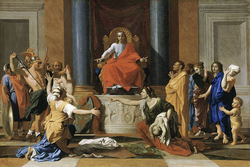
 ► Full Reference: M.-A. Frison-Roche, If King Solomon's probationary strategy hadn't worked, Working Paper, October 2025.
____
📝 This Working Paper is the basis of the article published in 2026 in the collective book dedicated to Professor Pierre Crocq.
____
► Summary of this Working Paper: As renowned and significant in biblical scholarship as it is in legal culture and imagination, Solomon’s Judgement is a procedural measure, an evidential stratagem (I). But even a King cannot be certain of the success of an investigative measure that his authority allows him to impose; nothing guarantees the success of the evidential stratagem he has devised, that is to say, the discovery of the truth. The investigative measure he devised presupposes a maternal love that leads the woman—who might prefer to continue disputing—to choose instead not to keep the child and to leave him in a state of death, a mere inert prey to the claim of appropriation made by the plaintiff. It is the woman’s virtue that enables the Judge’s wisdom. The evidence stratagem might not have worked (II). This is scarcely considered, as King Solomon is always portrayed as wise and the mother as preferring the child to herself. But if we step outside the Book of Kings, where virtue reigns—that of the mother as well as that of the judge—to confront the passion of the woman who smothered her newborn in the night and now seeks the force of justice to seize the second, one might reflect, whilst wandering through the lobby of a courthouse, that it is all too often the case that adults put themselves before children. What if the second mother had put herself before the child? What would have happened if the judge’s order, already being carried out, had not been halted by the virtue of the defendant? (III). What would the King then have done to exercise his office as Judge justly, since the truth would not have been accessible to him? (IV). If one changes an element of the narrative, because justice is human, because passions drive the parties, because children are often the silent victims on both sides, is justice still possible?
_____
🔓read the developments below⤵️
Aug. 15, 2025
Publications

🌐Follow Marie-Anne Frison-Roche on LinkedIn
🌐Subscribe to the Newsletter MAFR Regulation, Compliance, Law
🌐Subscribe to the video newsletter MAFR Overhang
____
► Full reference : M.-A. Frison-Roche, The role of Discretionary Jurisdictio in the judicial treatment of Compliance cases, working paper, August 2025.
____
📗This working document was prepared as a contribution to the collective book offered to Professor Dominique d'Ambra, published in June 2026.
____
► Summary of the working document : Based on the definition of Judicial Office, the procedural principles that derive from it and the consequent powers that judges exercise, the objet of this study is to measure the degree of discretion that exists in the judicial treatment of compliance, without direct consideration for the dispute between litigants. This part is very ignored, when it should be given top priority. Indeed, because Systems are involved in compliance cases brought before civil or commercial judges, we are seeing a development of this discretionary element in judicial fonction. Discretionary matters differ from unilateral discretionary procedures, and this discretionary element relates to what the judge examines, possibly in the context of a dispute.
The first part of this contribution therefore aims to describe the natural development of the discretionary power of the judge to deal with compliance cases brought before them. This role stems from the fact that, even when triggered by a dispute, what is submitted to the judge is a situation composed of a system, which cannot defend its interests before the civil or commercial judge in this Systemic Litigation arising from the very nature of Compliance Law and the Compliance Obligations it engenders on systemic entites. Moreover, it is the Future whose interests must be considered and protected, which the judge must do directly.
This leads to the second part of the contribution, calling for a rethinking of the procedure and the role of the Compliance Judge, so that ex gratia matters can be dealt with. The judge must therefore verify that there are no conflicts of interest between the litigants, including hidden ones, and must learn about the systems involved. The inquisitorial principle must therefore be strengthened. But at the same time, since the primary aim is not to settle a dispute but to resolve a systemic problematic situation, the judge must facilitate the movements of the parties, and the adversarial principle must also be strengthened. Must be encouraged this activation of a powerful and discretionary approach, not as an exception but as a principle fully articulated with a contentious principle, with the dispute being only a means used by the necessary parties to enable systemic compliance situations to be resolved.
________