
Sept. 30, 2025
Publications

Working Paper serving as the basis for a contribution to a collective book dedicated to a Friend
🚧If King Solomon's probationary strategy hadn't worked
pour lire ce document de travail en français⤴️cliquer sur le drapeau français
🌐follow Marie-Anne Frison-Roche on LinkedIn
🌐subscribe to the Newsletter MAFR Regulation, Compliance, Law
🌐subscribe to the Video Newsletter MAFR Surplomb / Overhang
🌐subscribe to the Newsletter MaFR Droit & Art
____
 ► Full Reference: M.-A. Frison-Roche, If King Solomon's probationary strategy hadn't worked, Working Paper, October 2025.
____
📝 This Working Paper is the basis of the article published in 2026 in the collective book dedicated to Professor Pierre Crocq.
____
► Summary of this Working Paper: As renowned and significant in biblical scholarship as it is in legal culture and imagination, Solomon’s Judgement is a procedural measure, an evidential stratagem (I). But even a King cannot be certain of the success of an investigative measure that his authority allows him to impose; nothing guarantees the success of the evidential stratagem he has devised, that is to say, the discovery of the truth. The investigative measure he devised presupposes a maternal love that leads the woman—who might prefer to continue disputing—to choose instead not to keep the child and to leave him in a state of death, a mere inert prey to the claim of appropriation made by the plaintiff. It is the woman’s virtue that enables the Judge’s wisdom. The evidence stratagem might not have worked (II). This is scarcely considered, as King Solomon is always portrayed as wise and the mother as preferring the child to herself. But if we step outside the Book of Kings, where virtue reigns—that of the mother as well as that of the judge—to confront the passion of the woman who smothered her newborn in the night and now seeks the force of justice to seize the second, one might reflect, whilst wandering through the lobby of a courthouse, that it is all too often the case that adults put themselves before children. What if the second mother had put herself before the child? What would have happened if the judge’s order, already being carried out, had not been halted by the virtue of the defendant? (III). What would the King then have done to exercise his office as Judge justly, since the truth would not have been accessible to him? (IV). If one changes an element of the narrative, because justice is human, because passions drive the parties, because children are often the silent victims on both sides, is justice still possible?
_____
🔓read the developments below⤵️
1. Pierre Crocq💡director of the Institut d'Etudes Judiciires -IEJ (Judicial Studies Institute in a Law School), guided students – first in Angers and then in Paris – into the courtrooms where, having become judges and lawyers, they now practise the art of justice. We pass through these places, each of us awaiting Justice; it must be present and embodied there. The walls of the IEJ at the Faculty of Law in Angers now pay tribute to their director Pierre Crocq. Just as much as a book and better than glass walls, the stone walls bear inscriptions, portraits and representations of this human justice and of those who teach and administer it. In the grand courtroom of the Paris First Degree Judicial Court, a glass fortress, there is nevertheless enough stone and height to have allowed the reproduction of the first paragraph of Article 16 of the Code of Civil Procedure, known as the “Professors Code”: The judge must, in all circumstances, ensure compliance with and himself observe the principle of adversarial proceedings. Thank you to Professors Motulsky, Cornu, Foyer and Terré, who brought this Code and this article into being. Thank you to the professors who, like Pierre Crocq, lead the IEJs and guide students through the ‘hall of lost steps’—that is, the passage through which one finds one’s way to the legal aid office, to the courtroom where the judge hears the case in public and delivers his judgement aloud, and to his more secluded office where he reconciles.
2. King Solomon in the text and in the algorithms 💡 One of the representations often used to explain Justice to students is that of King Solomon. It is indeed an “edifying story”📎!footnote-4591. The image is thus more accurate, more forceful than the popular image of the fruit cut in two without seeking to determine who is right and who is wrong📎!footnote-4590. Rarely has there been such a gulf between the biblical account and what is said to be its defining wisdom: cutting the claims in two so that each party goes away half-satisfied, without ever knowing who was right and who was wrong. Thus, if we ask the algorithm for a definition, the answer is: “A judgement of Solomon therefore refers to a verdict that ends a conflict by sending the parties away empty-handed: either by apportioning the blame equally, or by forcing one of the parties to abandon their claim”. This is the very opposite of justice📎!footnote-4601. But we will no doubt see this inaccurate definition increasingly in exam papers, since we read texts less and less and simply refer to what algorithms tirelessly repeat. Yet this definition is inaccurate.
3. Violence and Passion💡Inaccurate, because first of all in the Book of Kings📎!footnote-4592 it is, on the contrary, not a matter of reconciling without knowing, but rather of discerning truth from falsehood and, from that alone, deducing who is right and who is wrong, so as to do full justice to the one who is right and reject the one who is wrong: Solomon, because he knows the truth of the facts, will thus be able, in this second stage, to be just. Secondly, the narrative consists solely of lies, threats and deaths. There is no gentleness; everything is force. The passion of the desire to possess the child in the woman who is not its mother, the strength of love in the mother who sacrifices herself for her child, the force of the Law which strikes twice, first by ordering the child to be cut in two, and secondly by granting the legal title of mother, thereby restoring order through Justice📎!footnote-4597.
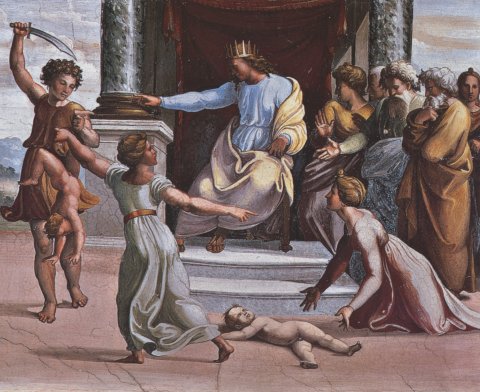
4. The accuracy of the paintings💡This, indeed, is what art has retained. This biblical story, said to be rooted in even more ancient times and even more distant lands, was painted by Raphael’s school in a picture in which we can see the body of a newborn lying on the ground whilst the other child struggles, no doubt in vain, for the executioner holds him firmly upright and will cut him lengthwise without the victim, held by one foot, being able to escape him. Hardly any attention is paid to the two children: neither the one who has just died, already abandoned by his mother who killed him in the night whilst falling asleep on top of him, nor the one still trying to escape his fate; one struck down by his own mother’s negligence, the other soon to be killed on the Judge’s orders. The King looks at the child who is therefore to die, already raising his arm, either to bring down his deadly sentence or to protect him and suspend his order, whilst the women dispute the coveted and claimed legal status of mother, since Solomon has the power to grant this legal title to one or the other. At that time, the uniqueness of motherhood was not disputed.
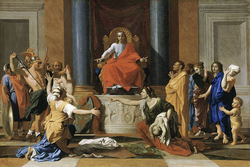
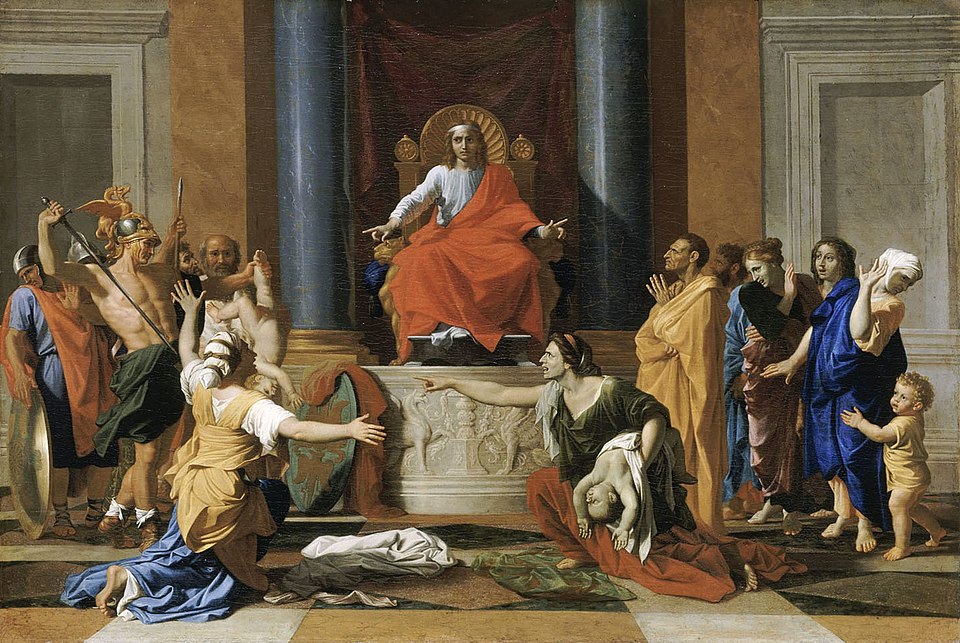
Valentin de Bourgogne reworked the composition in 1629. The painting produced by Poussin in 1649 is constructed differently. It depicts the judge standing motionless in a magistrate’s pose, gazing straight ahead. He is the central figure around whom everything is arranged, for he embodies justice. Weighing up the pros and cons—a duality and opposition represented by the two litigants. With each arm pointing towards one of them, his very posture embodies the scales of justice. Yet he will grant full satisfaction to one and reject the other’s claim in its entirety.
5. The truth having been established—a prerequisite secured by King Solomon for a judgement that could only be just, since Judge Solomon is impartial💡 When Judge Solomon rules on the substance of the dispute, he will declare that the defendant woman is the mother of the disputed newborn and will entirely reject the claim of the woman who was seeking custody of the child. But what is known as Solomon’s Judgement is not the judgement on the merits; it is the order by which he commands the child to be cut in two, that is to say, not an act of juris-dictio but an act of imperium by which proof of the maternal bond is established. This act of power is possible; here it is an act of absolute power, since it imposes the death of innocence itself—the newborn—because he is King. King Solomon thus uncovers the truth through an investigative measure that only a King, because he is endowed with Authority, can order. It is subsequently easy for him to be just, for any third party may thus, if they know the truth, be just in the exercise of juris-dictio from the moment they are impartial and disinterested. It is therefore because he is a ‘King-Judge’ that such a narrative can unfold, for when he assumes his pure function as a judge, Solomon will be able to designate only the woman who, by right, deserves the title of mother.
6. Plan 💡Solomon’s Judgement is a preliminary investigation, an evidential stratagem (I). But even a King cannot be certain of the success of an investigative measure that his imperium allows him to impose; nothing guarantees the success of the probative stratagem he has devised, that is to say, the discovery of the truth. The investigative measure he devised presupposes a maternal love which leads the woman—who might prefer to continue disputing—to choose instead not to keep the child and to leave it in a state of death, a mere inert prey to the claim of appropriation made by the claimant. It is the woman’s virtue that enables the Judge’s wisdom📎
I. A MEASURE OF INSTRUCTION THAT ONLY A KING, DOTÉ OF AUTHORITYÉ CAN ORDER, THUS ENABLING THE JUST JUDGEMENT THAT WILL BE RENDEREDBYTHE IMPARTIAL JUDGE
7. Reflection on knowledge and prejudice💡 The painter’s view, which depicts the situation for us, is set. To make the painting edifying, the defendant is bathed in light and her magnificent protest causes her to fill the space of the painting, whilst she hopes that the outcome of the dispute will not cost the child its life, whereas the plaintiff, who demands custody of the child—even half of its corpse—shares the cadaverous pallor of the first newborn she crushed beneath her weight in the night. The viewer is thus made complicit in what will later emerge as the truth. Before the judgement on the merits, we have a preconceived idea of what must be said regarding the claims of each: to find against the one who is like death, to find in favour of the one who is like life.
This is one of the challenges of impartiality when describing a case: not to allow prejudice to cast a favourable light on the one we like and make the one we do not like seem repulsive, whilst respecting the fundamental principle of the trial that it is the Judgement which determines the outcome, in this case, the woman who killed her child by suffocating it through negligence and who wishes to steal another—justice being merely a means to that end—and the woman who cared for her newborn, who remained alive. The painters, who know the end of Solomon’s tale, thus use preconceptions to instruct us, by inserting the final judgement into the earlier stage of the inquiry. This is why the painting, too, is a narrative that encompasses the past (the death of the first child the previous night), the present moment (the interrogation) and the future (the revelation, through the play of light, of who is in the wrong and who is in the right).
What role do social media play in ongoing trials before the judges have reached a verdict? Do they not cast a favourable light on those they already wish to see triumphant, whilst portraying those they deem guilty as if they were already dead? Do they already know the verdicts on the merits of the case? Or do they prejudge the outcome to ensure victory for those they favour and to condemn those they do not? There is no shortage of studies on the ‘media trial’. The Louvre is not far away, where Poussin depicted the features of an edifying story within his frame. But this work is retrospective, and the past of the dispute may therefore be coloured by what was subsequently revealed, the painter himself having lived through the period following the judgment on the merits. The European Court of Human Rights points out that when the spotlight shone on facts and individuals is too harsh, democratic debate and the right to information are no longer served.
8. A substantiated claim made by the woman claiming the living child💡 The text is more neutral than these pictorial representations. As René Girard points out in his commentary on the text📎
The claimant, a woman seeking custody of the living child, presents a well-structured account to the judge. The factual basis of her case is sound. She maintains that she gave birth to her son but that the woman living with her in the brothel—who gave birth to a boy on the same night and whose child died at birth—stole him from her: she is seeking his return. The defendant has no account of her own. She simply says that this is untrue. That the opposite is what happened.
How can we know what happened? The judge may only refer the claimant to the appropriate court, often specifying which one, if the obstacle lies in a lack of jurisdiction. One might have said that here only God knows who the mother is, and even more so who the father is, of a child, but the defence of inadmissibility was not raised by the defendant. On the contrary, her defence was feeble, claiming that everything her opponent said was false
9. The evidential difficulties of the case: the darkness of night, the loss of credibility due to prostitution, the lack of autonomy in the denial 💡 There are several types of evidential difficulties. They relate primarily to the subject of the evidence: the maternal bond between the woman and the child. If, from antiquity to the present day, it has been assumed that the mother is the woman from whose womb the child emerges, it is because the bond is visible and the evidence is thus straightforward, which has never been the case for the paternal bond. Today, we must move towards a different definition of motherhood, namely the desire and the will to have a child, in order to escape the evidential conundrum created by the separation of childbirth from the proof of motherhood. But by changing the method of proof—which is simpler, since proof of desire will be provided through its expression— by producing consent, a contract, on the one hand we make the maternal bond equal to the paternal bond, and on the other hand we can establish for the same child multiple bonds of co-parenthood, co-motherhood, whatever one desires and whatever one wants. In this new system, the King-Legislator sides with the many women, with those who want the child more strongly prevailing over the weaker ones. The only element in the picture that remains stable is the newborn child, who remains silent. But today, the Judge can cut the child in two.
At the time of the story, when the Judge is still seeking the truth about the maternal bond, the difficulty lies in the lack of witnesses, as at some point the two children were swapped. At what point during the night, and how? No third party is there to tell the tale, since both mothers were asleep with their children—one protecting hers, the other crushing hers. It is the darkness of the night that stands in the way and explains the lack of evidence. When Carbonnier describes the night as a lawless space📎
Another evidential difficulty, often highlighted, relates to the lack of credibility of the parties. Both are prostitutes and both children were born in a brothel. Commentators often point out that if one of them had had an “honest livelihood”, her testimony would have carried more weight with the judge and she would have won the case. This is a strange assessment. For, without even asking whether prostitution is a “disreputable” activity, without even engaging in a psychosocial analysis based on the assumption that a judge, who himself leads an honourable life, will listen more readily to someone who broadly resembles him than to someone he disapproves of, that is to say, he never achieves the detachment required of him📎
Finally, the last evidential difficulty lies in the absence of any debate. Indeed, the defendant merely claims that everything the first woman says is false. She does not put forward any new facts, nor does she produce any new evidence. She denies everything. She can probably do nothing else, for the child-stealer’s scheme consisted not only in taking her newborn baby but also in stealing her own narrative: constructing a story in advance in which the thief presents herself as the victim, claiming that the deceased child is the other woman’s and not her own, and that the other woman mistreated her and took her child. The premeditation lay in seizing not only the coveted child but also the story that the mother of the living child, thus stripped of her child, would have told in her defence, so that she now has nothing left to say. There can be no further debate. The defendant can do nothing but say “that’s not true” and remain silent.
There is therefore an epistemic aporia📎
II. NOT EVEN A KING CAN GUARANTEE THE SUCCESS OF A PROBATIVE STRATEGY
9. The King’s power, holding theimperium💡 – How, through his imperium as King Solomon, will he enable Judge Solomon to administer justice, that is to say, to give everyone their due📎
By their very nature, investigative measures can be highly intrusive. It is striking that the commentary on this civil dispute draws entirely on the vocabulary of criminal law, referring to complaints, guilt, charges, and so on. Here, an order is given to kill a child, whose innocence is evidenced by the fact that he was born only a few hours earlier. But all investigative measures are violent, including in civil matters, whether they involve seizing documents, entering private premises, etc., particularly for the purpose of gathering evidence in futurum.
10. The King’s powerlessness, as the truth does not lie within the children’s hearts💡 But even if we assume that the orders issued are always carried out, their execution must still produce the effect expected of an investigative measure: the emergence of the truth. Whilst the first child died of suffocation caused by his own mother, the truth was thus supposed to emerge from the severed belly of the surviving child. For so long it was believed that one could read the entrails to such an extent that so many living beings, including humans, were sacrificed in order to read the truth of things, both present and future. But Solomon is a wise King, who does not disembowel his fellow men to increase his knowledge and claims to do so only to better read the hearts and minds of the two disputants. As everyone knows, having read or heard the tale, it is a stratagem devised under the guise of an order issued.
11. The King’s clever and ingenious stratagem, a model for all💡 The King never intended to exercise his imperium against the two newborns who survived their mother’s greed, whose negligence caused the death of the first, the child now coveted being alive because he was not suffocated in the night by the weight of the indifference of she who fell asleep on top of the other. The order is issued only to be interrupted by the mother who rebels and sacrifices herself so that her son might not be sacrificed: her own sacrifice can halt that of her son. This is a ‘happy stratagem’, not of the kind designed to deceive so that vice may prevail, but of those devised so that order may be restored📎
His inquiry was merely a ruse to provoke the one who holds the truth; the cry from the heart allowing the maternal bond to emerge in this way. But whilst it is true that kings by birth may also be intelligent, intelligence is neither a prerequisite for their title nor their exclusive privilege. The model of the Republic, or indeed that of the market, leads to power being attributed to human beings capable of adopting the behaviour appropriate to the situation through the means of action from which the solution will result, in this case the discovery of the truth. This practical quality, which is common to all human beings, is not even that of the scientist, perhaps that of the entrepreneur, but of the one who sets a trap for the woman who wishes only to possess the child and also unflinchingly contemplates the child’s death. One need not be a King to act in this way; it is enough to understand the human soul and that desire for possession which an adult sometimes has over a child, who is merely the inert projection of a ‘project’.
12. Is this ingenious evidential stratagem reproducible? The evolution of the evidential system💡 It is, however, rather strange that no one reproaches Solomon for having acted in this way, since he lied, out of ‘cunning’. Can one imagine a person holding the power of coercion issuing an order, for example, to imprison someone or deprive them of a fundamental right—someone whose innocence is as indisputable as that of a newborn—so that another person might reveal the truth for the sole purpose of saving the first?
It is tempting, and it is said that this sometimes happens. But in law, we know that tricks and stratagems—frequent devices in comedies of manners and Marivaux-style plays—are evidentiary techniques which, whilst permitted in American law, are in principle prohibited in French law. However, the principle of fairness is now being undermined not only when evidence has been obtained unfairly by a party seeking to bolster its case, but also when public authorities use information provided by informants, whistleblowers, or agents of regulatory authorities—who may act as mystery shoppers to test the conduct of the organisers they supervise. One might consider that the ‘clever evidential stratagem’, an exercise in intelligence designed to make the truth accessible, has now, in principle, entered our legal system.
13. The pitfall of the enforceable interim order💡 But this stratagem was ‘successful’ here only because the mother chose her child over herself: what would have become of it if this presumption on the part of man—in this case, on the part of the King—had not worked? Would the King have had time to stop the sword whose movement he himself had set in motion? By the time he had observed the silence of the two women and seen the sword fall, would the second child’s life have been extinguished? For an investigative measure, by its very nature, must be carried out.
III – THE INNOCENT CHILD WOULD HAVE BEEN SACRIFICED HAD HIS MOTHER NOT BEEN VIRTUOUS
14. The early gift of ‘divine wisdom’💡 The narrative emphasises that Solomon, first as King and then as Judge, embodies ‘divine wisdom’, a wisdom he received early on through the gift of an ‘intelligent heart’. It is easy for God to be wise, since He is all-knowing and can therefore judge without fail, being perfectly just. By asserting that Solomon, in returning the newborn to his mother and turning away from the woman who had no connection to him, possessed “divine wisdom”, the narrative indicates that he ruled as one who, like God, knows the truth of things—in this case, the truth of the maternal bond—which coincides with the subject of the dispute, which boils down to that very bond, thereby enabling perfect justice. All this is possible only because God gave Solomon, whilst he was still almost a child, an “intelligent heart”📎
15. The primacy of the mother’s wisdom, in the face of the King’s challenge and the other party’s indifference💡 But unless God spoke on his behalf and told him who the child’s mother was, Solomon only knew this through the successful outcome of his stratagem: it was therefore the mother’s wisdom that enabled the King to win his wager📎
If she had not been remarkably virtuous—already sacrificed by a society that reduced her to serving passing travellers, mistreated by her companion in misfortune who dragged her before a judge to snatch her child away—what would the King have done? Could he still have been just, he who, without her, could no longer be wise?
IV – IF THE TRUTH HAD ESCAPED HIM, WHAT COULD JUDGE SOLOMON HAVE DONE TO BE FAIR?
16. To be fair, withdraw the preliminary investigation💡 One might imagine that, instead of a King as immovable as the scales, a quick-witted King is required, so that he might revoke his order; for, seeing two motionless and silent women waiting for the child to be cut in two, and realising that his ruse had therefore failed, he would have halted the execution of his order. He would have retracted it. However, bearing in mind the principles of Articles 146 and 147 of the Code of Civil Procedure, firstly, under no circumstances may an investigative measure be ordered to make up for a party’s failure to adduce evidence. Yet the claimant has not produced any evidence to support her claim. Moreover, everything is ‘unverifiable’📎
17. To be fair, we must re-frame the claim brought before the judge💡 As René Girard shows, the two women’s claims are not identical. It is, moreover, for this reason that the truth may reveal itself. The second woman seeks the child’s protection, whilst the first seeks to claim the child as her own. Thus, maternal love, which ‘speaks for itself’, emerges as a kind of party to the moment, designating the second woman as the mother—a fact of which the King takes note, enabling him to judge fairly, thanks to the ‘intelligent heart’ God has given him. Solomon can thus reclassify the claim brought before him: the claimant has constructed a claim for the appropriation of the child as an object of desire📎
18. To be fair, identify who bears the burden of proof💡 Solomon could still, by the mere fact that he is a Judge, be just even if he had not resorted to the clever stratagem afforded by the imperium of his status as King, by arguing that the means of proof he had envisaged fails because it could cost a human being their life📎
19. Ways of being just without knowing the truth💡 We can therefore see that if Solomon had been merely a judge, without being king, and had not appeared to order the child to be cut in two, he could still have been just. By refraining from establishing the maternal parentage of this fatherless newborn, the sole survivor of that night with no witnesses—for example, by entrusting the child to whoever seemed best able to raise him with care and devotion, that is, the woman who cares for him, whether or not she is his mother. For there may also be mothers who are not caring. And sometimes Justice and Truth do not go hand in hand.
Conclusion : MASTERING THE VIOLENCE AND PASSION OF TRUTH AND JUSTICE
20. Wisdom, justice and a passion for truth💡If one takes a less confident reading of the narrative, and relies less on the preceding episode in which God gave the child Solomon an ‘intelligent heart’, a form of ‘divine wisdom’ that gave him the idea for the ‘clever stratagem’ through which maternal love spoke for itself, the truth emerged and justice followed of its own accord, one might consider that the woman who shouted the loudest and had seized the narrative of the innocent girl would undoubtedly have won. For we cannot rule out the possibility that the child might have been cut in two. At every moment, it is a fine line between disaster and safety. No doubt because the addition of a passion for truth can lead parties and judges to great violence. Especially if it can draw on what Carbonnier refers to with detachment as the ‘passion for the law’📎
__________
🕴️W.A.M. Beuken, 📝No Wise King without a Wise Woman (I Kings iii 16-28), quoted by André Wénin 📝Le roi, la femme et la sagesse. Une lecture de 1 Rois 3, 16-28 1998)
E. Abécassis, Justice à la française, 2024.
🕴️M.-A. Frison-Roche🎤Juger une situation familiale, une "obligation impossible", Dialogue avec Éliette Abécassis autour de son roman Divorce à la française, 2025.
R. Girard, tout d'abord dans les développements de Les secrets cachets depuis l'origine du monde,..., puis en réponse à une critique faite de ceux-ci par .. dans la Revue, dialogue repris in, in ..., Le jugement de Salomon....
In a novel that explores this issue in depthDans un récit romanesque qui porte en profondeur sur cette question, 🕴️E. Abécassis, 📙Divorce à la française, 2024.
🕴️Carbonnier,📝 L'hypothèse du non-droit, 1963.
On the relationship between Impartiality, distance and the conduct of the trial, 🕴️M.-A. Frison-Roche, L'impartialité du juge, 2019
On the view of the newborn as an object of property, particularly in Roman Law, and the persistence of this concept, 🕴🏻F.Terré, 📗L'enfant de l'esclave. Droit et génétique, 1992.
On the possibility of then applying the evidentiary technique of the risk of proof, see below...
This thus brings Law and Ethics together. This definition of Lustice by Aristotle in the part V of the *Nicomachean Ethics* has been taken up and developed, in particular, by 🕴🏻Michel Villey (s. notably📗Philosophie du droit. Définitions et fins du droit, 1984, 2001).
On the concept of the ‘happy stratagem’, as found in Marivaud, s.. 🕴🏻S. Marchand, « Quelques hypothèses sur la ruse marivaudienne », Sorbonne, 2012, 15 p.
In the sense of a ‘wise heart’, a concept to which the legend of Solomon also refers, a gift that God is said to have bestowed upon him previously, s. in this onception 🕴🏻J. T. Godbout, « Le jugement de Salomon », prec. p. 49. S. infra n° 14 et s.
About this question, s. 🕴🏻S. Dehaene (dir.), Formes de l’intelligence, Collège de France, Cct. 2025.
The word ‘heart’ here is to be understood in its Greek sense of ‘tumos’, that is, energy—the kind that characterises youth. This energy is reflected in the King’s power to issue a command. An ‘intelligent heart’ is what is required of the Judge when he presides over a dispute in which Violence and Passions run high.
On this dialectic, v. 🕴🏻A. Wénin, « Le jugement de Salomon », prec.
Comme l’expose Jacques T. Godbout se référant à l’amour maternel, « Salomon a fait le pari du don » (« Le jugement de Salomon », préc., p. 48).
Dans ce sens, A. Wénin, « Le roi, la femme et la sagesse », préc., p. 34.
What René Girard expresses through the concept of the violence of mimetic desire.
[11]V. supra n° 16.
V. par ex. Th. le Bars, « De la théorie générale des charges de la preuve et de l’allégation à la théorie globale des risques processuels », in Mélanges G. Goubeaux, Dalloz-LGDJ, 2009, p. 319, les travaux de Gilles Goubeaux ayant été décisifs pour dégager l’autonomie de la notion de « risque de preuve ».
🕴🏻J. Carbonnier, 📗Droit et passion du droit sous la Ve République, 1995.
comments are disabled for this article