
July 6, 2026
Publications

🌐Follow Marie-Anne Frison-Roche on LinkedIn
🌐subscribe to the Newsletter MAFR Regulation, Compliance, Law
🌐Subscribe to the Video Newsletter MAFR Surplomb
🌐Subscribe to the MaFR Law & Art Newsletter
____
► Full reference: M.A. Frison-Roche, “Considérer la géographie juridique africaine pour y réussi l'obligation de vigilance" (Taking into account the legal landscape in Africa to fulfil the Vigilance Obligation), in E. Da Allada (ed.), Devoir de vigilance, quelles perspectives africaines ? (The Vigilance Duty: what African perspectives?), Lefebvre-Dalloz, “Thèmes et Commentaires” series, 2026, pp. 235–235.

____
📝Read the article (in French)
____
🚧read the bilingual working document on which this article is based
____
🎤read the presentation of the conference which summarised this topic
____
► Summary of the article: The French ‘Vigilance’ Act of 2017 incorporated the technical provisions and the spirit of the ‘Sapin 2’ Act of 2016. They share a common ambition. They have been, and remain, a source of both controversy and fervour. At their heart lies the establishment of a “compliance obligation”, for which vigilance techniques form the “vanguard” in serving a grand ambition: to protect systems from present and future risks in order to safeguard the people involved in them.
The passion that continues to surround the Vigilance Act – which gave rise to the CS3D Directive – is not a good thing, because the law and passion are never allies. Some are passionately committed to the triumph of vigilance by forcing companies to perform miracles, whilst others are passionately committed to the destruction of all the legislation that has established the very concept of this compliance law, built upon these monumental humanist goals.
But let us recognise that in these debates on the Duty of Care, which is being legally implemented across value chains, Africa is often cited as an example in a general discussion. It is not often considered as a distinct case in its own right. No account is taken of its strengths or its own legal mechanisms, even though value chains – particularly industrial ones – so often lead to it, both now and in the future. Through analyses of the duty of care, Africa is perceived as a place of retribution or of a new form of paternalism, and when its future is considered, prospects seem to be lacking, even though the very purpose of compliance – and therefore of due diligence – is the future.
If we take a less confrontational view and focus more on the ‘legal geography’ of African countries and their social and inter-state structures social and inter-state structures, we can see that concern for others – both present and future – which ultimately constitutes the Monumental Aim of Compliance Law and thus of the Duty of Vigilance – is more prevalent in Africa than it is in Europe, which is now built upon legal individualism. This concern for others is reflected in legal mechanisms akin to mediation and various legal structures that our own institutions would do well to take on board – our legislators before adopting legislation, and our judges, who could listen to them as amici curiae before always reaching a decision.
If we turn our attention to the African continent, where a segment of the value chains operates, and to the way work is organised, it becomes clear that here too, legislation and sanctions are not the whole story. Compliance techniques that make use of soft law and the contractual arrangements underpinning the chains themselves can remove the element of abstraction that is, by its very nature, inherent in general legislation. Making progress through contracts, under the scrutiny and with the support of the courts, is an approach that could prove more fruitful than well-intentioned legislation – which served as a catalyst – given the prominent role of Contract Law within OHADA.
This serves to enhance the judge’s importance. The judicialisation of compliance is also linked to the growing connection between compliance and contracts. However, it appears that not only can European judges specialising in due diligence thus rule on matters concerning Africa – a continent they can only know from a distance (though it is the lot of every judge to be an outsider) – but African and inter-state courts, notably through OHADA, can address the duty of care because value chains are constituted by contracts. By developing it not as a foreign concept to be assimilated, but as something that expresses the very heart of the law in Africa: concern for others, solidarity, and the search for compromises and solutions to ensure that the social and environmental – that is to say, human – system continues to thrive tomorrow.
________

June 10, 2026
Thesaurus : Doctrine
► Référence complète : E da Allada. (dir.), Devoir de vigilance. Quelles perspectives africaines ?, Lefebvre-Dalloz, coll. "Thèmes & Commentaires, 2026, sous presse.
____
►Voir notamment la présentation des contributions :

Updated: Feb. 20, 2026 (Initial publication: Aug. 28, 2025)
Publications
🌐Follow Marie-Anne Frison-Roche on LinkedIn
🌐Subscribe to the newsletter MAFR Regulation, Compliance, Law
🌐Subscribe to the video newsletter MAFR Surplomb
🌐Subscribe to the newsletter MaFR Law & Art
____
► Full reference : M.-A. Frison-Roche, Taking African legal geography into account to achieve an efficient vigilance system, working paper, August 2025/February 2026
____
🎤This working paper follows on from the closing address at the symposium Devoir de vigilance, quelles perspectives africaines ? Regards croisés en droit international, droit comparé et droit OHADA (Vigilance Duty: what are the prospects in Africa? Perspectives from international law, comparative law and OHADA Law, organised by the Faculty of Law of Bordeaux, through its Institut de Recherches en Droit des Affaires et du Patrimoine - IRDAP (Institute for Research in Business and Property Law), held on 15 November 2024.
____
📝This working paper forms the basis of the article "Considérer la géographie juridique africaine pour y réussir l'obligation de vigilance", which concludes the volume edited by Eustache da Allada in 2026 by Éditions Lefebvre-Dalloz, in the “Thèmes & Commentaires” collection,📗Devoir de vigilance, quelles perspectives africaines ? Regards croisés en droit international, droit comparé et droit OHADA (Vigilance Duty: what are the African perspectives? Comparative perspectives in international law, comparative law and OHADA Law).
To this end, following an initial draft in August 2025, it was revised a second time to better incorporate the written contributions that make up the book, since the article on which it is based sets out a personal approach drawing on external research whilst also needing to synthesise these contributions.
____
► Summary of the working paper : The French “Vigilance” Act of 2017 incorporated the technical provisions and the spirit of the “Sapin 2” Act of 2016. They share a common goal. They have been and remain a common source of controversy and passion. At their heart lies the establishment of a “compliance obligation”, for which vigilance techniques form the “edge ” in serving a grand ambition: to protect systems from risks, both now and in the future, in order to protect the people involved in them.
The passion that continues to surround the Vigilance Act, which gave rise to the European CS3D , is misguided, because the law and passion are never allies. Some would passionately want to see vigilance triumph by condemning companies to perform miracles; others would passionately want to see the destruction of all the texts that established the very concept of this Compliance Law, built upon these Humanist Monumental Goals.
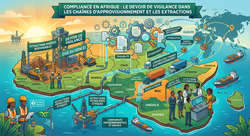
But let us acknowledge that in these debates on the Vigilance Obligation, which is being legally implemented across value chains, Africa is often cited as an example in a general discussion. It is not often considered as a distinct case with its own legal landscape. No reliance is placed on its strengths or on its own legal mechanisms, even though value chains – particularly industrial ones – so often lead to it, both now and in the future. Through analyses of the Vigilance Obligation, Africa is perceived as a place of retribution or of a new form of paternalism, and when its future is envisaged, prospects seem to be lacking, even though the very essence of compliance—and therefore of Vigilance—is the future.
If we take a less confrontational view and focus instead on the ‘legal geography’ of African countries and their social and inter-state structures, we see that the concern for others, both present and future – which ultimately constitutes the Monumental Goal of Compliance Law and thus of the Vigilance Obligation – is more prevalent in Africa than it is in Europe, which is now built upon legal individualism. This concern for others is reflected in legal mechanisms akin to mediation and various legal structures that our own institutions would do well to heed: our legislators before adopting bills, and our judges who might listen to them as amici curiae before reaching a decision.
If we turn our attention to the African continent, which is exploited by certain segments of value chains, and to labour organisations, it becomes clear that here too, legislation and sanctions are not the whole story. Compliance techniques that make use of soft law and the contractual frameworks underpinning the chains themselves can remove the element of abstraction that is, by nature, inherent in general legislation. Moving forward through contracts under the supervision and with the support of the courts is an approach that could prove more fruitful than well-intentioned legislation, which has served as a catalyst, in line with the privileged position of contract law within OHADA.
This serves to enhance the judge’s authority. The Compliance Judicialisation is also linked to the growing connection between Compliance and Contracts. However, it appears that not only can European judges specialising in Compliance Law and Vigilance Obligation thus rule on matters concerning Africa, which they can only know from a distance – though it is the lot of every judge to be an outsider – but African and inter-state Courts, notably through OHADA, can address the Vigilance Obligation because value chains are constituted by contracts. By developing it not as a foreign concept to be assimilated, but as that which expresses the very heart of the Law in Africa: concern for others, solidarity, the search for compromises and solutions so that the social and environmental system – that is to say, the human system – may endure into the Future.
___
🔓Read the developments below⤵️