
2 décembre 2025
droit illustré

𝑫𝒓𝒐𝒊𝒕 𝒊𝒍𝒍𝒖𝒔𝒕𝒓é🎬Droit et Cinéma
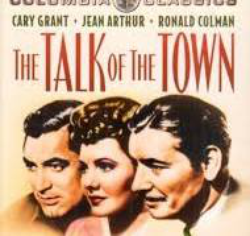
🎭𝐅𝐢𝐜𝐭𝐢𝐨𝐧 🎬𝑳𝒂 𝒋𝒖𝒔𝒕𝒊𝒄𝒆 𝒅𝒆𝒔 𝒉𝒐𝒎𝒎𝒆𝒔 (1942) :𝐪𝐮𝐞 𝐩𝐞𝐮𝐭 𝐲 𝐟𝐚𝐢𝐫𝐞 𝐮𝐧 𝐩𝐫𝐨𝐟𝐞𝐬𝐬𝐞𝐮𝐫 𝐝𝐞 𝐝𝐫𝐨𝐢𝐭 ?
🌐suivre Marie-Anne Frison-Roche sur LinkedIn
🌐s'abonner à la Newsletter MAFR Regulation, Compliance, Law
🌐s'abonner à la Newsletter en vidéo MAFR Surplomb
🌐s'abonner à la Newsletter MaFR Droit & Art
____
► Référence complète : M.-A. Frison-Roche, "Fiction🎬La justice des hommes : que peut y faire un professeur de droit ?", article de la Newsletter Droit & Art, décembre 2025.
____
🌐Consulter la publication de cet article dans la Newsletter MaFR Droit & Art : cliquer ici
____
____
► Résumé de l'article : Ce film de 1942 semble avoir laissé peu de trace. Pourtant le personnage principal,à savoir l'innocent que le méchant fait en sorte que la population de la petite ville le désigne déja comme le coupable et le conduit à se comporter comme un coupable, est joué par Cary Grant.
Ce film inspira davantage les juristes.
Et davantage les professeurs de droit, car c'est à un professeur de droit, doyen de la Faculté de droit d'Harvard que l'innocent pris au piège devra son salut.
Et plus encore aujourd'hui puisque c'est en jouant sur les rumeurs, en les construisant dans le départ, ce que l'on appellerait de la désinformation, que le puissant méchant, comptait bien l'emporter et se faire au passage maire de la ville, après avoir échappé à la faillite en ayant organisé lui-même l'incendie de son usine, crime qu'il impute à l'innocent jeté en pâture à l'opinion des citoyens qui se réunissent sur la place. On s'y croirait....
____
🔓lire l'article ci-dessous⤵️
This 1942 film seems to have left little trace. Yet the main character, namely the innocent man whom the villain ensures the small town already points to as the culprit and leads to behave like a guilty person, is played by Cary Grant.
He inspired lawyers even more.
And even more so law professors, because it was a law professor, the dean of Harvard Law School, who saved him.
And even more so today, since it was by playing on rumours, by creating them from the outset, in what we would call disinformation, that the powerful villain intended to win and, in the process, become mayor of the town, after escaping bankruptcy by setting fire to his own factory, a crime he blames on the innocent man thrown to the wolves of public opinion as citizens gather in the square. It's almost as if we were there...
This is how Cary Grant comes to appear as the most disturbing of characters, since this is how he is photographed by municipal journalists and the legal press.

ANGLES OF VIEW AND NAMES GIVEN
It is ironic that the villainous industrialist's surname is Holmes.
But the professor of criminal law who manages to restore justice is called Professor Lightcap.
Which goes to show that we should favour those who enlighten us over the big names in the history of law.
I. A PROFESSOR OF CRIMINAL LAW DEVOTED TO THE "PHILOSOPHY OF JUSTICE"
This highly qualified and respected professor of criminal law (everyone greets him and tips their hats to him) arrives at dusk in a small town, having rented a small house to rest and write. He arrives in the rain and says to the young woman who opens the door: "I've just finished a semester of teaching 400 lazy students and I'd like to rest and write in peace." He is waiting for an important phone call.
He does not know that a few minutes earlier, a man who had been sent to prison for arson at a factory, a fire in which he perished, escaped and, wounded, found refuge in the attic.
He explains that his job consists of studying the history of criminal law, mastering the law, and teaching the "philosophy of justice". In the new book he is writing, he cites the principles and provides references to the young girl who, having taken on a secretarial position, transcribes onto typewritten sheets the essays he recites in the garden on the definition of justice.
II. THE VOICE OF UNJUST EXPERIENCE
But he is interrupted by the young man who, having heard him from the attic where he remains hidden, cannot help but interrupt his monologue. To justify his presence, the young woman introduces him as the gardener. We understand that he knows nothing about law, and the professor concludes that he knows nothing about justice either. Still wanting to protect him, she asks him to return to what he knows, that is, his flowers.
But the innocent man unjustly sentenced to hanging does not see it that way.
He asserts that justice is not only "contained in the law" and in books (Pound's words are not far off...). He asserts that justice also lies in the fact that an innocent person is not convicted and a guilty person is. He argues that if the science of law does not achieve this, it is nothing, it serves no purpose, it is worse than nothing, and that he is in a much better position to talk about it than the professor, considering himself to be a more relevant expert than the academic scholar.
III. THE TRANSFORMATION OF THE LAW PROFESSOR THROUGH HIS STRICT ADHERENCE TO PRINCIPLES
Admittedly, the young woman's charms certainly played a part in the scholar's transformation, for he explained to her at length and with sighs that all the time he had devoted to his long studies had cost him his attention to women, which he suddenly regretted.

But even when the telephone rings to announce that the President of the United States has appointed him to the Supreme Court, it does not tear him away from his books, nor distract him from his love of scholarship and the handling of the principles contained in the laws and treaties he writes and his students recite.
What will guide him in the situation he finds himself in by chance is his commitment to the principles of evidence.
Indeed, from the outset, he has stated that he does not judge a situation without knowing the facts of the case, refusing to consider the young man as the perpetrator of the acts as long as he does not know the facts of the case and does not have consistent evidence. And that "talks in the town" are not valid evidence.
He reiterates these fundamental principles: the presumption of innocence, the burden of proof, and the relevance of the facts.
He steadfastly refuses to give it up. This is particularly true when a friend advises the young man to turn himself in and "make concessions" in order to obtain a lenient sentence, a prospect of clemency that shocks him (in 1942, no one could have imagined the role that the DPA would play, even for those who had done nothing wrong).
Without replacing the local authorities, who are very close to the real criminal, he confronts the most powerful instrument of condemnation: the local newspaper, read every day by those who gather in the square. A newspaper that bears the exact likeness of the man who, therefore, can only be guilty. A newspaper that disseminates accurate information, since it is true that the man in question has escaped from prison (misinformation is constructed from accurate facts).

For this reason alone, to view the CJIP with less enthusiasm and those who respect the probation system with more interest, it is worth watching this film.
The scene preceding the final scene shows the law professor, who, in his brilliant career, is in the period following his nomination by the President and preceding its confirmation by the Senate: he is in the courtroom of the small town, in the dock itself, in the place of the young man who occupied it.
He asserts that "the law is not just a set of principles written on bound paper" but a set of essential rules that are brought to life by real-life cases so that people can live freely together.
As for the final scene, it takes place at the Supreme Court itself, where he puts on his judge's robe and receives the young girl in his office of Justice (because everyone has now stopped calling him Professor) , to whom he explains that these living principles are as strong in this small town as they are in Washington.
As Cary Grant says as he leaves the room before the end, embracing the young girl: "The rest is only the law, very boring."
________
les commentaires sont désactivés pour cette fiche