Expert

Articles in a legal collective publication

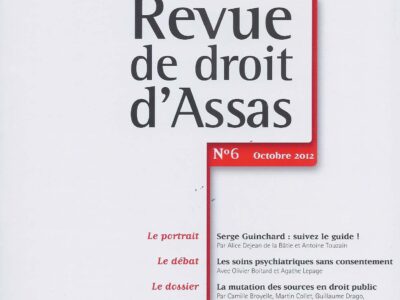
📝Experts et procédure : l’amicus curiae (Experts and procedure: the amicus curiae)

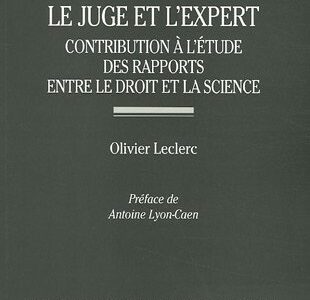
► Référence complète : M.-A. Frison-Roche, "Experts et procédure : l'amicus curiae" ("Experts and procedure: the amicus curiae"), Revue de droit d'Assas, october 2012, pp. 91-94 - 📝read the article (in French) - ► English Summary of the article: A recent thesis has argued that amicus curiae is becoming a common principle of Procedural Law. This shows its importance. The fact that the mechanism, the character, is designated by a Latin formula leads us to suspect that something is being concealed that legal technique ordinarily forbids: it is the legal expert and the party's expert, which is what the amicus curiae most often is, either one or the other, or both at the same time. Therefore, removing the prudish cloak of Latin, it is these two difficulties that must be addressed. If we exclude the legal expert, it is because "jura novit curia" ("the court knows Law". But this rule, which recalls the principle that "no one is supposed to be ignorant of the law", merely indicates a sharing of the burden of evoking facts and Law between the parties and the judge (Motulsky) and not a presumption of knowledge. Consequently, the modest, and therefore self-confident, judge has no reason, either psychological or legal, to shy away from a legal expertise. As for the party's expert, or the judge's expert who is highly influenced by a party, a profession, a social group, in short, a judge's expert who is in fact an expert held by a party, this can only be a problem if the judge cannot keep his distance from this expert whose opinion is biased by the weight of the party. But first of all, any opinion is biased. Whether it is given in bad faith or good faith, it is biased, and in rhetoric we know that an opinion biased in good faith is more dangerous than a bought opinion, because the latter is known to be twisted by self-interest. In this respect, the person who listens to it, the judge, knows the difference. Indeed, the legal system that recognises the party's expert and the amicus curiae, i.e. North American Law or European Union Law, draws the necessary procedural consequence: they include the party's expert opinion in the adversarial debate. It is the principle of adversarial debate, the principle of principles in the conduct of proceedings, that makes amicus curiae acceptable and welcome, since it provides the judge with a scientific input that the latter does not have. -

I-2.0: Is there a compelling need for neutral action in regulated economic sectors ? ?

TRANSLATED SUMMARIES ENGLISH “Acting in a neutral way” is an oxymoron. “Companies often require however that States use their powers in a neutral way (eg tax neutrality). In regulated sectors, some are right or even duty , of not being neutral. Firstly, it is the State, which requires the market for other purposes, other temporalities and other values​​. Secondly, they are also the “crucial operators”, which are sort of regulators of second degree, such as transmission system operators or companies capital markets firms. The difficulty increases when the systeme requires neutrality of regulators and judges, when first build economic policy and the second create jurisprudence. Their consistency, impartiality and rationality can create an objectifiable neutralitys FRENCH «Agir de façon neutre» est un oxymoron. «Les entreprises ont souvent besoin, cependant, que les États utilisent leurs pouvoirs de manière neutre (neutralité fiscale par exemple). Dans les secteurs réglementés, certains ont le droit ou même le devoir de ne pas être neutre. Tout d’abord, c’est l’État, qui insère le marché à d’autres fins, d’autres temporalités et d’autres valeurs. En second lieu, ils sont aussi les «opérateurs crucial», qui sont des sortes de régulateurs du second degré : par exemple les opérateurs de réseaux de transport ou de entreprises de marchés financiers. La difficulté augmente lorsque le systeme économique et politique exige la neutralité des autorités de régulation et des juges, alors que les premiers construisent la politique économique et les seconds construisent la jurisprudence. Le respect qu’ils doivent avoir de l’impartialité et d’une rationalité suffisamment objectivables pourra permettre cette objectivité requise.

I-1.31: The Competition Authority between “regulation” and competition policiy

Translated Summaries ENGLISH Two and a half years after having been established by the LME, the French Competition Authority has uncontestably acquired its “place in the sun” amongst the competition authorities of other countries, as demonstrated by multiple indicators.   ITALIAN Articolo: L’Autorità garante della concorrenza tra “regolazione” e politica in materia di concorrenza Due anni e mezzo dopo l’instaurazione da parte del LME, l’Autorità francese garante della libera concorrenza ha trovato il suo posto tra le diverse autorità degli altri paesi, così come è stato dimostrato da diversi indicatori. SPANISH Artículo: La Autoridad de la competencia, entre “regulación” y política competitiva.   Después de dos años y medio de haber sido establecido por el LME, la Autoridad francesa de la competencia ha incontestablemente adquirido su “lugar bajo el sol” entre las autoridades de la competencia de otros países, como demostrado por varios indicadores. ………………… Other translations forthcoming.