Constitutional law

SCALIA, Antonin and BREYER, Stephen🕴🏻

🎥Original Intent and a Living Constitution: debate between Antonin Scalia and Stephen Breyer

► Full reference: A. Scalia and S. Breyer, “Original Intent and a Living Constitution”, debate organised by the Supreme Court Historical Society, moderated by James Duff, broadcast by C-SPAN, 23 March 2010. - ► Summary: two Justices of the United States Supreme Court compare their conceptions of constitutional interpretation. For Antonin Scalia, an “originalist”, the judge must abide by the meaning the text had for those who adopted it (original meaning, rather than the intent of its drafters): the Constitution is meant to impede change, and it is for the people, not the judges, to decide democratically the questions it does not settle; reliance on purpose and legislative history seems to him subjective and open to manipulation. For Stephen Breyer, a proponent of a “living Constitution”, the judge takes into account text, history, tradition and precedent, but also values and consequences: he does not invent rights, he applies enduring values to new circumstances, the purpose of a provision often being more accessible than its history. - 🎥watch an excerpt of the debate (short version) 🎥watch the full debate

OBAMA, Barack🕴🏻

🎥Professor POTUS on the Senate and the Supreme Court

► Full reference: B. Obama, “Professor POTUS on the Senate and the Supreme Court”, conversation with students and faculty at the University of Chicago Law School, 7 April 2016, video posted by The Obama White House on 27 April 2016. - ► Summary: back in April 2016 at the University of Chicago Law School, where he had taught constitutional law, President Barack Obama, while the Republican-led Senate refused to consider the nomination of Judge Merrick Garland to the Supreme Court, explains as a professor the constitutional role of the Senate in the appointment of judges: to give its advice and consent, which presupposes hearing the nominee. He stresses that a partisan paralysis of the procedure would bring political polarisation into the judiciary and ruin public confidence in the courts, a confidence that democracy cannot afford to lose. - 🎥watch the video

Books

BREYER, Stephen🕴

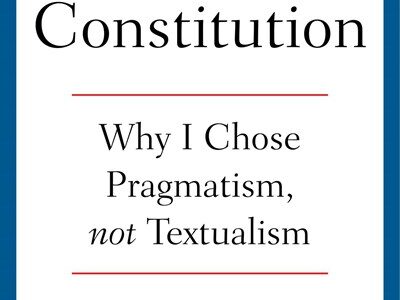
📗Reading the Constitution: Why I Chose Pragmatism, Not Textualism

► Full reference : S.Breyer, Reading the Constitution: Why I Chose Pragmatism, Not Textualism, Simon & Schuster, 2024, 361 p. - 📗read the 4th cover page - 📗read the book's table of contents - ► Book summary (by the publisher) : "A provocative, brilliant analysis by recently retired Supreme Court Justice Stephen Breyer that deconstructs the textualist philosophy of the current Supreme Court’s supermajority and makes the case for a better way to interpret the Constitution. “You will not read a more important legal work this election year.” —Bob Woodward, Washington Post reporter and author of fifteen New York Times bestselling books “A dissent for the ages.” —The Washington Post “Breyer’s candor about the state of the court is refreshing and much needed.” —The Boston Globe The relatively new judicial philosophy of textualism dominates the Supreme Court. Textualists claim that the right way to interpret the Constitution and statutes is to read the text carefully and examine the language as it was understood at the time the documents were written. This, however, is not Justice Breyer’s philosophy nor has it been the traditional way to interpret the Constitution since the time of Chief Justice John Marshall. Justice Breyer recalls Marshall’s exhortation that the Constitution must be a workable set of principles to be interpreted by subsequent generations. Most important in interpreting law, says Breyer, is to understand the purposes of statutes as well as the consequences of deciding a case one way or another. He illustrates these principles by examining some of the most important cases in the nation’s history, among them the Dobbs and Bruen decisions from 2022 that he argues were wrongly decided and have led to harmful results." -

Breaking news

📧 Compliance and Ethics. Technologies may be inacceptable “in themselves” and designing their “ethical use” is therefore not acceptable: practical case on the control of workers’ emotions

► An article from March 3, 2021, Smile for the camera: the dark side of China's emotion-recognition tech, then an article from June 16, 2021, "Every smile you fake" – an AI emotion – recognition system can assess how "happy" China's workers are in the office describes how a new technology of emotional recognition is able, through what will soon be out of fashion to call "facial recognition", to distinguish a smile that reflects a mind state of real satisfaction from a smile which does not correspond to it. This allows the employer to measure the suitability of the human being for his or her work. It is promised that it will be used in an ethical way, to improve well-being at work. But isn't it in itself that this technology is incompatible with any compensation through ethical support? The technology developed by a Chinese technology company and acquired by other Chinese companies with many employees, allows to have information on the actual state of mind of the person through and beyond his or her facial expressions and bodily behavior. Previously, the technology of emotional recognition had been developed to ensure security, by fighting against people with hostile plans, public authorities using it for example in the controls at airports to detect the criminal plans which some passengers could have. It is now affirmed that it is not about fighting against some evil people ("dangerousness") to protect the group before the act is committed ("social defense”) but that it is about helping all workers. Indeed, the use that will be made of it will be ethical, because first the people who work for these Chinese companies with global activity, like Huawaï, do it freely and have accepted the operation of these artificial intelligence tools (which is not the case with people who travel, control being then a kind of necessary evil that they do not have to accept, which is imposed on them for the protection of the group), but even and above all, the purpose is itself ethical: if it turns out that the person does not feel well at work, that they are not happy there, even before they are perhaps aware, the company can assist. Let’s take this practical case from the perspective of Law and let’s imagine that it is contested before a judge applying the principles of Western Law. Would this be acceptable? No, and for three reasons. 1. An "ethical use" cannot justify an unethical process in itself 2. The first freedoms are negative 3. "Consent" should not be the only principle governing the technological and digital space   I. AN "ETHICAL USE" CAN NEVER LEGITIMATE AN UNETHICAL PROCESS IN ITSELF These unethical processes in themselves cannot be made "acceptable" by an "ethical use" which will be made of them. This principle was especially reminded by Sylviane Agacinski in bioethics: if one cannot dispose of another through a disposition of his or her body which makes his or her very person available (see not. Agacinski, S., ➡️📗Le tiers-corps. Réflexions sur le don d’organes, 2018). Except to make the person reduced to the thing that his or her body is, which is not ethically admissible in itself, that is excluded, and Law is there in order to this is not possible. This is even why the legal notion of "person", which is not a notion that goes without saying, which is a notion built by Western thought, acts as a bulwark so that human beings cannot be fully available to others, for example by placing their bodies on the market (see Frison-Roche, M.-A., ➡️📝To protect human beings, the ethical imperative of the legal notion of person, 2018). This is why, for example, as Sylviane Agacinski emphasizes, there is no ethical slavery (a slave who cannot be beaten, who must be well fed, etc.). That the human being agrees ("and what about if it pleases me to be beaten?") does not change anything.   II. THE FIRST FREEDOM IS THE ONE TO SAY NO, FOR EXAMPLE BY REFUSING TO REVEAL YOUR EMOTIONS: FOR EXAMPLE HIDING IF YOU ARE HAPPY OR NOT TO WORK The first freedom is not positive (being free to say Yes); it is negative (being free to say No). For example, the freedom of marriage is having the freedom not to marry before having the freedom to marry: if one does not have the freedom not to marry, then the freedom to marry loses any value. Likewise, the freedom to contract implies the freedom not to contract, etc. Thus, freedom in the company can take the form of freedom of speech, which allows people, according to procedures established by Law, to express their emotions, for example their anger or their disapproval, through the strike. But this freedom of speech, which is a positive freedom, has no value unless the worker has the fundamental freedom not to express his or her emotions. For example if he or she is not happy with his or her job, because he or she does not appreciate what he or she does, or he or she does not like the place where he or she works, or he or she does not like people with whom he or she works, his or her freedom of speech demands that he or she have the right not to express it. If the employer has a tool that allows him or her to obtain information about what the worker likes and dislikes, then the employee loses this first freedom. In the Western legal order, we must be able to consider that it is at the constitutional level that the infringement is carried out through Law of Persons (on the intimacy between the Law of Persons and the Constitutional Law, see Marais , A., ➡️📕Le Droit des personnes, 2021).   III. CONSENT SHOULD NOT BE THE ONLY PRINCIPLE GOVERNING THE TECHNOLOGICAL AND DIGITAL SPACE   We could consider that the case of the company is different from the case of the controls operated by the State for the monitoring of airports, because in the first case observed people are consenting. "Consent" is today the central notion, often presented as the future of what everyone wants: the "regulation" of technology, especially when it takes the form of algorithms ("artificial intelligence"), especially in digital space. "Consent" would allow "ethical use" and could establish the whole (on these issues, see Frison-Roche, M.-A., ➡️📝Having a good behavior in the digital space, 2019). "Consent" is a notion from which Law is today moving away in Law of Persons, in particular as regards the "consent" given by adolescents on the availability of their body, but not yet on digital. No doubt because in Contract Law, "consent" is almost synonymous with "free will", whereas they must be distinguished (see Frison-Roche, M.-A., ➡️📝Remarques sur la distinction entre la volonté et le consentement en Droit des contrats, 1995). But we see through this case, which precisely takes place in China, that "consent" is in Law as elsewhere a sign of submission. It is only in a probative way that it can constitute proof of a free will; this proof must not turn into an irrebuttable presumption. The Data Regulatory Authorities (for example in France the CNIL) seek to reconstitute this probative link between "consent" and "freedom to say No" so that technology does not allow by "mechanical consents", cut off from any connection with the principle of freedom which protects human beings, from dispossessing themselves (see Frison-Roche, M.-A., Yes to the principle of will, No to pure consents, 2018). The more the notion of consent will be peripheral, the more human beings will be able to be active and protected. -

Working papers

🚧 Resolve the contradiction between “sanction” and “Incentive” under the fire of Compliance Law

This Working Paper has been the basis for the first conference of the two conferences in the colloquium in Toulouse (France) under the scientific direction of Lucien Rapp, about Les incitations, outils de la Compliance ("Incitations, as Compliance Tools"), on December 12, 2019, the first one about The sanction as incitation and the second one about Incitations and Compliance Law (synthesis of this colloquium).  Then, it has been the basis for the article, to be published in the books Les outils de la Compliance and Compliance Tools in the Series Régulations & Compliance. Read a general presentation of this book.     Summary and Introduction of this Working Paper: At first glance, Compliance and Incentives appear to be totally opposite. For two major reasons. In the first place, because the sanctions have a central place in the Law of Compliance and the incentives suppose an absence of constraint on the operators. Secondly, because the incentives are linked to self-regulation and that Compliance Law assumes a strong presence of public authorities. Taking the first reason, one should choose: either Compliance or Incentives! Either the effectiveness of one or the effectiveness of the others; either the techniques of one or the techniques of others; either the philosophy of one or the philosophy of the others. Resign oneself to the loss that such a necessary choice would involve. But to put the terms thus amounts to think poorly about the situations and reduce the fields of the solutions which they call for. If we take a rich definition of Compliance Law, it is possible on the contrary to articulate Compliance and Incentives. From this perspective, sanctions can no longer become what blocks the use of incentives but, on the contrary, what constitutes them. Even more, the coupling between Incentives and the requirements of Compliance Law must be strongly encouraged, as soon as the public authorities supervise in Ex Ante all the initiatives taken by the "crucial operators".  This working document deals with the first issue1La seconde problématique est analysée in "Compliance et Incitation : un couple à propulser", 2020.. Indeed, the so-called incentive theory targets mechanisms that do not directly use coercion. They would therefore have little place in Compliance Law. But Compliance seems saturated with sanction procedures. We can even say that it seems to put them at the center, the public authorities presenting the number of sanctions as a sign of success, while the companies seem obsessed with their prospects, the two concerns ending in such a strange convergence that are the D.P.O… An honest observer can only feel immediately uneasy. Indeed, he can only raise the definition of the sanction as a "constraint" triggered Ex Post, at the very heart of Compliance Law which is presented as a set of Ex Ante mechanisms. Based on this contradiction in terms, should we give up the association and think that it would be wrong against the spirit to think of the sanction as an incentive? It is undoubtedly in this connection that one perceives most clearly the clash of two cultures, which do not communicate, while technically they apply to the same situations. Indeed, because Compliance was firstly designed by Finance, everything is a tool for it. Therefore, the tendancy to think about the sanction only as an incentive is very strong in Compliance Law. It manifests itself continuously and will not stop (I). But whatever the reasons are to conceive it this way, the principles of the Rule of Law cannot disappear and if we do not want them to be erased, then they must be articulated (II). It’s an essential adjustment. This is why we can literally say that Compliance has set Criminal Law on fire by its conception, logical but closed in on itself, of sanctions as simple incentives. For Law to remain, however, it is necessary to hold a very firm definition of Compliance Law centered on its Monumental Goal, which is the protection of the person.

Working papers

🚧 Compliance and Incentives: a couple to propel by the notion of “Incentive Compliance”

This working document serves as the basis for two conference given in the symposium made under the direction of Lucien Rapp, Les incitations, outils de la Compliance ("Incitations: Compliance Tools"). Référence : Frison-Roche, M.-A., Compliance et Incitations : un couple à propulser, in Faculté de droit de l'Université Toulouse-Capitole, et Journal of Regulation & Compliance (JoRC),Les incitations, outils de la Compliance, 12 décembre 2019, Toulouse.  This Working Paper has been the basis for two conferences in the colloquium in Toulouse (France) under the scientific direction of Lucien Rapp, about Les incitations, outils de la Compliance ("Incitations, as Compliance Tools"), on December 12, 2019, the first one about The sanction as incitation and the second one about Incitations and Compliance Law (synthesis of this colloquium). sur le thème de la sanction comme incitation, la seconde en synthèse de ce colloque sur  After it has been the basis for the article, to be published in the books Les outils de la Compliance and Compliance Tools in the Series Régulations & Compliance. Read a general presentation of this book.   - Summary of this Working Paper: Compliance and Incentives appear at first glance to be totally opposite. Not only because sanctions are at the heart of Compliance and that sanction is associated with constraint while incentive is associated with non-constrained1Voir cette question analysée d’une façon autonome, Frison-Roche, M.A., Résoudre la contradiction entre « sanction » et « incitation » sous le feu du Droit de la Compliance, 2020., but also because incentives are linked to self-regulation and that Compliance Law requires a strong presence of public authorities. Thus, one should choose: either Compliance or Incentives! Either the effectiveness of one or the effectiveness of the others; either the techniques of one, or the techniques of others; either the philosophy of one or the philosophy of the others. Resign yourself to the waste that such a necessary choice would involve. But putting the terms thus is thinking poorly about the situations and reducing the fields of the solutions which they call for. If we take a rich definition of Compliance Law, we can on the contrary articulate Compliance and Incentives. To do this, the concept of “incentive Compliance” should be developed. This concept is not only appropriate, but it is necessary in a new conception of Sovereignty. For example for the digital Europe. -   Read the developments below.