🌐 follow Marie-Anne Frison-Roche on LinkedIn 🌐 subscribe to the Newsletter MAFR Regulation, Compliance, Law -
► Full Reference:
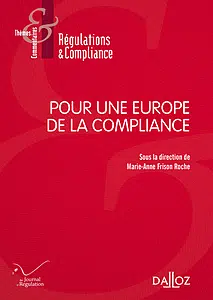
M.-A. Frison-Roche (ed.),
Pour une Europe de la Compliance (
For the Europe of the Compliance), series “
Régulations & Compliance“, Dalloz, 2019, 124 p. - This volume is the continuation of the books dedicated to Compliance in this collection.
► Read the presentations of the other books in the series:
the following books:
🕴️M.-A. Frison-Roche (ed.),
Les outils de la Compliance (Compliance Tools), 2021
🕴️M.-A. Frison-Roche (ed.),
Les Buts Monumentaux de la Compliance (Compliance Monumental Goals), 2022
🕴️M.-A. Frison-Roche (ed.),
La juridictionnalisation de la Compliance (Compliance Jurisdictionalisation), 2023
🕴️M.-A. Frison-Roche and M. Boissavy (eds.),
Compliance et droits de la défense. Enquête interne – CJIP – CRPC (Compliance and rights of the defence. Internal investigation – French Judicial Public Interest Agreement – French guilty plea procedure), 2024
🕴️M.-A. Frison-Roche (ed.),
L’Obligation de Compliance (Compliance Obligation), 2025
🕴️M.-A. Frison-Roche (ed.),
Compliance et Contrat (Compliance and Contract), forthcoming
🕴️L. Laref (ed.),
Compliance et vigilance bancaire (Compliance and Banking Vigilance), forthcoming
🕴️M.-A. Frison-Roche,
Le système juridique global des noms de domaine. Structure multi-acteurs et durabilité de l’Internet (The Global Legal System of Domain Names. Multi-Stakeholder Structure and Sustainability of the Internet), forthcoming
🕴️M.-A. Frison-Roche (ed.),
Le système probatoire de la Compliance, forthcoming
the previous books:
🕴️N. Borga, J.-Cl. Marin and J.-Ch. Roda (eds.),
Compliance : l’entreprise, le régulateur et le juge (Compliance: the Company, the Regulator and the Judge), 2018
🕴️M.-A. Frison-Roche (ed.),
Régulation, Supervision, Compliance (Regulation, Supervision, Compliance), 2017
🕴️M.-A. Frison-Roche (ed.),
Internet, espace d’interrégulation (Internet, Space of Interregulation), 2016
Read the presentations of the other titles of the collection. -
► General presentation of the book: This book is written in French. The topic is : “
For the Europe of the Compliance“. See below its general presentation in English. The political dimension is intrinsic to the Compliance Law. Indeed, compliance mechanisms consist of internalizing in certains companies the obligation to implement goals of general interest set by Public Authorities. These public bodies control the Ex Ante reorganization that implies for these companies and punish Ex Post the possible structural inadequacy of these compagnies, becoming transparent for this purpose. This new mode of governance establishes a
continuum between
Regulation, Supervision, Compliance (book published in 2017) and renew the links between Companies, Regulators and Judges
1Frison-Roche, M.-A., Compliance, see. This political dimension must be increased: the Compliance Law of Compliance must today be used to build Europe. One can observe not only the construction of the European Compliance Law, object-by-object, sector-by-sector, purpose-by-purpose, but also the construction of the European Compliance Law that transcends and unifies them. Becoming independent of American Law and ceasing to be in reaction, even on the defensive, the Compliance Law contributes to the European project, offering it a higher ambition, that Europe can carry and, by this way, can carry the Europe itself, not only to preserve the European economy from corruption or money laundering, but by claiming the protection of nature and human beings. This is why the book describes the “reasons and objectives” of the Europe of the Compliance, which makes it possible to describe, detect and even predict the ways and means. -
► Understand the book through the Table of Contents and the summaries of each article: 🕴️M.-A. Frison-Roche, 📝
Avant propos 🕴️K. Lenaerts, 📝
Le juge de l’Union européenne dans une Europe de la compliance 🕴️M.-A. Frison-Roche, 📝
Un droit substantiel de la compliance, appuyé sur la tradition européenne humaniste I. LES RAISONS ET LES OBJECTIFS D’UNE EUROPE DE LA COMPLIANCE (THE REASONS AND OBJECTIVES OF THE EUROPE OF THE COMPLIANCE) 🕴️X. Musca, 📝
Construire une Europe de la compliance en donnant une meilleure place aux entreprises 🕴️P. Vimont, 📝
La place de la diplomatie dans l’avancée d’une Europe de la compliance 🕴️P. Sellal, 📝
Les vertus de la compliance : une réponse possible aux faiblesses de l’Union européenne ? 🕴️J.-J. Daigre, 📝
Compliance, entreprise et Europe II. LES VOIES ET MOYENS D’UNE EUROPE DE LA COMPLIANCE (THE WAYS AND MEANS OF THE EUROPE OF THE COMPLIANCE) 🕴️J.-Cl. Marin, 📝
Quels outils pour la construction du droit de la compliance en Europe ? 🕴️M. Canto-Sperber, 📝
La compliance et les définitions traditionnelles de la vertu 🕴️T. Bonneau, 📝
Compliance et secteur bancaire et financier en Europe 🕴️C. Duchaine, 📝
L’Agence française anticorruption, à l’appui de l’Europe de la compliance 🕴️D. Martin, 📝
Les contraintes et les vertus de la compliance 🕴️A. de La Cotardière, 📝
Construire une Europe de la compliance lisible pour les entreprises -