Insurance

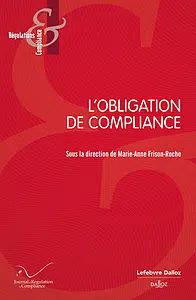
Couverture – L’Obligation de Compliance

Articles in a JoRC book

FRANÇON, Mathieu🕴️

📝L’intensité du devoir de vigilance dans le secteur bancaire (The Intensity of the Duty of Vigilance in the Banking Sector), in 🕴️M.-A. Frison-Roche (dir.), 📕L’Obligation de Compliance

► Full Reference: M. Françon, “L’intensité du devoir de vigilance dans le secteur bancaire” (The Intensity of the Duty of Vigilance in the Banking Sector), in M.-A. Frison-Roche (dir.), L’Obligation de Compliance, Journal of Regulation & Compliance (JoRC) and Lefebvre-Dalloz, coll. “Régulations & Compliance”, 2025, pp. 551-557. - read the general presentation of the book, L’Obligation de Compliance, in which the contribution is published - ► This article is written in French. English summary of this contribution (done by the Journal of Regulation & Compliance – JoRC): The author develops the case of banking and insurance operators. He emphasises that, in banking and insurance matters, Vigilance consists of an obligation to process information, collected beforehand where necessary, in order to prevent a systemic risk from materialising. Identifying and preventing risk is an enhanced obligation of means which, in this context, varies in intensity. The obligation is long-standing, whereas the Duty of Vigilance is recent. This time lag is explained by the fact that the required Vigilance is consubstantial with the very activity of the banker and the insurer, and by the systemic nature that the sector has always had, which produces an interweaving of hard and soft law. The variations in the intensity of the obligation of Vigilance stem from the fact that there are two types of obligations: those imposed in the interest of the activity and of the client, and those imposed in the interest of the stability of the system. The latter are much stronger than the former. They weigh on the banker as well as on the client. Thus, anti-money laundering obligations have the general interest as their sole purpose, the client being unable to rely on the bank’s failures (Cour de cassation (French Court of cassation), Chambre commerciale (Commercial Chamber), 28 April 2004). Moreover, in matters of asset freezing, the obligation of Vigilance becomes an obligation of result. Within the general interest itself, intensity varies according to the goals pursued, giving rise to “standard, simplified, enhanced” Vigilance, depending on the underlying risk. In addition, interfering rights cause the obligation to vary, notably the right to the protection of personal data, or the right to non-interference by the banker. Finally, the obligations of Vigilance weighing on third parties, including those located outside Europe, also interfere. - 🦉This article is available in full text to those registered for Professor Marie-Anne Frison-Roche’s courses -


Publication director

🏗️ direction of the collection: 📚Cours Dalloz – Série Droit privé

📚Publication of : 🕴️Pierre-Grégoire MARLY, 📕Droit des assurances (Insurance Law), 2nd ed.

► Full Reference : P.-Gr. Marly, Droit des assurances (Insurance Law), 1st ed. 2013 – 2nd ed., 2024, Dalloz, “Cours Dalloz-Série Droit privé” Series, 330 p. - ► General presentation of the book (written in French) : Insurance law: the meeting of a conjuring act and a predictive art. Insurance undertakes to grasp the future by organising the meeting of a conjuring act and a predictive art. Legally, this meeting emerges from a contract whose regime is set out in Book One of the French Insurance Code. The purpose of this book is to go through this Book in order to discover or deepen a normative corpus whose technicality is matched only by its richness. In the light of case law and legal scholarship, insurance law calls for constantly renewed reflection, which this course aims both to present and to nourish. Structured in three parts, it examines the rules common to all insurance contracts before studying the provisions specific to property and casualty insurance and then to personal insurance. This pedagogical book will be of interest to Master 1 and specialised Master 2 students as well as to insurance professionals. - 📚See the entire collection in which the book is published. -

Glossary

Insurance

The insurance sector has always been regulated in that it presents a very high systemic risk, since the economic operators' strength is required for the operation of the sector and the bankruptcy of one of them may weaken or even collapse all. In addition, insurance is the sector in which moral hazard is the highest, since the insured will tend to minimize the risks to which he is exposed in order to pay the lowest premium possible, even though ehe company is engaged to cover an accident whose size can not be measured in advance. Thus, the science of insurance is above all that of probabilities. The recent challenge of regulating insurance, both institutional, the construction and the powers of the regulator of the sector, and also functional, namely the relations that it must have with the other bodies and institutions, lies mainly in the relationship between the insurance regulator and the bank regulator, which refers to the concept of "interregulation." If the formal criteria are followed, the two sectors are distinct and the regulators must be similarly separated. There was the case in France before 2010. En 2010, considering activities, sensitive to the fact that insurance products, for example life insurance contracts, are mostly financial products, and moreover, through the notion of "bank-insurance", the same companies engage in both economic activities, the solution of an unique body has been chosen. A part from the fact that in Competition Law companies are defined by market activity, the main consideration is that the risk of contamination and spread is common between insurance sector and banking sector. For this reason, the French  Ordinance of 21 January 2010 created the Autorité de Contrôle Prudentiel -ACP (French Prudential Supervisory Authority), which covers both insurance companies and banks, since their soundness must be subject to similar requirements and to an organization common. The law of July 2013 entrusted this Authority with the task of organizing the restructuring of these enterprises, thus becoming the Autorité de Contrôle Prudentiel et de Résolution – ACPR  (French Prudential Control and Resolution Authority). However, the substantive rules are not unified, on the one hand because the insurers are not in favor of such assimilation with banks, secondly because the texts, essentially the European Directive on the insolvency of insurance companies ("Solvency II") , eemain specific to them, and at a distance from the Basel rules applying to banks, which contradict the institutional rapprochement exposed before. European construction reflects the specificity of the insurance sector, the Regulation of 23 November 2010 establishing EIOPA, which is a European quasi-regulator for pension funds, including insurance companies. The current issue of insurance regulatory system is precisely the European construction. While the Banking Union, the Europe of banking regulation, is being built, the Europe of Insurance Regulation is not being built. Already because, rightly, it does not want to merge into the banking Europe, negotiations of the texts of "Solvency II" stumbling on this question of principle. We find this first truth: in practice, it is the definitions that count. Here: Can an insurance company define itself as a bank like any other? L'enjeu actuel de la Régulation assurantielle est précisément la construction européenne. Tandis que par l’Union bancaire, l’Europe de la régulation bancaire se construit, l’Europe de la Régulation assurantielle ne se construit. Déjà parce que, à juste titre, elle ne veut pas se fondre dans l’Europe bancaire, les négociations des textes de « Solvabilité II » achoppant sur cette question de principe. L’on retrouve cette vérité première : en pratique, ce sont les définitions qui compte. Ici : une compagnie d’assurance peut-elle se définir comme une banque comme une autre ?  

I-2.5: Neutralization using impact surveys before the adoption of Acts and Regulation

Translated Summaries In The Journal of Regulation the summaries’ translation are done by the Editors and not by the authors ENGLISH: Nowadays, it’s necessary to define, initially, the framework of an impact survey. An impact survey is an analysis estimating the economic consequences of a bill (in Europe or in the US) in order to limit, reduce or compensate for negative impacts. It requires the prior adoption of the text. ITALIAN Nei giorni nostri, è necessario definire, inizialmente, la struttura di una valutazione d’impatto. Una valutazione d’impatto è uno studio che cerca di fare una stima delle conseguenze economiche dell’adozione di una legge (in Europa o negli Stati Uniti) in modo tale da limitare, ridurre o compensare le sue conseguenze negative. Tuttavia questo richiede l’adozione preliminare del testo. ………………… Other translations forthcoming.